Posts Tagged ‘cancer’
“The study of taxonomy in its broadest sense is probably the oldest branch of biology or natural history as well as the basis for all the other branches, since the first step in obtaining any knowledge of things about us is to discriminate between them and to learn to recognize them”*…

The Holotypic Occlupanid Research Group (HORG) is a tongue-in-cheek non-profit organization founded in 1994 by John Daniel (a visual effects artist with a background in invertibrate zoology). It playfully researches and classifies plastic bread clips, calling them “occlupanids,” as if they were a species in a scientific taxonomy (Kingdom: Plasticae), documenting their diverse forms from around the world. They treat these common, often-ignored objects as fascinating organisms, collecting specimens and creating a taxonomy and a database of their shapes, colors, and “species”…
This site contains several years of research in the classification of occlupanids. These small objects are everywhere, dotting supermarket aisles and sidewalks with an impressive array of form and color. The Holotypic Occlupanid Research Group has taken on the mantle of classifying this most common, yet most puzzling, member of phylum Plasticae…
Occlupanids are generally found as parasitoids on bagged pastries in supermarkets, hardware stores, and other large commercial establishments. Their fascinating and complex life cycle is unfortunately severely under-researched. What is known is that they take nourishment from the plastic sacs that surround the bagged product, not the product itself, as was previously thought. Notable exceptions to this habit are those living off rubber bands and on analog watch hands.
In most species, they often situate themselves toward the center of the plastic bag, holding in the contents. This leads to speculation that the relationship may be more symbiotic than purely parasitic.
Their stunning diversity and mysterious habits have entranced many a respectable scientist into studying, collecting, and cataloging specimens late into the night.
This site contains several years of research in the classification of occlupanids. For those of you who do not consume sliced bread, occlupanids do not form an important part of your life. For the rest of the world, These small objects are everywhere, dotting supermarket aisles and sidewalks with an impressive array of form and color.
The Holotypic Occlupanid Research Group has taken on the mantle of classifying this most common, yet most puzzling, member of phylum Plasticae.
They’ve even created a handy, free print-your-own set of cut-out identifcation placards “for the excitable amateur scientists out there who want to start their own collection!”
Ready, set, browse: HORG- Holotypic Occlupanid Research Group
For more on HORG, see here and here.
###
As we contemplate classification, we might send insightful birthday greetings to a man who revolutionized the understanding of the taxonomy of his field, Harold Varmus; he was born on this date in 1939. A microbiologist and medical doctor, he shared (with J. Michael Bishop) the 1989 Nobel Prize in Physiology or Medicine for discovery of the cellular origin of retroviral oncogenes— a discovery that led to great strides in the understanding, diagnosis, and treatment of a variety of cancers.

“The vast majority of terrestrial species are in fact microbes, and scientists have only begun scratching the surface of the microbial realm. It is entirely possible that examples of life as we don’t know it have so far been overlooked.”*…

Not only do we continue to find surprising new forms of microbial life, some of them challenge our very defintion of “life.” Alice Sun reports…
Scientists recently discovered a microbe with one of the tiniest genomes on Earth. More surprising, the creature is almost entirely dependent on its host: Its genes don’t support any of the functions of metabolism, one of the key processes of life. As such, it challenges fundamental notions of what it means to be a living organism. The discovery was “pure serendipity,” says Takuro Nakayama, an evolutionary microbiologist at the University of Tsukuba in Japan. Takayama wanted to study the many microbes that live within a single-celled marine dinoflagellate, Citharistes regius, a kind of plankton. But when he and his colleagues sequenced the genes of this microbial community, they kept turning up tiny, odd chunks of DNA.
It turns out that these DNA chunks belong to some unusual archaea—a branch on the tree of life populated by single-celled microbes that can often survive in extreme environments. (Archaea are similar to bacteria, but distinct in their structure, genetics, and metabolism.)
Nakayama and his colleagues proposed the name Sukunaarchaeum mirabile for the newly-discovered microbe: Sukunaarchaeum after the Japanese dwarf deity Sukuna-biko-na, and mirabile for marvelous. At only 238,000 base pairs, the number of genes in the DNA of Sukunaarchaeum is smaller than that of any other known archaea. The scientists described their finding in a bioRxiv preprint earlier this year.
So how did Sukunaarchaeum end up with such a strikingly tiny genome? Over the course of evolution, genetic instructions for life often become increasingly complex. But evolution can also go in the other direction, leading to greater simplicity in the genome. This so-called genomic reduction, where organisms end up with fewer genes than their ancestors, is typically observed in the domains of bacteria and archaea. What struck Nakayama and his colleagues about Sukunaarchaeum was the extent of reduction and specialization in its genes.
With its stripped down genome, Sukunaarchaeum appears to be completely dependent on its host, C. regius, for essential energy and nutrients. “It likely cannot produce its own cellular building blocks,” notes Nakayama. “No previously discovered microbe has shown such an extreme degree of metabolic dependence.”
Sukunaarchaeum seems to almost inhabit a new category of life, suspended somewhere between archaea and virus. It is like viruses—which aren’t typically considered to be “alive”—in that it has a tiny genome and is totally dependent on its host for metabolism. But unlike a virus, Sukunaarchaeum has its own ribosomes, cellular structures that synthesize proteins, and it can replicate itself without the help of a host.
To get a sense of just how unusual Sukunaarchaeum is, the researchers decided to scan the oceans for potential relatives. They analyzed environmental genetic sequence data from marine environments all over the world, focusing on spots where C. regius is known to live. Using a database called the Tara Oceans project, they discovered a vast array of sequences that are comparable to that of Sukunaarchaeum, which they hypothesize could represent a new, deeply branching archaeal lineage.
For Nakayama, this additional finding suggests that many more microbes that challenge the definition of life may be out there, living in what Nakayama calls “microbial dark matter,” or microbes that can’t be cultivated in the lab. “The extreme, virus-like lifestyle we hypothesize for Sukunaarchaeum is a perfect example of the surprising outcomes found in this ‘natural laboratory of evolution,’” he says.
Mart Krupovic, a virologist and microbiologist at Institut Pasteur in France who wasn’t involved in the study, called the finding “remarkable.” Krupovic has studied giant viruses that, like Sukunaarchaeum, defy categorization. These giant viruses have evolved larger and more complex genomes that include some of the genes for DNA translation, a characteristic thought to be reserved for cellular life. “I think that is fascinating,” says Krupovic, “how little we still know about the world which surrounds us.”…
How did Sukunaarchaeum end up with such a strikingly tiny genome? “A Rogue New Life Form,” from @alicesunreports.bsky.social in @nautil.us.
See also; “Candidatus Sukunaarchaeum Mirabile Is A Novel Archaeon With An Unprecedentedly Small Genome” (source of the image at the top).
The BioRxiv preprint is here.
###
As we look again at “living,” we might spare a thought for Robert Huebner; he died on this date in 1998. A physician and virologist, his research into viruses, their causes, and treatment led to his breakthrough insights into the connections between viruses and cancer, which have led to new treatments. His hypothesized oncogene was discovered to be a trigger for normal cells turning cancerous.

“Judge me by my size, do you?”*…
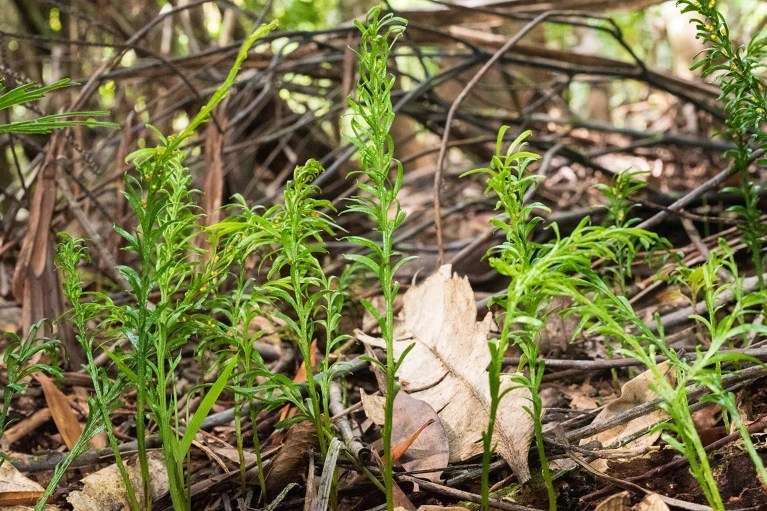
A tiny variety of the fork fern seems altogether unremarkable– but has a genome that dwarfs the human genome in size. Max Kozlov explains what that might teach us…
A small, unassuming fern-like plant has something massive lurking within: the largest genome ever discovered, outstripping the human genome by more than 50 times.
The plant (Tmesipteris oblanceolata) contains a whopping 160 billion base pairs, the units that make up a strand of DNA. That’s 11 billion more than the previous record holder, the flowering plant Paris japonica, and 30 billion more than the marbled lungfish (Protopterus aethiopicus), which has the largest animal genome. The findings were published [on May 31] in iScience…
The world’s genomic champion, which is native to New Caledonia and neighbouring archipelagos in the South Pacific, is a species of plant called a fork fern. Its colossal number of base pairs raises questions as to how the plant manages its genetic material. Only a small proportion of DNA is made of protein-coding genes, leading study co-author Ilia Leitch, an evolutionary biologist at London’s Royal Botanic Gardens, Kew, to wonder how the plant’s cellular machinery accesses those bits of the genome “amongst this huge morass of DNA. It’s like trying to find a few books with the instructions for how to survive in a library of millions of books — it’s just ridiculous.”
There’s also the question of how and why an organism evolved to have so many base pairs. Generally, having more base pairs leads to higher demand for the minerals that comprise DNA and for energy to duplicate the genome with every cell division, Leitch says. But if the organism lives in a relatively stable environment with little competition, a gargantuan genome might not come with a high cost, she adds.
That could help to provide an explanation — although a rather boring one — for the fork fern’s large genome: it might be neither detrimental nor particularly helpful for the plant’s ability to survive and reproduce, so the fork fern has gone on accumulating base pairs over time, says Julie Blommaert, a genomicist at the New Zealand Institute for Plant and Food Research in Nelson.
For now, researchers can only speculate on answers to these questions. The largest genome to be sequenced and assembled belongs to the European mistletoe (Viscum album), with about 90 billion base pairs. Modern techniques might not be sufficient to do the same for the fork fern’s genome: even if it’s sequenced, there’s still the computational challenge of taking the data and “sticking them together in a way that biologically reflects what’s going on”, Leitch says.
Finding ways to analyse enormous genomes could yield crucial insights into how genome size influences where organisms can grow, how they are able to flourish in their environments and their resilience to climate change, independent of their specific DNA sequence, she adds. Pellicer says it’s remarkable that a tiny, non-flowering plant that most people “wouldn’t bother to stop and look at” could offer such important lessons. “The beauty of the plant is inside.”
“Biggest genome ever found belongs to this odd little plant,” from @maxdkozlov in @Nature.
* Yoda, “The Empire Strikes Back”
###
As we rescope scale, we might send insightful birthday greetings to Phillip Allen Sharp; he was born on this date in 1944. A geneticist and molecular biologist, he co-discovered RNA splicing— for which he shared the 1993 Nobel Prize in Physiology or Medicine (with Richard J. Roberts). His work has spurred new research in evolutionary biology, and has contributed to the development of both treatments and vaccines for infectious diseases, cancer and other ailments.

“The spirit of inquiry and the courage to challenge the status quo are at the heart of scientific progress”*…

Adam Mastroianni on the challenges– and opportunities– facing science…
Randomized-controlled trials only caught on about 80 years ago, and whenever I think about that, I have to sit down and catch my breath for a while. The thing everybody agrees is the “gold standard” of evidence, the thing the FDA requires before it will legally allow you to sell a drug—that thing is younger than my grandparents.
There are a few records of things that kind of look like randomized-controlled trials throughout history, but people didn’t really appreciate the importance of RCTs until 1948, when the British Medical Research Council published a trial on streptomycin for tuberculosis. Humans have possessed the methods of randomization for thousands of years—dice, coins, the casting of lots—and we’ve been trying to cure diseases for as long as we’ve been human. Why did it take us so long to put them together?
I think the answer is: first, we had to stop trusting Zeus.
To us, coin flips are random (“Heads: I go first. Tails: you go first.”). But to an ancient human, coin flips aren’t random at all—they reveal the will of the gods (“Heads: Zeus wants me to go first. Tails: Zeus wants you to go first”). In the Bible, for instance, people are always casting lots to figure out what God wants them to do: which goat to kill, who should get each tract of land, when to start a genocide, etc.
This is, of course, a big problem for running RCTs. If you think that the outcome of a coin flip is meaningful rather than meaningless, you can’t use it to produce two equivalent groups, and you can’t study the impact of doing something to one group and not the other. You can only run a ZCT—a Zeus controlled trial.
It’s easy to see how technology can lead to scientific discoveries. Make microscope -> discover mitochondria.
Clearly, though, sometimes those technologies get invented entirely inside our heads. Stop trusting Zeus -> develop RCTs.
Which raises the question: what mental technologies haven’t we invented yet? What brain switches are just waiting to be flipped?…
On reinvigorating science: “Declining trust in Zeus is a technology,” from @a_m_mastroianni.
Apposite to an issue he raises: “Citation cartels help some mathematicians—and their universities—climb the rankings,” from @ScienceMagazine.
[Image above: source]
###
As we deliberate on discovery, we might send micro-biological birthday greetings to a woman who modeled the attitude and behavior that Mastroianni suggests: Ruth Sager; she was born on this date in 1918. A pioneering geneticist, she had, in effect, two careers.
In the 1950s and 1960s, she pioneered the field of cytoplasmic genetics by discovering transmission of genetic traits through chloroplast DNA, the first known example of genetics not involving the cell nucleus. She identified a second set of genes were found outside of the cell’s nucleus, which, even though they were nonchrosomomal, also influenced inherited characteristics. The academic community did not acknowledge the significance of her contribution until after the second wave of feminism in the 1970s.
Then, in the early 1970s, she moved into cancer genetics (with a specific focus on breast cancer); she proposed and investigated the roles of tumor suppressor genes. She identified over 100 potential tumor suppressor genes, developed cell culture methods to study normal and cancerous human and other mammalian cells in the laboratory, and pioneered the research into “expression genetics,” the study of altered gene expression.

“It is sad to go to pieces like this but we all have to do it”*…

Still, some species “do it” differently than others…
It is well known that somatic mutations — mutations in our body’s genetic code that accumulate over time — can cause cancer, but their broader role in ageing is less clear.
Now a team of researchers have measured the somatic mutation rates of a range of mammals and discovered a striking correlation between mutation rate and lifespan. Lending evidence to the theory that somatic mutations are a cause of ageing rather than a result of it…
Ageing is linked to accumulated mutations: “The lifespan secret: why giraffes live longer than ferrets,” from @Nature.
* Mark Twain, on aging
###
As we grow old gracefully, we might send carefully-deduced birthday greetings to William Ian Beardmore (WIB) Beveridge; he was born on this date in 1908. A veterinarian who served as director of the Institute of Animal Pathology at Cambridge, he identified the origin of the Great Influenza (the Spanish Flu pandemic, 1918-19)– a strain of swine flu.

You must be logged in to post a comment.