Posts Tagged ‘agribusiness’
“Where’s the beef?”*…

There’s been some consternation over the FDA’s new food pyramid, with nutritionists arguing that, while the emphasis on “whole foods” (as opposed to processed) is a plus, the guidance overstresses satured-fat-rich foods and under-recommends gut-healthy fermented foods, and beans and grains (see also here).
There could be material economic costs as well. The Federal goverment already spends over $72 Billion subsidizing livestock— not counting the reduced cost grazing permits offered ranchers on Federal land. And as ranch and farm land ownership has become more and more concentrated in fewer and fwer hands, the benifits are flowing to fewer, wealthier “ranchers” (like Bill Gates, Warren Buffett, Jeff Bezos, a clutch of large corporations, and foreign investors).
Then there are the environmental implications. Oliver Milman ponders the potential scale of that impact if the new pyramid is followed…
The Trump administration’s new dietary guidelines urging Americans to eat far more meat and dairy products will, if followed, come at a major cost to the planet via huge swathes of habitat razed for farmland and millions of tons of extra planet-heating emissions.
A new inverted food pyramid recently released by Donald Trump’s health department emphasizes pictures of steak, poultry, ground beef and whole milk, alongside fruits and vegetables, as the most important foods to eat.
The new guidelines are designed to nearly double the amount of protein currently consumed by Americans. “Protein and healthy fats are essential and were wrongly discouraged in prior dietary guidelines,” said Robert F Kennedy Jr, the US health secretary. “We are ending the war on saturated fats.”
But a surge in meat-eating by Americans would involve flattening vast tracts of ecosystems such as forests to make way for the hefty environmental hoofprint of raised livestock, emitting large quantities of greenhouse gases in the process, experts have warned.
Even a 25% increase in the amount of protein consumed in this way in the US would require about 100m acres of additional agricultural land each year, an area about the size of California, and add hundreds of millions of tons of extra pollution to an already overheating planet, according to an estimate by the World Resources Institute (WRI), a non-profit research body.
“We are seeing millions of acres of forest cut down and agricultural expansion is the lead driver of that – adding 100m acres to that to feed the US means additional pressure on the world’s remaining ecosystems,” said Richard Waite, the director of agriculture initiatives at WRI.
“It’s already hard to feed the global population while reducing emissions and stopping deforestation, and a shift in this direction would make the challenge even harder. We need to reduce the impact of our food systems urgently and the US is an important piece of the puzzle in doing that.”
While many Americans will simply ignore the guidelines, the new framework will probably influence institutions such as schools and federal workplaces. The average American already eats about 144kg (317lb) of meat and seafood a year, second globally only to Portugal, and ingests more protein than previous federal government guidelines recommended.
Any further increase will be felt in places such as the Amazon rainforest, which is already being felled at a rapid rate for cattle ranches and to grow livestock feed.
Red meat, in particular, has an outsized impact upon the planet – beef requires 20 times more land and emits 20 times more greenhouse gas emissions per gram of protein than common plant proteins, such as beans. The raising of cows, pigs, lamb and other animals for slaughter is also associated with significant localized air and water pollution.
“To the extent that people follow these guidelines and eat more animal protein foods, particularly beef and dairy, they will negatively impact our environment, since the production of these foods emits way more greenhouse gases than vegetable protein foods, or even other animal foods,” said Diego Rose, a director of nutrition at Tulane University.
Choosing beef over beans and lentils is “a big choice we make that has real consequences”, said Waite. “If people want more protein there are ways to do that via eating plant-based foods without the environmental impacts. We can have our protein and our forests, too.”
Animal agriculture is responsible for about a fifth of global emissions, with little progress made in recent years to reduce its impact as more of the world starts to demand meat products. Worldwide consumption of pork, beef, poultry and meat is projected to reach over 500m tonnes by 2050 –double what it was in 2000.
In the US, much of this meat-eating is concentrated in a relatively small group of avid carnivores – just 12% of Americans consume nearly half of the country’s beef, a 2024 study found. But plant-based options, including “fake meat” burgers, have suffered a slump in sales in recent years amid a resurgent trend in meat-eating, fueled by online “meatfluencers” and a broader desire to consume more protein.
The environmental problems associated with the meat industry were previously highlighted by Kennedy himself, when he was a campaigner on green issues. At one point, Kennedy even said the pork industry was an even bigger threat to the US than Osama bin Laden, the terrorist mastermind.
“The factory meat industry has polluted thousands of miles of America’s rivers, killed billions of fish, pushed tens of thousands of family farmers off their land, sickened and killed thousands of US citizens, and treated millions of farm animals with unspeakable and unnecessary cruelty,” Kennedy wrote in 2004.
However, since becoming Trump’s health secretary, Kennedy has sought to elevate meat-eating, dismissing an independent scientific committee’s advice to emphasize plant-based proteins to instead favor meat.
“The Trump administration will no longer weaponize federal food policy to destroy the livelihoods of hard-working American ranchers and protein producers under the radical dogma of the Green New Scam,” a spokesperson for the Department of Health and Human Services said in response to questions about the knock-on environmental impacts of the new guidelines.
“Americans already eat a lot of meat, so this promotion of more meat and things like beef tallow is puzzling to me,” said Benjamin Goldstein, a researcher at the University of Michigan who has studied the huge emissions associated with meat-eating by city-dwellers in the US.
“We needed to be addressing climate change two decades ago and we are still not doing enough now. If we are adding more greenhouse gases to impose unnecessary ideas of protein intake, that’s going to destabilize the climate further. It’s going to have a big impact.”…
Even 25% increase in meat and dairy consumption would require 100m more acres of agricultural land: “Huge amounts of extra land needed for RFK Jr’s meat-heavy diet guidelines,” from @olliemilman.bsky.social in @theguardian.com.
* Wendy’s advertising tagline (from 1984)
###
As we deconstruct diet, we might send bibulous birthday greetings to William Claude Dukenfield; he was born on this date in 1880. Better known by his stage name, W.C. Fields, an actor, comedian, juggler, and writer, became a vaudeville headliner, “the world’s greatest juggler” [which he may have been], then transitioned to Broadway (e.g., the Ziegfeld Follies revue and Poppy, wherein he perfected his persona as a colorful small-time con man) and began appearing in silent films. In the 1930s, Fields wrote and starred in a series of successful short films for (his golf buddy) Mack Sennett, then appeared in 13 feature films for Paramount. An illness sidelined him in the late 30s, but he roared back in the early 40s with Universal classics like My Little Chickadee, The Bank Dick, and Never Give a Sucker an Even Break.
Now widely regarded one of the comic geniuses of the 20th century, the Surrealists loved Fields’ absurdism and anarchistic pranks. Max Ernst painted a Project for a Monument to W. C. Fields (1957), and René Magritte made an Homage to Mack Sennett (1934).
The Firesign Theatre titled the second track of their 1968 album Waiting for the Electrician or Someone Like Him “W. C. Fields Forever,” a riff on the Beatles song “Strawberry Fields Forever.”
“I personally stay away from natural foods. At my age I need all the preservatives I can get.”
– W. C. Fields

“First, we eat. Then, we do everything else.”*…

Tomorrow is, of course, Thanksgiving Day in the United States… and for many, an occasion to take “the cousin walk.” (R)D will be off for the day, returning (no doubt with a tryptophan hangover) on Friday.
Meantime, Alicia Kennedy on what’s become of “the foodie” and what it would mean to take taste serously again…
The foodie is in crisis. For forty years, the word itself has been hanging out in the culture, signifying a person who doesn’t just eat but knows what farm the arugula came from and which chef in town has the hottest pedigree. Where once the foodie had Anthony Bourdain roving the world in a leather jacket, telling them how to travel, what to eat, and how to be in restaurants, his death in 2018 left a hole that seemingly nothing in today’s food culture can fill. How does food emerge from its post-Bourdain malaise? Not even Stanley Tucci searching for Italy could resuscitate the culture into a consensus about who the foodie is now and what they care about.
Perhaps the foodie has become imperiled by the transformation of so many of our meals, snacks, and grocery hauls into mere fodder for social media. Preparing, serving, and eating food is now too often only a prelude to posting: the dimly lit dinner party featuring a mountain of whipped butter beside sourdough bread, the Saturday breakfast with an espresso cup placed just so upon the salmon newsprint of the Financial Times, a sun-drenched spread of shellfish on a trip to Lisbon—all in service to the almighty god of content. Being a foodie is no longer about experience and knowledge. Documentation is in; expertise is out, even if we can all cite Bourdain explaining that Sichuan food with Coke is the best way to cure a hangover.
The problem isn’t just about the domination of food culture by internet aesthetics. Instead, it’s about the way food enthusiasts use those aesthetics to curate away complexity and discomfort, leaving food systems unchallenged and food culture shallow. If all you want is a nice meal on the table, you don’t have to think about the overworked and underpaid farmworkers who made it possible. If you want pop history or recipes, you can gorge on them. This may all be perfectly pleasant. But what’s been lost in the process is the foodie’s potential power as both tastemaker and advocate…
[Kennedy consider two recent books: All Consuming: Why We Eat the Way We Eat Now, by Ruby Tandoh (former star of The Great British Bake Off) and Marion Nestle’s (author of Food Politics and originator of New York University’s Food Studies program) newly updated version of her 2006 classic, What to Eat Now. “Taken together, these books model what we’ve lost and point toward reclaiming it.” She then considers the late 20th century cultural history of food and foodies…]
… there’s a fundamental tension at the heart of foodie culture: everyone must eat, making food more universal than music or theater—yet class inequities shape how we do it, turning appetite into a marker of status. This is precisely why the term matters. Unlike other cultural identities, the foodie sits at the intersection of necessity and privilege, with the potential to bridge this divide—or to further entrench it.
Books like Tandoh’s and Nestle’s point toward closing that divide. They recognize that food can’t be detangled from industry and profit—that’s how it reaches our tables—but insist we look at the whole system. Behind the perfect peaches on social media feeds puppeteered by corporate algorithms are exploited farmworkers passing out from heatstroke. Behind every foodie is someone who just needs to eat, especially now that the federal government is fighting about SNAP. The question is whether those realities can coexist in our consciousness, or whether our fractured landscape will keep them separate.
For more than forty years, the word foodie has functioned as an inescapable shorthand for “someone who cares about food.” The shape that care takes is the real question. Nestle and Tandoh are arguing for rigorous care but in different ways: these books ask readers to remember the corporate and political power behind every option at the supermarket, and to be conscious of how various kinds of media are selling us certain sorts of gastronomic pleasure. Read in tandem, they ask us to be active participants in our daily meals beyond mere procurement. The first step toward a more conscientious foodie might be reclaiming the idea that our relationship to food exists not solely through recipes and memes but through power structures and systemic inequities that govern how food is grown, sold, and shared. A foodie’s appetite must have room for both pleasure and responsibility.
Eminently worth reading in full: “Who Was the Foodie?” from @aliciadkennedy.bsky.social in @yalereview.bsky.social.
###
As we contemplate comestibles, we might recall that this date in 1789 was chosen by George Washington (on October 3rd of that year) as the ocassion of the young nation’s first official Thanksgiving.
Thanksgiving was first cellebrated as a regular national holiday on the fianl THursday in November, by proclamation of President Abraham Lincoln, on this date in 1863.
Read the full text of Washington’s proclamation here (and of Lincoln’s here).

“Make hay while the sun shines”*…
Hay, the foundation of the diet of grazing animals, is central to American agriculture. The USDA forecasts 2025 hay production at 123.5 million tons (grown on about 50 million acres countrywide), of which, about 3.24 tons are exported (generating over $1 Billion in revenue); the balance is consumed domestically.
Most of that hay is baled for storage and transport (in rectangular or round bales) using special (and increasingly expensive) equipment. But as Katie Hill reports, 115 years ago, before the advent of those motorized balers, a homegrown invention redefined stacking hay in the West. Some ranchers still see no reason to upgrade…
A scan of the horizon in Montana’s Big Hole Valley reveals plenty of examples of the land reclaiming what once belonged to it. Derelict jackleg fence. Log calving sheds with caving roofs. Rusting Chevrolets and spools of barbed wire. A giant compost pile of livestock carcasses, bones protruding from the mulch like seashells at low tide.
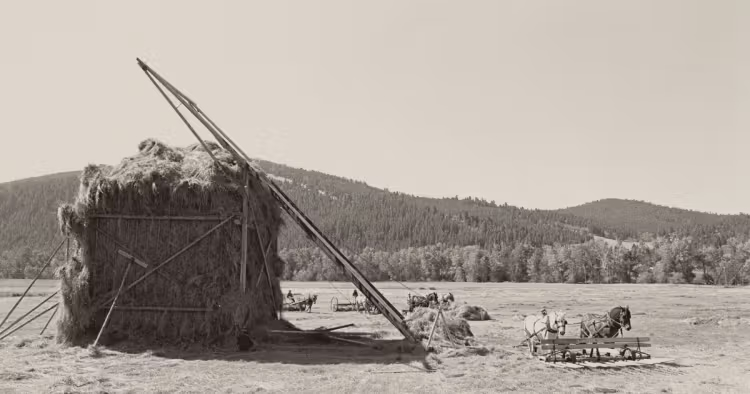
Then, every five miles or so, an old, spindly implement punctuates the scenery. It’s tall, maybe 30 feet, resembling a giant see-saw permanently out of balance. It’s not so much a stairway to heaven as it is a halted conveyor belt to nowhere; there’s no grain silo or corn crib nearby for a machine like this to fill up from above. Regardless, its efficacy in stacking giant piles of hay is clear from its construction. Grass grows tall around its base of rough-hewn lodgepoles, as if the earth might swallow it whole if it stayed put for another century.
This contraption [pictured at the top] is known as the beaverslide, patented in 1910 by Big Hole ranchers Herb Armitage and D.J. Stephens. The haystacking device consists of a wide, sliding fork at the base of a ramp and a cable pulley system rigged to the ramp’s underside. In practice, ranchers use a team of horses or a motorized vehicle with a winch to pull one of the cables perpendicular to the beaverslide, which in turn hoists the fork up the ramp, bringing a giant pile of hay up with it. (Ranchers rake cut hay onto the beaverslides with old buck rakes.) At the top of the ramp, the hay falls to the other side, forming three-story piles that can reach 25 tons in weight, depending on who you ask.
Details on the manufacturing and distribution of the beaverslide — named for its origins in Beaverhead County — are slim. The prevailing story is that ranchers often made their own, then made duplicates for neighboring ranches upon request, according to Big Hole rancher lore. Over the last few decades, the contraption has largely become a relic of a bygone era. But it’s not entirely obsolete, as some ranchers still use their old beaverslides today. With modern challenges like ballooning upgrade costs and the ever-present battle over a rancher’s right to repair their own equipment, the analog beaverslide makes more and more sense for those still using one with every passing hay season…
… he Kirkpatricks recall memories of neighbors being stuck in the middle of winter with broken-down bale processors and hungry cows. The closest repair shop in Jackson, an unincorporated community of roughly 20 people, is 42 miles south. The next closest shops or available technicians might be 53 miles away in Butte or 73 miles away in Dillon.
Many big-name mechanized implements run on trademarked chip technology that requires a trip to an authorized dealership for servicing. Even ranchers like Humbert who otherwise possess ample repair knowledge don’t have access to the diagnostic equipment necessary to solve problems on the fly. This might sound like sacrilege for an industry that lives and dies with rural, self-sufficient communities, but a bill calling for a rancher’s right to repair their own equipment died in the 2025 Montana legislature.
Score another point for the beaverslide…
Read on for more fascinating background: “Why Don’t You Beaverslide?” from @katiehillwriter.bsky.social
Watch the “technology” do it’s work here:
* A Tudor expression dating back to the mid-16th century, and used figuratively since 1673
###
As we honor old ways, we might recall that it was on this date in 1974 that Island Records released Country Life, the fourth studio album by Roxy Music.

“Wheat feeds the West, rice sustains the East”

Tomas Pueyo on why this is so… and what that has meant for culture and history…
What’s your staple, bread or rice?
This is a momentous fact, for it might have determined politics, culture, and wealth.
How? Well, bread comes from wheat, and rice from… rice…
… Wheat and rice are not harvested in the same places. Rice and bread are the predominant food where rice and wheat are respectively the predominant crops. Here’s another way to look at the same data:

This, in turn, is determined mainly by this:

… But this doesn’t fully explain it since it also rains a lot in Ireland, for example, but nobody grows rice there. You need the heat found closer to the equator: Rice grows in hot, wet, flat, floodable areas, whereas wheat prefers cooler, drier, better drained areas.
Flooding rots wheat but can 3x the yields of rice. That makes wheat well adapted to hills, whereas rice can only survive on hills when they are terraced.
This sounds like just a fun fact, but it ain’t. Because rice generates twice as many calories per unit of area.
This means that rice nourishes families on half the land that wheat requires. Which means population density in rice areas can be twice as high as in wheat areas, or four times with double cropping. A hectare of land can feed 1.5 families with wheat and 6 with rice.
Yet rice paddies also require a lot of work—twice as much as wheat. And that work is almost year-round: preparing paddies, raising seedlings in nurseries, transplanting every single seedling by hand into flooded fields, managing water, pumping it, weeding, harvesting, and threshing—often followed by a second rice crop or a winter crop. These tasks peak during transplanting and harvest, creating critical seasons where a huge amount of work must be done in a short window of time.
Crucially, this labor cannot be delayed—if you miss the planting window or harvest late, the crop is ruined. As a result, rice farmers developed reciprocal labor exchange: neighbors help each other transplant and harvest in time. The timeliness pressure meant rice villages became tightly cooperative communities to ensure everyone’s fields were tended before it was too late.
Wheat farming historically had a more seasonal rhythm with periods of relative quiet. Wheat is typically sown in the fall or spring and then mainly just left to grow with the rain. Aside from episodic weeding or guarding the fields, there was less continuous labor until harvest time. Harvest itself was a crunch period requiring many hands with sickles—European villages would collaborate during harvest, and farmers might hire extra reapers.
These differences made these regions diverge across politics, culture, and economy…
Read on: “How Bread vs Rice Molded History,” from Pueyo’s Uncharted Territories.
* adage
###
As we deliberate on our diets and their destinies, we might recall that it was on this date in 1887 that Chester A. Hodge of Beloit, Wisconsin received patent No. 367,398 for ‘spur rowel’ barbed wire (consisting of spur shaped wheels with 8 or 10 points mounted between 2 wires). It was one of many patents for barbed wire (e.g., here), which spread across the American West rapidly (thanks, in no small measure to the guy featured in the alamanc entry here)– and (by protecting farmers from foraging open-range cattle) paved the way for the expansion of wheat (and other kinds of) farming.

“As a work of art, I know few things more pleasing to the eye, or more capable of affording scope and gratification to a taste for the beautiful, than a well-situated, well cultivated farm”*…

That sentiment dates for the middle of the 19th century. The business of feeding humans (and our livestock) has changed a good bit since. George Steinmetz has traveled the globe documenting current practices. While (on the evidence of his remarkable photos) the process is still beautiful, it does raise some important questions…
Since the domestication of plants began some 11,000 years ago, humans have converted 40% of the earth’s surface into farmland. With the global population expected to reach 9.7 billion by the year 2050, combined with the rising standard of living in rapidly developing nations, it is estimated that we will have to increase the global food supply by 60%. The Feed the Planet project is an examination of how the world can meet the rapidly expanding challenge of feeding humanity without putting more natural lands under the plow. Most of us only come into contact with raw food in the supermarket, and are unaware of the methods used to raise it. In many cases, the food industry goes to significant lengths to prevent us from seeing how our food is produced. Access to this information is central to the personal decisions we make about what we eat, which cumulatively have huge environmental impact. This project seeks to show how our food is produced, so that we can make more informed decisions…


Many more striking photos, and their illuminating stories, at: “Feed the Planet.”
###
As we study sustenance, we might recall that it was on this date in 1825 that Ezra Daggett and Thomas Kensett of New York City were granted the first U.S. patent for food storage in tin cans. Canning had been practiced at an “industrial” scale in the U.S. since 1812 (when Kensett established the first U.S. canning facility for oysters, meats, fruits and vegetables in New York); Daggett and Kensett had been canning seafood since 1819.

You must be logged in to post a comment.