Author Archive
“When the going gets weird, the weird turn pro”*…

Philip K. Dick, whose work appeared from the 1950s into the early 1980s, is one of those too-rare writers whose deep questions–and the mind-bending ideas they spawned– are at least as relevant today as then. Jared Shurin offers a path in…
Philip K. Dick is a persistent, iconic cultural presence. His work has given us Blade Runner, Minority Report, The Man in the High Castle, A Scanner Darkly and a pair of Total Recall movies (one of which is an undisputed cinematic classic, the other of which has Colin Farrell). Like all adaptations, these all have a strained (and occasionally distant) relationship with the source material. But however bastardised they are, they demonstrate the greatest strength of PKD’s work: the big idea.
Science fiction’s history is filled with big ideas. But Philip K. Dick had an exceptional, if not unmatched, ability to think about the biggest ideas of them all. What if we are not who we think we are? What are memories if they are not our own? What if reality itself were not, in any sense, real? His work is unbothered with how we make fusion energy or break light speed or maintain life on the moon. The ‘how’ and the ‘what’ are often taken for granted; traditional science fiction platforms used as launch pads for deeper, more provocative expeditions into perception, interpretation, and the nature of truth itself.
Big Ideas are great for inspiring Big Movies, even if something gets lost in translation along the way. Why have Arnie wrestle with existential angst when he can pull a giant metal booger out of his brain instead? With that ease in mind, it is hardly a surprise that Dick thrives in adaptation while his fiction, I’m sorry to say, remains (relatively, at least) unappreciated.
This is not entirely Hollywood’s fault. Dick is inspirational. He’s exciting! He is challenging and surprising, always finding ways to push ideas forward; often beyond the point of exhaustion. His books can twist like a child’s tangled Slinky, and be—frankly—just as infuriating to unwind. In short, and I say this in full transparency: PKD’s works can be hard to read. Especially if one goes in expecting the film.
They are, however, well worth reading. Below, you’ll find a few suggestions on where to start, and why. I’m a believer in not plunging into the deep end, which, with Dick, can be outright abyssal. Instead, there’s merit in starting with some of the slightly more straightforward (for him) works, which riff off recognisable tropes and scenarios, but in a uniquely Dickian way. (I’m sure there are many brilliant readers out there that read VALIS when they were ten and think I’m a big weenie. I look forward to hearing from you in the comments.)…
There follows a path into the extraordinary works of PKD.
A reader’s guide: “Jump in the Deep End With Philip K. Dick,” from @reactorsff.bsky.social.
FWIW, your correspondent, while agreeing that VALIS (and The Divine Invasion) are titles to hold until one is acclimated, would include Time Out of Joint (1959) as one of the novels with which to start… but then, that’s the point of lists like this :)
* Hunter S. Thompson
###
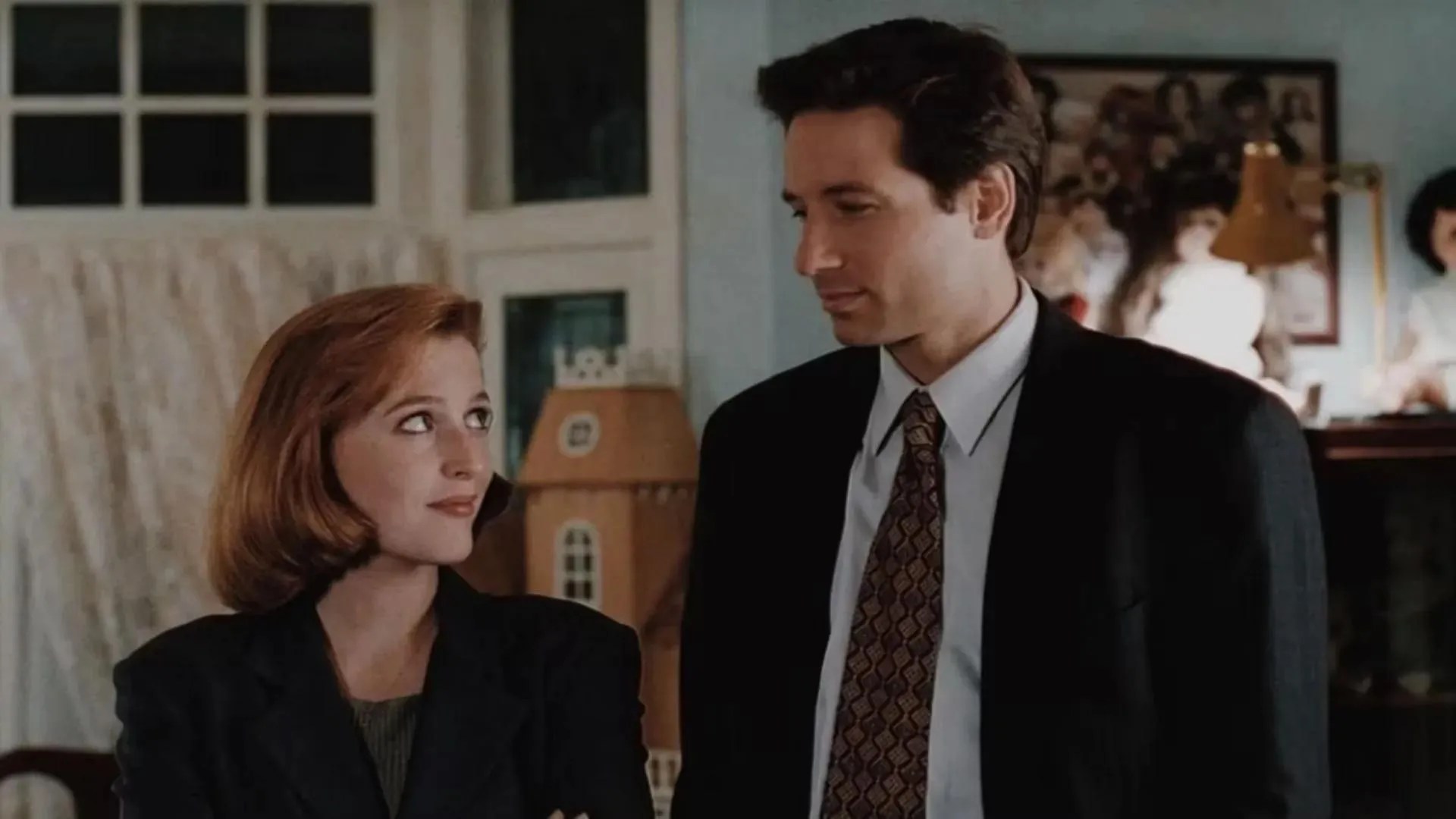
As we wrestle with reality, we might recall that it was on this date in 1993 (on the anniversary of the introduction of the first “TV dinner” about 40 years earlier) that the The X-Files, created by Chris Carter, premiered on Fox. The series– which followed FBI agents Fox Mulder (David Duchovny) and Dana Scully (Gillian Anderson) as they investigated unsolved cases involving paranormal phenomena, government conspiracies, and extraterrestrial life– spawned two feature films, multiple spin-offs, a revival series, and a dedicated fanbase known as “X-Philes.” The show’s tagline, “The Truth Is Out There,” has, of course, become an enduring phrase in popular culture.
“It is entirely possible that you get unpredictable behavior out of predictable rules”*…

For centuries, the hypnotic winter flights of starlings were thought to be telepathy. Today, science reveals a much darker reality. Behind one of nature’s most breathtaking visual displays lies a mathematical masterpiece built entirely on fear. From The Great Planet…
During the autumn and winter months, if you look to the skies over Europe and North America about an hour before sunset, you might witness one of nature’s most breathtaking visual spectacles. These massive black clouds of tens of thousands of European starlings (Sturnus vulgaris)—constantly shifting into spheres, planes, and waves—are known in the scientific community as a “murmuration.” Named after the deep, resonant sound produced by thousands of wings beating in unison, the phenomenon looks from afar like a colossal calligraphy brushstroke across the sky or a ball of fire flickering in the wind. Yet, beyond this aesthetic illusion lies a ruthless and flawless algorithm for survival.
For centuries, researchers were baffled by how tens of thousands of birds could fly at speeds of around 45 kilometers per hour without a single collision. This coordination was so inconceivable that in 1931, prominent ornithologist Edmund Selous described it as “a madness in the sky.” To Selous, there was only one logical explanation for this complex behavior: telepathy. “They must think collectively, all at the same time,” he wrote.
Like many others, Selous assumed that complex behavior must stem from equally complex origins. However, groundbreaking observations made in 2005 by the married physicists Andrea Cavagna and Irene Giardina from the rooftop of the Palazzo Massimo in Rome revealed a truth far more striking than telepathy. Over three years of chilly evenings, the team used pairs of cameras to reconstruct the 3D positions of more than 4,000 birds in a single flock, proving that there is no overarching plan and no leader. Each starling in the flock interacts exclusively with its seven closest neighbors—a number researchers suggest might be the maximum capacity their brains can handle. The starlings do not keep track of these constantly changing alliances; they simply align their flight path with whichever seven birds are nearest, remaining close, but never too close.
The birds do not need to engage in complex communication to navigate their massive trajectories. When Charlotte Hemelrijk of the University of Groningen in the Netherlands plugged just three simple rules—avoidance, alignment, and attraction—along with basic aerodynamics into a computer model, the resulting virtual murmuration perfectly matched the real-world data gathered in Rome.
Physicists explain this vast web of interaction through the concept of “scale-free correlation.” When a starling turns, this new alignment influences its neighbors, who in turn influence theirs. Yet, unlike a children’s game of telephone, this transfer of information does not degrade with errors; instead, the errors are entirely washed away in the movement. No matter how large the flock becomes, the information arrives at the furthest edge completely uncorrupted. Even though each bird only pays attention to seven neighbors, its senses effectively extend across the entire murmuration, allowing it to instantly react to a movement hundreds of birds away. The reason the flock looks like a single entity from the outside is that, physically, it truly behaves like one.
Why do starlings expend such an immense amount of energy to constantly shift shape in the sky? For a long time, the scientific consensus leaned toward the “warmer together” hypothesis, assuming the displays served to advertise a roosting site and gather more birds for thermal benefits on cold nights. However, an analysis of over 3,000 murmurations across 23 countries, gathered through citizen science, revealed only a weak negative correlation between temperature and flock duration. The true determining factor was the “safer together” principle: defense against predators.
In approximately 30% of the recorded murmurations, birds of prey such as hawks, falcons, or harriers were present. As predators approached or actively engaged the flock, both the duration and the size of the murmuration increased…
… Millions of years of evolution have granted starlings this colossal collective intelligence, allowing them to outmaneuver even nature’s most apex aerial predators. Yet, the primary threat they face today comes not from the sky, but from human activity on the ground. While European starlings are omnivorous, they rely heavily on insect larvae, such as leatherjackets, that live in the soil beneath grasslands; as these grassy areas vanish, so does their food supply. Their habitats are rapidly shrinking due to urbanization and changing farming practices, such as moving livestock feed indoors…
… For a species to merely exist within an ecosystem, narrowly avoiding physical extinction, does not mean it has truly been saved. Earth’s most beautiful phenomena only emerge when living things can act together in great, thriving numbers. You can evolve a flawless biological algorithm based on scale-free correlation to outwit nature’s most ruthless predators, but when your habitat is suddenly paved over with concrete, evolution affords you no time to design a new defense mechanism. The fact that we have finally decoded the mathematical secret of the starling murmuration just as we are on the verge of losing it forever remains one of the most haunting questions suspended in our skies—a stark reflection of modern human hubris and our destructive relationship with the planet…
A flawless algorithm is fading from our skies: “The Mathematics of Fear: Why Starlings Murmurate.”
See also: “The brain has corridors surpassing / Material place.”
* Frank Heppner (an ornihologist who helped create the first computer simulations of bird flocks in flight)
###
As we fly, we might send beautifully-plumed birthday greetings to Elliott Coues; he was born on this date in 1842. An army surgeon, historian, writer, and geographer, he led surveys of the Arizona Territory, first in his army posting there and later as secretary of the United States Geological and Geographical Survey of the Territories.
But we remember him here for his lifelong pursuit of his boyhood passion for birds. As a teen, he met many naturalists at the Smithsonian Institution and published his first ornithological paper in 1859, at age 19. As his army assignments took him to various locations throughout the West, he continued studying the bird life in each new area, and found new species. His Key to North American Birds (1872) was the first work of its kind to present a taxonomic classification of birds according to an artificial key and promoted the systematic study of wild fowl in North America. He founded the American Ornithological Union in 1883, and was editor of its publication, The Auk.

“We won because we insisted that no longer would politics be something that is done to us. Now, it is something that we do.”*…
Further, in a fashion, to yesterday’s post: Noam Lupu and Nicholas Carnes on a glaring imbalance in our electorial politics…
Both major U.S. political parties regularly tout their commitment to working-class Americans and claim to be the party of the working class. However, neither the Democrats nor the Republicans nominate many candidates who spent substantial time in working-class jobs.
This near-absence of people from working-class jobs in the halls of power matters. According to research in the U.S. and in other democracies, safety net programs are stingier, business regulations are flimsier and protections for workers are weaker than they would be if people from working-class jobs went on to hold office at higher rates. Working-class people can sometimes influence policy in other ways, but the fact that so few former workers hold elected office means that working-class interests often fall by the wayside in the world’s political institutions.
We research the causes and effects of the shortage of politicians from working-class jobs. We define working-class jobs as manual labor jobs, like construction worker, service industry jobs like restaurant server, and clerical jobs like receptionist.
We don’t include small-business owners or people who work in jobs that require extensive formal education. Instead, we focus on people in jobs that offer employees little stability or security.
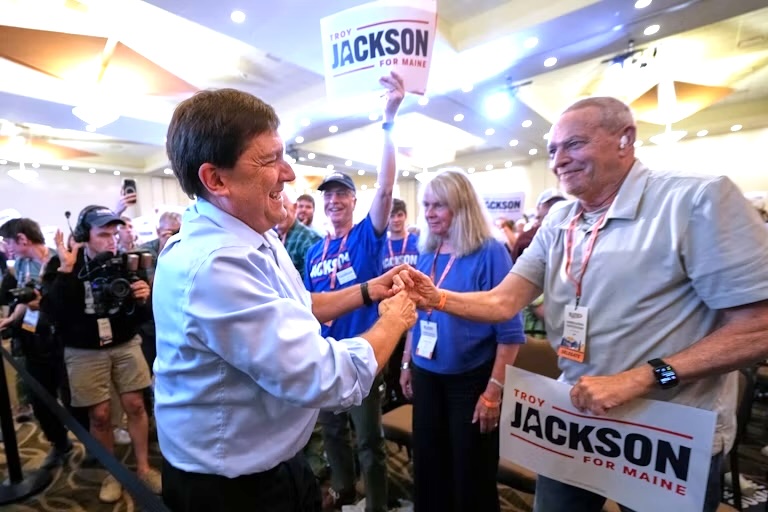
There are, of course, a small number of notable politicians from these kinds of occupations. U.S. Rep. Alexandria Ocasio-Cortez, a New York Democrat, was a bartender before she became a lawmaker. Troy Jackson, Maine’s Democratic Senate candidate, worked as a logger before entering state politics. Indiana state Sen. Jim Tomes, a Republican, worked as a truck driver and union steward.
There are also examples outside the U.S., such as Stefan Löfven, the former prime minister of Sweden, and Luiz Inácio Lula da Silva, the president of Brazil.
Politicians like these often attract outsized media attention, but overall, people from working-class jobs are sharply underrepresented in political institutions.
By our count, about half of all Americans in the labor force have working-class jobs. However, people who last had working-class jobs when they got into politics make up only about 1% of the average state legislature, regardless of their party affiliation. The same goes for Congress.
And the U.S. isn’t alone. Starting in 2016, we partnered with a team of researchers to collect data on 97 of the 103 democracies with more than 300,000 citizens. Like the U.S., the average global democracy draws just 2% of the members of its national legislature from people who last had working-class jobs.
People sometimes blame the shortage of working-class people in office on features of American elections, such as soaring campaign spending or the decline of labor unions.
But even in Germany and Belgium, which offer public financing to candidates, or Finland, where the vast majority of the labor force is unionized, people from working-class jobs make up around 5% or less of the national legislature.
There doesn’t seem to be any shortcoming on the part of working-class Americans that would explain why they so rarely go on to hold office.
Working-class candidates tend to be about as qualified in the ways we can measure as white-collar professionals, about as interested in running for office and about as likely to win when they run.
Our new book, “Keeping Workers Off the Ballot,” shows that what keeps working-class Americans – and their counterparts around the world – out of elected office is that they so rarely run. And that’s because campaigning anywhere for any office at any level of government is personally burdensome, as we show in our book. It takes time and energy, it entails personal risks ranging from embarrassment to physical violence, and the outcome is always uncertain…
… We believe there are ways to overcome the obstacles that keep working-class people out of office.
In a report we wrote for the American Academy of Arts and Sciences, we outline a range of options. Some of the reforms we’re proposing would help in the short term, such as creating candidate training programs or political scholarships that target working-class people. Some examples already exist, such as the New Jersey AFL-CIO’s Labor Candidates School.
Other options, which admittedly might be less likely to happen in the current political environment, would create long-lasting paths to office for working-class people, such as the creation of party or institutional quotas for people from working-class jobs, or randomly selected citizen juries that advise policymakers.
But without serious reform efforts that target the factors that keep workers off the ballot, our research suggests that working-class people will never make up more than tiny fractions of elected officials in the U.S. and in democracies around the world…
Putting the “representative” back into representative democracy: “Why working‑class people account for around 1% of lawmakers in the US – and only 2% in the average democracy around the world,” from @theconversation.com.
And of course some of our elected officials appoint others to office… which has led to our situation becoming even more egregious: “Trump’s Billionaire Boys Club: How Donald Trump has stacked his administration with investment bankers and billionaire businessmen and women.”
See also: “Class wars and the midterms” (“The US economic conversation is expanding to include things such as corruption and the Wall Street-Main Street divide…” Gift article from the Financial Times) and “Upend the trickle-down” (“Neoliberal policies have hollowed out democracies and spawned unchecked oligarchs. Grasping their structure points to a fix…” From Aeon)
* Zohran Mamdani
###
As we play fair, we might recall that it was on this date in 1819 that the Philadelphia Balloon Riot occurred at Vauxhall Garden in Philadelphia.
In the early 1800s, balloon aviation was a novelty in the U.S. So, when the Franklin Gazette of Philadelphia announced that French aeronaut Monsieur Michel would perform a balloon ascension and parachute leap at Vauxhall Garden, tens of thousands arrived to witness the balloon launch. But the one dollar admission fee (equal to $24.77 in 2024) prevented all but the wealthy from taking a closer look at the balloon. After guards beat a boy unconscious for attempting to get a better view by climbing atop a fence separating the paying guests from those who couldn’t afford the expensive entry fee, crowds broke down the fence and ripped the hot air balloon to shreds.

“Labor is prior to, and independent of, capital. Capital is only the fruit of labor, and could never have existed if labor had not first existed. Labor is the superior of capital, and deserves much the higher consideration.”*…

Today is, of course, Labor Day, a recognition of the American labor movement and the works and contributions of laborers to the development and achievements in the U. S. that dates from the latter 19th century. Livia Gershon reminds us that, earlier that century, labor had an important champion…
Today, the idea that the value of all commodities comes from the labor power used to produce them is closely associated with Karl Marx. But Marx was far from the only thinker in the mid-nineteenth century to believe this. Literature scholar Owen Cantrell looks at another: Abraham Lincoln [and here].
In 1847, Lincoln wrote that goods rightfully “belong to those whose labour has produced them,” and any good government should ensure that workers receive the entire product of their labor “or as nearly as possible.”
However, unlike Marx, Lincoln saw no problem with the private ownership of property, or even of some people becoming rich. Cantrell argues that his view was the product of his own background in rural middle America. As a young man, Lincoln’s father had worked odd jobs in Kentucky, sometimes alongside enslaved laborers. This became increasingly difficult as the growing use of enslavement crowded out free workers. But he was eventually able to help his community with his carpentry skills and establish a homestead in Indiana. There, Lincoln grew up doing manual labor on the homestead and at neighboring farms.
In 1861, the newly elected president warned that slavery threatened a system of free labor in which “the prudent, penniless beginner in the world, labors for wages for awhile, saves a surplus with which to buy tools or land for himself; then labors on his own account another while, and at length hires another new beginner to help him.”
Cantrell writes that Lincoln believed that both human advancement and political stability for the American democratic republic depended on workers’ dignity and ability to improve their conditions. He envisioned the Civil War as a fight between a slave economy that left workers powerless and a kind of capitalism in which they could use the cash economy to advance, improve production techniques, and create better material conditions for the country as a whole.
Marx had a very different view of the capitalist system, seeing wage work as the mark of an oppressed class making up the majority of industrial nations’ populations. But, like Lincoln, he saw the Civil War as an opportunity to secure better lives for all workers. When Lincoln was reelected in 1864, Marx—on behalf of the First International—wrote to him with hopes that the “American Antislavery War” would essentially function as a revolution bringing the working class to power.
In the end, the post-Civil War era did bring a new labor system, though not one for which either Marx or Lincoln had hoped. It saw the rise of large corporate employers and the consignment of an increasing part of the workforce to lifelong wage work—thanks in significant part to Lincoln’s Republican Party choosing to ally itself with the corporations.
“If he had witnessed the capitalist excesses of the Gilded Age, it would have proved the lie to his conception of capital and labor in the starkest possible way,” Cantrell writes…
Abraham Lincoln was no Marxist, but his ideas resonated—albeit with a rural American flavor: “Abraham Lincoln’s Labor Theory of Value,” from @liviagershon.bsky.social in @jstordaily.bsky.social.
If Lincoln would have been appalled at the Gilded Age, what might he think of what’s transpiring now? “How Did Trump Do on His Labor Day Report Card?” (“Spoiler alert: He flunked…” From @timothynoah.bsky.social in @newrepublic.com.)
* Abraham Lincoln
###
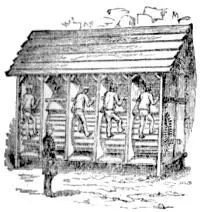
As we take the day off, we might recall that it was on this date in 1822 that a prisoner-powered treadmill for grinding corn began operation at the Bellevue County Penitentiary in New York City, located where 26th Street meets the East River. Up to 16 prisoners at a time walked on two paddle-wheel like treadmills, grinding about 50 bushells of corn per day.
“Anyone who has ever struggled with poverty knows how extremely expensive it is to be poor”*…

We’ve become a nation of credit and debit card users. As of this year, Pew reports, 42% of Americans don’t use cash for purchases in a typical week (up from 24% in 2015); another 46% use a mix of cash and plastic; only 12% use mostly (or entirely) cash. The Federal Reserve reports, unsuprisingly, that cash remains the dominant mode for the elderly and the poor; debit cards, for lower-to-middle-income households.
NBER unpacks one little-understood consequence of this shift…
Every time a consumer swipes a credit card, the merchant pays an interchange fee—typically around 1.9 percent of the transaction value—most of which funds the rewards that cardholders receive. Because merchants generally charge the same prices regardless of how customers pay, consumers who use cash or debit cards effectively help finance the rewards enjoyed by credit card users. In Who Pays for Payments? (NBER Working Paper 35067), Mark L. Egan, Gregor Matvos, Amit Seru, Lulu Wang, and Vincent Yao use novel merchant-level data from Fiserv—one of the largest US merchant acquirers—to measure how the payment system redistributes resources.
The primary dataset contains establishment-level payment data from 2006 to 2022, including total payment values, transaction counts, and interchange fees paid for different card types…
… The researchers’ analysis using these datasets suggests that interchange fees transfer approximately $30 billion annually from cash and debit card users to credit card users. Cash users lose about 96 basis points of purchasing power, and regulated debit card users lose roughly 47 basis points, while basic and premium credit card users gain approximately 48 and 59 basis points, respectively. Because credit card use rises with income, the system generates an estimated $9.2 billion annual transfer from households earning less than $150,000 to those earning more.
Two forces moderate this redistribution. First, the tendency for cash, debit, and credit card users to shop at different merchants limits the overlap necessary for cross-subsidization. Second, where overlap does occur, such as at large grocery stores and gas stations, interchange fees tend to be lower due to sector discounts and negotiated rates. Together, these forces reduce the transfer by approximately 25 percent relative to the transfer that would occur with homogeneous consumers and merchants.
The researchers also examine the redistributive consequences of two specific developments in the payment system. The first is the Durbin Amendment, which capped interchange fees on debit cards issued by large banks. The authors show that one perhaps unintended consequence of the amendment was that it primarily benefited credit card users through lower retail prices at the expense of regulated debit card users, who lost approximately $9.6 billion in rewards and free checking benefits. This was a net transfer from middle-income to higher-income households. The second development is the rise of premium credit cards, which grew from 15 percent of credit card volume in 2006 to 60 percent by 2022. This has also been a regressive development. While premium cardholders gained about $7.9 billion, debit card users—not cash users—bore the largest dollar losses because they shop most frequently alongside premium card users…

The rich getting richer: “Who Ultimately Pays Credit Card Interchange Fees?” from @nber.org.
Pair with Annie Lowrey on another burden– a “time tax”– that falls disportionately on the neediest: “How American Bureaucracy (Literally) Steals Years From Your Life“:
Washington currently estimates that Americans spend 12 billion hours a year filling out government forms, meaning the average person spends six 8-hour workdays filing their taxes, signing up for Medicaid, renewing their driver’s licenses, and applying for government loans. At prevailing wages, this uncompensated labor is worth $430 billion a year. If Washington were to create a Department of Bureaucracy to take on the paperwork it shunts to citizens, the agency would require 5.9 million employees, making it four times the size of the active-duty military. The DOB’s payroll would be larger than that of every other federal department combined.
The nation’s paperwork regime frustrates every resident, and particularly lower-income residents who use more government programs and interact more frequently with public officials. The political scientist Elizabeth Cohen has done seminal work exploring time as a potent, if obscure, form of political currency. “The devaluation of a person or group’s political time is a structural obstacle to equality,” she writes. Yet we can’t measure time and effort as easily as we measure dollars, and we don’t even try. The 12-billion-hour estimate is an undercount, and an egregious one…
* James Baldwin (see also Terry Pratchett’s “Boots theory“)
###
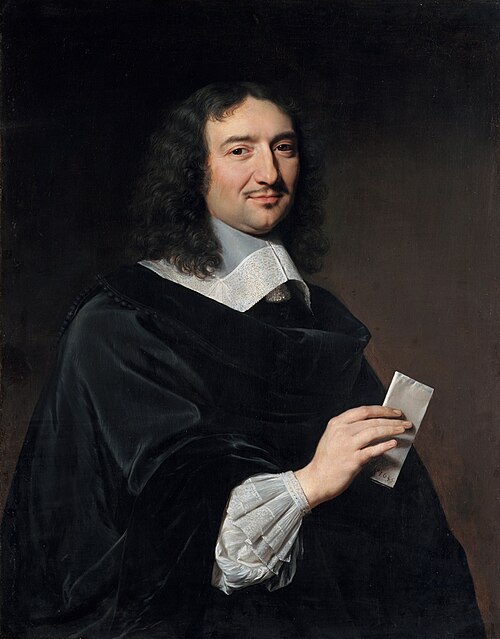
As we second-guess secreted subventions, we might spare a thought for Jean-Baptiste Colbert; he died on this date in 1683. A French statesman who served as First Minister of State under the rule of King Louis XIV from 1661 until his death. His lasting impact on the organization of the country’s politics and markets, known as Colbertism, a form of the mercantilism so popular in the Trump Administration today. Colbert also helped craft the Code Noir, a legal instrument that sanctioned an intentionally brutal system of torture and repression to enforce institutional slavery in the French colonial empire and restrict the enterprise of free Black people.
Though Colbert was more competent and less crony-ish than the crew at “work” in D.C. over the last couple of years, his goal of a healthy economy was frustrated by a King whose spending out-ran (and whose favoritism undermined) Colbert’s efforts. In the longer run, many economists suggest that “Colbertism” has contributed to contributed to a lack of adaptability in French industry and a hostility to technological innovation.
You must be logged in to post a comment.