Posts Tagged ‘Rosetta Stone’
“X marks the spot”*…

A reprise (because it’s just so much fun): the challenge facing pre-20th century alphabet book authors…
In 1895, the physicist Wilhelm Röntgen discovered X-rays, a groundbreaking moment in medical history which would lead to myriad improvements to people’s health. Perhaps one overlooked benefit though was in relation to mental health, specifically of those tasked with making alphabet books. How did they represent the letter X before X-rays? Xylophones, which have also been a popular choice through the twentieth century to today, are mysteriously absent in older works. Perhaps explained by the fact that, although around for millennia, the instrument didn’t gain popularity in the West (with the name of “xylophone”) until the early twentieth century. So to what solutions did our industrious publishers turn?
As we see… in addition to drawing on names — be it historical figures, plants, or animals, all mostly of a Greek bent (X being there much more common) — there’s also some more inventive approaches. And some wonderfully lazy ones too…

Many more amusing examples: “X is for...” from @PublicDomainRev.
###
As we wrestle with representation, we might spare a thought for Thomas Young; he died on this date 1829. A polmath described as “the last man who knew everything,” he made notable contributions to the fields of vision, light, solid mechanics, energy, physiology, musical harmony, and Egyptology. His work influenced that of William Herschel, Hermann von Helmholtz, James Clerk Maxwell, and Albert Einstein. Young is credited with establishing Christiaan Huygens’ wave theory of light (in contrast to the corpuscular theory of Isaac Newton).
Further, Young was an astute student of languages. He noticed eerie similarities between Indic and European languages. He went further, analyzing 400 languages spread across continents and millennia and proved that the overlap between some of them was too extensive to be an accident. A single coincidence meant nothing, but each additional one increased the chance of an underlying connection. In 1813, Young declared that all those languages belong to one family. He named it “Indo-European.”
And Young was instrumental in the deciphering of Egyptian hieroglyphs, specifically the Rosetta Stone.

“Those who cannot remember the past are condemned to repeat it”*…

The number of American university students selecting history as their chosen four year degree has been on the decline since the 1970s…

Tanner Greer (@Scholars_Stage) considers four possible reasons– and what they portend: “The Fall of History as a Major–and as a Part of the Humanities.”
(Image at top: source)
* George Santayana, The Life of Reason, 1905
###
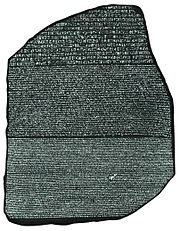
As we ponder the practicality of the past, we might we might celebrate a major contribution to the study of history; it was on this date in 1799 (or close; scholars agree that it was “mid-July” but disagree on the precise day) that a French soldier in Napoleon’s Egyptian Campaign discovered a black basalt slab inscribed with ancient writing near the town of Rosetta, about 35 miles north of Alexandria.
The stone contained fragments of passages written in three different scripts inscribed by priests of Ptolemy V in the second century B.C.– Greek, Egyptian hieroglyphics, and Egyptian demotic. The Greek passage proclaimed that the three scripts were all of identical meaning– so allowed French Egyptologist Jean Francois Champollion to decipher the hieroglyphics… and opened the language of ancient Egypt, a written language that had been “dead” for nearly two millennia.

“Common sense is calculation applied to life…”*

Josh Orter writes…
I updated my iPhone to the latest iOS version last week. Doing so required that “I agree” to Terms and Conditions amounting to 6,114 words: more than 37% longer than The Constitution of the United States (4,447). Although hardcore legalese enthusiasts may curl up with this masterpiece before the fire, mug of hot cocoa in hand, it will be read by virtually no one else. I clicked immediately, blissfully ignorant of my acquiescence…
Or maybe not so blissful. I was, in fact, vaguely annoyed at having just blindly accepted what amounts to a 24-page term paper (12-pt Times Roman, double-spaced). What, then, would fully informed consent cost?
$482,894,368, as it turns out.
With various reputable sources suggesting an average reading speed of 300 words per minute, 6,114 words would suck up 20.38 minutes of life for each user. Multiply by the average American’s hourly earnings of $24.09/hour (.4015/minute) and it’s $8.18257 in labor per updater.
A recently released study estimated Apple’s share of the 145 million-unit American smartphone market at 40.7%. 59 million iPhoners.
59,015,00 x $8.18257 = $482,894,368
Perhaps more unsettling than money is the cumulative man-hours this particular endeavor would consume: 20-million.
59,015,000 x users x 20.38 minutes per= 1,202,725,700 minutes= 20 million hours…
Find other arithmetic adventures at Josh’s wonderful Stupid Calculations (“Where practical facts get rendered into utterly meaningless ones”).
[TotH to the ever-illuminating Flowing Data]
* Henri Frédéric Amiel
###
As we carry the 1, we might recall that it was on this date in 1807 that Joseph Fourier’s monograph On the Propagation of Heat in Solid Bodies, was read to the Paris Institute. An important mathematical work containing what we now call Fourier series, it was reviewed by renowned respondents including Lagrange, Laplace, Monge, and Lacroix– who objected to his innovation (the expansion of functions as trigonometrical series: the Fourier series). Indeed, his work wasn’t published (in a revised and somewhat expanded form, as The Analytic Theory of Heat) until 1822. Fourier’s contributions were ultimately judged so important that, in addition to the series, Fourier’s Law and Fourier’s transform were named in his honor. And indeed, Fourier’s work, having first helped scientists and engineers understand heat transfer and vibrations, went on to help Watson and Crick discover the structure of DNA and to provide the underpinnings for quantum physics, radio astronomy, MP3 and JPEG compression, X-ray crystallography, voice recognition, and PET or MRI scans.
(Fourier was something of a polymath: just before developing his mathematical advances, he went with Napoleon Bonaparte on his Egyptian expedition in 1798, and was made governor of Lower Egypt and secretary of the Institut d’Égypte, where he was involved in the discovery and decoding of the Rosetta Stone. And after the publication of The Analytic Theory of Heat, he discovered the Greenhouse Effect.)
True greatness is when your name is like ampere, watt, and fourier—when it’s spelled with a lower case letter.
– Richard Hamming (in a 1986 Bell Labs Colloquium)

Infinitely cool…

How to Count to Infinity (or “Yes, Virginia, some infinities are bigger than others…”)
Many more sixty-second epiphanies at MinutePhysics’ You Tube channel (or via New Scientist TV)
***
As we check in to Hilbert’s Hotel, we might spare a thought for Joesph Fourier; the French mathematician, physicist, Egyptologist and administrator who died on this date in 1830. Fourier introduced Jean-Francois Champollion to the Rosetta Stone, which Champollion subsequently decoded/translated. And after calculating that a body the size of earth, at earth’s distance form the sun, should be cooler than our world is, discovered what we now call “the greenhouse effect.” But Fourier is best remembered for his contributions to mathematical physics through his Théorie analytique de la chaleur (1822; The Analytical Theory of Heat), which introduced an infinite mathematical series to aid in solving conduction equations. (The technique allowed the function of any variable to be expanded into a series of sines of multiples of the variable– now known as “the fourier series.”)
True greatness is when your name is like ampere, watt, and fourier—when it’s spelled with a lower case letter.
– Richard Hamming (in a 1986 Bell Labs Colloquium)

Explanations one would really rather not have to give…
 EATR (source)
From a press release issued by Cyclone Power Technologies and Robotic Technology:
In response to rumors circulating the internet on sites such as FoxNews.com, FastCompany.com and CNET News about a “flesh eating” robot project [ c.f., e.g., EATR: The Robot That Can Survive on Corpses], Cyclone Power Technologies Inc. (Pink Sheets: CYPW) and Robotic Technology Inc. (RTI) would like to set the record straight: This robot is strictly vegetarian.
On July 7, Cyclone announced that it had completed the first stage of development for a beta biomass engine system used to power RTI’s Energetically Autonomous Tactical Robot (EATR™), a Phase II SBIR project sponsored by the Defense Advanced Research Projects Agency (DARPA), Defense Sciences Office. RTI’s EATR is an autonomous robotic platform able to perform long-range, long-endurance missions without the need for manual or conventional re-fueling.
RTI’s patent pending robotic system will be able to find, ingest and extract energy from biomass in the environment. Despite the far-reaching reports that this includes “human bodies,” the public can be assured that the engine Cyclone has developed to power the EATR runs on fuel no scarier than twigs, grass clippings and wood chips – small, plant-based items for which RTI’s robotic technology is designed to forage. Desecration of the dead is a war crime under Article 15 of the Geneva Conventions, and is certainly not something sanctioned by DARPA, Cyclone or RTI.
“We completely understand the public’s concern about futuristic robots feeding on the human population, but that is not our mission,” stated Harry Schoell, Cyclone’s CEO. “We are focused on demonstrating that our engines can create usable, green power from plentiful, renewable plant matter. The commercial applications alone for this earth-friendly energy solution are enormous.”
As we contemplate off-label uses, we might also celebrate the happier fall-out of military maneuvers, as it was on this date in 1799 (or close; scholars agree that it was “mid-July” but disagree on the precise day) that a French soldier in Napoleon’s Egyptian Campaign discovered a black basalt slab inscribed with ancient writing near the town of Rosetta, about 35 miles north of Alexandria.
The stone contained fragments of passages written in three different scripts inscribed by priests of Ptolemy V in the second century B.C.– Greek, Egyptian hieroglyphics, and Egyptian demotic. The Greek passage proclaimed that the three scripts were all of identical meaning– so allowed French Egyptologist Jean Francois Champollion to decipher the hieroglyphics… and opened the language of ancient Egypt, a written language that had been “dead” for nearly two millennia.
![Reblog this post [with Zemanta]](https://i0.wp.com/img.zemanta.com/reblog_e.png?w=700)
You must be logged in to post a comment.