Posts Tagged ‘cycles’
“The crisis consists precisely in the fact that the old is dying and the new cannot be born; in this interregnum a great variety of morbid symptoms appear.”*…
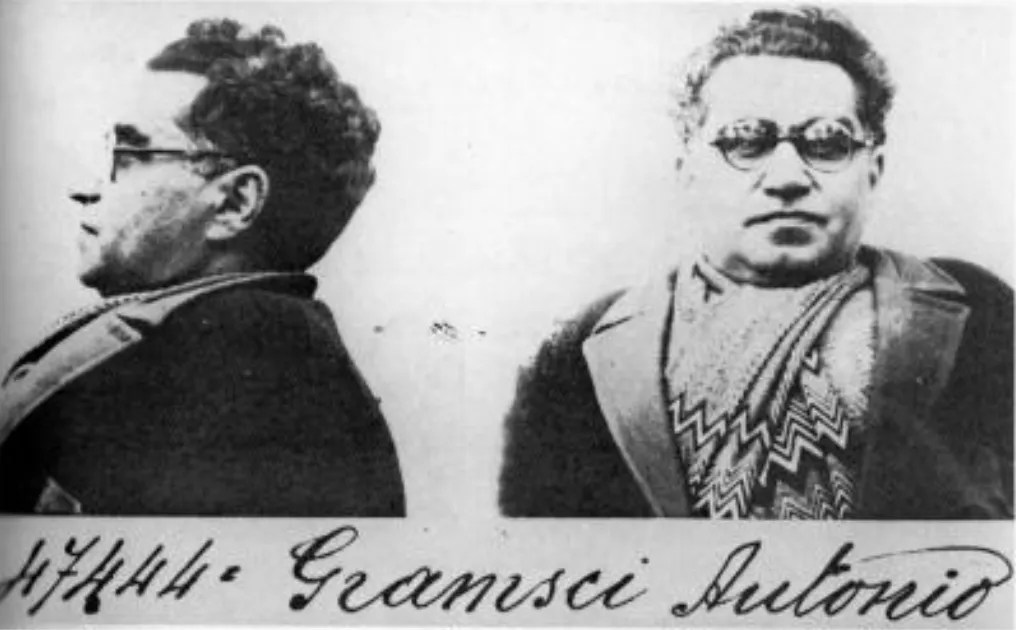
… for many, this phrase from Italian Marxist Antonio Gramsci sums up the current crisis of world politics and world power. Adam Tooze unpacks the oddity– and potential danger– of these lines becoming one of the soundbites of the early 21st-century…
… I want to put this conceptualization of our current crisis in question. Gramsci’s notion of interregnum may have served him to illuminate his immediate context. But, it transmits to our era a philosophy of history that actually obscures how we got from his moment of writing to our present day. It thus stands in the way of thinking hard about the challenges and opportunities of our current moment.
The currency of Gramsci’s lines today today should give us pause. After all, if we take Antonio Gramsci seriously as a historical thinker, as we absolutely must, we should also acknowledge the huge gulf that separates him from the present. He was a Communist who paid with his life for his commitment to the cause of world revolution. His lines on interregnum, now the stock in trade of after dinner speeches and think tank meetings, were composed in November 1930 in a fascist jail. Gramsci was thirty-nine. He would die at 46, his fragile health irrevocably broken by harsh imprisonment.
With morbid symptoms Gramsci may have been referring to fascism. Alternatively, he may have been criticizing the turn to the ultraleft of the Italian Communist party under pressure from Moscow. His medical language evokes Lenin’s famous denunciation of left communism as an “infantile disorder”.
Wondering about the popularity of Gramsci’s lines today, I’ve come to think that it may have something to do with the way in which they combine drama – crisis, birth, death, interregnum – with an undertone of reassurance. If this is true, it is a deep historic irony. Gramsci derived his fortitude and belief from his Marxist understanding of world history. Today his words serve very different purposes.
First of all, Gramsci’s quote implies a definite direction of historical travel. We know what is old. We know what is new. We may currently be in crisis, but it is only a matter of time before “the new” will eventually be delivered.
A transition from old to new might imply significant change, which could open us up to thinking about radically different futures. That might be good news. But it might also be disturbing. Once again reassurance is provided by Gramsci’s definition of the crisis as interregnum. The present is an inter-regnum, because it a period between two orders. It may be messy now, but a new era is on the way.
This kind of historical thinking is not confined to Gramsci. It is nicely illustrated, for example, in this conventional chronology of modern economic history.

Once cast in terms of the sequence of regnum-interregnum-regnum our current disorder becomes merely a passing moment. Given this sequence, who could doubt that a new white bar lies ahead of us. In this graphic, the grey phase of interregnum that began in 2008 already has a right-hand demarcation, even if no date is, as yet, attached to the endpoint.
A further point of certainty amidst Gramsci’s interregnum, is that we can confidently distinguish what is morbid from what is healthy. This again implies a superior vantage point, something that one might think would be in jeopardy in a true moment of crisis.
The obvious question is: what is the basis for Gramsci’s judgement? This troubling question is especially pressing if Gramsci was, in fact, applying the label morbid not to fascism but to those he disagreed with in the ranks of the international communist movement. Was this a medico-technical diagnosis? Or, was his judgement, like Lenin’s, a political act, an act of polemic, stigmatizing disagreement? In which case the naturalized conception of crisis is, in fact, disguising a political clash.
Finally, and most fundamentally, Gramsci’s diagnosis locates the current crisis within history imagined as a natural cycle of life, of birth and death…
…
… Models of this kind gesture to the confusion and terror of interregnum, all the while reducing that phase of disorder to something temporary, recurring and predictable. The model gestures to historical development – the upward step of phase after phase – but actually reduces radical change to repetition. After one hegemony what we look forward to, is simply another.
This line of thinking is not just simplistic. In the current moment it is dangerously so. To the drama of America’s evidently waning hegemony it adds the intensity of the follow-on question: who comes next? This question – far from necessary – is framed by the assumption of historical repetition – hegemon-interregnum-hegemony. In the current moment there can only be one possible answer: CCP-led China. That in turns eggs the flailing American elite on to a more intense rearguard action. But why assume that in the 21st century there will be a successor to America’s 20th century power?
Any serious examination of the foundations of modern power actually suggests that this kind of cyclical or sequential view of history is misplaced.
Take GDP as a proxy for power resources and think about the kind of intellectual gymnastics which are necessary to turn history as depicted by GDP below into [a cyclical] sequence…

As for the long-run continuity, global GDP prior to the 19th century is so low that it can not be sensibly depicted on the same graph extending into the 20th century. This is also true for economic heft and destructive power. Of course, there were highly destructive wars, in the 17th century for instance, but their violence unfolded according to a very different logic from that in the 20th century.
And as for the pattern of change, what we see is not a neat sequence of substitutions in which one hegemon displaces another, but rather something more akin to “piling on”. This is history not as repetition, but in Mark Blyth’s wonderful phrase as a “one-way trip into the unknown”…
…
… I see the construction of global hegemony in the 20th century not as a repetition of something familiar, but as itself a venture into the unknown. To put it simply, I see global hegemony as a 20th-century problem…
Of course, the distinctive 20th-century visions of global power had precursors. They had preconditions. Something had first to constitute our modern conception of globality. This happened through the global system of power, communication, transport and commerce created by the British Empire in the 19th century. This constituted for the first time what Michael Geyer and Charles Bright called the “global condition”. All too often this encourages thinking in terms of an Anglo-American sequence. But again this underestimates the power of accumulation and overlay. Compared to US power in its mid 20th-century pomp, the British empire was a thin mesh of networks. The British empire maintained its grip with extremely limited resources in large part as a result of the weakness of its rivals…
…
… But by 1916 it was clear that only the United States had the power to manage the new configuration of global forces. The weird architecture of global mobilization in the first phase of WWI could not be sustained without at least the approval of the government of the USA. This is the story of my book, Deluge.
The economy, as measured by novel statistics of national income, would be America’s trump card. But that in itself is not an obvious fact. It was an effect of particular circumstances. 1916 is a pivotal moment because with the inconclusive battles of materiel at Verdun and the Somme, following the “hunger winter” of 1915/1916, it became clear that purely military operations were at an impasse and this meant that war production and home front stability would take on a new and central role in determining the course of the war. War became a new kind of totalizing war. It was also an election year in the USA, arguably the first formal democratic event (as opposed to a revolution) to matter on a global scale. Certainly, it was the first US election that was watched with baited breath by political classes around the world.
It was out of the historically specific, financial and economic urgencies of World War I, that a new American-centered network of power emerged. This was something new, something architected and built to meet the urgency of the moment. There was no womb of hegemonic logic from which the US power was born to replace a dying British global order. It was not the inevitable sequence of monetary logic that ground through its inevitable development to make the dollar replace the pound sterling. It was war and war finance. The dollar in the 20th century would play a role quite different from sterling under the 19th century gold standard. Furthermore, America’s global power did not substitute for British power. It overlayed Britain’s own efforts, first in World War I, then in the interwar period and finally during World War II, to master the new hegemonic problem. In crucial areas, notably the oil fields of the Middle East, it was not until the late 1960s that the US finally took over…
…
… America’s age of hegemony was not an answer to an interregnum. It truly was new. It was thus not the latest iteration of some familiar form of power. It did not replace the British empire. The British empire was reinventing itself too in response to the new challenges of the early 20th century. It was overtaken by the US and nested itself under the wings of that power. It was not something born. It was built.
And if that is true for the early 20th century the question of how 21st century global power will be organized should be considered no less open. Certainly, our problem right now is not that the old is simply dying. Things are far from that simple. In certain crucial respects “the old” is hanging around and indeed seeking to mobilize new strength. At the same time the principal challenger may be “new” in the sense of unfamiliar. But the CCP-regime draws inspiration from a first successful century of ascent, evokes ancient Chinese history. And what its underlying drivers are, is a matter of contentious debate.
What is old and what is new, what morbid and what vigorous, what the underlying generative logic of history actually is, these are all questions that are at this moment up for debate. We are, therefore, experiencing a crisis of confidence and a period of uncertainty, that is far deeper than talk of an interregnum à la Gramsci implies. To be clear this does not necessarily mean more lethal or more tragic than the epoch that cut short Gramsci’s life. Our normality, however catastrophic, may be manageable. The environmental clock is ticking, but the majority of us are no longer poor. We live longer. Today, Gramsci’s life could probably have been saved. There are gigantic technological resources that democratic and progressive crisis-management could draw on. What we must let go of, is the false mantle of confidence and historical clarity that evoking the concepts of an earlier epoch entails. Abandoning talk of an interregnum may rob us of certainty. But rather than a council of despair this is simply a demand of realism. What that promises, is the chance to trade historic phantoms for new projects and the exploration of the actual possibilities of the present…
Eminently worth reading in full: “Built not Born – against “interregnum”-talk,” from @adam_tooze.
And what might we build? For a reminder that our options are perhaps broader than we might think: “The Gap at the End of the World,” from Cynthia Cruz in @LAReviewofBooks.
* Gramsci, Prison Notebooks
###
As we keep our eyes up, we might recall that it was on this date last year that a new kind of cultural phenomenon burst onto the scene, surrounding the simultaneous theatrical release of two films, Warner Bros. Pictures’ Barbie and Universal Pictures’ Oppenheimer— Barbenheimer, as it came to be called.
The simultaneous release was an instance of counterprogramming. As the release date approached, discussion from rivalry to the prospect of watching the films as a double feature. Cast members of both responded by encouraging audiences to watch the films on the same day. Celebrity participants included actor Tom Cruise, who purchased tickets to watch both while his latest film, Mission: Impossible – Dead Reckoning Part One, was still playing in theaters.
In the event, both Barbie and Oppenheimer received critical acclaim and exceeded box-office expectations. Their joint opening weekend was the fourth-largest at the American box office, and both rank among the highest-grossing films of 2023. The phenomenon also extended to the year’s awards season, in which both films emerged as leading contenders, earning a combined 21 nominations at the 96th Academy Awards. Both films were nominated for the Academy Award for Best Picture, which Oppenheimer won.

“Every solution tends to become the next problem”*…

Dingxin Zhao is sociologist who marshals history, historiography, and his own discipline to explain how ancient Chinese wisdom can shed light on the troubled times through which we’re living…
During a reading project I undertook to better understand the “third wave of democracy” — the remarkable and rapid rise of democracies in Latin America, Asia, Europe and Africa in the 1970s and 80s — I came to realize that this ascendency of democratic polities was not the result of some force propelling history toward its natural, final state, as some scholars have argued. Instead, it was the result of American political influence spreading around the world after the U.S. had established itself as the sole global superpower.
However, the U.S. endeavor to impose its political system in foreign lands where its policymakers did not have much knowledge facilitated the rise of many low-quality democracies, ethnic conflicts and refugee crises and triggered a global resurgence of authoritarianism and conservatism. Adding to such complexity, the crippled democratization movement, promoted under the banner of liberalism, inadvertently eroded the prominence of liberal ideologies — the very bedrock of enlightenment — across the world.
Upon arriving at this conclusion, I grappled with a sense of unease. I began to question whether I leaned too conservatively or possessed a certain authoritarian personality. Eventually, I realized that my conclusions were influenced by a Daoist perspective on history that had been imprinted on me during my upbringing in China.
Such a Daoist understanding of history contrasts with the teleological tenets found within the Judeo-Christian tradition and the symmetric cyclic interpretations that are also common in Western thought. And it could provide several insights in comprehending our increasingly intricate and uncertain world.
According to the Tao Te Ching, a succinctly composed text attributed to Laozi from the Warring States period (475-221 B.C.E.), history revolves around two pivotal elements. The first is that it unfolds in cycles that are characterized by perpetual transformations and negations. This cyclical perspective on historical development immediately sets the Daoist understanding of history apart from the linear and teleological understanding found in Judeo-Christian traditions, exemplified by narratives in the Bible and subsequently interpreted in diverse ways by theologians…
[Zhao explores the contrast, with both the teleological and the cyclical, using illuminating examples from St. Augustine, Hegel, Marx, Oswald Spengler, Neil Howe, Mancur Olson, Ibn Khaldun, and others]
… The second pivotal element within the Daoist understanding of historical development departs from this symmetry. The forces guiding each historical transformation and negation need not be the same: an “asymmetric cyclic theory.”
In the Tao Te Ching, Laozi famously wrote, “The Dao that can be stated cannot be the universal (or eternal) Dao.” This proclamation essentially asserts that symmetric cyclic theories cannot lay claim to universal or eternal truths. This is because the significance and function of any causal forces invariably change with different contexts.
In premodern China, Laozi’s precocious and highly sophisticated grasp of history often veered into mystical directions. Today, armed with the insights of modern social sciences, I would characterize the Daoist asymmetric cyclic theory of history as the “principle of reverse movement.”
This principle posits that as any organization, political system, idea, culture or institution gains ascendancy, the opposing, undermining forces concurrently intensify. In China, this has been visually conveyed through various forms of taiji diagrams. Among these diagrams, the one I believe best encapsulates the core of history’s asymmetric cyclical nature is also the simplest: Two forces of opposing nature undergo simultaneous change over time. As one force grows stronger, the other weakens, and vice versa.
To give some examples: In arenas of military and economic competition, entities that organize better and produce more efficiently tend to gain an edge. This nature of military and economic competition induces cumulative development — a form of societal change that bolsters humanity’s capacity to generate and accumulate wealth. In early modern Europe, heavily influenced by the linear historical outlook of Judeo-Christian traditions, thinkers often formulated theories that portrayed such cumulative developmental processes as progress toward a better future.
However, in the Daoist principle of reverse movement, as one actor in military or economic competition progressively secures the upper hand, opposing actors would also gather momentum. For instance, the dominant actor becomes increasingly susceptible to various errors — over-expansion, underestimating adversaries, disregarding internal vulnerabilities and potential crises. Meanwhile, weaker actors respond to their more formidable opponent by intensifying their desire to change, including learning from their opponent and striving for “self-strengthening.”…
[Zhao unpacks more examples]
… A Daoist understanding of history could contribute three key insights to the contemporary landscape of political theory and civilizational prosperity:
First, it asserts that historical transformations are not propelled by uniform forces, a perspective that challenges the concept of history being directed by a predestined end or ultimate purpose.
Second, it imparts a sense of humility upon influential social actors as their power ascends, encouraging them to gain insight into potential pitfalls and shifts that might undermine their status and avoid the fallacy of justifying their power supremacy by some teleological and thus moral rationale.
Third, it cautions us against the hubris of making linear predictions about upward-trending social tides and urges us to embrace the intricacies of complexity and acknowledge the multifaceted interplay of diverse forces. By doing so, we are compelled to appreciate the heterogeneous nature of historical change.
Belief in a linear or teleological understanding of history imparts a stronger sense of purpose in life, allows believers to create a more committed moral community and compels individuals within that community to act in a more principled manner. However, “true believers” can be convinced that they alone possess the correct beliefs and are aligned with the right course of history, that they hold a moral high ground to convert, exclude or even resort to violence against those deemed to be on the “wrong side.” Numerous times in centuries past, this belief has led to genocide, imperialism, racist governance, political purges and cultural conflict.
…
The Daoist principle of asymmetric reverse movement not only rejects the imposition of a direction onto history but also negates the existence of any specific, law-like forces underpinning the apparent cyclic patterns of historical events. Laozi’s concept of wuwei has prompted some scholars, like Charles Hucker, to interpret it as an ancient anarchist ideology that has “little to offer in the way of a governmental program.” However, in truth, Laozi is advocating for a form of statecraft characterized by profound humility. This humility is a rare trait, especially among powerful social actors — particularly very resourceful state actors. It becomes even scarcer within cultures dominated by a teleological comprehension of history…
Understanding the principle of reverse movement in history: “Daoist History” in Noema— eminently worth reading in full. And usefully accompanied by “A Daoist Take On The World Gone Sideways,” by Noema editor Nathan Gardels.
* your correspondent
###
As we honor humility, we might recall that it was on this date in 1890 that journalist Nellie Bly began her 72-day trip around the world.
In 1888, Bly suggested to her editor at the New York World that she take a trip around the world, attempting to turn the fictional Around the World in Eighty Days into fact for the first time. A year later, at 9:40 a.m. on November 14, 1889, with two days’ notice, she boarded the steamer Augusta Victoria, and began her 24,899-mile journey.
She brought with her the dress she was wearing, a sturdy overcoat, several changes of underwear, and a small travel bag carrying her toiletry essentials. She carried most of her money (£200 in English bank notes and gold in total as well as some American currency) in a bag tied around her neck.
Bly traveled through England, France (where she met Jules Verne in Amiens), Brindisi, the Suez Canal, Colombo (Ceylon), the Straits Settlements of Penang and Singapore, Hong Kong, and Japan. Just over seventy-two days after her departure from Hoboken, having used steamships and existing railway lines, Bly was back in New York; she beat Phileas Fogg‘s time by almost 8 days.

“If you would define the future, study the past”*…

The global economy and living standards have, Rafael Guthmann suggests, have had three “supercycles” of rise and fall over the past 4,000 years…
Economists often state that economic growth simply did not exist before recent times. The orthodox view that I was taught as an undergrad is that sustained economic growth began in the late 18th century. This view is articulated by economic historians like Clarke (2007). DeLong (2022) goes even further. He claims that modern economic growth only began in earnest in 1870, with the growth from 1770 to 1870 being very small in comparison, and that there was absolutely no growth in real incomes for ordinary people before 1770 (but he admits that living standards could have varied over pre-modern history for a tiny elite).
The data, however, shows that this model of economic history is plain wrong. Instead, over the last four thousand years, we can identify that there have been three major very-long-run economic cycles in the Western world that featured increasing incomes and then very long periods of decreasing incomes. These cycles of expansion and contraction lasted for several centuries.
As described by Bresson (2016), the first cycle corresponded to the rise and fall of Bronze Age civilizations, such as the Minoan and Mycenean cultures in Greece, the first literate civilization in Europe which developed writing around 2000 BC and collapsed towards the end of the 2nd millennium BC. The second cycle corresponded to the rise of Classical Greco-Roman civilization over the 1st millennium BC and its collapse during the 1st millennium AD. The third and present cycle began in the late 1st millennium AD and continues today. In this wider context, the industrial revolution beginning in the late 18th century was just an acceleration of the rate of economic development of the third cycle and did not really represent a discontinuity with past economic history…
He makes his case: “The Great Waves in Economic History,” @GuthmannR. (Note that, if one includes, for example, the long histories of the Chinese and African economies, the pattern of cycles of development and decline is further reinforced.)
* Confucius
###
As we contemplate cyclicality, we might recall that it was on this date in 12 CE– in the middle of the second wave identified above– that the Roman emperor Augustus (AKA, Caesar Augustus, Caesar, and Octavian) was named Pontifex Maximus (chief high priest of the College of Pontiffs (Collegium Pontificum) in ancient Rome, this was the most important position in the ancient Roman religion), incorporating the position into that of the emperor.

“Civilization is a movement and not a condition, a voyage and not a harbor”*…

It can seem, in this chaotic world-moment, that Huntington’s Clash of Civilizations is having a day. Nathan Gardels introduces a new series of essays in Noema that examine the prospects for rise and fall in our time…
“The intelligible unit of historical study,” Arnold Toynbee famously wrote, is neither the nation-state nor mankind as a whole, but civilizations that grew out of societies that evolved toward dominance of their “known world,” or stalled in isolation and fell into obscurity, depending on challenges to which they rose in response or that defeated them.
Writing his “Study of History” in the mid-20th century, he counted some 22 such civilizations that had arisen over the last 6,000 years, from the Mayan to Hindic to Sinic and Hellenic among many others. Each saw its foundation in a religious or cosmological outlook that shaped its internal cohesion through the form of the life of a society, its style of life, moral taste, form of government and spirit of laws.
For Toynbee, as the political scientist Robert Loevy has put it, “often one nation-state is the most powerful leader in the Civilization and comes to dominate it and symbolize it. After a lengthy period of domination, the Civilization falls, the world goes into a state of low-level organization, and humanity waits for the next Civilization to emerge and the cycle to begin anew.” Inevitably, as Toynbee saw it, creative elites become complacent in their success and fail to meet new challenges, both internally and from the outside.
Oswald Spengler, another philosopher of history most known for his book, “The Decline of the West”, similarly argued that the dominance of a civilization always diminished as the creative impulse that propelled its rise waned, overcome by “critical impulses” that destroyed the internal cohesion that sustained it.
These reflections are obviously relevant today as Vladimir Putin’s Russia and Xi Jinping’s China push back against the liberal world order led by the United States that has dominated the “known world” for the last eight decades following the West’s four-century rise.
Since they frame their challenge as “civilizational states” reasserting their historical identities anew, the question arises whether that challenge will defeat the West or serve to revitalize it by compelling a fresh creative response that both renews its internal cohesion and resists the hegemony of others.
Over the next weeks, Noema will address these issues in a running symposium of authors from West and East…
Clashes and cross-pollination: “The Cycle Of Civilizations,” a series eminently worth following in @NoemaMag.
* Arnold Toynbee
###
As we work out world order, we might recall that it was on this date in 1865 that President Abraham Lincoln signed the 13th Amendment, abolishing slavery and involuntary servitude (except as punishment for a crime).

On this date in 1960, the Greensboro Sit-Ins began. Four freshman at North Carolina A&T— Joseph McNeil, Franklin McCain, Ezell Blair Jr., and David Richmond, the “Greensboro Four,” as they came to be known– took seats at the lunch counter at the “Whites only” lunch counter of the F.W. Woolworths in downtown Greensboro. Followers of Martin Luther King, Jr., theirs was a non-violent protest– the Greensboro sit-ins grew (on February 4, more than 300 people took part) and lasted until July 25. On that date, after nearly $200,000 in losses ($1.8 million in 2021 dollars), and a reduction in salary for not meeting sales goals, store manager Clarence Harris asked four black employees, Geneva Tisdale, Susie Morrison, Anetha Jones, and Charles Bess, to change out of their work clothes and order a meal at the counter. They were, quietly, the first to be served at a Woolworth lunch counter. Most stores were soon desegregated.
The International Civil Rights Center & Museum in Greensboro contains the lunch counter, except for several seats which the museum donated to the National Museum of African American History and Culture in 2016 and a four-seat portion of the lunch counter acquired by the Smithsonian Institution in 1993, displayed in the National Museum of American History.

“Speculative bubbles do not end like a short story, novel, or play… In the real world, we never know when the story is over”*…
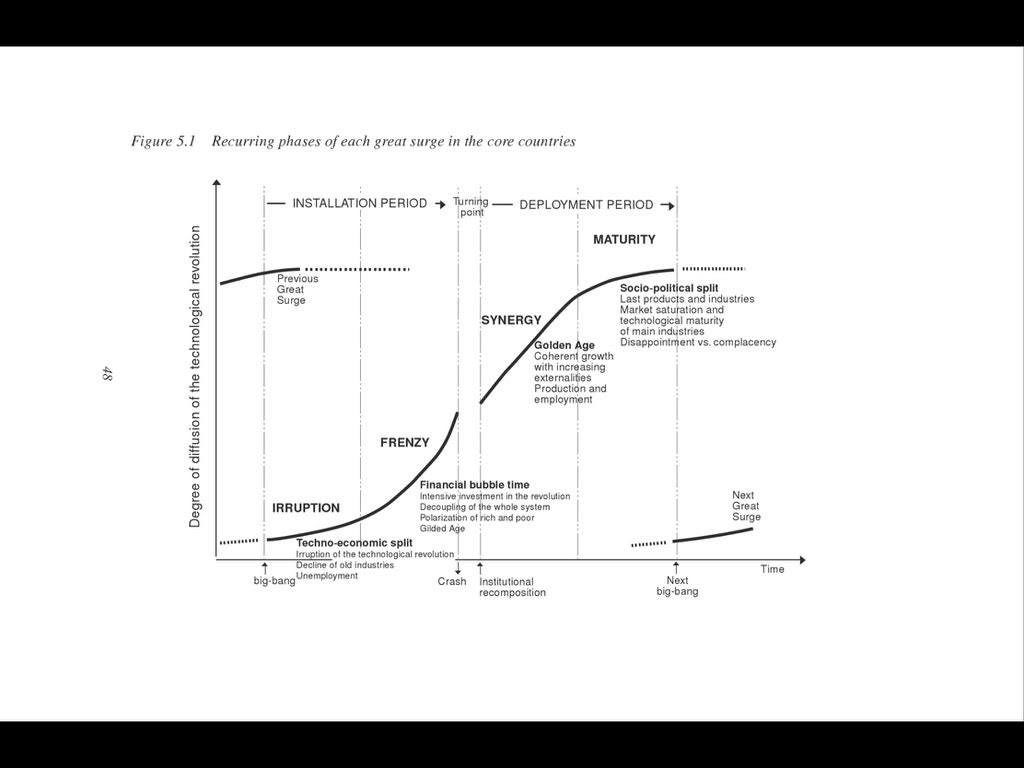
Technological Revolutions and Financial Capital: The Dynamics of Bubbles and Golden Ages is a hugely-influential book by Carlota Perez that suggests a connection between technological development and financial bubbles. which can be seen in the emergence of long term technology trends. She explicates her model by tracking repeated surges of technological development over the past three centuries, from the Industrial Revolution to the Information Age.
Written almost 20 years ago, it contained an implicit projection of where we would be today…
For this first stab at determining just when and where we are, we’re looking at 2002’s Technological Revolutions and Financial Capital, by Carlota Perez. One of the great economists of our time, Perez is a leading thinker on technology and socio-economic development. Her book outlines a four-phased financial cycle depicting the archetypical sequence of capital deployment and market traction for a major technological revolution. In this post, we’ll dig into Perez’s cycle and discuss where we sit today in 2021…
“Where Are We? Part 1: Bubbles, Bubbles, Toils, and Troubles“: Annika Lewis (@AnnikaSays) and David Phelps (@divine_economy) apply Perez’s principles in an attempt to figure out where we are and what our future might hold– the first in a series of attempts to break down economic theorists to try to figure out where exactly we are in a cycle.
* Robert Schiller
###
As we reset our sextants, we might recall that it was on this date in 1927 that the 15 millionth– and final– Model T rolled off of the Ford assembly line… effectively marking the end of the beginning (the “transition phase”) of the cycle that Perez calls the “age of oil, automobiles, and mass production.”

You must be logged in to post a comment.