Posts Tagged ‘Carlota Perez’
“There is often a decades-long time lag between the development of powerful new technologies and their widespread deployment”*…

Jerry Neumann explores the relevance of Carlota Perez‘s thinking (her concept of Techno-Economic Paradigm Shifts and theory of great surges, which built on Schumpeter’s work on Kondratieff waves) to the socio-economic moment in which we find ourselves…
I’ve been in the technology business for more than thirty years and for most of that time it’s felt like constant change. Is this the way innovation progresses, a never-ending stream of new things?
If you look at the history of technological innovation over the course of decades or centuries, not just years, it looks completely different. It looks like innovation comes in waves: great surges of technological development followed by quieter periods of adaptation.
The past 240 years have seen four of these great surges and the first half of a fifth…

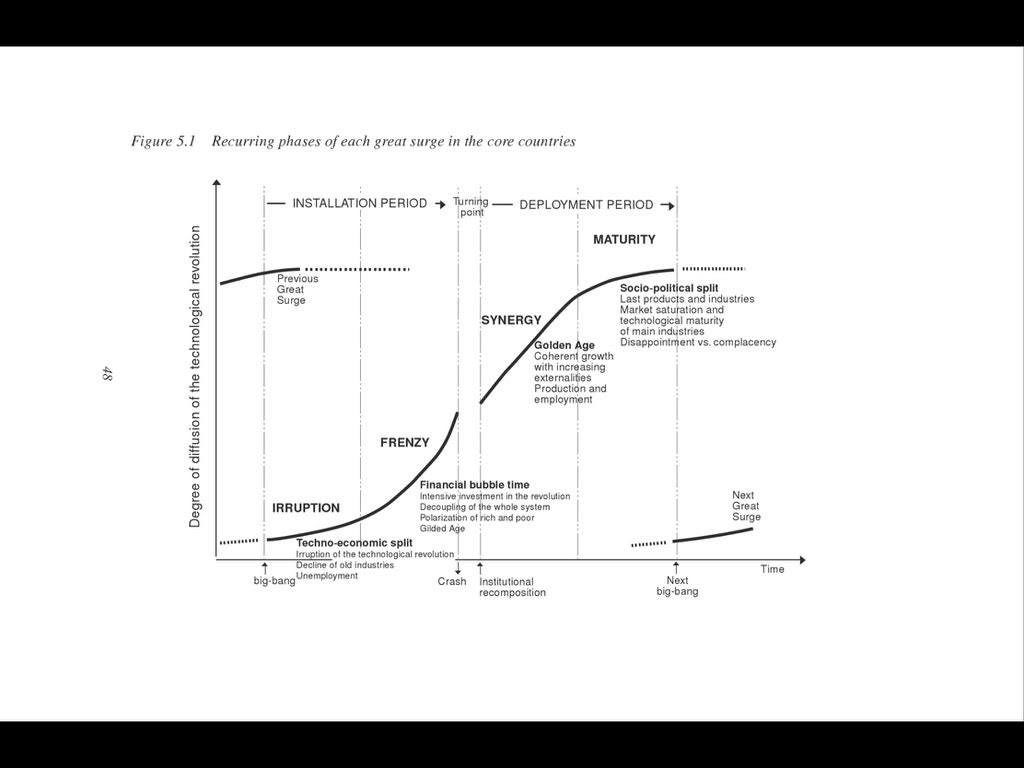
Economist Carlota Perez in her 2002 book Technological Revolutions and Financial Capital puts forward a theory that addresses the causes of these successive cycles and tries to explain why each cycle has a similar trajectory of growth and crisis. Her answers lie not just in technological change, but in the social, institutional, and financial aspects of our society itself…
Perez’ theory divides each cycle into two main parts: the installation period and the deployment period. Installation is from irruption to the crisis, and deployment is after the crisis. These are the ying and the yang of the cycle. Some of the differences between the two periods we’ve already mentioned—creative destruction vs. creative construction, financial capital vs. production capital, the battle of the new paradigm with the old vs. acceptance of the new TEP, etc…

We like theory because it tells us why, but more than that, a good theory is predictive. If Perez’ theory is correct, it should allow us to predict what will happen next in the current technological cycle…
A crisp distillation of Perez’s thinking and a provocative consideration of its possible meaning for our times: “The Age of Deployment,” from @ganeumann.
* Carlota Perez (@CarlotaPrzPerez)
###
As we ride the waves, we might recall that it was on this date in 1901, 11 years after the suicide of Vincent Van Gogh (and as his vision and its impact flowered in its “Deployment Age”) a large retrospective of his work (71 paintings) was held at the Bernheim-Jeune Gallery. It captured the excitement of André Derain and Maurice de Vlaminck— and thus contributed to the emergence of Fauvism.

“Create more value than you capture”*…

A thoughtful consideration of Web 3.0 from the always-insightful Tim O’Reilly…
There’s been a lot of talk about Web3 lately, and as the person who defined “Web 2.0” 17 years ago, I’m often asked to comment. I’ve generally avoided doing so because most prognostications about the future turn out to be wrong. What we can do, though, is to ask ourselves questions that help us see more deeply into the present, the soil in which the future is rooted. As William Gibson famously said, “The future is already here. It’s just not evenly distributed yet.” We can also look at economic and social patterns and cycles, using as a lens the observation ascribed to Mark Twain that “history doesn’t repeat itself, but it rhymes.”
Using those filters, what can we say about Web3?…
There follows a fascinating– and educational– analysis of the state of play and the issues that we face.
Tim concludes…
Let’s focus on the parts of the Web3 vision that aren’t about easy riches, on solving hard problems in trust, identity, and decentralized finance. And above all, let’s focus on the interface between crypto and the real world that people live in, where, as Matthew Yglesias put it when talking about housing inequality, “a society becomes wealthy over time by accumulating a stock of long-lasting capital goods.” If, as Sal Delle Palme argues, Web3 heralds the birth of a new economic system, let’s make it one that increases true wealth—not just paper wealth for those lucky enough to get in early but actual life-changing goods and services that make life better for everyone.
“Why it’s too early to get excited about Web3,” from @timoreilly.
See also: “My first impressions of web3” from Matthew Rosenfeld (AKA Moxie Marlinspike, @moxie, founder of @signalapp).
* Tim O’Reilly
###
As we focus on first principles, we might recall that it was on this date in 2007 that Steve Jobs introduced the iPhone at MacWorld. The phone wasn’t available for sale until June 29th, occasioning one of the most heavily anticipated sales launches in the history of technology. Apple sold 1.4 million iPhones in 2007, steadily increasing each year; estimated sales in 2021 are 240-250 million.

“Speculative bubbles do not end like a short story, novel, or play… In the real world, we never know when the story is over”*…
Technological Revolutions and Financial Capital: The Dynamics of Bubbles and Golden Ages is a hugely-influential book by Carlota Perez that suggests a connection between technological development and financial bubbles. which can be seen in the emergence of long term technology trends. She explicates her model by tracking repeated surges of technological development over the past three centuries, from the Industrial Revolution to the Information Age.
Written almost 20 years ago, it contained an implicit projection of where we would be today…
For this first stab at determining just when and where we are, we’re looking at 2002’s Technological Revolutions and Financial Capital, by Carlota Perez. One of the great economists of our time, Perez is a leading thinker on technology and socio-economic development. Her book outlines a four-phased financial cycle depicting the archetypical sequence of capital deployment and market traction for a major technological revolution. In this post, we’ll dig into Perez’s cycle and discuss where we sit today in 2021…
“Where Are We? Part 1: Bubbles, Bubbles, Toils, and Troubles“: Annika Lewis (@AnnikaSays) and David Phelps (@divine_economy) apply Perez’s principles in an attempt to figure out where we are and what our future might hold– the first in a series of attempts to break down economic theorists to try to figure out where exactly we are in a cycle.
* Robert Schiller
###
As we reset our sextants, we might recall that it was on this date in 1927 that the 15 millionth– and final– Model T rolled off of the Ford assembly line… effectively marking the end of the beginning (the “transition phase”) of the cycle that Perez calls the “age of oil, automobiles, and mass production.”

You must be logged in to post a comment.