Archive for February 2022
“Round and round she goes, where she stops, nobody knows”*…

Low Earth Orbit Satellites are objects that orbit the earth at lower altitudes than geosynchronous satellites, usually at between 160 km and 1000 km above the earth. They’re primarily used for imaging (think Google Maps/Earth, military reconnaissance, spying, and the like) or communications (signal relay, a la Starlink‘s new satellite internet service).
Even as there are concerns about the proliferation of objects in the sky at that altitude– ranging from the occlusion of the view into space through privacy to the accumulating layer of junk that defunct satellites could become— the rush to launch is on.
Leo Labs (@LeoLabs_Space) is a platform that aims to support developers and operators of LEOs. They provide a handy (and mesmerizing) real-time visualization of all of the LEOs aloft.
* a recurring line on Major Bowes Original Amateur Hour, a radio show that aired from 1934-1948 (then became Ted Mack Original Amateur Hour on television).
###
As we look up, we might recall that it was on this date in 1962 that President John F. Kennedy (and Vice-President Lyndon B. Johnson) visited newly-minted American hero John Glenn at Cape Canaveral to congratulate Glenn on becoming the first American to orbit the earth. Piloting Friendship 7, he had orbited the earth three times before splashing down in the Atlantic.

“We do not inherit the earth from our ancestors, we borrow it from our children”*…

… and the interest rate on that loan is rising.
There’s much discussion of what’s causing the sudden-feeling spike in prices that we’re experiencing: pandemic disruptions, nativist and protectionist policies, the over-taxing of over-optimized supply chains, and others. But Robinson Meyer argues that there’s another issue, an underlying cause, that’s not getting the attention it deserves… one that will likely be even harder to address…
Over the past year, U.S. consumer prices have risen 7 percent, their fastest rate in nearly four decades, frustrating households and tanking President Joe Biden’s approval rating. And no wonder. High inflation corrodes the basic machinery of the economy, unsettling consumers, troubling companies, and preventing everyone from making sturdy plans for the future…
For years, scientists and economists have warned that climate change could cause massive shortages of major commodities, such as wine, chocolate, and cereals. Financial regulators have cautioned against a “disorderly transition,” in which the world commits only haphazardly to leaving fossil fuels, so it does not invest enough in their zero-carbon replacements. In an economy as prosperous and powerful as America’s, those problems are likely to show up—at least at first—not as empty grocery shelves or bankrupt gas stations but as price increases.
That phenomenon, long hypothesized, may be starting to actually arrive. Over the past year, unprecedented weather disasters have caused the price of key commodities to spike, and a volatile oil-and-gas market has allowed Russia and Saudi Arabia to exert geopolitical force.
“This climate-change risk to the supply chain—it’s actually real. It is happening now,” Mohamed Kande, the U.S. and global advisory leader at the accounting firm PwC, told me.
…
How to respond to these problems? The U.S. government has one tool to slow down the great chase of inflation: Leash up its dollars. By raising the rate at which the federal government lends money to banks, the Federal Reserve makes it more expensive for businesses or consumers to take out loans themselves. This brings demand in the economy more in line with supply. It is like the king in our thought experiment deciding to buy back some of his gold coins.
But wait—is it always appropriate to focus on dollars? What if the problem was caused by too few goods? Worse, what if the economy lost the ability to produce goods over time, throwing off the dollars-to-goods ratio? Then what was once an adequate number of dollars will, through no fault of its own, become too many...
… if the climate scars on supply continue to grow, does the Federal Reserve have the right tools to manage? Stinson Dean, the lumber trader, is doubtful. “Raising interest rates will blunt demand for housing—no doubt. But if you blunt demand enough to bring lumber prices down, you’re destroying the economy,” Dean told me. “For us to have lower lumber prices, we can only build a million homes a year. Do you really want to do that?
“Raising rates,” he said, “doesn’t grow more trees.” Nor does it grow more coffee, end a drought, or bring certainty to the energy transition. And if our new era of climate-driven inflation takes hold, America will need more than higher interest rates to bring balance to supply and demand.
A provocative look at the tangled roots of our inflation, suggesting that “The World Isn’t Ready for Climate-Change-Driven Inflation,” from @yayitsrob in @TheAtlantic. Eminently worth reading in full. Via @sentiers.
* Native American proverb
###
As we dig deeper, we might send carefully calculated birthday greetings to Frank Plumpton Ramsey; he was born on this date in 1903. A philosopher, mathematician, and economist, he made major contributions to all three fields before his death (at the age of 26) on this date in 1930.
While he is probably best remembered as a mathematician and logician and as Wittgenstein’s friend and translator, he wrote three paper in economics: on subjective probability and utility (a response to Keynes, 1926), on optimal taxation (1927, described by Joseph E. Stiglitz as “a landmark in the economics of public finance”), and optimal economic growth (1928; hailed by Keynes as “”one of the most remarkable contributions to mathematical economics ever made”). The economist Paul Samuelson described them in 1970 as “three great legacies – legacies that were for the most part mere by-products of his major interest in the foundations of mathematics and knowledge.”
For more on Ramsey and his thought, see “One of the Great Intellects of His Time,” “The Man Who Thought Too Fast,” and Ramsey’s entry in the Stanford Encyclopedia of Philosophy.

“All ancient books which have once been called sacred by man will have their lasting place in the history of mankind”*…

In 1999, Santa Cruz, California software engineer John Bruno Hare founded what he hoped would become “a quiet place in cyberspace”…
Welcome to the largest freely available archive of online books about religion, mythology, folklore, and the esoteric on the Internet… Texts are presented in English translation and, where possible, in the original language…
This site has no particular agenda other than promoting religious tolerance and scholarship. Views expressed at this site are solely those of specific authors, and are not endorsed by sacred-texts. Sacred-texts is not sponsored by any religious group or organzation.
This site strives to produce the best possible transcriptions of public domain texts on the subject of religion, mythology, folklore and the esoteric. The texts are posted for free access on the Internet. This site is like a public library: it is accessible to anyone, contains unfiltered information, and does not advocate any particular point of view. However, nobody is going to shush you if you make too much noise while using this site…
Sacred texts is one of the top 20,000 sites on the web based on site traffic, consistently one of the top 10,000 sites in Australia, the US and India, and is one of the top 5 most visited general religion sites (source: Alexa.com)…
Spirituality in all of its shapes: The Internet Scared Text Archive.
* “All ancient books which have once been called sacred by man will have their lasting place in the history of mankind; and those who possess the courage, the perseverance, and the self-denial of the true miner, and of the true scholar, will find even in the darkest and dustiest shafts what they are seeking for–real nuggets of thought, and precious jewels of faith and hope.” – Max Müller, Introduction to the Upanishads Vol. II
###
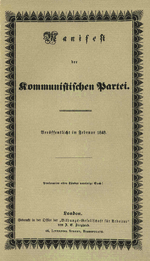
As we delve into the devotional, we might recall that it was on this date in 1848 that a document that isn’t in the Sacred Text Archive, but that is arguably apposite, was published– a political pamphlet by the German philosophers Karl Marx and Friedrich Engels, The Communist Manifesto. Commissioned by the Communist League and written in German, it appeared as the Revolutions of 1848 began to erupt. Subsequently, of course, Marx elaborated on his argument (with Engel’s help, after Marx’s death) in Das Kapital.
“A good bookshop is like a genteel black hole that knows how to read”*…

Some good news…
Riding strong gains in the second half of the year, bookstore sales increased 28% in 2021 over 2020, according to preliminary estimates from the U.S. Census Bureau. Sales were $9.03 billion, compared to sales of $6.50 billion in pandemic-ravaged 2020.
The rebound was not quite enough to bring 2021 bookstore sales back to 2019 levels, falling 1% below 2019 sales of $9.13 billion… [but] was higher than the 19.3% increase for the entire retail sector…
Book shops are back: “Bookstore Sales Rose 28% in 2021,” from @PublishersWkly
* Terry Pratchett
###
As we browse, we might spare a thought for an author whose works are eminently worth picking up on one’s next bookstore run: social reformer, orator, writer, and statesman Frederick Douglass (Frederick Augustus Washington Bailey); he died on this date in 1895. Born into slavery, he escaped to become a national leader of the abolitionist movement in Massachusetts and New York, famous for his oratory and incisive antislavery writings.
He was described by abolitionists in his time as a living counterexample to slaveholders’ arguments that slaves lacked the intellectual capacity to function as independent American citizens; indeed, some Northerners at the time found it hard to believe that such a great thinker had once been a slave.
Douglass believed in dialogue and in making alliances across racial and ideological divides, and in the liberal values of the U.S. Constitution. When radical abolitionists, under the motto “No Union with Slaveholders,” criticized Douglass’s willingness to engage in dialogue with slave owners, he replied: “I would unite with anybody to do right and with nobody to do wrong.”

“Prediction and explanation are exactly symmetrical”*…

From a December, 1969 episode of the BBC series Tomorrow’s World, an eerily-prescient look at the computerized future of banking…
The emergence of the debit card, the impact on back-office jobs, the receding importance of branch banks… they nailed it.
TotH to Benedict Evans (@benedictevans)
* “Prediction and explanation are exactly symmetrical. Explanations are, in effect, predictions about what has happened; predictions are explanations about what’s going to happen.” – John Searle
###
As we find our ways into the future, we might recall that it was on this date in 1878 that the modern music business was effectively born: Thomas Edison was awarded U.S. Patent No. 200,521 for his invention, the phonograph.

You must be logged in to post a comment.