Posts Tagged ‘Wikipedia’
“Nature doesn’t feel compelled to stick to a mathematically precise algorithm; in fact, nature probably can’t stick to an algorithm.”*…

Just over 30 years ago, my GBN partner Stewart Brand and I were discussing the then-new web affordance Pointcast, an active screensaver that displayed news and other information tailored to a user’s expressed interests and delivered live over the Internet. It was big news at the time; and while it failed, it prefigured the emergence of the algorithms that today feed “preferences” that we don’t even need (nor for that matter have the opportunity) to articlulate.
The problem, we mused, is that a system like that becomes a trap, one that (by simply satisfying expressed desires) impicitly works against discovery of the altogether new, of the thing we didn’t yet know might interest (or benefit) us. A system like that pulls us more deeply into holes instead of helping us explore broader horizons– it is biased against discovery, against learning (in its broadest sense). Our most important discoveries are often the books somewhere on the library shelp near the one we were seeking, the article in the (old print) newpaper next to the one to which we were intially drawn.
The answer, we imagined, wasn’t to skip such systems altogether; they can play a useful role; rather, it was to introduce a complementary “dial-up randomness”– to create ways to feed ourselves a stream of surprises.
Benj Edwards reports on just such an affordance…
[Recently] a New York-based app developer named Isaac Gemal [here] debuted a new site called WikiTok, where users can vertically swipe through an endless stream of Wikipedia article stubs in a manner similar to the interface for video-sharing app TikTok.
It’s a neat way to stumble upon interesting information randomly, learn new things, and spend spare moments of boredom without reaching for an algorithmically addictive social media app. Although to be fair, WikiTok is addictive in its own way, but without an invasive algorithm tracking you and pushing you toward the lowest-common-denominator content. It’s also thrilling because you never know what’s going to pop up next.
WikiTok, which works through mobile and desktop browsers, feeds visitors a random list of Wikipedia articles—culled from the Wikipedia API—into a vertically scrolling interface. Despite the name that hearkens to TikTok, there are currently no videos involved. Each entry is accompanied by an image pulled from the corresponding article. If you see something you like, you can tap “Read More,” and the full Wikipedia page on the topic will open in your browser.
For now, the feed is truly random, and Gemal is currently resisting calls to automatically tailor the stream of articles to the user’s interests based on what they express interest in.
“I have had plenty of people message me and even make issues on my GitHub asking for some insane crazy WikiTok algorithm,” Gemal told Ars. “And I had to put my foot down and say something along the lines that we’re already ruled by ruthless, opaque algorithms in our everyday life; why can’t we just have one little corner in the world without them?”
The breadth of topics you’ll encounter on WikiTok is staggering, owing to the wide range of knowledge that Wikipedia covers…
… Gemal posted the code for WikiTok on GitHub, so anyone can modify or contribute to the project. Right now, the web app supports 14 languages, article previews, and article sharing on both desktop and mobile browsers. New features may arrive as contributors add them. It’s based on a tech stack that includes React 18, TypeScript, Tailwind CSS, and Vite.
And so far, he is sticking to his vision of a free way to enjoy Wikipedia without being tracked and targeted. “I have no grand plans for some sort of insane monetized hyper-calculating TikTok algorithm,” Gemal told us. “It is anti-algorithmic, if anything.”
WikiTok cures boredom in spare moments with wholesome swipe-ups: “Developer creates endless Wikipedia feed to fight algorithm addiction,” @benjedwards.com in @arstechnica.com.
###
As we supersize serendipity, we might recall that it was on this date in 1967 that a remarkably warm and open new neighbor moved into the neighborhood: Misteroger’s Neighborhood premeired nationally on public television stations.
Fred McFeely Rogers was born in Latrobe, Pennsylvania on March 20, 1928. After earning his bachelor’s degree in music from Rollins College in 1951, he began working for NBC for a short time in New York. In 1953, he began working at the new public television station WQED for the show, The Children’s Corner where he learned that wearing sneakers were a lot quieter on the set than his dress shoes.
In 1961, Rogers moved to Toronto, Ontario to work on a new 15-minute show called Misterogers for CBC Television. In 1966, Rogers went back to WQED to create Misteroger’s Neighborhood.
In 1970, the show was renamed Mister Rogers’ Neighborhood. The series ended again in 1976 but was picked up three years later when Rogers felt as if his work speaking to children wasn’t done. The show continued from 1979 through 2001. Mr. Rogers passed away on February 27, 2003.
In 2011, PBS created an animated “spinoff” of the show called Daniel Tiger’s Neighborhood featuring the characters Rogers had created in his “land of make-believe”; and in 2019, Tom Hanks portrayed Rogers in the film, A Beautiful Day in the Neighborhood,” a role that earned him an Oscar nomination.

“The press is a blind old cat yelling on a treadmill”*…

Well, in any case, it’s been a trying time for journalism. What’s next? The estimable Nieman Lab polled 21 experts…
Each year, we ask some of the smartest people in journalism and media what they think is coming in the next 12 months. At the end of a trying 2024, here’s what they had to say…
They’re all eminently worth reviewing, but your correspondent would call out a few:
Nick Petrie: “The year newsrooms tackle their structural issues“
Many publishers remain anchored to hierarchies born in the print era, with editorial at the center and product and technology bolted on as afterthoughts…
Ben Smith: “Back to the Bundle“
If media companies can’t figure out how to be the bundlers, other layers of the ecosystem — telecoms, devices, social platforms — will…
Alice Marwick: “The mainstream media will lose its last grip on relevancy“
The gap between mainstream media readers, people who get most of their news through influencers or partisan social media, and people who barely think about news at all will create a fundamental schism in how Americans see the world… 2024 was the year “disinformation” outlasted its usefulness. Moving forward, we should not be concerned with isolated incorrect facts, but with the deeply-rooted stories that circulate at all levels of culture and shape our points of view. The challenge for 2025 is to confront these deeper epistemic divides that shape how Americans understand the world…
And on a more positive (albeit, more distant) note, Adam Thomas: “Impact investment enters the chat“
Somewhere in the future, beyond 2025, a flourishing landscape of adequately financed, equitable media enterprises will deliver impactful content, serve diverse communities, and achieve financial independence…
These and the other provocative pieces at “Predictions for Journalism, 2025,” from @niemanlab.org.
(Image above: source)
* Ben Hecht (from Erik Dorn, his first novel, written while he was a journalist covering the aftermath of World War I in Berlin for the Chicago Daily News)
###
As we contemplate civil discourse, we might recall that it was on this date in 1768 that the first volume of the first edition of the Encyclopædia Britannica was published by its Edinburgh-based founders, Colin Macfarquhar and Andrew Bell. It relatively quickly attained a reputation for excellence in its summarization of knowledge. It prospered in print until the digital revolution and the advent of, first Encarta (which decimated print encyclopedia sales), then Wikipedia (which has much broader and often deeper coverage than a print encyclopedia can, and which has continued to improve its reliability to a level approaching that of EB).

“My fake plants died because I didn’t pretend to water them”*…
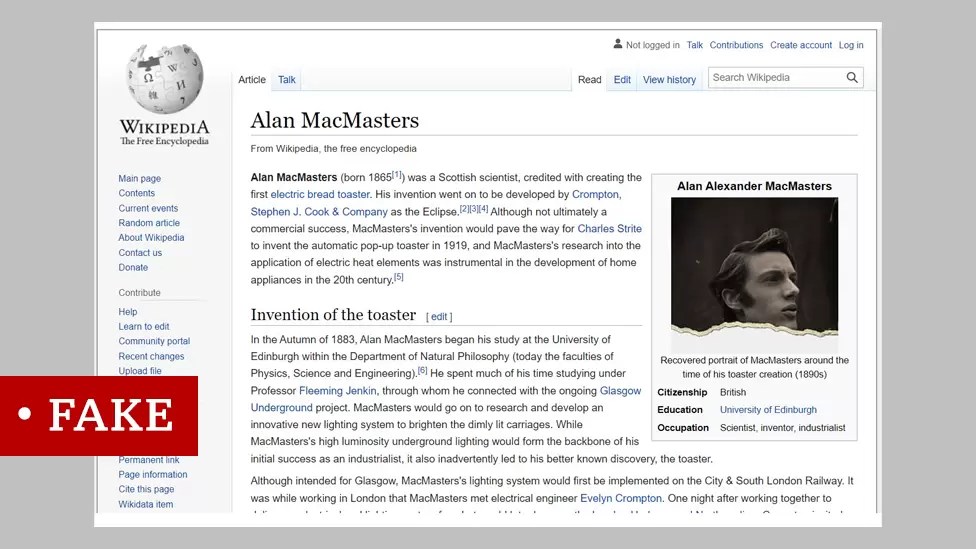
Your correspondent treasures Wikipedia, and uses it often. But as Marco Silva points out, it has its vulnerabilities…
“I read through Wikipedia a lot when I’m bored in class,” says Adam, aged 15, who studies photography and ICT at a school in Kent. One day last July, one of his teachers mentioned the online encyclopaedia’s entry about Alan MacMasters, who it said was a Scottish scientist from the late 1800s and had invented “the first electric bread toaster”.
At the top of the page was a picture of a man with a pronounced quiff and long sideburns, gazing contemplatively into the distance – apparently a relic of the 19th Century, the photograph appeared to have been torn at the bottom.
But Adam was suspicious. “It didn’t look like a normal photo,” he tells me. “It looked like it was edited.”
After he went home, he decided to post about his suspicions on a forum devoted to Wikipedia vandalism.
…
Until recently, if you had searched for “Alan MacMasters” on Wikipedia, you would have found the same article that Adam did. And who would have doubted it?
After all, like most Wikipedia articles, this one was peppered with references: news articles, books and websites that supposedly provided evidence of MacMasters’ life and legacy. As a result, lots of people accepted that MacMasters had been real.
More than a dozen books, published in various languages, named him as the inventor of the toaster. And, until recently, even the Scottish government’s Brand Scotland website listed the electric toaster as an example of the nation’s “innovative and inventive spirit”…
All the while, as the world got to know the supposed Scottish inventor, there was someone in London who could not avoid a smirk as the name “Alan MacMasters” popped up – again and again – on his screen…
For more than a decade, a prankster spun a web of deception about the inventor of the electric toaster: “Alan MacMasters: How the great online toaster hoax was exposed,” from @MarcoLSilva at @BBCNews.
* Mitch Hedberg
###
As we consider the source’s source, we might recall that it was on this date in 1972 that Atari introduced its first product, Pong, which became the world’s first commercially successful video game. Indeed, Pong sparked the beginning of the video game industry, and positioned Atari as its leader (in both arcade and home video gaming) through the early 1980s.

“May all beings have happy minds”*…

But then it’s important to be careful as to how we look for that happiness…
– Games where players either remove pieces from a pile or add pieces to it, with the loser being the one who causes the heap to shake (similar to the modern game pick-up sticks)
– Games of throwing dice
– Ball games
– Guessing a friend’s thoughts
Just a few of the entries in “List of games that Buddha would not play,” from the T. W. Rhys Davids‘ translation of the Brahmajāla Sutta (though the list is duplicated in a number of other early Buddhist texts, including the Vinaya Pitaka).
(TotH to Scott Alexander; image above: source)
* the Buddha
###
As we endeavor for enlightenment, we might recall that it was on this date in 2001 that Wikipedia was born. A free online encyclopedia that is collaboratively edited by volunteers, it has grown to be the world’s largest reference website, attracting 1.7 billion unique-device visitors monthly as of November 2021. As of January 9, 2022, it has more than fifty-eight million articles in more than 300 languages, including 6,436,030 articles in English (serving 42,848,899 active users of English Wikipedia), with 118,074 active contributors in the past month.

“This page contains material that is kept because it is considered humorous. It is not meant to be taken seriously.”*…

A cow with antlers atop a pole. Wikipedia contains other images and articles that are similarly shocking or udderly amoosing.
Of the over six million articles in the English Wikipedia there are some articles that Wikipedians have identified as being somewhat unusual. These articles are verifiable, valuable contributions to the encyclopedia, but are a bit odd, whimsical, or something one would not expect to find in Encyclopædia Britannica. We should take special care to meet the highest standards of an encyclopedia with these articles lest they make Wikipedia appear idiosyncratic. If you wish to add an article to this list, the article in question should preferably meet one or more of these criteria:
- The article is something a reasonable person would not expect to find in a standard encyclopedia.
- The subject is a highly unusual combination of concepts, such as cosmic latte, death from laughter, etc.
- The subject is a clear anomaly—something that defies common sense, common expectations or common knowledge, such as Bir Tawil, Märket, Phineas Gage, Snow in Florida, etc.
- The subject is well-documented for unexpected notoriety or an unplanned cult following at extreme levels, such as Ampelmännchen or All your base are belong to us.
- The subject is a notorious hoax, such as the Sokal affair or Mary Toft.
- The subject might be found amusing, though serious.
- The subject is distinct amongst other similar ones.
- The article is a list or collection of articles or subjects meeting the criteria above.
This definition is not precise or absolute; some articles could still be considered unusual even if they do not fit these guidelines.
To keep the list of interest to readers, each entry on this list should be an article on its own (not merely a section in a less unusual article) and of decent quality, and in large meeting Wikipedia’s manual of style. For unusual contributions that are of greater levity, see Wikipedia:Silly Things.
At once a delineation of the frontiers of canonical (vs. valuable but off-beat) knowledge and a rabbit hole down which it’s eminently amusing to descend: “Wikipedia:Unusual articles”
* Notice atop the Wikipedia page “Wikipedia:Unusual articles”
###
As we forage on the fringe, we might recall that it was on this date in 1975 that then-27-year-old director Steven Spielberg’s adaptation of Peter Benchley’s best-selling novel Jaws premiered. Released “wide” (to 500 theaters at once, as opposed to rolling out in a few theaters first, as was then customary) and backed by a (then substantial) $700,000 marketing campaign, Jaws grossed $7 million in its opening weekend (on its way to over $450 million worldwide). Prior to Spielberg’s triumph, summer had been the studios’ dumping ground for their weaker films; Jaws ushered in the era of the summer blockbuster.

You must be logged in to post a comment.