Posts Tagged ‘Space’
“The sacred moon overhead / Has taken a new phase”*…
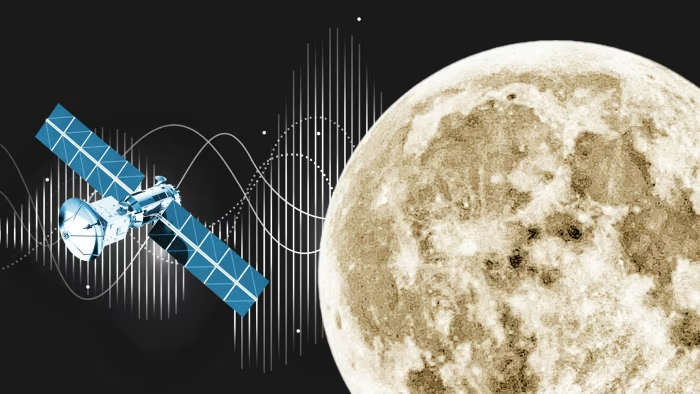
As Oliver Hawkins and Peggy Hollinger report, an analysis of commercial radio spectrum filings shows a growing number of players– government agencies, but increasingly private companies– bettting on the emergence of a lunar economy…
Private companies are staking claims to radio spectrum on the Moon with the aim of exploiting an emerging lunar economy, Financial Times research has found.
More than 50 applications have been filed with the International Telecommunication Union since 2010 to use spectrum, the invisible highway of electromagnetic waves that enable all wireless technology, on or from the Moon.
Last year the number of commercial filings to the global co-ordinating body for lunar spectrum outstripped those from space agencies and governments for the first time, according to FT research. The filings cover satellite systems as well as missions to land on the lunar surface.
“We will look back and see this as an important inflection point,” said Katherine Gizinski, chief executive of spectrum consultancy River Advisers, which has filed for lunar spectrum for three satellite systems on behalf of other companies since 2021.
Although total registrations were lower in 2024 than the previous year, the increased proportion of commercial filings reflects a race to build the infrastructure that will enable the “cislunar economy”, the area between the Earth and Moon…
More on the players and the game: “The race to claim the Moon’s airwaves” (gift article), from @financialtimes.com. See also:
* William Butler Yeats, “The Cat and the Moon”
###
As we linger over the lunar, we might recall that it was on this date in 1971 that NASA accomplished the third lunar EVA: Commander Alan B. Shepard and Lunar Module pilot Edgar D. Mitchell became the fifth and sixth men to walk on the Moon (in the lunar highlands near the crater Fra Mauro) as part of the Apollo 14 mission.
During this four-hour “activity,” they deployed the Apollo Lunar Surface Experiments Package (ALSEP)– scientific experiments that were left on the lunar surface and other scientific and sample collection apparatus. B efore lifting off on the next day, the astronauts went on another moonwalk almost to the rim of nearby Cone crater, collecting 42.9 kg of samples along the traverse. At the end of this 3.45 km walk, Shepard used a contingency sampler with a Wilson 6-iron connected to the end to hit two golf balls.
“The earth is what we all have in common”*…

Explore a catalog of NASA images and animations of our home planet: “Visible Earth,” from @NASAEarth.
* Wendell Berry
###
As we peruse our planet, we might recall that it was on this date in 1965 that NASA turned on planetary science mode on the Mariner IV spacecraft (which had been launched on November 28, 1964 from Cape Canaveral) as it flew by Mars. Over the next two days, Mariner IV captured the first “close up” pictures (21 in all) of the planets surface. The images taken during the flyby were stored in the on-board tape recorder; each individual photograph took approximately six hours to be transmitted back to Earth.
While waiting for the image data to be computer processed, the team used a pastel set from an art supply store to hand-color (paint-by-numbers style) a numerical printout of the raw pixels. The resulting image provided early verification that the camera was functioning. The hand drawn image compared favorably with the processed image when it became available.

“It is better to have your head in the clouds, and know where you are… than to breathe the clearer atmosphere below them, and think that you are in paradise”*…

Take a ride from the earth’s surface to the Kármán line (the conventionally-acknowledged boundary between Earth’s atmosphere and outer space) on Neal Agarwal‘s (@nealagarwal) Space Elevator.
* Henry David Thoreau
###
As we get high, we might recall that this date in 1970 was the first Earth Day. First suggested by John McConnell for March 21 (the Equinox in the Northern Hemisphere, a day of natural equipoise), Secretary General U Thant signed a UN Proclamation to that effect. But Earth Day as we know it was founded by U.S. Senator Gaylord Nelson (who was later awarded the Presidential Medal of Freedom Award for his work) as an environmental teach-in to be held on on this date. The first Earth Day had participants and celebrants in two thousand colleges and universities, roughly ten thousand primary and secondary schools, and hundreds of communities across the United States. Later that year, President Nixon signed the Environmental Protection Agency into being. Earth Day is now observed in 192 countries, coordinated by the nonprofit Earth Day Network, chaired by the first Earth Day 1970 organizer Denis Hayes– according to whom Earth Day is now “the largest secular holiday in the world, celebrated by more than a billion people every year.”

Earth Day Flag created by John McConnell
“Space is to place as eternity is to time”*…

Josh Worth (@misterjworth), with a mesmerizing interactive reminder that space is vast: “If the Moon Were Only 1 Pixel.”
###
As we scrutinize scale, we might recall that it was on this date in 1988 that NASA, undaunted by distance, launched the Space Shuttle Discovery (which had been out of service for three years), marking America’s return to manned space flight following the Challenger disaster. By its last mission in 2011, Discovery had flown 149 million miles in 39 missions, completed 5,830 orbits, and spent 365 days in orbit over 27 years.

“‘Space-time’ – that hideous hybrid whose very hyphen looks phoney”*…

Space and time seem about as basic as anything could be, even after Einstein’s theory of General Relativity threw (in) a curve. But as Steven Strogatz discusses with Sean Carroll, the reconciliation of Einstein’s work with quantum theory is seeming to suggest that space and time might actually be emergent properties of quantum reality, not fundamental parts of it…
… we’re going to be discussing the mysteries of space and time, and gravity, too. What’s so mysterious about them?
Well, it turns out they get really weird when we look at them at their deepest levels, at a super subatomic scale, where the quantum nature of gravity starts to kick in and become crucial. Of course, none of us have any direct experience with space and time and gravity at this unbelievably small scale. Up here, at the scale of everyday life, space and time seem perfectly smooth and continuous. And gravity is very well described by Isaac Newton’s classic theory, a theory that’s been around for over 300 years now.
But then, about 100 years ago, things started to get strange. Albert Einstein taught us that space and time could warp and bend like a piece of fabric. This warping of the space-time continuum is what we experience as gravity. But Einstein’s theory is mainly concerned with the largest scales of nature, the scale of stars, galaxies and the whole universe. It doesn’t really have much to say about space and time at the very smallest scales.
And that’s where the trouble really starts. Down there, nature is governed by quantum mechanics. This amazingly powerful theory has been shown to account for all the forces of nature, except gravity. When physicists try to apply quantum theory to gravity, they find that space and time become almost unrecognizable. They seem to start fluctuating wildly. It’s almost like space and time fall apart. Their smoothness breaks down completely, and that’s totally incompatible with the picture in Einstein’s theory.
s physicists try to make sense of all of this, some of them are coming to the conclusion that space and time may not be as fundamental as we always imagined. They’re starting to seem more like byproducts of something even deeper, something unfamiliar and quantum mechanical. But what could that something be?….
Find out at: “Where Do Space, Time and Gravity Come From?, ” from @stevenstrogatz and @seanmcarroll in @QuantaMagazine.
* Vladimir Nabokov
###
As we fumble with the fundamental, we might send far-sighted birthday greetings to Jocelyn Bell Burnell; she was born on this date in 1943. An astrophysicist, she discovered the first pulsar, while working as a post-doc, in 1957. She then discovered the next three detected pulsars.
The discovery eventually earned the Nobel Prize in Physics in 1974; however, she was not one of the prize’s recipients. The paper announcing the discovery of pulsars had five authors. Bell’s thesis supervisor Antony Hewish was listed first, Bell second. Hewish was awarded the Nobel Prize, along with the astronomer Martin Ryle.
A pulsar— or pulsating radio star– a highly magnetized, rotating neutron star that emits a beam of electromagnetic radiation. The precise periods of pulsars make them very useful tools. Observations of a pulsar in a binary neutron star system were used to confirm (indirectly) the existence of gravitational radiation. The first extrasolar planets were discovered around a pulsar, PSR B1257+12. And certain types of pulsars rival atomic clocks in their accuracy in keeping time.


You must be logged in to post a comment.