Posts Tagged ‘populism’
“Populist victors continue to behave like victims; majorities act like mistreated minorities”…

… and, as Rachel Kleinfeld explains, that doesn’t work out well for their economies…
In the 20th century, economic and political systems could be situated on a simple 2×2 grid. Economic policies ran from left to right, while political systems could be arrayed from authoritarian to democratic.
Most U.S. business pegged themselves easily on this spectrum: they wanted favorable regulation and management-friendly policies of the sort generally pursued by the right. And while a few opened up shop behind the Iron Curtain, CEOs knew business prospered most under classically liberal democratic systems that upheld the rule of law and inalienable rights—including property rights.
The rise of populism in the 21st century has overturned this game board. Today, even supposedly right-wing populists exploit distrust, pessimism, and anger to make the case that government should wield a heavy—and often retaliatory—hand in markets. But while such interference by authoritarian leaders could once be portrayed as undemocratic, modern populists often bask in electoral support. Voters cheer as their elected leaders undermine rights and the rule of law.
Populism, in other words, has shaken the kaleidoscope of 20th century political and economic identities—and acting as if those labels still apply could be catastrophic for market economies. Modern populists from the right use right-wing rhetoric to sell what used to be left-wing economic ideas. And many marry the electoral aspects of democracy with authoritarian tactics to undermine the rights, institutions, and norms that create a stable business environment.
Economic and historical studies show that even supposedly pro-business populism is bad for business; countries that elect one populist tend to elect others, its effects creep well past a single election cycle.
This matters because populists are getting elected at a rate last seen in the 1930s. In 2018, they presided over nearly a third of global GDP, including mega-countries like India. Next year, with 40 countries (accounting for 44% of global GDP) going to the polls, they could control even more. Some come from the left, particularly in Latin America. But as in the turbid 1930s, many populist leaders like Jair Bolsonaro in Brazil, Narendra Modi in India, and Donald Trump in the United States hail from the right—deploying a trio of political strategies that characterize populists regardless of their avowed ideology.
First, populists win elections by deepening existing social divisions. By turning nearly every political question into a fight between a virtuous “us” and a deceitful, dangerous, disloyal “them” they create an intense base that is personally loyal to the leader and not any particular ideology. That base lets populists maintain strong voter support even as they centralize and personalize power, their second go-to tactic. Finally, by redefining democracy as majority rule, they can claim that anything that stands against their desires (as the embodiment of the majority) is anti-democratic. This rhetorical jujitsu lets them undermine checks and balances, once-independent institutions from judiciaries to statistical bodies, and the rule of law itself, depicting them as obstacles to taking radical steps to implement the majority’s wishes.
The dire economic effects of left-wing populism are well-researched. Leaders from Argentina’s Juan Perón to Mexico’s Andrés Manuel López Obrador nationalize businesses, politicize their management, and fill their ranks with supportive political appointees. They shower voters with government money come election time and overheat their economies. The result is often a short-term economic boom followed by a long, inflationary bust…
Using Victor Orbán and Hungary as an example, Kleinfeld demonstrates that right-wing populists are just as disastrous for their countries; the problem is not that the leader comes from the left or the right, it’s that they pursue the populist playbook.
Eminently worth reading in full. Aspiring autocrats keep ruining their countries’ economies: “The Economic Cost of Right-Wing Populism,” from @RachelKleinfeld in @JoinPersuasion.
[Image above from the co-published version of the article]
Apposite: Zeynep Tufekci with a diagnosis of the attractiveness of autocratic leaders: “A Strongman President? These Voters Crave It.” (gift article). Not sure that I buy her sense that Trump has been working a careful and canny strategy from the start (2016); but her focus is on his adherents’ grievances and their response to his charisma and his self-anointed status as “the only one who can save [us]”… a provocative read.
* Jan-Werner Müller, What Is Populism?
###
As we contemplate civics, we might recall that it was on this date in 1870 that pioneering political cartoonist Thomas Nast gave the Democratic Party its mascot:
On January 15, 1870, Nast published the cartoon [see below] that would forever link the donkey to the Democrat. A few ideas should be clear for the cartoon to make sense: First, “republican” and “democrat” meant very different things in the 19th century than they do today (but that’s another article entirely); “jackass” pretty much meant the exact same thing then that it does today; and Nast was a vocal opponent of a group of Northern Democrats known as “Copperheads.”
In his cartoon, the donkey, standing in for the Copperhead press, is kicking a dead lion, representing President Lincoln’s recently deceased press secretary (E.M. Stanton). With this simple but artfully rendered statement, Nast succinctly articulated his belief that the Copperheads, a group opposed the Civil War, were dishonoring the legacy of Lincoln’s administration. The choice of a donkey –that is to say, a jackass [understood at the time to be a play on “Jackson,” as populist Andrew Jackson was an inspiration to the Copperheads]– would be clearly understood as commentary intended to disparage the Democrats. Nast continue to use the donkey as a stand-in for Democratic organizations, and the popularity of his cartoons through 1880s ensured that the party remained inextricably tied to jackasses…
“Political Animals: Republican Elephants and Democratic Donkeys”- Smithsonian

“What people these days call ‘Vibes’ is a smell, a taste of the soul”*…

Up? Down? Better? Worse? What’s actually going on in our economy? Noah Smith on the asymmetric warfare going on around that question…
As we gear up for election season, a big debate is whether the U.S. economy is doing well or not. Biden supporters point to extremely low unemployment, falling inflation, and real wages that have started rising again. Biden opponents — including both conservatives and socialists — contend that the inflation of 2021-22 left such a severe scar on Americans’ pocketbooks that low consumer confidence is perfectly justified. Biden supporters counter that since inflation has come down — and was never as severe as in the 1970s — the anger over the economy is just “vibes”.
Basically, the Biden supporters are right; the U.S. economy is truly excellent right now. Inflation looks beat, everyone has a job, incomes and wealth are rising, and so on. But on the other hand, I can’t command people to simply stop being mad about the inflation that reduced their purchasing power back in 2021-22. People care about what they care about.
At the same time, though, I think it’s possible for negative narratives about the economy to take hold among the general populace and distort people’s understanding of what’s actually going on. For example, John Burn-Murdoch of the Financial Times recently found [gift article] that consumer sentiment closely tracks real economic indicators in other countries, but has diverged in America since 2020:

Now this could be because Americans simply care about different things than Europeans; we might simply have started to really really hate interest rates since 2021, while Europeans didn’t. But a simpler explanation is that Americans’ negative sentiment is due to something other than economic indicators. And it’s possible that that “something” is a negative narrative — i.e., vibes…
“Vibes vs. data”
Indeed, as Burn-Murdoch observes in his analysis…
… It seems US consumer sentiment is becoming the latest victim of expressive responding, where people give incorrect answers to questions to signal wider tribal political or social affiliations. My advice: if you want to know what Americans really think of economic conditions, look at their spending patterns. Unlike cautious Europeans, US consumers are back on the pre-pandemic trendline and buying more stuff than ever…
“Should we believe Americans when they say the economy is bad?” (gift article)
But why? Jonathan Kirshner‘s review of Martin Wolf‘s important book The Crisis of Democratic Capitalism, suggest an unsettling answer…
The Crisis of Democratic Capitalism is an essential read for its articulation of the perilous crossroads at which the future of enlightened liberal civilization now stands. Wolf argues persuasively that, for all their visible flaws and imperfections, competitive market capitalism and liberal democracy are the best bad systems available for organizing human societies. And each requires the other to thrive—“[b]ut this marriage between those complementary opposites […] is always fragile.” Capitalism has been allowed to run amok, and it has elicited a backlash that threatens democracy…
Wolf’s central argument is that capitalism and democracy are inherently interdependent, yet also often in tension with one another—and managing the balance of that indispensable relationship is akin to walking a tightrope. In traditional autocracies, the economy has been captured by those that control the state, and that control is the basis of their power (which is why they are so reluctant to let go of the reins of authority). Liberal democracies today face the inverse problem: the capture of the state by those that control the economy. This is plutocracy, and aside from the injustice it visits on societies, it is also profoundly dangerous, because in democratic plutocracies (like the United States today), the simmering frustrations of mass polities will at some point lead to the voluntary election of an autocrat: “[I]nsecurity and fear are gateways to tyranny.” Decades of stagnant incomes, rising inequality, and the erosion of high-quality jobs for the middle class and the less-educated have allowed the relationship between capitalism and democracy to become dangerously unbalanced. The Crisis of Democratic Capitalism argues that the fault lies with the failure of public policy to tame the excesses of capitalism; it warns that those excesses will unleash the forces that destroy democracy.
Economic inequality, on the rise for 50 years, has soared to ever greater extremes in recent decades. As Wolf reports, from 1993 to 2015, the real income of the top 1 percent of the population in the United States nearly doubled; for everybody else, over those same years, aggregate real income grew by 14 percent. More pointedly, as the very rich got much, much richer from 2005 to 2014, 81 percent of US households had flat or falling real income—a weighty reminder that we continue to live in a world defined by the Global Financial Crisis and its aftermath…
… the financialization of the economy, especially after the 1990s, and the fortunes amassed from that process, were part and parcel of a larger shift towards “rigged capitalism”—the emergence of which The Crisis of Democratic Capitalism places at the heart of the matter. In a remarkable (and laudable) intellectual evolution, Wolf, who welcomed and celebrated the Thatcher revolution in Britain, and not so long ago penned the book Why Globalization Works (2004), now attributes the crisis of our time to “what Adam Smith warned us against—the tendency of the powerful to rig the economic and political systems against the rest of society.” Superseding a well-ordered market society, rigged capitalism—a toxic brew of developments and practices including financialization, winner-take-all markets, reduced competition, increased rent-seeking behavior (the use of concentrated economic power to extract monopoly profits), tax avoidance and evasion, and the erosion of ethical standards—has led to a widespread loss of confidence in the legitimacy of democracy…
These pathologies run deep, and well below the headlines. The use of political power to undermine competition—which must thrive at the heart of any capitalist society—is an endemic attribute of rigged capitalism. (And it is why we pay higher prices for most things than a “free market” would levy.) Many if not most giant corporations are now monopolies or near-monopolies, a situation that, as any card-carrying professional economist of even the most conservative stripe would agree, generates inefficiencies, rent-seeking behavior, and outright exploitation. Many markets have become shielded, protections reinforced by access to the corridors of power, with wealth extracted from consumers (and workers) in consequence: consider the atrocity of unskilled workers in fast food restaurants being forced to sign “non-compete” clauses, an act of collusive wage suppression.
Rigged capitalism—which yields massive concentrations of wealth for a sliver of largely-above-the-law plutocrats, combined with stagnation and declining opportunities for the majority—leads to a basic political problem: “How, after all, does a political party dedicated to the material interests of the top 0.1 percent of the income distribution win and hold power in a universal suffrage democracy? The answer is pluto-populism.” This is where race, identity politics, and the culture wars come into play. The century-long political hammerlock held by the Democratic Party on the Old South was based on voter suppression and other devices that guaranteed, for working-class whites, greater economic opportunity, access to the legal system, and higher social status than Blacks, in exchange for their political support. Bob Dylan, at 22 years old, saw through this in his song “Only a Pawn in Their Game” (1964)—and nearly 60 years later, that game hasn’t changed much…
rigged capitalism will nevertheless unleash forces not easily contained—and render liberal democracy unsustainable. As political scientist Rawi Abdelal has argued, “the social fact of unfairness is more important than the material fact of income and wealth distribution.” Endemic corruption, arbitrariness of justice, and fear for future prospects are poisonous to the body politic, undermining shared perceptions of the legitimacy of democratic society. In such settings, past and present, fear, despair, and frustration create the space for charismatic personalist authoritarians peddling promises of deliverance but who, once in power, consolidate their hold on the state by undermining the institutional constraints on their authority. And so, democracy dies from within.
What is bewildering about the American case is not that it has witnessed the rise of a leader who, as Wolf describes, “not only had no idea what a liberal democracy was but despised the idea,” and who was “instinctively authoritarian”—this, after all, is what pluto-populism conjures. What remains bizarre, however, is that, of all the possible choices, a hedonistic, ethically suspect, narcissistic grifter—who for decades was a signature beneficiary of rigged capitalism—would emerge as the people’s choice. Yet Donald Trump, like the gargantuan Stay-Puft Marshmallow Man from Ghostbusters, has been summoned by a collective subconscious rage to act as a malevolent score-settling agent of destruction…
“Rigged Capitalism and the Rise of Pluto-populism: On Martin Wolf’s ‘The Crisis of Democratic Capitalism’”
All three articles– and Wolf’s book– are eminently worth reading in full.
###
As we ponder populism, we might recall that it was on this date in 1865 that the 27th state (Georgia) ratified the 13th Amendment to the U.S. Constitution, abolishing slavery and involuntary servitude (except as punishment for a crime). Proclaimed on December 18, it was the first of the three Reconstruction Amendments adopted following the American Civil War.
The Emancipation Proclamation (made in September 1862; effective January 1, 1863) had freed all current slaves in the U.S. (though as a practical matter freedom took years longer). The Thirteenth Amendment assured that it would never be reinstated.


“The real war will never get in the books”*…

Still, historians try. And as Anton Jäger argues in his consideration of Charles S. Maier‘s The Project-State and Its Rivals- A New History of the Twentieth and Twenty-First Centuries, that’s a challenging, frustrating, but ultimately very useful thing…
“We thought we knew the story of the twentieth century,” Charles Maier notes in an announcement for his new book The Project State and Its Rivals. Both haunting and tantalizing, the sentence’s past tense speaks to a profoundly contemporary mood. As the twenty-first century progresses, confident visions about the previous century conceived from the vantage point of the 1990s—the “age of extremes” resolved by a set of liberal settlements—no longer seem safe and secure. In 2023, the European extreme Right is establishing itself as a force of government, populism is going global, and inter-imperial tensions have ushered in a new arms race. In Germany, the Alternative für Deutschland is currently polling above 20 percent, while Modi is set to win another term in India with an approval rating near 80 percent. To the desperation of liberals nostalgic for the 1990s, the “end of the end of history” has arrived.
As Maier surmises, there might be a connection between this sense of surprise and the comfortable judgments we tend to make about humanity’s last hundred years. “If the twentieth century meant the triumph of liberalism,” he asks, “why have the era’s darker impulses—ethnic nationalism, racist violence, and populist authoritarianism—revived?” The question provides the working hypothesis for Maier’s new monograph, a self-described “rethinking of the long twentieth century,” which aims to “explain the fraying of our own civic culture” while also “allowing hope for its recovery.” Provocatively, Maier’s focus is on “both democracies and dictatorships that sought not just to retain power but to transform their societies,” next to “new forms of imperial domination,” “global networks of finance,” and “international associations” that both challenged and shaped the state. The ambition is nothing less than a new general theory of the twentieth century, one that would allow us to deal with an unmastered past, but also to gain proper self-understanding in a new and confusing century.
Readers would be hard-pressed to find a more suitable candidate for the task than Charles S. Maier. At eighty-four, Maier—still teaching European and international history at Harvard—remains a scholar with panoramic disciplinary reach. His 1975 debut, Recasting Bourgeois Europe: Stabilization in France, Germany, and Italy in the Decade after World War I, swiftly established itself a masterpiece of comparative political history. Based on a prior Harvard dissertation complemented with a decade of additional archival research, it examined the fraught resolution of the crises of liberalism after 1918, and what factors determined the potential emergence and stymieing of authoritarian regimes. After works on Germany’s collective memory of the Holocaust and an elite-driven account of the fall of East Germany, he waded into historical political science with Leviathan 2.0: Inventing Modern Statehood in 2014, followed by Once within Borders: Territories of Power, Wealth, and Belonging since 1500 in 2016. Clearly a product of a buoyant Cold War academe, Maier has always been locked in an uneasy pas-à-deux with Marxism: attentive to the class content of political life, but never taken to monolithic views of business interests and overly abstract notions of capital. His work on political economy looked closely at the class coalitions that gave way to divergent corporatist settlements in the 1920s and ’30s, and how these national blocs interlocked with differing international arrangements—a Marxist historiography despite itself. He also took the force of ideas seriously, weaving a tapestry of conceptual, political, and economic history, which explains the unique force of his writing. Yet unlike cultural historians, Maier has retained an interest in causality through the construction of comparative counterfactuals—what Britain and Germany shared in 1918, for instance, or why English Tories did not need a Duce and why the American South was different from the Mezzogiorno—a sensibility that also informed his consistently transnational approach to the twentieth century.
The Project State and Its Rivals exudes a similarly boundless ambition. As the book’s announcements make clear, Maier is on the lookout for a unifying category to cohere our historical experience of the twentieth century—or, more specifically, the forms of statehood that emerged in the interwar period, and that still present such vexing challenges to our intellectual imagination…
A critical account of Maier’s hypothesis, eminently worth reading in full: “The Rise and Fall of the Project State: Rethinking the Twentieth Century,” from @AntonJaegermm in @AmericanAffrs. Via Adam Tooze/@adam_tooze.
* Walt Whitman
###
As we keep searching, we might pause to contrast the rigorously serious with the frivolously venal: it was on this date in 1835 that the New York Sun began a series of six articles detailing the discovery of civilized life on the moon; circulation soared. Now known as “The Great Moon Hoax,” the articles attributed the “discovery” to Sir John Herschel, the greatest living astronomer of the day. Herschel was initially amused, wryly noting that his own real observations could never be as exciting. But ultimately he tired of having to answer questioners who believed the story. The series was not discovered to be a hoax for several weeks after its publication and, even then, while the paper did admit (on September 16, 1835) that the whole thing was a “satire,” it never issued a retraction (and didn’t suffer a drop in sales).

“One who deceives will always find those who allow themselves to be deceived”*…

Even if 2020 [and indeed, the events of January 6, 2021] felt apocalyptic, it is reasonable to think we have not yet hit rock bottom. The threat of climate disaster and resource wars, the building of walls and refugee camps, the exorbitant wealth of powerful oligarchs alongside poverty and precarity—these will not go away with vaccines or new presidents. Amidst all this, no wonder Niccolò Machiavelli has returned to our reading lists. In his new biography of the Florentine Secretary, Machiavelli: The Art of Teaching the People What to Fear, originally published in French in 2017, historian Patrick Boucheron reminds us that there is always interest in Machiavelli in turbulent times “because he’s the man to philosophize in heavy weather. If we’re reading him today, it means we should be worried. He’s back: wake up.”
Born in 1469 in Florence, Machiavelli is a central figure in the Western canon of political philosophy. Though he is best known in the popular imagination as the conniving mastermind behind The Prince (written in 1513), which so many think of as a kind of House of Cards how-to guide for seizing and maintaining political power, we miss what is crucial when we reduce his political thought to the simplistic thesis that the ends justify the means. It is not this misunderstood consequentialism that is noteworthy in Machiavelli’s philosophy; what really makes his writing so radically distinctive is his class-based, materialist outlook. He came from an impoverished household, and his philosophy disrupted naturalized hierarchies and the hegemonic ideas that reproduce them. John Adams would rightly describe him as the founder of a “plebeian philosophy” that marshaled strong arguments for embracing popular control over government…
The introduction to the English edition of The Art of Teaching the People What to Fear, written in June 2019 for readers in the United States, begins with the theme of fear in politics and an issue of Time magazine with Trump on the cover. Boucheron argues that the United States had entered a “Machiavellian moment”—“the dawning realization of the inadequacy of the republican ideal”—in the aftermath of the 9/11 terrorist attacks and that today, under “Trumpian America,” a fusion of politics and fiction has allowed for techniques of domination to be perfected, setting “a general disregard for the ‘actual truth of the matter.’” Referencing George Orwell’s 1984, Boucheron sees the United States as captured by a propaganda machine that has undermined reality and common sense—“that sixth sense Machiavelli spoke of, the accessory knowledge that the people have of what is dominating them.” Given the pervasive lack of realism in U.S. politics today, it is clear that the republic would appear to Machiavelli as a corrupt order, not because the powerful few break the rules or because a faction attempts to undermine the integrity of elections, but because the people have been “either deceived or forced into decreeing their own ruin.” Perhaps the most important part of Machiavelli’s wisdom for our own time is that republics tend to become oligarchic, giving the powerful few indirect control over government…
Much maligned as a mere tactician of power, Machiavelli was in fact a philosopher of the people. His critique of oligarchic domination remains essential today: “Our Machiavellian Moment.”
* Niccolò Machiavelli
###
As we ponder populism, we might recall that it was on this date in 1776 that Thomas Paine first published (albeit anonymously) his pamphlet “Common Sense.” A scathing attack on “tyrant” King George III’s reign over the colonies and a call for complete independence, “Common Sense” advocated immediate action. America, Paine argued, had a moral obligation to reject monarchy and declare independence. An instant bestseller in both the colonies and Britain (over 120,000 copies in just a few months), it greatly affected public sentiment at a time when the question of independence was still undecided, and helped shape the deliberations of the Continental Congress leading up to the Declaration of Independence.

“We all know that an angry electorate is a voting electorate”*…

Further to yesterday’s post…
The final vote tallies still aren’t known, but the media verdict of this presidential election is in: it’s 2016 all over again. Four years ago, in the hours after Donald Trump declared victory on the strength of 306 Electoral College votes and the ballots of nearly sixty-three million Americans, I wrote a column about the failures of the press throughout that campaign, and declared that “journalism’s moment of reckoning” had arrived. “Reporters’ eagerness first to ridicule Trump and his supporters, then to dismiss them, and finally to actively lobby and argue for their defeat have led us to a moment when the entire journalistic enterprise needs to be rethought and rebuilt,” I wrote then.
It is astonishing, today, how little we seem to have learned since. Once again, opinion polls were overhyped and under-scrutinized. Some of them were also wildly off—and, though that’s different from 2016, when the polls were largely accurate but widely misunderstood, it doesn’t let media organizations off the hook for their treatment of the numbers. Newsrooms leaned too heavily on polls as a substitute for on-the-ground reporting, and they were led astray. Journalists spent too much time talking to each other on Twitter, inhabiting an alternate algorithmic reality that bore little resemblance to the life of the country. And major media institutions made it all but impossible to envision that, despite the wealth of reporting on the president’s lies and his racism and his circus—nearly half the country remains beholden to the man and his beliefs. “We can’t go back to assuming, just because we think Donald Trump is an outlier, that he is not connecting to a lot of American people in ways that, frankly, a lot of us cannot understand,” Claire McCaskill, a former Missouri senator, said Wednesday morning on MSNBC. The feeling of déjà vu, and of lost journalistic opportunity, is inescapable…
Kyle Pope (@kylepope), editor of the Columbia Journalism Review on lessons unlearned: “What the polls show, and the press missed, again.”
On the problem(s) with polls, pair with “Of course Trump’s voters lie to pollsters. You call us all racists” (with an eye to the phenomenon it addresses– and the questions raised by the rationale it offers…)
For one (very compelling) account of why Pope’s project matters, see Fintan O’Toole’s “Democracy’s Afterlife.” (For more, see also Ron Brownstein, Roxane Gay, and George Packer on the same family of issues… there are lots of diagnoses abroad in the infosphere at the moment; these are among the best your correspondent has found.)
And for a resonant but different take on the necessary role of “honest journalism” going forward, see also Jay Rosen’s “America’s Press and the Asymmetric War for Truth.”
###
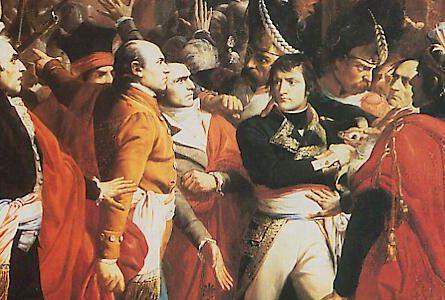
As we look more deeply, we might recall that it was on this date (18 Brumaire in the French Republican Calendar) in 1799 that thirty-year-old Corsican General Napoleon Bonaparte overthrew the Directory in France and established the Consulate, ending the power of the revolutionary oligarchy and creating himself as First Consul… or dictator.
You must be logged in to post a comment.