Apposite to yesterday’s post, a provocative piece by Ben Ansell, who is reacting to a [terrific] piece by Henry Farrell in which Farrell, as he contemplates Trump’s moves, unpacks the “coordination” problems facing– and, Farrell suggests, often limiting– autocratic rulers…
… But you will notice an assumption I and Henry have been making – that Trump is like any other authoritarian leader. I suspect that in lots of ways Trump does wish to behave like one – certainly the treatment of Kilmar Abrego Garcia and his current refusal to follow court judgments meets that mark.
But Trump is attempting this in an otherwise democratic system and I think there is a risk that we overstate the degree to which that system has already deteriorated by assuming that the language and logic that we use to describe authoritarianism fits his case. Part of the risk is we give up on democracy while it’s still here. But the other danger is that we think Trump behaves like a rational authoritarian leader, a la Svolik, when it’s all just bluntly a lot dumber than that…
… In an earlier post I referred to Donald Trump as a ‘chaotic authoritarian’. I don’t think it’s implausible that a democracy could have such a figure as a leader, though I do think it’s unlikely that it would remain democratic indefinitely under such leadership.
But in the absence of already having subverted elections, stymied courts, shut down the media, banned opponents and the other types of effective institutional backsliding that are the tell-tale signs of a democracy dying, I think we might do better to think about how such a figure operates in, what for now, is a democracy.
The temptation when talking about dictators is to reach for Thomas Hobbes. We depict them as the Leviathan – imposing order on the body politic to prevent chaos but also any rivals. Hobbes’ vision was after all a painstaking justification for monarchical absolutism.
If you are not familiar with Leviathan, well do read it, it’s a banger. But the very basic gist is a theory of government built from the ground up. Hobbes even starts with a slightly rococo account of how we process sensations. But his core mechanism is to imagine a world without government – his famous state of nature – in which every individual was essentially on their own. A self-help system if you will, but not the kind in the woo-woo psychology section of the bookstore – the kind where if you don’t look after number one, you’ll get an axe in the back of the head.
The Hobbesian state of nature is anarchy and life in it is – say it with me – ‘solitary, poor, nasty, brutish and short’. And so anyone living in this state would seek to escape this ceaseless terror and have some entity that could guarantee security. Hobbes is a social contract theorist, and the contract upon which we could all be presumed to agree is a third party that can ruthlessly crush insecurity. An absolute sovereign power that would protect its subjects…
… The Hobbesian vision of the state is draconian of course and in… err… pretty sharp contrast with the social contract theories of John Locke or Jean Jacques Rousseau. But one way it has come down to us is in how we think about authoritanism. As about order and control, crushing dissent mercilessly, but also preventing anarchy, rebellion, and so forth. It is governing with an iron fist. Rational authoritarianism if you will.
Whatever Trump is trying to achieve, it’s not hitting this mark. Instead of authoritarianism containing chaos, it is chaos personified. Instead of quelling the anarchic state of nature, it is spreading anarchy and confusion. Hobbes’ frontispiece Leviathan is a steady ruler, holding sword and staff, made up out of their ordered subjects [In contrast to the disintegrating beast in the illustation above]…
… Hence, it’s not clear to me that the standard tools we use to think about authoritarianism accordingly make that much sense with Trump. Is he really thinking about how to coordinate among the elites to keep his support base? Because he’s not doing a brilliant job here having already lost the support of the Wall Street journal editorial board, a litany of very conservative judges, and increasingly corporate elites…
… what I find most interesting about Trump’s anti-Leviathan is that his rule is creating anarchy everywhere else too. And that means not only are his promises not credible but nor are his threats…
[Ansell reviews Trumps’ attack on universities, his approach to tariffs, and trade policy, his “crackdown” on immigration, and his foreign policy (or lack thereof)…]
… We will spend a lot of time over the next few years trying to figure out if Trump’s America remains a democracy. Already the main indices we use are starting to downgrade the USA. I struggle as to whether that coding is premature or not – we will of course know much more by the midterms about the stability and freedom of elections, though by then it could be too late.
It is very clear that Trump wishes to act as an authoritarian. But it is not yet obvious to me that analysing him using the logic of dictatorship makes sense. Because he lacks the control, the ruthlessness, and the rationality of normal authoritarian leaders. As Henry says in his post, ‘absolute power can be a terrible weakness.’ True. However, for many – perhaps most – dictators, absolute power is a terrible (in the original sense of that word) strength. Think to the horrors of the twentieth century.
That, however, is not Donald Trump. He may be the master of chaos. But he is not the Leviathan…
* “Power doesn’t always corrupt. Power always reveals. When you have enough power to do what you always wanted to do, then you see what the guy always wanted to do.” – Robert Caro (riffing on Lord Acton: “Power tends to corrupt and absolute power corrupts absolutely”) Or as David Brin put it: “it is said that power corrupts, but actually it’s more true that power attracts the corruptible.”
###
As we rein in reigns, we might recall that it was on this date in 1945 that Hermann Göring, head of the Luftwaffe and Adolf Hitler’s designated successor as leader of Nazi Germany, wired the Führer asking permission to assume leadership of the crumbling regime. The telegram caused an infuriated Hitler to strip Göring of power and to appoint new successors, Joseph Goebbels and Karl Dönitz, as chancellor and head of state, respectively.
Around half the world’s population live in places that held elections in 2024. Some 1.65bn ballots were cast across more than 70 countries. But while the number of democratic elections in a single year has never been higher, 2024 also brought big challenges. According to the latest democracy index published by EIU, our sister company, on February 27th, global democracy is in worse shape than at any point in the nearly two-decade history of the index.
Since 2006 EIU has scored 167 countries and territories on a scale of zero to ten based on five criteria: electoral process and pluralism, functioning of government, political participation, political culture, and civil liberties. The countries are then grouped into four categories: full democracies, flawed democracies, hybrid regimes and authoritarian regimes.
For the 16th consecutive year, Norway was named the most democratic country in the world, with a score of 9.81. New Zealand and Sweden followed. Afghanistan has been the lowest-ranked country since 2021, scoring just 0.25 points. The biggest change came from Bangladesh, which dropped 25 places. Rebuilding democracy there will be an enormous task after the ouster of Sheikh Hasina, the country’s longtime autocratic ruler. But there is cause for optimism. A temporary technocratic government, led by Muhammad Yunus, a Nobel peace prizewinner, has restored order and stabilised the economy. For those reasons, we named Bangladesh our country of the year in 2024.
The global average dropped to a new record low of 5.17, down from a high of 5.55 in 2015. Just 6.6% of the world’s population now lives in a full democracy, down from 12.5% ten years ago. And a large share of the world’s population—currently two in five people—lives under authoritarian rule.
Despite the promise of a global election extravaganza, some of the ballots were a farce. Polling day in Pakistan, for example, was marred by violence. The most popular politician, Imran Khan, whose own democratic credentials are questionable, was jailed shortly before the election took place. The country’s score dropped from 3.25 in 2023 to 2.84. In Russia another sham election gave Vladimir Putin a fifth term as president—it scored just two points on the index. In other countries—including Burkina Faso, Mali and Qatar—elections were cancelled altogether.
Even Europe—home to nine of the top ten countries in the index—saw some notable declines. France was downgraded from a full democracy to a flawed one. This mostly reflects a deterioration in its confidence-in-government score after president Emmanuel Macron’s snap election in June failed to secure a legislative majority for any single party or bloc. (Four different prime ministers during the course of the year did little to instil confidence either.) Romania was also downgraded after allegations of Russian interference, illegal social-media tactics and campaign-finance violations prompted the constitutional court to annul the presidential election and call for a new vote. In Asia, South Korea dropped out of the full-democracy category after President Yoon Suk Yeol declared—then hastily revoked—martial law, plunging the country into crisis.
America remained a flawed democracy, shifting only slightly from its position in 2023. But it could face bigger problems this year: the first month of President Donald Trump’s second term has already challenged the political independence of the civil service and seen a flurry of executive orders of questionable legal authority.
Mr Trump’s victory in 2024 was part of a broader global backlash against incumbents. The next test for global democracy in 2025 will be how these newly elected leaders choose to govern…
* John Adams, whose own handiwork as a Founding Father has been nicked, but so far evaded the fate he predicted (in an 1814 letter to John Taylor)
###
As we batten the hatches, we might recall that it was on this date in 1933 that RKO‘s King Kong premeired. Directed and produced by Merian C. Cooper and Ernest B. Schoedsack, with special effects by Willis H. O’Brien and music by Max Steiner, it received rave reviews, with praise for its stop-motion animation and score… and has only grown in esteem: in 1991, it was deemed “culturally, historically and aesthetically significant” by the Library of Congress and selected for preservation in the National Film Registry. In 2010 it was ranked by Rotten Tomatoes as the greatest horror film of all time and the fifty-sixth greatest film of all time.
Trevor Jackson on Martin Wolf‘s new book, The Crisis in Democratic Capitalism, and a fundamental question it raises: if globalization has allowed elites to remove themselves from democratic accountability and regulation, is there any path toward a just economy?…
Something has gone terribly wrong. In his 2004 book Why Globalization Works, the economics journalist Martin Wolf wrote that “liberal democracy is the only political and economic system capable of generating sustained prosperity and political stability.” He was articulating the elite consensus of the time, a belief that liberal democratic capitalism was not only a coherent form of social organization but in fact the best one, as demonstrated by the West’s victory in the cold war. He went on to argue that critics who “complain that markets encourage immorality and have socially immoral consequences, not least gross inequality,” were “largely mistaken,” and he concluded that a market economy was the only means for “giving individual human beings the opportunity to seek what they desire in life.”
Wolf wrote those words midway through a four-decade global expansion of markets. Throughout the 1980s in Britain, the United States, and France, governments led by Margaret Thatcher, Ronald Reagan, and François Mitterrand set about privatizing public assets and services, cutting welfare state provisions, and deregulating markets. At the same time, a set of ten policies known as the “Washington Consensus” (because they were shared by the International Monetary Fund, the World Bank, and the US Treasury) brought privatization, liberalization, and globalization to Latin America following a series of sovereign debt crises. In the 1990s a similar set of policies, then known as “shock therapy,” suddenly converted the formerly Communist economies of Eastern Europe and the Soviet Union to free markets. Around the Global South, and especially in the rapidly industrializing countries of East Asia after the 1997 financial crisis, “structural adjustment” policies that were conditions for IMF bailouts again brought liberalization, privatization, and fiscal discipline. The same policies were enforced on the European periphery after 2009, in Portugal, Ireland, Italy, Greece, and Spain, again, either as conditions for bailouts or through EU fiscal restrictions and restrictive European Central Bank policy. Today there are far more markets in far more aspects of human life than ever before.
But the sustained prosperity and political stability that these policies were meant to create have proved elusive. The global economy since the 1980s has been riven by repeated financial crises. Latin America endured a “lost decade” of economic growth. The 1990s in Russia were worse than the Great Depression had been in Germany and the United States. The austerity and high-interest-rate policies after the 1997 East Asia crisis restored financial stability but at the cost of domestic recessions, and contributed to political instability and the repudiation of incumbent parties in Indonesia, the Philippines, and South Korea, as they did again across Europe after 2009–2010. Global economic growth rates in the era of globalization have been about half what they were in the less globalized postwar decades. Around the world, violent racist demagogues keep winning elections, and although they all seem very happy with the idea of private property, they are openly hostile to the rule of law, political liberalism, individual freedom, and other ostensible preconditions and cultural accompaniments to market economies. Both democracy and globalization seem to be in retreat in practice as well as in ideological popularity. Or, as Wolf writes in his new book, The Crisis of Democratic Capitalism:
Our economy has destabilized our politics and vice versa. We are no longer able to combine the operations of the market economy with stable liberal democracy. A big part of the reason for this is that the economy is not delivering the security and widely shared prosperity expected by large parts of our societies. One symptom of this disappointment is a widespread loss of confidence in elites.
What happened?
Martin Wolf is probably the most influential economics commentator in the English-speaking world. He has been chief editorial writer for the Financial Times since 1987 and their lead economics analyst since 1996. Before that he trained in economics at Oxford and worked at the World Bank starting in 1971, including three years as senior economist and a year spent working on the first World Development Report in 1978. This is his fifth book since moving to the Financial Times. The blurbs and acknowledgments are stuffed with central bankers, financiers, Nobel laureates, and celebrity academics. The bibliography contains ninety-six references to the author himself.
Wolf’s diagnosis is impossible to dispute: “Neither politics nor the economy will function without a substantial degree of honesty, trustworthiness, self-restraint, truthfulness, and loyalty to shared political, legal, and other institutions.” But, he observes, those values have run into crisis all over the world, and, especially since about 2008,
…people feel even more than before that the country is not being governed for them, but for a narrow segment of well-connected insiders who reap most of the gains and, when things go wrong, are not just shielded from loss but impose massive costs on everybody else…
He describes in detail the mistaken policies of austerity in the US and Europe, the rise of a wasteful and extractive financial sector, the atomization and immiseration of formerly unionized workers, the pervasiveness of tax avoidance and evasion, and the general accumulation of decades of elite failure…
And for an interview with Jackson that elaborates on his thoughts and their historical context, see here.
* Warren Buffett
###
As we assess systems, we might send provocative birthday grretings to Founding Father Thomas Paine; he was born on this date in 1736 (O.S.; on February 9, 1737 per N.S., which accrued in Britain and its colonies in 1752). He is best known for Common Sense and The American Crisis, two influential pamphlets that helped to inspire colonial era American patriots in 1776 to declare independence from Great Britain.
But relevantly to the article above, in 1797 (after witnessing the birth and early years of the U.S. and spending time in France) he wrote Agrarian Justice, in which he proposed remedies for several of the (then nascent) ills discussed by Wolf and Jackson…
In response to the private sale of royal (or common) lands, Paine proposed a detailed plan to tax land owners [the “capitalists” of their day] once per generation to pay for the needs of those who have no land. Some consider this a precursor to the modern idea of citizen’s dividend or basic income. The money would be raised by taxing all direct inheritances at 10%, and “indirect” inheritances, those not going to close relations, at a somewhat higher rate. He estimated that to raise around £5,700,000 per year.
Around two-thirds of the fund would be spent on pension payments of £10 per year to every person over the age of 50, which Paine had taken as his average adult life expectancy.
Most of the remainder would be used to make fixed payments of £15 to every man and woman on reaching the age of 21, then the age of legal majority.
The small remainder of the money raised that was still unused would be used for paying pensions to “the lame and blind.”
For context, the average weekly wage of an agricultural labourer was around 9 shillings, which would mean an annual income of about £23 for an able-bodied man working throughout the year.
Paine’s proposal presaged the social safety net of later eras and governments, proposing seven entitlements to protect the poorest citizens from the ravages of market capitalism:
Grants to subsidize schooling of 4 pounds per annum
One-time payments to adults on reaching maturity
One-time payments to newly married couples and new parents
Eliminate taxes on working poor
Back-to-work schemes
Pensions for seniors
Burial benefits to surviving spouses
and also provided a scheme of how to pay for them.
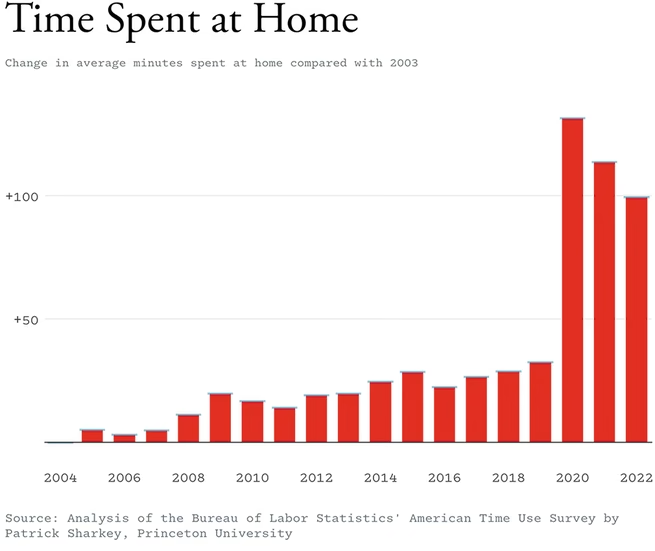
Americans are now spending more time alone– mostly at home– than ever. It’s changing our personalities, our politics, and even our relationship to reality. While the pandemic certainly enforced some of that isolation; the post-COVID world remains extraordinarily atomized.
In a bracing essay, Derek Thompson, explores the emergence of this wide-spread isolation, unpacking its drivers, enumerating its considerable (personal and civic) costs, musing on the possible impact of AI, and pondering what might lead to a return to sociability…
… “I have a view that is uncommon among social scientists, which is that moral revolutions are real and they change our culture,” Robert Putnam [author of Bowling Alone] told me. In the early 20th century, a group of liberal Christians, including the pastor Walter Rauschenbusch, urged other Christians to expand their faith from a narrow concern for personal salvation to a public concern for justice. Their movement, which became known as the Social Gospel, was instrumental in passing major political reforms, such as the abolition of child labor. It also encouraged a more communitarian approach to American life, which manifested in an array of entirely secular congregations that met in union halls and community centers and dining rooms. All of this came out of a particular alchemy of writing and thinking and organizing. No one can say precisely how to change a nation’s moral-emotional atmosphere, but what’s certain is that atmospheres do change. Our smallest actions create norms. Our norms create values. Our values drive behavior. And our behaviors cascade.
The anti-social century is the result of one such cascade, of chosen solitude, accelerated by digital-world progress and physical-world regress. But if one cascade brought us into an anti-social century, another can bring about a social century. New norms are possible; they’re being created all the time. Independent bookstores are booming—the American Booksellers Association has reported more than 50 percent growth since 2009—and in cities such as New York City and Washington, D.C., many of them have become miniature theaters, with regular standing-room-only crowds gathered for author readings. More districts and states are banning smartphones in schools, a national experiment that could, optimistically, improve children’s focus and their physical-world relationships. In the past few years, board-game cafés have flowered across the country, and their business is expected to nearly double by 2030. These cafés buck an 80-year trend. Instead of turning a previously social form of entertainment into a private one, they turn a living-room pastime into a destination activity. As sweeping as the social revolution I’ve described might seem, it’s built from the ground up by institutions and decisions that are profoundly within our control: as humble as a café, as small as a new phone locker at school…
As we call a friend, we might recall that it was on this date in 1915 that Alexander Graham Bell placed the first transcontinental phone call, from New York to San Francisco, where the Panama–Pacific International Exposition celebrations were underway and his assistant, his assistant Thomas Augustus Watson stood by. Bell repeated his famous first telephonic words, “Mr. Watson, come here. I want you,” to which Watson this time replied “It will take me five days to get there now!” Bell’s call officially initiated AT&T’s transcontinental service.
Alexander Graham Bell, about to call San Francisco from New York. (source)
And, on ths date 45 years later, in 1959, The first non-stop transcontinental commercial jet trip was made by an American Airlines Boeing 707, from Los Angeles to New York. The sleek silver plane made the flight in airline official time of 4 hours and 3 minutes, half the usual scheduled time for the prop-driven DC- 7Cs then in regular use on that route.
As the press continues to treat this year’s all–too–consequentialelection as ahorserace, your correspondent is re-visiting a topic touched a few weeks ago: the prevalence of polling data in election coverage. Rick Perlstein weighs in with a (fascinating) history of presidential election polling, then turns to it implications…
… That polls do not predict Presidential election outcomes any better now than they did a century ago is but one conclusion of this remarkable history. A second conclusion lurks more in the background—but I think it is the most important one to absorb.
For most of this century, the work was the subject of extraordinary ambivalence, even among pollsters. In 1948, George Gallup called presidential polling (as distinguished from issue polling, which has its own problems) “this Frankenstein.” In 1980, Elmo Roper admitted that “our polling techniques have gotten more and more sophisticated, yet we seem to be missing more and more elections.” All along, conventional journalists made a remarkably consistent case that they were empty calories that actively crowded out genuine civic engagement: “Instead of feeling the pulse of democracy,” as a 1949 critic put it, “Dr. Gallup listens to its baby talk.”
Critics rooted for polls to fail. Eric Sevareid, in 1964, recorded his “secret glee and relief when the polls go wrong,” which might restore “the mystery and suspense of human behavior eliminated by clinical dissection.” If they were always right, as James Reston picked up the plaint in 1970, “Who would vote?” Edward R. Murrow argued in 1952 that polling “contributed something to the dehumanization of society,” and was delighted, that year, when “the people surprised the pollsters … It restored to the individual, I suspect, some sense of his own sovereignty” over the “petty tyranny of those who assert that they can tell us what we think.”
Still and all, the practice grew like Topsy. There was an “extraordinary expansion” in polls for the 1980 election, including the first partnerships between polling and media organizations. The increase was accompanied by a measurable failure of quality, which gave birth to a new critique: news organizations “making their own news and flacking it as if it were an event over which they had no control.”
And so, after the 1980 debacle, high-minded observers began wondering whether presidential polls had “outlived their usefulness,” whether the priesthood would end up “defrocked.” In 1992, the popular columnist Mike Royko went further, proposing sabotage: Maybe if people just lied, pollsters would have to give up. In 2000, Alison Mitchell of TheNew York Times proposed a polling moratorium in the four weeks leading up to elections, noting the “numbing length … to which polling is consuming both politics and journalism.”
Instead, polling proliferated: a “relentless barrage,” the American Journalism Review complained, the media obsessing over each statistically insignificant blip. Then, something truly disturbing started happening: People stopped complaining.
A last gasp was 2008, when Arianna Huffington revived Royko’s call for sabotage, until, two years later, she acquired the aggregator Polling.com and renamed it HuffPost Pollster. “Polling, whether we like it or not,” the former skeptic proclaimed, “is a big part of how we communicate about politics.”
And so it is.
Even as the resources devoted to every other kind of journalism atrophied, poll-based political culture has overwhelmed us, crowding out all other ways of thinking about public life. Joshua Cohen tells the story of the time Silver, looking for a way to earn eyeballs between elections, considered making a model to predict congressional votes. But voters, he snidely remarked, “don’t care about bills being passed.”
Pollsters might not be able to tell us what we think about politics. But increasingly, they tell us how to think about politics—like them. Following polls has become our vision of what political participation is. Our therapy—headlines like the one on AlterNet last week, “Data Scientist Who Correctly Predicted 2020 Election Now Betting on ‘Landslide’ Harris Win.” Our political masochism: “Holy cow, did you hear about that Times poll.” “Don’t worry, I heard it’s an outlier …”
TheWashington Post’s polling director once said, “There’s something addictive about polls and poll numbers.” He’s right. When we refer to “political junkies,” polls are pretty much the junk.
For some reason, I’ve been able to pretty much swear off the stuff, beyond mild indulgence. Maybe it’s my dime-store Buddhism. I try to stay in the present—and when it comes to the future, try to stick with things I can do. Maybe, I hereby offer myself as a role model?
As a “political expert,” friends, relatives, and even strangers are always asking me, “Who’s going to win?” I say I really have no idea. People are always a little shocked: Prediction has become what people think political expertise is for.
Afterward, the novelty of the response gets shrugged off, and we can talk. Beyond polling’s baby talk. About our common life together, about what we want to happen, and how we might make it so. But no predictions about whether this sort of thing might ever prevail. No predictions at all…
Presidential polls are no more reliable than they were a century ago. So why do they consume our political lives?
Eminently worth reading in full. Presidential polls are no more reliable than they were a century ago. So why do they consume our political lives? “The Polling Imperilment,” from @rickperlstein in @TheProspect.
As we pray for more consequential coverage, we might recall that it was on this date in 1936 that the (then-venerable) Literary Digest mailed out return postcard to 2,000,000 Americans, asking them to return the card with an indication for whether they would be voting in the upcoming presidential election for incumbent, Franklin D. Roosevelt or challenger Alf Landon. They published the results of their anxiously-anticipated poll in their October 31 issue: a massive victory for Landon. In the event, of course, Roosevelt defeated Landon in an unprecedented landslide.




You must be logged in to post a comment.