Posts Tagged ‘podcasts’
“The blues are the roots and the other musics are the fruits”*…

We recently lost an audio pioneer: Ben Manilla, an award-winning radio and podcast producer, audio entrepreneur, pioneering disc jockey, and broadcast journalism educator, passed away at the end of last month. In his long and storied career, he won awards (the Peabody, Columbia University’s Edward Howard Armstrong Award, RTNDA Edward R. Murrow Award, and the Scripps Howard Award among others) for everything from Philosophy Talk (from Stanford University) to The Loose Leaf Book Company (with Tom Bodett).
But Ben had a long suit in programming about the Blues. His work with Martin Scorcese and the Experience Music Project helped lead the year-long, nation-wide multimedia event, “The Blues.” It included Ben’s thirteen-hour radio documentary, The Blues with Keb’ Mo’, the most widely distributed special in the history of Public Radio International (PRI). His long running Elwood’s BluesMobile with Dan Aykroyd (nee, House of Blues) was recently inducted into the Library of Congress.

Here in tribute both to Ben and to the Blues, the series’ induction ceremony at the Library of Congress:
(Image at the top: source)
* “The blues are the roots and the other musics are the fruits. It’s better keeping the roots alive, because it means better fruits from now on. The blues are the roots of all American music. As long as American music survives, so will the blues.” – Willie Dixon
###
As we feel it, we might recall that it was on this date in 1997 that Bo Diddley, Keb’ Mo’, Buddy Guy, and a host of others performed at a tribute at the Kennedy Center to the “father of Chicago Blues,” Muddy Waters.
“How television stages the world becomes the model for how the world is properly to be staged”*…
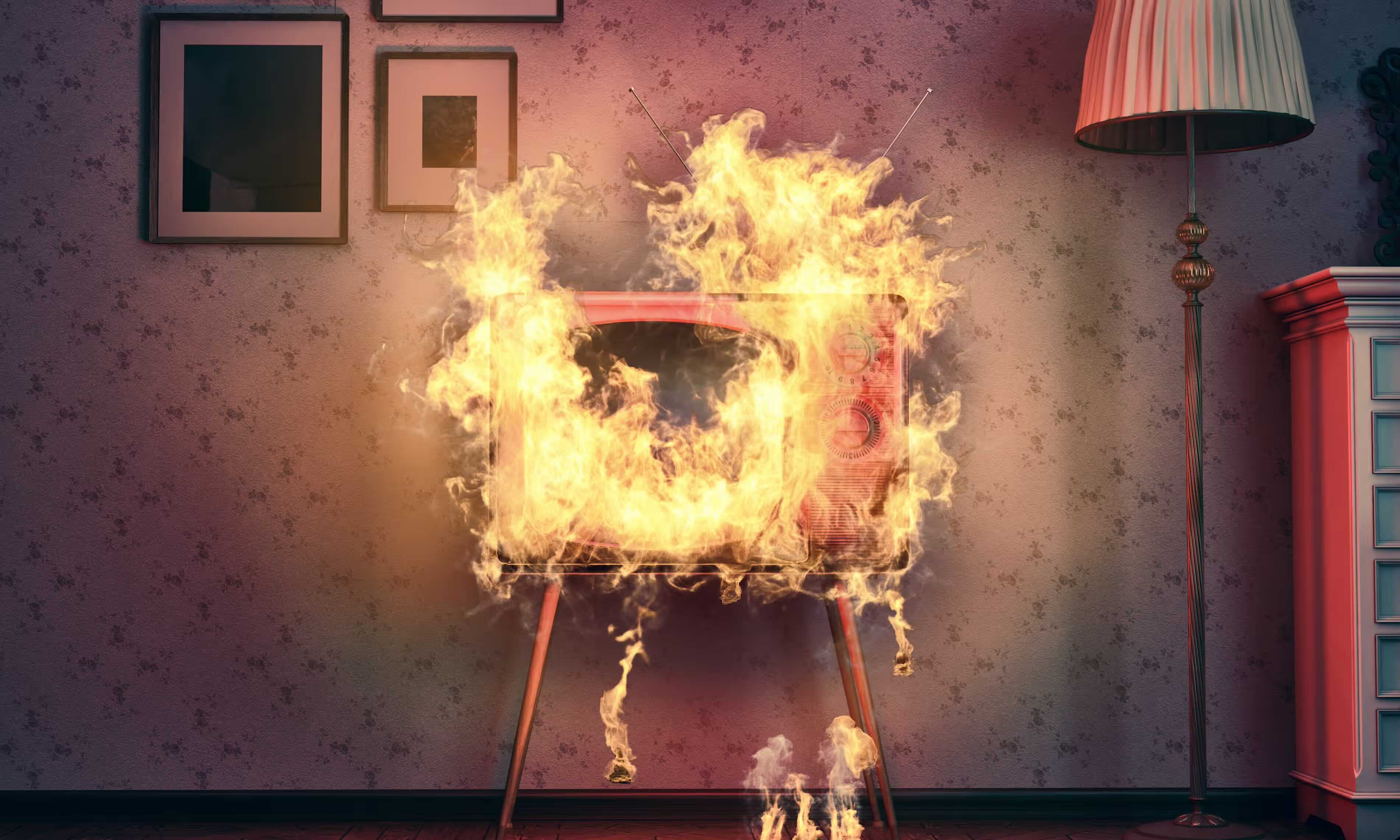
… and, as Mark Sweney reports, that staging is undergoing a fundamental transition. Case in point: Warner Bros Discovery’s recent massive write-down of traditional broadcast assets as it struggles to play catch-up with streaming and video services…
Warner Bros Discovery’s announcement… of a $9bn (£7bn) writedown in the value of its TV networks is a stark acknowledgment of the damage the streaming wars are inflicting on traditional broadcasting models.
The astonishing figure, which pushed the US entertainment group to a quarterly net loss of $10bn (£7.9bn) and sent shares sliding 12% in early trading on Thursday, lays bare how channels such as CNN, TLC and the Food Network can no longer rely on a captive cable subscriber base.
The rapid consumer shift away from high-priced TV packages, coupled with the inexorable decline in advertising, has forced traditional TV companies to invest billions in low-cost streaming services to catch up with first movers such as Netflix.
The question is now whether companies such as WBD – home to TV and film content including Furiosa: A Mad Max Saga, Godzilla x Kong: The New Empire, The Big Bang Theory, Succession, Friends and all Olympics events – can build the scale and make significant profits from their streaming operations before the death of linear television delivered by cable, satellite or aerial…
…
… Disney has more than 200 million global streaming subscribers, and WBD exceeds 100 million globally, with Discovery+ now the fastest-growing service in the UK thanks to winning the rights to show every Olympic discipline. But the battle is not just to continue to drive scale.
Boosting revenue and profits per subscriber has become critical through strategies including rapid rounds of price increases – Disney has just announced a set of price rises for later this year – as well as driving slightly cheaper ad-funded tiers to pull in cost-conscious consumers.
While traditional TV companies struggle with managing the decline in their legacy businesses, with drastic rounds of cost-cutting after a decade of profligate spending on content in the first decade of the streaming wars, Netflix points to a viable future.
The streaming giant, which once struggled with mounting losses running into tens of billions of dollars, has seen its market value surge by more than 50% over the past year after turning the profitability corner while continuing to see significant growth in subscribers.
WBD’s chief executive, David Zaslav, who has considered breaking up the company but concluded that is not currently the best option, said the market was being hit by a “generational disruption” that requires traditional TV companies to take “bold, necessary steps”.
Richard Broughton, director at Ampere Analysis, said: “Legacy TV businesses are in decline but the shift is not so rapid that it can’t be managed. There are still a lot of broadcast TV viewers, they have the time to pivot to profitability in the streaming world.”…
Dealing with disruption: “‘Traditional TV is dying’: can networks pivot and survive?” from @marksweney in @guardian.
Corollary damage: “two venerable TV trade publications, Broadcasting & Cable and Multichannel News, will shut down“
See also: “The music industry is suffering from a streaming hangover” (gift link) and on a more upbeat note, “Radio shows surprising resilience even in a rapidly changing media world.”
For (just one example of) the kind of speculation that tectonic shifts of this sort can elicit: “Why Apple should buy Warner Bros. Discovery. No, seriously.“
And for one take on why all of this is underway: “The Addiction Economy.”
* Neil Postman, Amusing Ourselves to Death
###
As we muse on media, we might spare a thought for Dominick George “Don” Pardo Jr.; he died on this date in 2014. A member of the Television Hall of Fame, Pardo had a 70-year tenure with NBC, working as the announcer for early incarnations of such notable shows as The Price Is Right, Jackpot, Jeopardy!, Three on a Match, Winning Streak, and NBC Nightly News. His longest, and best-known, announcing job was for NBC’s Saturday Night Live, a job he held for 38 seasons, from the show’s debut in 1975 until his death.

“I prefer radio to TV because the pictures are better”*…

Was Walter Benjamin the ur-podcaster? Peter E. Gordon on Benjamin’s audio adventures, how they relate to his cultural theories, and what they suggest about what has become (and may yet become) of audio…
No audio recordings of Walter Benjamin have survived. His voice was once described as beautiful, even melodious—just the sort of voice that would have been suitable for the new medium of radio broadcasting that spread across Germany in the 1920s. If one could pay the fee for a wireless receiver, Benjamin could be heard in the late afternoons or early evenings, often during what was called “Youth Hour.” His topics ranged widely, from a brass works outside Berlin to a fish market in Naples. In one broadcast, he lavished his attention on an antiquarian bookstore with aisles like labyrinths, whose walls were adorned with drawings of enchanted forests and castles. For others, he related “True Dog Stories” or perplexed his young listeners with brain teasers and riddles. He also wrote, and even acted in, a variety of radio plays that satirized the history of German literature or plunged into surrealist fantasy. One such play introduced a lunar creature named Labu who bore the august title “President of the Moon Committee for Earth Research.”
Today Benjamin is widely esteemed as one of the foremost cultural critics and theorists of the 20th century. But his career was uneven and marked by failure. In 1925, after the faculty of philosophy in Frankfurt rejected his enigmatic study of German Baroque drama and dashed his hopes for an academic career, he found himself adrift, with little assurance of a regular income. But this failure also brought freedom. His untethering from the university meant that he could indulge in his interests without restraint, and he turned his talents to writing essays that took in the whole panorama of modern life—from high literature to children’s books and from photography to film—and, for nearly six years, he supplemented his earnings with radio broadcasts, some for adults and others meant especially for children. Of the many broadcasts, about 90 in all, that he produced for the radio stations in Frankfurt and Berlin, only a fragment of a single audio recording has been preserved; unfortunately, Benjamin’s voice cannot be heard.
Now transcripts of these broadcasts have been assembled and translated into English in a new volume edited by Lecia Rosenthal, whose incisive introduction assists the reader in appreciating their true significance. One can’t help but wonder what Benjamin would have made of all this attention, since he was inclined to dismiss his radio work as unimportant. In correspondence with his friend Gershom Scholem, he wrote with some embarrassment of “piddling radio matters” and condemned nearly all of it as having “no interest except in economic terms.” Today we know that he was mistaken. The transcripts are more than mere ephemera; they are perfect specimens of Benjamin’s interpretative method, exercises in a style of urban semiotics that he would later apply during his exile in Paris. Hannah Arendt once likened her late friend to a pearl diver who possessed a gift for diving into the wreckage of bourgeois civilization and emerging into the sunlight with the rarest of treasures. The radio transcripts offer further evidence of a genius whose career was ended far too soon…
A fascinating– and illuminating– read. Walter Benjamin’s radio years: “President of the Moon Committee,” from @thenation.
* Alistair Cooke
###
As we listen in, we might spare a thought for Hugo Gernsback, a Luxemborgian-American inventor, broadcast pioneer, writer, and publisher; he was born on this date in 1884. Gernsback founded radio station WRNY, was involved in the first television broadcasts, and is considered a pioneer in amateur radio. And he was a prolific inventor, with 80 patents at the time of his death.
But it was a writer and publisher that he probably left his most lasting mark: In 1926, as owner/publisher of the magazine Modern Electrics, he filled a blank spot in his publication by dashing off the first chapter of a series called “Ralph 124C 41+.” The twelve installments of “Ralph” were filled with inventions unknown in 1926, including “television” (Gernsback is credited with introducing the word), fluorescent lighting, juke boxes, solar energy, television, microfilm, vending machines, and the device we now call radar.
The “Ralph” series was an astounding success with readers; and later that year Gernsback founded the first magazine devoted to science fiction, Amazing Stories. Believing that the perfect sci-fi story is “75 percent literature interwoven with 25 percent science,” he coined the term “science fiction.”
Gernsback was a “careful” businessman, who was tight with the fees that he paid his writers– so tight that H. P. Lovecraft and Clark Ashton Smith referred to him as “Hugo the Rat.”
Still, his contributions to the genre as publisher were so significant that, along with H.G. Wells and Jules Verne, he is sometimes called “The Father of Science Fiction”; in his honor, the annual Science Fiction Achievement awards are called the “Hugos.”

“The test of a first-rate intelligence is the ability to hold two opposed ideas in the mind at the same time, and still retain the ability to function”*…
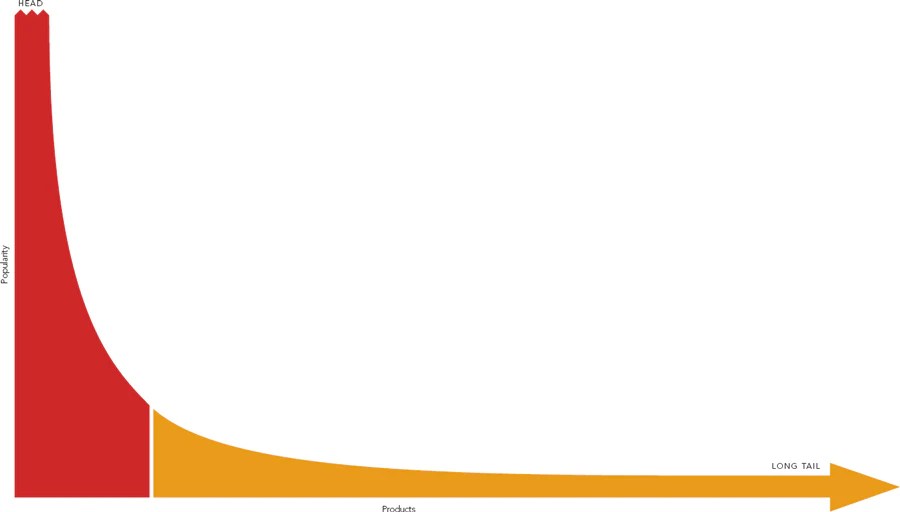
One the one hand: Ted Gioia suggests that, while ‘The Long Tail’ was supposed to boost alternative voices in music, movies, and books, the exact opposite has happened…
When I first heard people predict the rise of the Long Tail, I was amused. Not only did it seem wrong-headed, but it ran counter to everything I saw happening around me.
It pains me to say this—because the Long Tail was sold to us as an economic law that not only predicted a more inclusive era of prosperity, but would especially help creative people. According to its proponents, the Long Tail would revitalize our culture by expanding the scope of the arts and giving a boost to visionaries on the fringes of society.
Alternative voices would be nurtured and flourish. Music would get cooler and more surprising. Books would become more diverse and interesting. Indie films would reach larger audiences. Etc. etc. etc.
Hey, what’s not to like?
But it never happened. More to the point, it was never going to happen because the story was a fairy tale. I knew it back then because I had been hired on a number of occasions to analyze the Long Tail myself. But the flaws in the reasoning are far more obvious today, even to me.
Nonetheless many believed it—and many still do. So it’s worth digging into the story of the Long Tail, and examining exactly why it never delivered its promise.
And maybe we can find some alternative pathway to that lost cultural renaissance by seeing how this one went off the rails.
…
On the other hand: Cal Newport suggest that Kevin Kelly‘s fourteen-year-old prediction that an artist could make a living online with a thousand true fans is (finally) coming true…
In his “1,000 True Fans” essay, Kelly explains that he wasn’t as excited about this new economic model as others seemed to be. “The long tail is famously good news for two classes of people: a few lucky aggregators, such as Amazon and Netflix, and 6 billion consumers,” he writes. “But the long tail is a decidedly mixed blessing for creators.” If your work lives in the long tail, the introduction of Internet-based markets might mean that you go from selling zero units of your creations to selling a handful of units a month, but this makes little difference to your livelihood. “The long tail offers no path out of the quiet doldrums of minuscule sales,” Kelly writes. “Other than aim for a blockbuster hit, what can an artists do to escape the long tail?”
This question might seem fatalistic, but Kelly had a solution. If your creative work exists in the long tail, generating a small but consistent number of sales, then it’s probably sufficiently good to support a small but serious fan base, assuming you’re willing to put in the work required to cultivate this community. In an earlier age, a creative professional might be limited to fans who lived nearby. But by using the tools of the Internet, Kelly argued, it was now possible for creative types to both find and interact with supporters all around the world…
A shining example of the 1,000 True Fans model is the podcasting boom. There are more than eight hundred and fifty thousand active podcasts available right now. Although most of these shows are small and don’t generate much money, the number of people making a full-time living off original audio content is substantial. The key to a financially viable podcast is to cultivate a group of True Fans eager to listen to every episode. The value of each such fan, willing to stream hours and hours of a creator’s content, is surprisingly large; if sufficiently committed, even a modest-sized audience can generate significant income for a creator. According to an advertising agency I consulted, for example, a weekly podcast that generates thirty thousand downloads per episode should be able to reach Kelly’s target of generating a hundred thousand dollars a year in income. Earning a middle-class salary by talking through a digital microphone to a fiercely loyal band of supporters around the world, who are connected by the magic of the Internet, is about as pure a distillation of Kelly’s vision as you’re likely to find…
The real breakthroughs that enabled the revival of the 1,000 True Fans model are better understood as cultural. The rise in both online news paywalls and subscription video-streaming services trained users to be more comfortable paying à la carte for content. When you already shell out regular subscription fees for newyorker.com, Netflix, Peacock, and Disney+, why not also pay for “Breaking Points,” or throw a monthly donation toward Maria Popova? In 2008, when Kelly published the original “1,000 True Fans” essay, it was widely assumed that it would be hard to ever persuade people to pay money for most digital content. (This likely explains why so many of Kelly’s examples focus on selling tangible goods, such as DVDs or custom prints.) This is no longer true. Opening up these marketplaces to purely digital artifacts—text, audio, video, online classes—significantly lowered the barriers to entry for creative professionals looking to make a living online…
But can this last? Is it destined to fall prey to the forces that Gioia catalogues?
The recent history of the Internet, however, warns that we shouldn’t necessarily expect the endearingly homegrown nature of these 1,000 True Fans communities to persist. When viable new economic niches emerge online, venture-backed businesses, looking to extract their cut, are typically not far behind. Services such as Patreon and Kickstarter are jostling for a dominant position in this direct-to-consumer creative marketplace. A prominent recent example of such attempts to centralize the True Fan economy is Substack, which eliminates friction for writers who want to launch paid e-mail newsletters. Substack now has more than a million subscribers who pay for access to newsletters, and is currently valued at around six hundred and fifty million dollars. With this type of money at stake, it’s easy to imagine a future in which a small number of similarly optimized platforms dominate most of the mechanisms by which creative professionals interact with their 1,000 True Fans. In the optimistic scenario, this competition will lead to continued streamlining of the process of serving supporters, increasing the number of people who are able to make a good living off of their creative work: an apotheosis of sorts of Kelly’s original vision. A more pessimistic prediction is that the current True Fan revolution will eventually go the way of the original Web 2.0 revolution, with creators increasingly ground in the gears of monetization. The Substack of today makes it easy for a writer to charge fans for a newsletter. The Substack of tomorrow might move toward a flat-fee subscription model, driving users toward an algorithmically optimized collection of newsletter content, concentrating rewards within a small number of hyper-popular producers, and in turn eliminating the ability for any number of niche writers to make a living…
The future of the creative economy: “Where Did the Long Tail Go?,” from @tedgioia and “The Rise of the Internet’s Creative Middle Class,” from Cal Newport on @kevin2kelly in @NewYorker.
* F. Scott Fitzgerald (“The Crack-Up,” Esquire, February, 1936)
###
As we contemplate culture and commerce, we might recall that it was on this date in 1894 (after 30 states had already enshrined the occasion) that Labor Day became a federal holiday in the United States.

You must be logged in to post a comment.