Posts Tagged ‘Nature’
“Nature does not hurry, yet everything is accomplished”*…

Paul Constance on a chain of dedicated scientists who are building data sets on the natural world around us, and how– coupled with emerging new nature apps that enable citizen scientists– they are expanding our ecological attention span into the long now…
Every two weeks from March to November, Chris Halsch walks a ten-mile loop near the Donner Pass, high up in California’s Sierra Nevada, for the sole purpose of counting butterflies.
It is one of five sites at various altitudes that Halsch, a PhD candidate at the University of Nevada, Reno, has been visiting with metronomic regularity for the past five years. At each one he retraces his steps, pausing every so often to jot down species and numbers in a notebook.
Along the way, he sometimes meets recreational birders or hikers who take photographs and use nature apps to identify species for fun. But unlike those random snapshots, Halsch’s notes are a coveted resource for scientists. Once he types them into a spreadsheet, each of his data points adds a new segment to a chain of observations that has been growing without interruption for half a century, in one the world’s longest-lived efforts to monitor butterfly populations. Like a relay runner, Halsch is extending a marathon of sustained attention that began 20 years before he was born.
Multi-decadal time-series of field observations are among the rarest and most valuable artifacts in ecosystem science because they help to overcome a peculiar weakness in our ability to perceive and interpret the natural world. Humans have developed powerful methods for reconstructing events in the distant past, from the birth of a galaxy to mass extinctions in the Devonian. We have built instruments that can parse the present down to the zeptosecond. But when it comes to the modest timescale of our own lifespans, we are like near-sighted moles.
Weren’t there more birds in this meadow when we were kids?
Doesn’t it seem like spring is a lot rainier than it used to be?
Are you sure it’s safe to eat fish from this river?
Our answers to these types of questions are notoriously unreliable. Think of the tendency to describe a single weather event as evidence for (or against) climate change, or the panic caused by invasive zebra mussels that, 20 years later, turns out to have been misplaced. Perceptions are distorted by selective memories, cognitive biases, political agendas and shifting baseline syndrome—the propensity of each generation to gradually forget past environmental conditions and accept present ones as normal. In an essay published in 01990, the zoologist John J. Magnuson wrote that this temporal myopia can trap us in the “invisible present,” a space where we fail to see slow changes and are unable to interpret effects that lag years behind their causes. “In the absence of the temporal context provided by long-term research, serious misjudgments can occur not only in our attempts to understand and predict change in the world around us, but also in our attempts to manage our environment,” he warned.
Magnuson was echoing a group of mid-century scientists who believed that some of the biggest questions in ecology could only be answered with field observations that were carefully structured and repeated at the same sites for at least two decades. The longer the time-series, the greater likelihood that the invisible present will “melt away,” exposing the complex and often unexpected dynamics of ecosystem change….
[Constance describes a variety of efforts underway…]
… Collectively, these efforts are widening the aperture of our ecological attention, enabling scientists to find and stitch together scattered fragments of temporal data into panoramas that tell a more illuminating story about the interactions that drive change. Unfortunately, the emerging picture is still largely focused on wealthy countries—particularly ones with long histories of field-based science. A map of the International LTER network, an association of 750 field stations that, like their U.S. counterparts, are making long-term observations, shows that more than two thirds are concentrated in Western Europe. Numerous countries in Asia, Africa and Latin America have no stations at all. Moreover, even as scientists like Moran and Grames are exploiting the new wealth of temporal evidence, it is not clear how this research will influence the wider culture, where the blinkered perceptions of the “invisible present” are still pervasive.
The trend that may ultimately overcome both of these limitations is driven, paradoxically, by smartphones. Non-scientists have long been a critical source of field labor for long time-series, most famously for the Audubon Society’s 122-year-old Christmas Bird Count, but also in hundreds of smaller projects that monitor other kinds of flora and fauna. Now, smartphones with powerful cameras and apps such as eBird, iNaturalist, Seek and Picture Insect have enabled millions of casual observers to supplement this pool of dedicated volunteers. Despite the lively debate on whether smartphone usage in the outdoors enhances or interferes with people’s appreciation of nature, one fact is clear: because nature apps automatically time-stamp, geo-reference and store each observation in a robust database, they are generating potential time-series at an unprecedented scale.
In the 20 years since the Cornell Lab of Ornithology launched eBird, the app has amassed more than one billion observations by 700,000 birders from every country in the world. Carrie Seltzer, who heads stakeholder engagement at iNaturalist, says that more than 2.4 million people have made observations on the app, at a rate that has grown between 50 percent and 100 percent per year since 02012… This torrent of raw field data vastly exceeds what even well-funded researchers could ever dream of gathering with traditional methods…
Understanding the world around us: “Peering into The Invisible Present,” from @presentbias and @longnow. Eminently worth reading in full– then browsing the other remarkable pieces available on the Long Now website.
* Lao Tzu
###
As we take the long view, we might send insightful birthday greetings to a man who encourages us to see in different ways, M. C. Escher; he was born on this date in 1898. A graphic artist inspired by mathematics, he created woodcuts, lithographs, and mezzotints, that— while largely ignored by the art world in his lifetime, have become widely celebrated. He’s been recognized as an heir to Parmigianino, Hogarth, and Piranesi.
His work features mathematical objects and operations including impossible objects, explorations of infinity, reflection, symmetry, perspective, truncated and stellated polyhedra, hyperbolic geometry, and tessellations. And though Escher believed he had no mathematical ability, he interacted with the mathematicians George Pólya, Roger Penrose, and Donald Coxeter, and the crystallographer Friedrich Haag, and conducted his own research into tessellation.
For more on (and more examples of) Escher’s work, see here.


“The daily hummingbird assaults existence with improbability”*…

Zito Madu‘s lovely meditation on– and appreciation of– the hummingbird…
… Hummingbirds are wondrous creatures. As Katherine Rundell wrote in her 2022 essay “Consider the Hummingbird”:
There is nothing I admire more than evolution. But it’s difficult, more than with any other living thing, to imagine hummingbirds beginning as archaebacteria among primordial murk, painstakingly working over millions of years to grow bright wings. They seem as if they were made in an instant, a spark of genius from an extravagant god.
They are the smallest living birds in the world. There are 366 known species of hummingbirds, with the smallest being the bee hummingbird that measures at two inches, and the largest being the giant hummingbird, which is 9.1 inches long. Most live in the tropics, largely in Central and South America, but there are around seventeen species in the United States. They have long needle-like beaks, can fly forward, backward, up, down, and in zigzags. They flap their wings faster than any other bird, up to fifty times per second, they have the largest heart-to-body-size rate in an animal, and that heart has typically 500 to 1200 beats per minute, according to The Hummingbird Handbook (2021) by John Shewey. When in a state of deep rest, and to conserve energy, the hummingbird can slow down its heart rate to only fifty beats per minute, and drop its metabolism by 95 percent.
In 2022, a study was published by Yale scientists on the range of colors in the plumage of hummingbirds, which “exceeds the known diversity of colors found in the plumages of all other bird species combined, increasing the total of known bird-visible plumage colors by 56 percent.”…
“Hummingbirds are Wondrous,” from @_Zeets in @Plough.
* Ursula K. Le Guin, No Time to Spare: Thinking About What Matters
###
As we appreciate abundance, we might send bucolic birthday greetings to Ralph Waldo Emerson; he was born on this date in 1803. An essayist, lecturer, philosopher, abolitionist, and poet, he articulated the philosophy of Transcendentalism in his 1836 essay “Nature.”
A mentor and friend of Henry David Thoreau, a fellow Transcendentalist, and remains among the linchpins of the American romantic movement.

“It always seems impossible until it is done”*…

Adam Tooze unpacks a recent report from the clean energy think tank Ember— one that heralded a profoundly important historical turning point…
Electrification is key to the new energy system that is being built around the world. Electricity generation is one process we do know how to decarbonize. With concerted action, net neutrality is within reach in electric power generation for OECD countries by the 2030s and for the whole world by 2045. Furthermore, as Ember points out, electrification will replace “fossil fuel burning that currently takes place in car and bus engines, boilers, furnaces and other applications.”
Green electrification is the key to the future. And in 2023, according to Ember’s report, almost the entirety of new power demand was covered by growth in renewables, above all solar. Though there was growth in demand for electricity around the world, fossil fuel generation barely increased. Growth in solar and wind alone were sufficient to cover 82 percent of new electricity demand.
This is not new in rich countries. In the OECD demand growth for electricity is not strong or is even negative and renewable investment has been ongoing for two decades. The sensation is that this is now happening at the global level where the growth in demand for electric power is relentless.
In 2024 Ember expects the trend to be even more pronounced. This year, for the first time there will be substantial growth in global demand for electricity, whilst fossil fuel generation will likely fall…
… There is an obfuscation involved in talking about “the global” when, in fact, there is one country that dominates the entire dynamic of the energy transition: China.
As Ember’s data show: “China remained the main engine of global electricity demand growth. China’s rapid growth (+606 TWh, +6.9%) was just 21 TWh lower than the net global increase. India’s growth (+99 TWh, +5.4%) was the next largest contributor.”
Until the 2010s China fed its voracious demand for new power with coal-fired power stations. The energy transition in the advanced economies was never going to be sufficient to offset this. Of course, the renewable energy transition in the West was also painfully slow. But even if the USA and the EU had taken more drastic action, China’s growth was simply too large and too dirty. The fact that we are now reaching a turning point in the balance between fossil and clean power generation is due to a turning point in China: a huge surge in renewable energy investment.
In 2023 China alone accounted for more than half of the new global additions in wind and solar…
Measured in terms of power consumed China’s electrification of road transport is 3.5 times larger than that of the entire rest of the world. That is the EV revolution that the West is so worried about….
It is also the largest heat pump market in the world with more installations per year than any other country. Electrolysers, used mostly in demonstration plants by chemical and petrochemical companies, have also grown faster in China than the rest of the world. As a result, China accounted for 50% of global electrolyser capacity in 2023…

But as Ember notes, this process of applying electricity to new uses, is only at the beginning.
“Even in China, electrification is still in its infancy. Only a fifth of China’s electricity demand growth in 2023 (124 TWh of 606 TWh) was from the three electrification technologies, but this share will rise in time. These technologies added 1.4% to China’s electricity demand in 2023, up from 1.1% in 2022. Meanwhile in the rest of the world, electrification added 0.25% to electricity demand in 2022 and 0.28% in 2023. As China further accelerates the deployment of key electrification technologies and the world continues to catch up, the contribution of electrification will expand even further.“
At COP28 in 2023 many countries around the world committed to tripling global renewable electricity capacity by 2030. This has the potential to almost halve power sector emissions by 2030, as coal-fired power generation will be replaced first. Furthermore, it will provide enough new electricity to replace drive forward the electrification of transport, home and industrial heating with a 32 percent increase in electricity demand.
Having shattered all previous experience of renewable power rollout, China’s huge surge in solar now actually puts us within striking distance of achieving a net zero path, driven by green electric power…
What we are witnessing is the most rapid take-up of a significant energy technology in history.
The response of Western politicians? Protectionism. Of course there are complex motives. They need to build coalitions to sustain the energy transition. They are worried about the CCP regime in China. They want to escape extreme dependence on imported sources of energy (though of course in the renewable space it is capital equipment not energy they are importing). But the more basic question is simply this. Are Western government and societies willing to prioritize the energy transition if it is not their drama, not their success story? Or, if the PV panels and the electric vehicles are from China, do other interests take priority?
In the European case one can see a compromise based on a balance between domestic and Chinese-sourced energy transition solutions. As Martin Sandbu has remarked there is at least the possibility of a grand bargain. In the case of the United States it seems increasingly clear that the energy transition as such is a second order concern, and geopolitical confrontation and the struggle to form domestic coalitions take precedence. That is depressing. And it matters. But, as Ember’s data make clear, it is far from being a decisive obstacle. The global energy transition will go on anyway…
“The beginning of a new era: How the ‘global’ energy transition is happening in China,” from @adam_tooze and @EmberClimate. Eminently worth reading in full (both Tooze’s summary and the Ember report).
Apposite (and divergent, though not opposite, from Tooze): “The climate case for Biden’s new China tariffs,” from @timmcdonnell in @semafor.
And this: “We might be closer to changing course on climate change than we realized,” from @voxdotcom.
* Nelson Mandela
###
As we find solace where we can, we might spare a thought for Joseph Wood Krutch; he died on this date in 1970. An author, critic, and naturalist, he began his career in New York City, where he was a professor at Columbia and theater critic for The Nation, and where he wrote The Modern Temper (challenging the then-fashionable notions of scientific progress and optimism), biographies of Samuel Johnson and Henry David Thoreau, and (inspired by Thoreau) The Twelve Seasons, Krutch’s first nature book.
In 1952, on doctor’s orders, Krutch left the East for Tucson and the Sonoran Desert, where he began writing about ecology, the southwestern desert environment, and the natural history of the Grand Canyon. He won renown as a naturalist, nature writer, and an early conservationist for works like The Voice of the Desert and The Desert Year, arguing that human beings must move beyond purely human centered conceptions of “conservation” and learn to value nature for its own sake.

“Biodiversity is our most valuable but least appreciated resource”*…

As Chris Armstrong reminds us, the environment is about so much more than climate…
Later this month [May 22] it will be World Biodiversity Day, and we will again celebrate the remarkable contributions that biodiversity makes to the resilience and productivity of the earth’s ecosystems. But it will also be a fitting time to face the continued failure of our institutions to grasp the scale of biodiversity loss. Or, if not to grasp it, to respond in any way adequately.
The figures speak for themselves. Since 1992, the Convention on Biological Diversity has been charged with agreeing global targets for biodiversity conservation. The Aichi Biodiversity Targets for 2011-2020, for instance, aimed to halve the rate of habitat loss, protect 17% of terrestrial ecosystems, and much else besides.
None of those targets were met. In response, the Kunming-Montreal Agreement recently agreed to protect 30% of ecosystems by 2030, to restore 30% of degraded ecosystems, and so on and so on and so on. On current projections, these targets are going to be missed too, by some distance. Like Canute ordering the tides to stop, it turns out that setting targets, by itself, achieves nothing.
So why has the biodiversity governance regime failed so spectacularly?…
Read on learn: “Why has global biodiversity governance failed so badly?” from @crookedtimber.
(Image above: source)
###
As we value variety, we might recall that it was on this date in 1908 that President Theodore Roosevelt convened a three-day Conference of Governors. Largely driven by U.S. Chief Forester Gifford Pinchot, the gathering was focused on the problems of conservation. The Conference was a seminal event in the history of “conservationism,” most fundamentally in drawing public attention to the issue in a highly visible way. More concretely, there were two outgrowths of the Conference: the National Conservation Commission, (which Roosevelt and Pinchot set up with representatives from the states and Federal agencies, and which prepared the first inventory of the natural resources of the United States), and the first National Conservation Congress, which Pinchot led as an assembly of private conservation interests. Not long after, annual governors’ conferences became a regular event, and 38 state conservation commissions were created.

“I discovered that if one looks a little closer at this beautiful world, there are always red ants underneath”*…
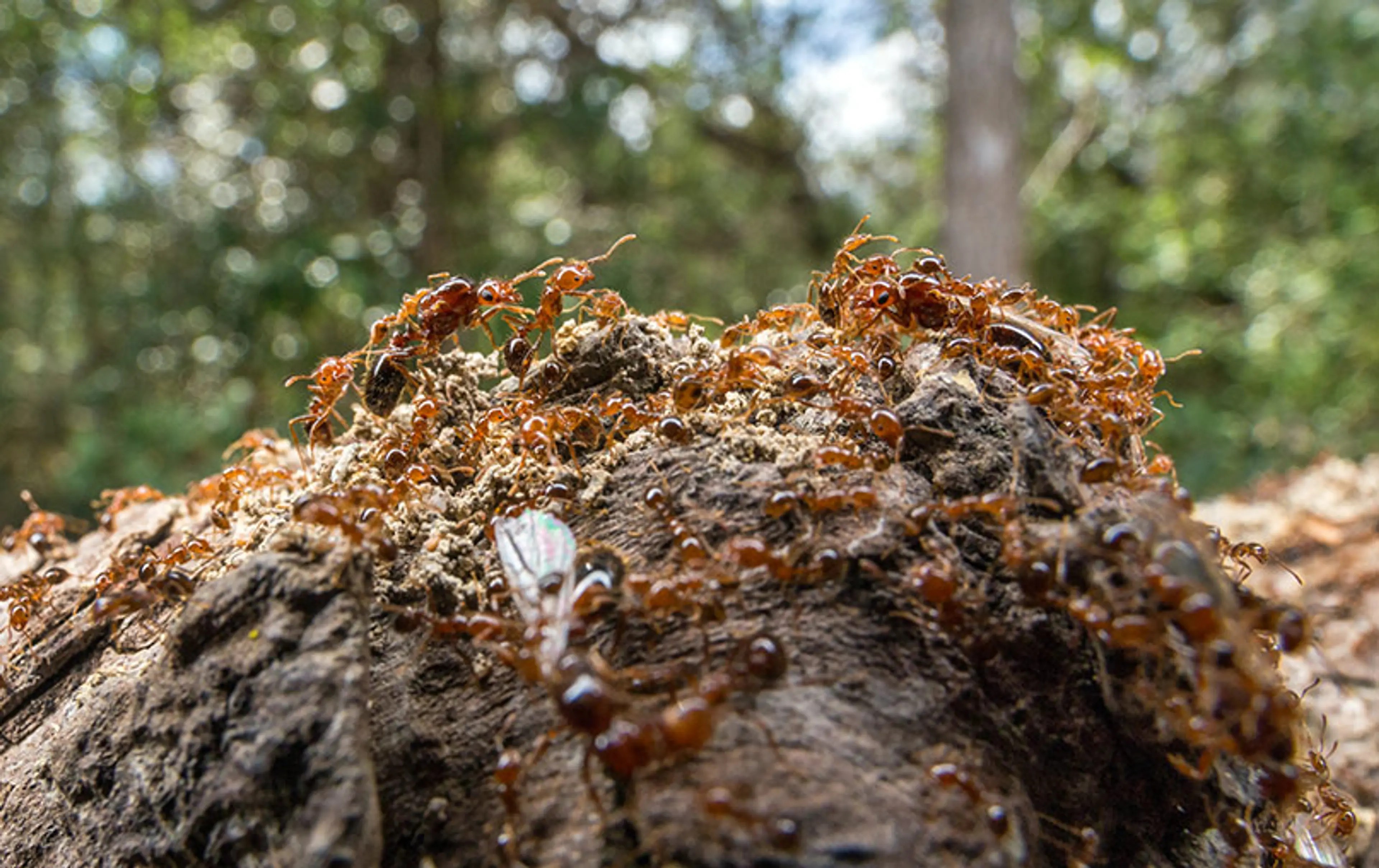
E.O. Wilson once observed that “Ants have the most complicated social organization on earth next to humans.” John Whitfield explores the way in which, over the past four centuries, quadrillions of ants have created a strange and turbulent global society that shadows our own…
It is a familiar story: a small group of animals living in a wooded grassland begin, against all odds, to populate Earth. At first, they occupy a specific ecological place in the landscape, kept in check by other species. Then something changes. The animals find a way to travel to new places. They learn to cope with unpredictability. They adapt to new kinds of food and shelter. They are clever. And they are aggressive.
In the new places, the old limits are missing. As their population grows and their reach expands, the animals lay claim to more territories, reshaping the relationships in each new landscape by eliminating some species and nurturing others. Over time, they create the largest animal societies, in terms of numbers of individuals, that the planet has ever known. And at the borders of those societies, they fight the most destructive within-species conflicts, in terms of individual fatalities, that the planet has ever known.
This might sound like our story: the story of a hominin species, living in tropical Africa a few million years ago, becoming global. Instead, it is the story of a group of ant species, living in Central and South America a few hundred years ago, who spread across the planet by weaving themselves into European networks of exploration, trade, colonisation and war – some even stowed away on the 16th-century Spanish galleons that carried silver across the Pacific from Acapulco to Manila. During the past four centuries, these animals have globalised their societies alongside our own.
It is tempting to look for parallels with human empires. Perhaps it is impossible not to see rhymes between the natural and human worlds, and as a science journalist I’ve contributed more than my share. But just because words rhyme, it doesn’t mean their definitions align. Global ant societies are not simply echoes of human struggles for power. They are something new in the world, existing at a scale we can measure but struggle to grasp: there are roughly 200,000 times more ants on our planet than the 100 billion stars in the Milky Way…
…
The more I learn, the more I am struck by the ants’ strangeness rather than their similarities with human society. There is another way to be a globalised society – one that is utterly unlike our own. I am not even sure we have the language to convey, for example, a colony’s ability to take bits of information from thousands of tiny brains and turn it into a distributed, constantly updated picture of their world. Even ‘smell’ seems a feeble word to describe the ability of ants’ antennae to read chemicals on the air and on each other. How can we imagine a life where sight goes almost unused and scent forms the primary channel of information, where chemical signals show the way to food, or mobilise a response to threats, or distinguish queens from workers and the living from the dead?
As our world turns alien, trying to think like an alien will be a better route to finding the imagination and humility needed to keep up with the changes than looking for ways in which other species are like us. But trying to think like an ant, rather than thinking about how ants are like us, is not to say that I welcome our unicolonial insect underlords. Calamities follow in the wake of globalised ant societies. Most troubling among these is the way that unicolonial species can overwhelmingly alter ecological diversity when they arrive somewhere new. Unicolonial ants can turn a patchwork of colonies created by different ant species into a landscape dominated by a single group. As a result, textured and complex ecological communities become simpler, less diverse and, crucially, less different to each other. This is not just a process; it is an era. The current period in which a relatively small number of super-spreading animals and plants expands across Earth is sometimes called the Homogecene. It’s not a cheering word, presaging an environment that favours the most pestilential animals, plants and microbes. Unicolonial ants contribute to a more homogenous future, but they also speak to life’s ability to escape our grasp, regardless of how we might try to order and exploit the world. And there’s something hopeful about that, for the planet, if not for us.
The scale and spread of ant societies is a reminder that humans should not confuse impact with control. We may be able to change our environment, but we’re almost powerless when it comes to manipulating our world exactly how we want. The global society of ants reminds us that we cannot know how other species will respond to our reshaping of the world, only that they will…
Bracing: “Ant geopolitics,” from @gentraso in @aeonmag.
* David Lynch
###
As we investigate insects, we might spare a thought for Sara Josephine Baker; she died on this date in 1945. A physician, she was a pioneer in public health and child welfare in the United States in her roles as assistant to the Commissioner for Public Health of New York City, and later, head of the city’s Department of Health in “Hell’s Kitchen” for 25 years. Convinced of the value of well-baby care and the prevention of disease, in 1908 she founded the Bureau of Child Hygiene– and decreased the death rate by 1200 from the previous year. Her work made the New York City infant mortality rate the lowest in the USA or Europe at the time. She set up free milk clinics, licensed midwives, and taught the use of silver nitrate to prevent blindness in newborns.
Baker is also remembered as the public health official who (twice) tracked down “Typhoid Mary.”

You must be logged in to post a comment.