Posts Tagged ‘literature’
“There are no shortcuts to any place worth going”*…

As Anne Lawrence-Mathers explains, centuries before Neo instantly mastered Kung Fu in The Matrix, and AI emerged promising quick command of any subject to any of us, medieval scholars found a shortcut to years of difficult study: a magical manuscript that promised to fast-track advanced learning. Anne Lawrence-Mathers investigates the Ars notoria, its supposed powers, and the demonic influence it had upon some users…
Mastering the full range of subjects taught in medieval universities normally required many years of hard and expensive study. From the thirteenth century on, however, an anonymous work known as the Ars notoria promised, through diagrams, incantations, and arcane rituals, to rapidly transmit to scholars the total knowledge of anything they might need. Condemned by church authorities, the fifty-six extant manuscripts nevertheless testify to the seductiveness of that offer.
Its complex diagrams were at the center of its appeal. Unlike diagrams in other magical texts, those in Ars notoria do not illustrate what the text is seeking to communicate. Nor do they act as models to be replicated in three-dimensional form as pieces of magical equipment. Instead, they supposedly work almost in the same way as religious icons. That is, faithful possession and use of them can offer direct contact with powerful and benign supernatural forces — and ultimately even with God. The diagrams themselves are the route to magic and consist of arrangements of symbolic and geometric forms, patterns, and symbols, interspersed with “words”, which are frequently unintelligible combinations of letters.3 Practitioners who opened their minds to receive and imprint these labyrinthine images, while reciting complex verbal formulae and strings of mysterious, almost unpronounceable words and names, are engaging in a significant act of trust.
Several factors made the Ars notoria fundamentally different from other magical texts. First, this is not a text in conflict with the church. In fact, the rituals framing and shaping usage of the images are presented as extremely pious, and the texts to be recited are identified as prayers. The alien words, names, and characters are explained as coming from ancient languages such as Greek, Hebrew, and “Chaldean”, and are claimed to preserve both the names of angels and words used to communicate with them. Second, the advantages offered are relatively virtuous: contact with spiritual beings and full knowledge of the subjects taught in medieval universities. Such claims cut little ice with thirteenth-century theologians, however, who saw clear links to things condemned as superstitious and demonic by St Augustine, despite the text’s assertion that it contains wisdom revealed to King Solomon.
St Thomas Aquinas was worried enough by the Ars notoria to name and condemn it specifically in his Summa theologiae — one of the most authoritative summaries of Christian teaching. He dealt with the very serious issue of superstition in Book Two, Part 2 — Question 96 is effectively devoted to the Ars notoria. Aquinas’ conclusion is wholly negative: the “art” is both “unlawful and futile”. It is futile because it cannot deliver what it promises. Still more seriously, its “signs” are neither understood by humans (like ordinary words and letters) nor sent by God (as sacraments are), and thus are precisely the type of thing that lures humans into contact and compact with demons.
That may seem a conclusive case for the rejection of the Ars notoria, especially as Aquinas’ objections were echoed by other major theologians. However, the number of surviving medieval copies of the work, and the fact that it was copied and owned in religious institutions until the end of the medieval period, show that the church ultimately had neither the interest nor ability to stamp it out. Moreover, it was translated in the early modern period and also went into print, demonstrating an ongoing — and more widespread — interest…
[Professor Lawrence-Mathers explains how the Ars notoria was used…]
… For some users, the rituals were so powerful that they seemed demonic. One of these was Brother John, an early fourteenth-century monk of the abbey of Morigny, near Étampes. John’s account of his introduction to the text, his powerful attraction to it, and the terrifying experiences he underwent while using it, was given in several chapters of John’s own, visionary work, the early fourteenth century Liber florum celestis doctrine.6
The great attraction of the Ars notoria for John was its promise of quick access to advanced scholarly knowledge. He recounts his continuing wish to study, and how he was lent a copy of a book of necromancy by “a certain cleric”. He copied much of it and wanted more. This led to an encounter with a “medical expert” from Lombardy, who informed John that what he needed was the Ars notoria, and that a copy of it was to be found within the walls of the school (at Orléans) where John had been sent. These details provide important evidence of the liminal status of works of ritual magic. They were recognised as dangerous, and were far from being officially approved, and yet were well known, owned and recommended by educated individuals, including monks and clerics.
For John, the Ars notoria was dangerous not in some abstract way, but very directly. He confesses that it struck him at first as beautiful and holy, and seemed to offer miraculous gifts rather than demonic temptations. It became apparent, however, that the book was utterly deceptive, a work of the Devil, a “sick pleasure” that was actually fatally poisonous to the soul, not only to the body…
Medieval “technology”: “Artificial Intelligence– Ars Notoria and the Promise of Instant Knowledge,” from @publicdomainrev.bsky.social.
Pair with: “The Cost of Seamlessness” from @taotuner.bsky.social, and “Experience vs. Efficiency: Why the Human Still Matters in Learning,” from @lnddave.bsky.social.
Also a (vaguely) apposite, but (very) amusing (in a macabre kind of way) report on a piece of OpenAI’s handiwork: “US government map of Africa mislabels every country at global conference.”
* Beverly Sills
###
As we do the work, we might recall that it was on this date in 1965 that Frank Herbert’s Dune was published.
Herbert published a three-part serial Dune World in the monthly Analog, from December 1963 to February 1964. The serial was accompanied by several illustrations that were not published again. After an interval of a year, he published the much slower-paced five-part The Prophet of Dune in the January–May 1965 issues. The first serial became “Book One: Dune” in the final published Dune novel, and the second serial was divided into “Book Two: Muad’dib” and “Book Three: The Prophet”. The serialized version was expanded, reworked, and submitted to more than twenty publishers, each of whom rejected it. The novel, Dune, was finally accepted and published in August 1965 by Chilton Books, a printing house better known for publishing auto repair manuals. Sterling Lanier, an editor at Chilton, had seen Herbert’s manuscript and had urged his company to take a risk in publishing the book. However, the first printing, priced at $5.95 (equivalent to $60.79 in 2025), did not sell well and was poorly received by critics as being atypical of science fiction at the time. Chilton considered the publication of Dune a write-off and Lanier was fired. Over the course of time, the book gained critical acclaim, and its popularity spread by word-of-mouth to allow Herbert to start working full time on developing the sequels to Dune, elements of which were already written alongside Dune.
– source
Herbert died in 1986; his son Brian Herbert and author Kevin J. Anderson continued the series in over a dozen additional novels since 1999. Among them was Dune: The Butlerian Jihad, a prequel which chronicles the fictional Butlerian Jihad, a crusade by the last free humans in the universe against the thinking machines, a violent and dominating force led by the sentient computer Omnius.

“To coin a phrase”*…

Elliot Thornley nods to Shakespeare as the prodigious coiner of words (and phrases) that he was…

And then reminds us that Jeremy Bentham was no slouch with a neologism himself…
It’s pretty amazing. Shakespeare really shaped the English language!
So did Jeremy Bentham. He’s best-known for inventing utilitarianism and the panopticon [see here], but he also coined the words:
- Minimize
- International
- Percentage
- Pluralism
- Monetary
- Locating
- Marginalize
- Codify
- The prefix ‘self-’
- Maximize
- The prefix ‘post-’
- The prefix ‘infra-’
- Exhaustive
- Insurable
- Collaborator
- Alleviating
- Unaffordable
- Exclusionary
- Inexclusively
- Antagonising
- Deontology
- Disambiguation
- Eudemonic
- Evidentiary
- Characterizable
- Perusable
- Preferability
- Remediation
- Astuteness
- Uncalculating
- Uncoerced
- Unbridgeable
- Subvariety
You can find even more Bentham coinages at my source [lots more].
And as if all that weren’t enough, Bentham kind of invented jogging:
Bentham appears to have been a regular jogger—or, as he put it, ‘circumgyrater’. According to the journalist George Wheatley, who stayed with the eighty-one year-old Bentham in March 1831, before both breakfast and dinner Bentham would take ‘a few turns in the garden, which … he calls circumgyrating’, which Wheatley described as a ‘trotting or taking up a kind of trotting step’.
So not only are you quoting Bentham, you might be mimicking him too…
The second-greatest coiner of English words? “You are quoting Bentham.”
More coinage (and source of the image at the top): “Coined Words Acknowledged.”
* idiom
###
As we commend contrivers, we might recall that it was on this date in 1940 that another colossal coiner of phrases appeared: the Warner Bros. Merrie Melodies animated short “A Wild Hare”– the first “official” Bugs Bunny cartoon– premiered (though long-time readers will recall that Bugs [or at least, his prototype] made his inaugural screen appearance two years earlier). Directed by Tex Avery, “A Wild Hare” was nominated for an Academy Award.

“Never trust people who promise to make you rich in a day. They are generally crazy swindlers”*…

Scheduling note: as a consequence of visitors and attendant obligations, (R)D will be off tomorrow and Sunday. Regular service will resume on Monday.
Last month we lost Om Malick. The journalist, investor, and blogger who chronicled Silicon Valley was a collector of fine pens. In one of his final posts, he mused on one of his last acquisitions and on its inspiration…
I have always wanted to own a Montblanc Writers Edition dedicated to Carlo Collodi, the Italian author whose real name was Carlo Lorenzini. He took his pen name from the Tuscan village where his mother was born, and then spent his career writing under a false name about a character who could not sustain one. I grew up reading the tales of Pinocchio, but only read the non-Disneyfied version as a grown-up. The book left an indelible impression on me. It is a great parable for modern times.
In case you were wondering, I did get the pen. It is one of the most beautiful and underrated pens in the Montblanc Writers Series. I have been mildly obsessed with it for a long time.It is not overwhelming, gaudy, or over the top. It tells the full story, not just of the pen but the story behind it. And it starts with the clip, that subtly hints at Pinocchio’s nose.
The cap is where Montblanc’s craftsmen did their most serious work. It is cylindrical, dark resin, topped by the Montblanc snowflake, wrapped in a silver and platinum skeletal overlay, a filigree of characters and scenes from the story, the dark resin visible beneath through the cutouts. The effect is like looking at a shadow puppet theater contained in your hand. The barrel is restrained by comparison, dark resin with horizontal platinum ring banding, letting the cap hold the eye. The nib carries its own engraving tied to the story.
Holding it in my hands recently, I found myself thinking about the story of Pinocchio, and how it throws the names that dominate our headlines into sharp relief — the ones who shape our zeitgeist of half-truths…
… The Adventures of Pinocchio was published in serial form in 1881, aimed at Italian children in the way the 19th century aimed things at children, full of suffering, consequence, and moral instruction delivered through catastrophe. The puppet is hanged. He is swallowed by a giant fish. He watches companions degrade into beasts of burden. The world he moves through is predatory at every level, and the institutions that should protect him are either absent, corrupted, or actively hostile to his interests.
I can only imagine the outrage and horror over this story should it have been published today. I am old enough to have been smacked for my stupid mistakes as a kid. So this was actually not a bad story to read. Still, I can understand how much anxiety it might cause today’s parents.
Most people remember Pinocchio as a story about lying. The nose grows. You get caught. Lesson learned. But that reading misses almost everything Collodi was actually doing. The book is a close study of a society where deception has gone ambient, woven into every institution, every transaction. Courts punish victims. Authority figures perform competence without exercising it. Experts are decorative. Society holds together through spectacle and habit rather than accountability. Into this environment, a naive creature is released, constitutionally unable to resist a good story about easy reward.
The nose is the least interesting lie in the book. The interesting lies are the ones that work.
The Fox and the Cat are the novel’s most modern characters. They persuade Pinocchio to bury his coins in the Field of Miracles on the promise that they will multiply overnight. Exploit impatience, exploit greed, frame skepticism as a failure of imagination, and dismiss skeptics as lacking vision. Remind you of someone? Space Cowboy for example?
That structure is so familiar I barely need to name it. But let me name it anyway.
Everyone from Jensen Huang to Sam Altman to Elon Musk spent a decade accumulating what I have called symbolic capital, the reputation, the prestige, the weight of being seen as someone who understands the future better than the rest of us. Now each of them seems to be running some version of the Field of Miracles, with promises that keep not arriving, timelines that dissolve, products that exist primarily as announcements, and platforms run as machines for generating more reputation regardless of what they actually do. They don’t need to be right. They need to be believed. Velocity is the new authority, and no one has weaponized that more effectively.
We are living, as I wrote years ago, in the golden age of half-truths.
Your average influencer flogging a supplement, a course, a skin cream, or a crypto token on TikTok and Instagram is running the same operation, just cheaper. The confidence is the product. The audience wants to believe. The Field of Miracles is open for business everywhere you look.
Collodi in 1881 was writing about all this at a point of major societal inflection. So perhaps now you understand why I am drawn to this story. Pinocchio is a story about a society organized around deception.
The Land of Toys is the sequence that haunts me most, especially now. Children abandon school and responsibility for a place of permanent amusement. They play. And then, gradually, they begin to change. They grow ears. They grow tails. They become donkeys, beasts of labor and exploitation, stripped of language, used until they break.
This is a parable of who we have become, a BNPL-fueled spectacle in itself.
Collodi was writing during rapid industrialization and the early emergence of mass entertainment. He understood, earlier than most, that distraction offered as pleasure can be a leash. The children who choose the Land of Toys over school are not liberated. They are owned more completely than any schoolroom could manage.
The algorithmic feed is the Land of Toys. It is built to keep you there past the point of nourishment, past the point where you are even enjoying it. Outrage travels faster than understanding. Spectacle beats judgment. The algorithm doesn’t care whether something is true. It cares whether it moves. And it keeps you scrolling, reacting, and returning in ways that benefit the platform, not you.
The political system has learned the same lesson. Governance is slow and grinding and unsatisfying. Performance is fast and shareable. We have built media and political economies that reward entertainers over administrators, and the clean story over the complicated truth.
Collodi refuses to assign blame only upward. That is what keeps the novel from collapsing into moralism. Pinocchio is deceived because he wants to be deceived. He chooses shortcuts over work, belonging over truth, spectacle over judgment, every time, until the costs become too steep to ignore. The Fox and the Cat succeed because he hands them what they need. His credulity is not innocent. It is participation.
The grifters and the hucksters and the influencers selling impossible things succeed because audiences reward certainty and punish doubt. They honor confidence and resist complication. A clean story about a genius who will fix everything travels faster than a difficult story about tradeoffs. The Field of Miracles stays open because people keep wanting to bury their coins there.
The Fox and the Cat is how the whole thing works.
Pinocchio becomes real, becomes human, only after he accepts obligation. Collodi is saying that it is important to have self-governance. It is necessary to choose the difficult truth over the easy satisfying one. That doesn’t jibe with everything the attention economy is selling, dopamine hits delivered so frequently that it becomes hard to distinguish stimulation from autonomy.
There is an obvious irony in a luxury pen commemorating a story about the seductions of wanting things you have not earned. The Montblanc Collodi is made to be admired, displayed, collected. And it honors a puppet who had to lose everything, friends, coins, his own body, before he understood what was actually worth having.
I am not sure Collodi would find that irony disqualifying. A beautiful object that makes you think seriously about the spectacle we are living in. It makes you think about what is the cost of being real. It is a more interesting pen to own than one that simply confirms your taste.
The clip is shaped like Pinocchio’s nose because the nose is the one honest thing in a world built on performance. It grows because the body keeps the score even when the mouth doesn’t.
When I hold this pen, I try to remember what that means…
A story for our times: “We Are Living in Pinocchio’s World.”
* Carlo Collodi, The Adventures of Pinocchio
###
As we know that the nose knows, we might remark that today Rhys Frake-Waterfield‘s horror film reimagining of Collodi’s tale, Pinocchio: Unstrung— featuring Robert “Freddy Krueger” Englund as the voice of “Cricket” (Jiminy!)– opens in theaters around the U.S.
The trailer is here.

“You can’t judge a book by its cover”*…

… Fair enough. But you can sometimes get a pretty good feel from the first several pages. And there’s a website available to help…
Read an endless stream of free book samples. Reveal and save the ones you like.
Judge a book by its writing: “Uncovered Ink.”
* Common idiom
###
As we browse, we might send engrossing birthday greetings to a writer whose first pages are highly likely to compel you, David Mitchell; he was born on this date in 1969. A novelist, screenwriter, and translator, he has authored nine novels, two of which (number9dream and Cloud Atlas) were short-listed for the Booker Prize; one of which (The Bone Clocks) was long-listed for the Booker and won the World Fantasy Award. His 2016 work, From Me Flows What You Call Time, was the second contribution to the Future Library project (to be published in 2114).

“The clearest way to see through a culture is to attend to its tools for conversation”*…
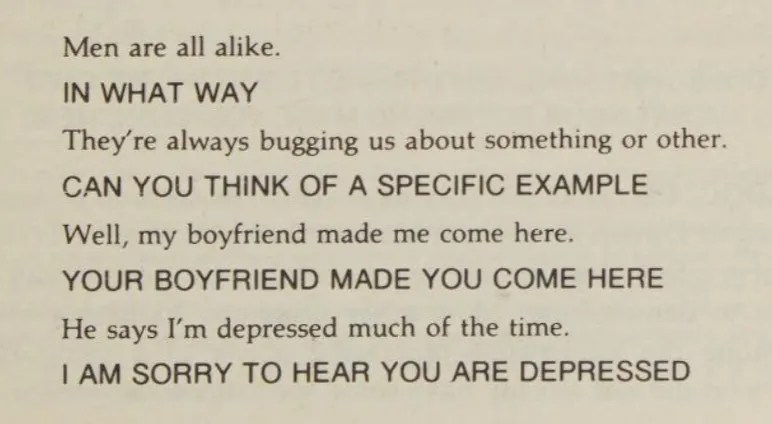
Matt Pearce revisits Neil Postman‘s 1992 Technopoly: The Surrender of Culture to Technology…
In the 1960s, a German-American computer scientist named Joseph Weizenbaum coded an early version of today’s AI chatbots. Weizenbaum called his program ELIZA, after the “My Fair Lady” character Eliza Doolittle who takes speech lessons (and gets better).
How people reacted to Weizenbaum’s crude creation tells us almost everything we need to know about AI hype more than half a century later.
ELIZA could hold basic “conversations,” including playing the role of a psychotherapist with real human users. [In the example above, ELIZA’s responses to one woman are shown in capital letters.]
Anybody with a cursory awareness of recent headlines about AI romances and AI psychosis already knows where this is going. ELIZA’s human interlocuters in the 1960s, despite talking to a clunky machine they knew had been programmed by Weizenbaum, refused to believe that they were talking to a mere machine. His secretary, having watched him build the contraption over several months, after just a few exchanges with ELIZA, asked Weizenbaum to leave the room so she could have some privacy.
Weizenbaum, exhibiting a bit of Freudian sangfroid about all this, was not surprised to see people form emotional attachments with inanimate objects. He’d already seen people get attached to their cars or guitars or computers. But “what I had not realized is that extremely short exposures to a relatively simple computer program could induce powerful delusional thinking in quite normal people,” Weizenbaum wrote in his 1976 book “Computer Power and Human Reason: From Judgment to Calculation.”…
… I learned about Weizenbaum’s ELIZA experiment from Neil Postman’s 1992 book “Technopoly: The Surrender of Culture to Technology,” a work of technoconservatism that, like Weizenbaum’s writings, was imbued with foresight about our struggles with today’s vastly more powerful technologies.
Consider this passage from Postman’s “Technopoly”:
In a technocracy, tools play a central role in the thought-world of the culture. Everything must give way, in some degree, to their development. The social and symbolic worlds become increasingly subject to the requirements of that development. Tools are not integrated into the culture; they attack the culture. They bid to become the culture. As a consequence, tradition, social mores, myth, politics, ritual, and religion have to fight for their lives.
Technology, attacking and taking over the culture? Bending society to its own imperative for advancement? In my United States of America? Postman (most famous for writing “Amusing Ourselves to Death”) thought the U.S. was the world’s first “Technopoly,” a society marked by “the submission of all forms of cultural life to the sovereignty of technique and technology,” where information itself has become a form of pollution.
To Postman, “the milieu in which Technopoly flourishes is one in which the tie between information and human purpose has been severed, i.e., information appears indiscriminately, directed at no one in particular, in enormous volume and at high speeds, and disconnected from theory, meaning or purpose.”
Neil Postman wrote “Technopoly” before the introduction of ChatGPT and Sora; TikTok and YouTube; Twitter and Facebook; Google Search and the Netscape browser. Postman wrote the book before Windows 95 existed. A philosophy of technology that mostly holds up through successive eras of technical revolution has already passed time’s first test, which is for the philosophy to outlive the philosopher. And Postman’s philosophy is ultimately conservative, motivated by the desire to preserve the traditions of humanism, social cohesion and a shareable sense of collective history.
Technoconservatism was old before it was new. Postman quotes Plato’s “Phaedrus,” where Thamus warns that whoever learns writing (one of our first dangerous technologies) “will cease to exercise their memory and become forgetful” and “will receive a quantity of information without proper instruction, and in consequence be thought very knowledgeable when they are for the most part quite ignorant.” And Postman, to his credit, is like — well, yeah! Writing really did that. A new technology is neither good nor bad, but ecological: it “does not add or subtract something. It changes everything. In the year 1500, fifty years after the printing press was invented, we did not have old Europe plus the printing press. We had a different Europe.”
In previous generations, societies dealt with information revolutions (which always produced information gluts) by creating institutions that prioritize “good” information and deprioritize the bad; think about schools with their organized curricula, courts with their standards of evidence, newspapers with their party lines or codes of journalistic ethics. But Postman notes that we got lucky after the Gutenberg revolution, when information technology’s development slowed down long enough for societies to catch up and be excellent:
From the early seventeenth century, when Western culture undertook to reorganize itself to accommodate the printing press, until the mid-nineteenth century [with the invention of the telegraph], no significant technologies were introduced that altered the form, volume, or speed of information. As a consequence, Western culture had more than two hundred years to accustom itself to the new information conditions created by the press. It developed new institutions, such as the school and representative government. It developed new conceptions of knowledge and intelligence, and a heightened respect for reason and privacy. It developed new forms of economic activity, such as mechanized production and corporate capitalism, and even gave articulate expression to the possibilities of a humane socialism. New forms of public discourse came into being through newspapers, pamphlets, broadsides, and books. It is no wonder that the eighteenth century gave us in the work of Goethe, Voltaire, Diderot, Kant, Hume, Adam Smith, Edmund Burke, Vico, Edward Gibbon, and, of course, Jefferson, Madison, Franklin, Adams, Hamilton, and Thomas Paine. I weight the list with America’s “Founding Fathers” because technocratic-typographic America was the first nation ever to be argued into existence in print.
Contrast the luxuriously slow social pace of the Gutenberg era with today’s information development timelines. Over the course of three decades, we’ve seen the rise and now-decline of the open web; the rise and now-decline of social media; the rise of short-form video and the rise of chatbots and synthetic information. All created enormous economic and philosophical disruptions whose fundamental impacts you can’t get a group of people in a room together to describe accurately. Among the disruptions: These increasingly efficient forms of sharing information keep encountering falling test scores; universities are trying to implement AI as their own students use it for cheating or boo the tech at their graduations; people are falling in love with their chatbots, which sometimes tell their users to kill themselves. A society that wants to understand itself probably wouldn’t act like this…
Read on for how we might — dare one suggest, should— act: “A society that wants to understand itself probably wouldn’t act like this,” from @mattdpearce.com.
Compare to/contrast with with Yuval Avnar‘s riff on Pascal’s musing on the implications of his invention, the “arithmetic machine” (an early, if not the first, modern mechanical calculator): “The Inventor of the Thinking Machine Didn’t Worry. Neither Should You.“
* Neil Postman, Amusing Ourselves to Death: Public Discourse in the Age of Show Business
###
As we introspect, we might send pointed birthday greetings to Ambrose Bierce; he was born on this date in 1842. His satirical lexicon The Devil’s Dictionary was named as one of “The 100 Greatest Masterpieces of American Literature” by the American Revolution Bicentennial Administration. His story “An Occurrence at Owl Creek Bridge” has been described as “one of the most famous and frequently anthologized stories in American literature”; and his book Tales of Soldiers and Civilians (also published as In the Midst of Life) was named by the Grolier Club as one of the 100 most influential American books printed before 1900.
A prolific and versatile writer, Bierce was regarded as one of the most influential journalists in the United States, and as a pioneering writer of realist fiction. For his horror writing, Michael Dirda ranked him alongside Edgar Allan Poe and H. P. Lovecraft. S. T. Joshi argues that he may well be the greatest satirist America has ever produced, and can take his place with such figures as Juvenal, Swift, and Voltaire. His war stories influenced Stephen Crane, Ernest Hemingway, and others; and he was an influential and feared literary critic. In recent decades Bierce has gained even wider regard as a fabulist and for his poetry.
In 1913, Bierce told reporters that he was travelling to Mexico to gain first-hand experience of the Mexican Revolution. He disappeared over the border and was never seen again.
Apropos the piece featured above:
TELEPHONE, n. An invention of the devil which abrogates some of the advantages of making a disagreeable person keep his distance.
– The Devil’s Dictionary

You must be logged in to post a comment.