Posts Tagged ‘Life’
“An understanding of the natural world, and what’s in it is a source of not only great curiosity but great fulfillment”*…
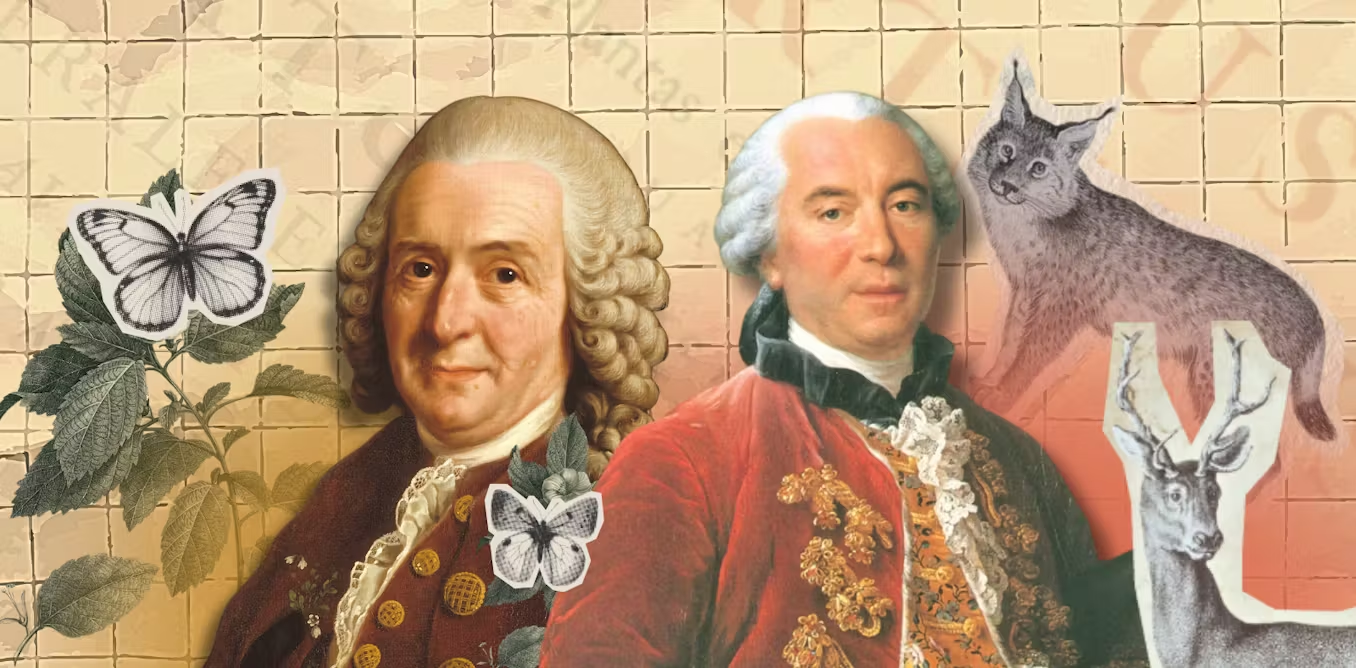
Ah yes, but in what does that understanding consist? John Long considers the competing frameworks of Linnaeus and Buffon…
The modern science biography must hold back no punches in its mission to represent the subject’s life, equally celebrating their great works while including their personal shortcomings.
Jürgen Neffe’s Einstein: A Biography (2005) and Dava Sobel’s The Elements of Marie Curie (2024) are wonderful examples of this style. Such books succeed in clearly explaining the complex science of their subject’s work for non-scientific readers, enabling a deep appreciation of their achievements and bringing them to life as rounded, flawed humans.
The modern science biography must hold back no punches in its mission to represent the subject’s life, equally celebrating their great works while including their personal shortcomings.
Jürgen Neffe’s Einstein: A Biography (2005) and Dava Sobel’s The Elements of Marie Curie (2024) are wonderful examples of this style. Such books succeed in clearly explaining the complex science of their subject’s work for non-scientific readers, enabling a deep appreciation of their achievements and bringing them to life as rounded, flawed humans.
Jason Roberts’ Every Living Thing – The Great and Deadly Race to Know all Life is another of these rare works. This engrossing, precisely researched book focuses on two central characters born in the same year: Carl Linnaeus (1707-1778), a Swede, and Frenchman Georges-Louis LeClerc, the Compte de Buffon (1707-1788), better known as just Buffon.
Roberts’ book won the 2025 Pulitzer Prize for biography. His writing pulls the reader effortlessly through the story, revealing delightful, unexpected twists and turns in the two men’s complex and disparate lives. Each worked diligently to reach a level of global notoriety for their many published books. Both are revered in the natural history world today.
Linnaeus, a biologist and physician, is known for his system of hierarchical classification: how all living things comprise a genus and species, (we humans are Homo sapiens), which fit into families, orders, classes and so on. (A good many intermediate ranks were added later). While his work has been hugely influential, Linnaeus is portrayed by Roberts at times as being lazy, vain and unethical.
Linnaeus was primarily driven to be the first to name new species. Buffon was working on a grand thesis of how all life’s organisms function and are related to one another. A wealthy count who inherited a vast fortune at the age of ten, Buffon trained as a lawyer but became fascinated by the trees that grew in his large garden.
Buffon is best known today for his extensive books on natural history and works on mathematics and cosmology. He calculated the Earth was much older than the Bible predicted and that life sprung from unorganised matter. He explored the relationships between organisms rather than how they were classified. His core work formed the basis for modern evolutionary theory.
Why was all this important? At the time, the task of classifying plants was vital to the growing economies of nations. Travellers to the far reaches of the globe brought back examples of economically valuable new species, like plant foods, medicinal plants or beautiful ornamental specimens.
The author’s central thesis is Linnaeus was not as brilliant as history paints him and Buffon was a far greater genius for his day.
Where does genius come from, Roberts asks? Is it inherent by birth, grown from an inspiring education, or is it something within that is nurtured by passion?
Both these brilliant men who made a lasting mark on science came from not very inspiring families. Nor did they excel at school or university. This story shows success in academic work is not just about intellect, but intimately tied to the ethics and morality of doing research…
Eminently worth reading in full: “How do we understand life on Earth? A prize-winning biography charts the tension between two types of science ‘genius’” from @theconversation.com.
* David Attenborough, who also observed, “We moved from being a part of nature to being apart from nature.”
###
As we noodle on knowing, we might send birthday greetings to Gregor Mendel; he was born on this date in 1822 (though some sources give the date as July 20). A botanist, geneticist, and monk, he pioneered in the study of heredity.
Mendel spent his adult life with the Augustinian monastery in Brunn, where as a plant experimenter, he was the first to lay the mathematical foundation of the science of genetics, in what came to be called Mendelism. Over the period 1856-63, Mendel grew and analyzed over 28,000 pea plants. He carefully studied for each their plant height, pod shape, pod color, flower position, seed color, seed shape and flower color. He made two very important generalizations from his pea experiments, known today as the Laws of Heredity, and coined the genetic terms recessiveness and dominance. He read a paper on his studies in 1865 to the Brünn Society for Natural Sciences in Moravia– but it lay unappreciated until 1900.

“Who knows whether it is not true that phosphorus and mind are not the same thing?”*…

In an excerpt from his book White Light, Jack Lohmann explores the rare and special element phosphorus…
In the moments that follow the death of a whale, when the light disappears and is swallowed by dark, the body’s weight draws to the base of the sea and compresses. It settles in mud. It forms an environment known as a whale fall, a world that will last for decades.
The whale fall grows in stages. The larger species come, the eels, the sharks. They rip apart the dead whale’s flesh. The tail, the head, the organs are consumed. The size of predator lessens as the length of time extends. Tiny mouths clean the bones dry. A skeleton remains; bacteria descend upon it. They turn bones into nutrition, consuming the whale in a process that is almost imperceptibly slow. Worms arrive and burrow through the skeleton. Other organisms come and eat the worms. Larger predators reinhabit the space. Within a barren, lightless plain, on the basis of decaying bones, a world is born.
Whalebone contains an element that is rare: phosphorus, a limiting ingredient in life on Earth. Of all the elements of the periodic table, phosphorus is one of six that are absolutely necessary for the existence of life. Of those six, phosphorus is the most limited. Because of its rarity, it controls life—it determines who grows and shrinks, who lives and dies, what areas become biologically wealthy and which ones will be biologically poor. “The maximum mass of protoplasm which the land can support, like the maximum that the sea can support, is dictated by the phosphorus content,” Isaac Asimov, the biochemist, wrote in 1959. Phosphorus, he wrote, “is life’s bottleneck.”
Each of the six essential elements performs a vital role. Carbon forms long chains, connecting compounds together to create large, complicated structures. Hydrogen and oxygen combine to form water. Nitrogen and sulfur create proteins, providing organisms with food. Phosphorus converts energy, carries information, constructs cell membranes, and performs a host of other actions that underpin life’s complexity. Phosphorus allows seeds to grow and fruit to ripen. It is the main ingredient in matches. It both enables life and destroys it. Sarin gas, created from white phosphorus, is a potent agent of chemical warfare.
When it is isolated, phosphorus emits a steady, menacing glow. Phosphorescence is the name that is applied to this phenomenon: it describes materials that glow without ignition. The glow of the upper ocean is phosphorescent. Some paint glows. One consistent feature of the near-death experience, reported by people whose hearts stopped beating and bodies began to fade, has been the presence of a peculiar brightness all around. Images flash, the soul floats, and the body is left behind. The mind feels calm. (It is, in fact, surging with electricity: its final moments are seemingly near.)
When phosphorus burns, it bonds with oxygen, creating phosphate: one atom phosphorus, four atoms oxygen. Phosphate is remarkably prevalent in all life forms, although it is otherwise comparatively rare throughout the world. It is crucial to our existence. Outside of life, phosphate exists in geological form, made up of condensed, crystalline structures that are hidden in the crevices of our planet. Inside of life, it exists in every cell. It forms the membranes that hold the parts of cells together. It provides energy, in the form of adenosine triphosphate, ATP, which powers the actions of all life-forms. Even before birth, each of us gained identities by way of the cumulative influences of small phosphate groups, which held together the strands of our DNA. As we grew from zygote to cellular zillionaire, those groups enabled the replication of DNA and the formation of more complex beings—us.
The phosphorus in our bodies came, at first, from molten lava, hardened into rock. That rock eroded out of mountains, flowed down rivers, and fertilised the land below. The land supported the growth of plants, which allowed the spread of animals. The human body is, roughly speaking, one percent phosphorus. Phosphorus is spread throughout our cells, but it is concentrated mainly in our bones. We are extensions of the planet—we forage for phosphorus by eating plants and animals, and we fertilise the soil through waste and death. Plants thrive on this natural fertiliser. Phosphorus moves through the bodies of plants and animals, fungi and bacteria, and ultimately, usually, makes its way to the water. It is deposited as sediment: it forms new rock on the seafloor. The rock is made of compressed bodies, phosphorus squeezed from lives that are no more. It is littered with phosphatic bones, with phosphate-encrusted bivalves, with fossilised phosphate scraps. These things are hidden, set to be released in geologic time. As this time passes, the Earth’s plates move. The underwater rock becomes land. The land erodes. The cycle continues.
The story of phosphorus runs through every strand of DNA in every organism in the world. It runs through every piece of food and waste, and every living thing. But the story of how humans changed the phosphorus cycle is rooted in a few specific spots. We first found phosphate rock in England, and the fertiliser industry began. The industry changed when rock of greater scale was found in Florida; but today, the Florida rock is almost gone. Our global agricultural system rests upon the dictates of Morocco’s monarch.
Already, in some places around the world, the end of phosphate rock has occurred. It happened on the island of Nauru, far out in the Pacific, and there we see a world that passed its limits. It peaked, declined, and fell to ruin. Amid those ruins, the story of our broken phosphorus cycle comes to a close.
But it does not need to end there. There is mass resistance to the modern expansion of corporate farming methods. The world’s small farmers, who produce half our food, work their land with the nuanced understanding that agriculture has always been an ecological effort. They safeguard phosphate and replenish it.
Scientists, economists, and engineers are working to make phosphorus recycling compatible with modern life. Food, we now know, feeds our bodies better when it comes from healthy soils, and healthy soils come from nature, not from machines. Supported by this understanding, people are working to create a better agriculture. Cities are composting food scraps. Disenfranchised farmers are fighting for their land. If we listen to those with knowledge—rather than those with money—it is possible to restore the cycles of the earth.
There was once, long ago, a different kind of phosphate problem. When life first started, 4.5 billion years ago, the problem was that phosphorus existed only in rocks—and then, of course, no one was available to mine them. Life needed concentrated pockets of phosphorus in order to form. In a century of study, scientists have not come to an agreement about how nature solved its problem. Something happened in a pond, around a vent, near a meteor strike—something. We do not know exactly. We do know something happened, though, because we are here.
Today, phosphorus remains a part of the mix of chemical elements present in the earth’s magma, and volcanic eruptions create sprawling beds of igneous rock that hold within them trace amounts of the mineral. Now, however, humanity has transferred large amounts of phosphorus onto farmland, into streams and ponds, into rivers, and, ultimately, into the ocean.
The result of this is somewhat murky, but it appears that humans are changing the geology of the world. We are leaving a legacy in stone, and we are doing it by creating anew a world that once existed—one overrun with algae in the waters, with dying fish, with widespread oxygen loss in the sea. This new world is not, for us, ideal. (For algae lovers, it may be paradise.) But it is conducive to the formation of phosphate rock. This new rock will be formed and buried over intervals of millions of years. It will be hidden beneath the ground, prepared to be discovered in the future.
Just as phosphate enables life in humans, so too does it feed the life of the whale fall. The destruction of the bones of the whale provides enough fat to support a community of bacteria, and it releases enough phosphate to support the expansion of the ecosystem. The whale fall lasts because of the barrenness that surrounds it: the cold temperatures and darkness of the deep ocean preserve the whale carcass for the creatures that can access it, allowing the ecosystem to exist without floating away or being quickly eaten. Instead, whale falls remain as they begin—remote, shadowed, and teeming with life.
The nutrients provided by a whale fall represent, in a single day, two thousand years of sustenance. Their effect, ecologically, is strong enough that biologists have identified dozens of species of ocean-dwelling organism that evolved to specialise only in whale falls, those thousands of little worlds beneath the sea. There are four-foot worms and hairy crabs, clinging shrimp and curious sharks, bacteria that float, fish that feast, a mess of life, growing and thriving, a community unto itself, separated from all other beings by a dark emptiness that extends in all directions.
This blip of abundance seems bound to recede, and eventually it will. Over a period of half a century, the whale fall’s nutrients begin to dwindle, and the organisms that feasted on them go away in turn. The ecosystem fades into the landscape that surrounds it. Barrenness overtakes the ground. Just decades after a new world of opportunity opened up, life disappears; this little spot of seafloor is unlikely to be visited by such prosperity ever again…
Of the six chemical elements necessary for life, phosphorus is the rarest. It determines what grows and shrinks, who lives and dies: “Life’s Ancient Bottleneck,” via @quillette.bsky.social.
* Stendhal
###
As we esteem an exquisite element, we might recall that it was on this date in 1897 that Jell-O was introduced in strawberry, raspberry, orange and lemon fruit flavours. The product is based on gelatin, derived from a protein produced from collagen– importantly (a la whalebone) composed in part of phosphorus— extracted from boiled bones, connective tissues, and other animal products.
Peter Cooper, inventor and founder of the Cooper Union for the Advancement of Science and Art, obtained the first American patent for the manufacture of gelatin in 1845. In 1895, cough syrup manufacturer Pearl B. Wait purchased the patent and developed a packaged gelatin dessert. Wait’s wife, May David Wait named it “Jell-O.” In 1899, Wait sold Jell-O to “Orator Francis Woodward”, whose Genesee Pure Food Company produced the successful Grain-O health drink. While sales were intitially slow, they grew steadily, and Walt’s company (which changed its name to Jell-O Company) merged first with Postum, then General Foods, then Kraft– which reports that they sell more than a million packages of Jell-O brand gelatin each day.

“I think the next century will be the century of complexity”*…

… and as Philip Ball reports, a team of scientists at Carnegie Science agrees…
In 1950 the Italian physicist Enrico Fermi was discussing the possibility of intelligent alien life with his colleagues. If alien civilizations exist, he said, some should surely have had enough time to expand throughout the cosmos. So where are they?
Many answers to Fermi’s “paradox” have been proposed: Maybe alien civilizations burn out or destroy themselves before they can become interstellar wanderers. But perhaps the simplest answer is that such civilizations don’t appear in the first place: Intelligent life is extremely unlikely, and we pose the question only because we are the supremely rare exception.
A new proposal by an interdisciplinary team of researchers challenges that bleak conclusion. They have proposed nothing less than a new law of nature, according to which the complexity of entities in the universe increases over time with an inexorability comparable to the second law of thermodynamics — the law that dictates an inevitable rise in entropy, a measure of disorder. If they’re right, complex and intelligent life should be widespread.
In this new view, biological evolution appears not as a unique process that gave rise to a qualitatively distinct form of matter — living organisms. Instead, evolution is a special (and perhaps inevitable) case of a more general principle that governs the universe. According to this principle, entities are selected because they are richer in a kind of information that enables them to perform some kind of function.
This hypothesis, formulated by the mineralogist Robert Hazen [here] and the astrobiologist Michael Wong [here] of the Carnegie Institution in Washington, D.C., along with a team of others, has provoked intense debate. Some researchers have welcomed the idea as part of a grand narrative about fundamental laws of nature. They argue that the basic laws of physics are not “complete” in the sense of supplying all we need to comprehend natural phenomena; rather, evolution — biological or otherwise — introduces functions and novelties that could not even in principle be predicted from physics alone. “I’m so glad they’ve done what they’ve done,” said Stuart Kauffman, an emeritus complexity theorist at the University of Pennsylvania. “They’ve made these questions legitimate.”…
[Ball explains the origin and outline of Hazen’s and Wong’s conjecture, explores the critiques– among them, that it’s not clear how to test the hypothesis– and examines the resonant work on Assembly Theory being done by Lee Cronin and Sara Walker…]
… Wong said there is more work still to be done on mineral evolution, and they hope to look at nucleosynthesis and computational “artificial life.” Hazen also sees possible applications in oncology, soil science and language evolution. For example, the evolutionary biologist Frédéric Thomas of the University of Montpellier in France and colleagues have argued that the selective principles governing the way cancer cells change over time in tumors are not like those of Darwinian evolution, in which the selection criterion is fitness, but more closely resemble the idea of selection for function from Hazen and colleagues.
Hazen’s team has been fielding queries from researchers ranging from economists to neuroscientists, who are keen to see if the approach can help. “People are approaching us because they are desperate to find a model to explain their system,” Hazen said.
But whether or not functional information turns out to be the right tool for thinking about these questions, many researchers seem to be converging on similar questions about complexity, information, evolution (both biological and cosmic), function and purpose, and the directionality of time. It’s hard not to suspect that something big is afoot. There are echoes of the early days of thermodynamics, which began with humble questions about how machines work and ended up speaking to the arrow of time, the peculiarities of living matter, and the fate of the universe…
A new suggestion that complexity increases over time, not just in living organisms but in the nonliving world, promises to rewrite notions of time and evolution: “Why Everything in the Universe Turns More Complex,” from @philipcball.bsky.social and @quantamagazine.bsky.social.
See also: Benjamin Bratton‘s explantion of the work he and his collegues are doing at a new institute at UCSD: “Antikythera.” See his recent Long Now Foundation talk on this same subject here.
* Stephen Hawking
###
As we celebrate complication, we might spare a thought for G. N. Ramachandran (Gopalasamudram Narayanan Ramachandran); he died on this date in 2001. A biophysicist, he discovered the triple helical “coiled coil” structure of the collagen molecule, among other remarkable contributions to structural biology.
Ramachandran was a master of X-ray crystallography, and with his colleagues, constructed space filling models of protein molecules. He devised the Ramachandran Plot, a method to diagram the conformation of polypeptides, polysaccharides and polynucleotides– which remains the international standard to describe protein structures.
Ramachandran, inspired by the ancient Syaad Nyaaya (doctrine of “may be”), also explored artificial intelligence. He developed the Boolean Vector Matrix Formulation which has important application in writing software for AI.

“The past lives within the present, and our ancestors breathe through our children”*…
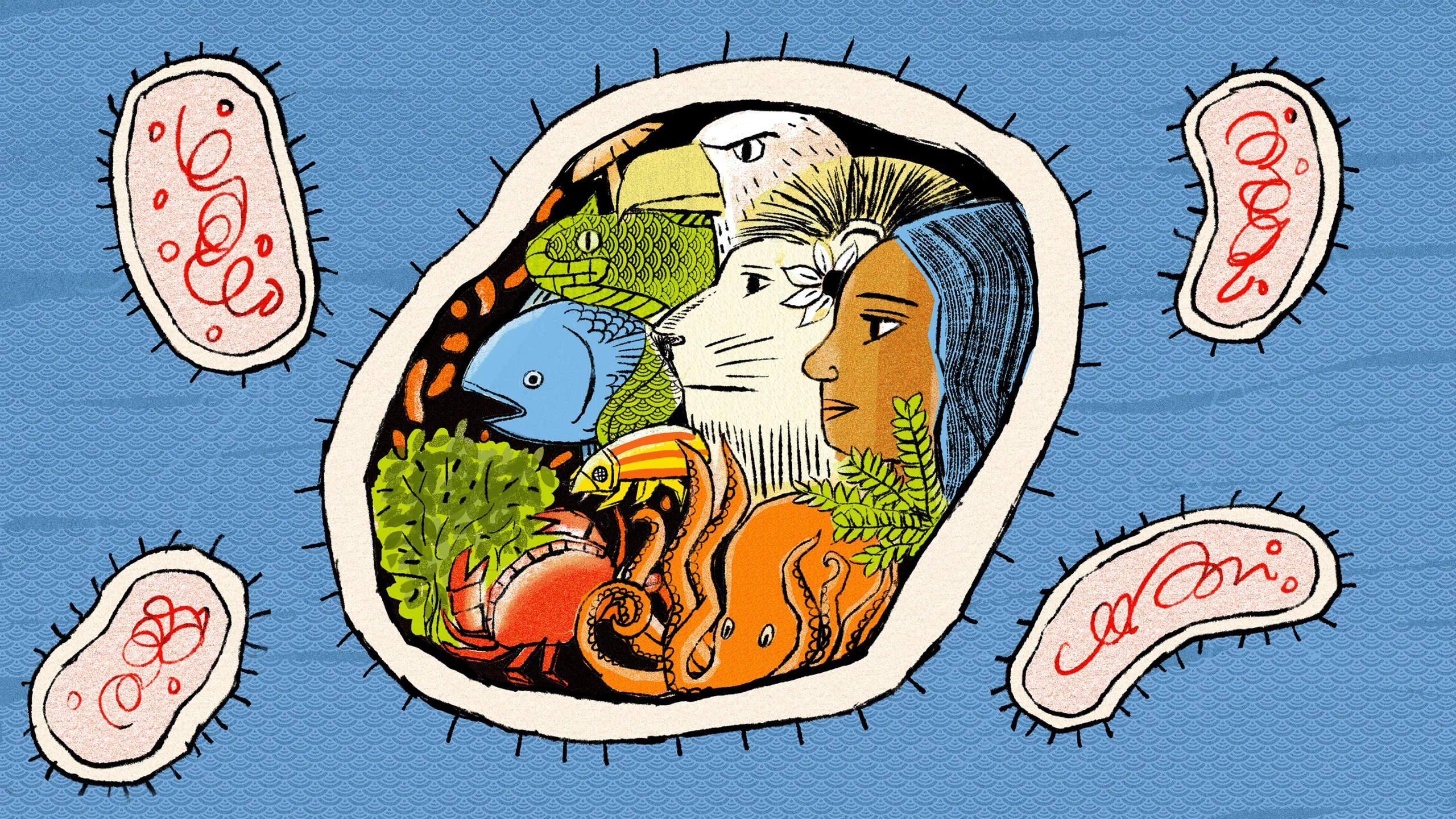
Indeed, that’s true all the way back. And as Jonathan Lambert explains, we now have more visibility on that distant past. The emerging understanding of our “last universal common ancestor” suggests it was a relatively complex organism living 4.2 billion years ago, a time long considered too harsh for life to flourish…
If you follow any path of ancestry back far enough, you’ll reach the same single point. Whether you begin with gorillas or ginkgo trees or bacteria that live deep in the bowels of the Earth — or yourself, for that matter — all roads lead to LUCA, the “last universal common ancestor.” This ancient, single-celled organism (or, possibly, population of single-celled organisms) was the progenitor of every varied form that makes a life for itself on our planet today.
LUCA does not represent the origin of life, the instance whereby some chemical alchemy snapped molecules into a form that allowed self-replication and all the mechanisms of evolution. Rather, it’s the moment when life as we know it took off. LUCA is the furthest point in evolutionary history that we can glimpse by working backward from what’s alive today. It’s the most recent ancestor shared by all modern life‚ our collective lineage traced back to a single ancient cellular population or organism.
“It’s not the first cell, it’s not the first microbe, it’s not the first anything, really,” said Greg Fournier, an evolutionary biologist at the Massachusetts Institute of Technology. “In a way, it is the end of the story of the origin of life.”
Still, understanding LUCA — whether it was simple or complex, and how quickly it emerged after life’s origin — could help answer some of our deepest questions about where we come from and whether we’re alone in the universe.
“[LUCA] tells our own story,” said Edmund Moody (opens a new tab), an evolutionary biologist at the University of Bristol. “It gives us a point from which we can look even further back.”
For half a century, biologists have focused on different kinds of physiological, genomic and fossil evidence to paint portraits of LUCA that sometimes clash dramatically. In 2024, Moody and a team of interdisciplinary researchers, including geologists, paleontologists, system modelers and phylogeneticists, combined their knowledge to build a probabilistic model that reconstructs modern life’s shared ancestor and estimates when it lived.
The analysis, published in Nature Ecology and Evolution in July, sketched a surprisingly complex picture of the cell. LUCA lived off hydrogen gas and carbon dioxide, boasted a genome as large as that of some modern bacteria, and already had a rudimentary immune system, according to the study. Its genomic complexity, the authors argue, suggests that LUCA was one of many lineages — the rest now extinct — living about 4.2 billion years ago, a turbulent time relatively early in Earth’s history and long thought too harsh for life to flourish.
The analysis reaches two conclusions that seem in conflict with each other, according to Aaron Goldman, who studies the molecular evolution of early life at Oberlin College and wasn’t involved in the new research. “The first is that LUCA was a complex cellular organism that likely lived in a complex ecological setting,” he said. “The second is that LUCA dates to a time that is pretty early in the history of Earth.” The results could mean that life evolved from a simple replicator into something resembling modern microbes remarkably quickly, he said. “That’s really exciting.”
“Our work suggests that those early steps of evolution weren’t hard; they’re pretty easy,” said co-author Phil Donoghue, an evolutionary biologist at the University of Bristol. “If you’re concerned with the origin of microbial-grade life, then that’s apparently very easy, and it should be quite common in the universe.”
Not all experts in the field agree, however. Some argue that a few hundred million years is not enough time for complex life to have evolved. The authors stress that their analysis is a first attempt to paint a fuller, admittedly fuzzy, picture of LUCA. “I fully expect and hope people prove us wrong in certain aspects,” said Moody, the paper’s lead author, especially if those new results offer a clearer view of the ancient ancestor of all life we know…
Eminently worth reading in full: “All Life on Earth Today Descended From a Single Cell. Meet LUCA,” from @evolambert in @QuantaMagazine.
###
As we look back, we might send microscopic birthday greetings to Lewis Thomas; he was born on this date in 1913. A physician, poet, etymologist, essayist, administrator, educator, policy advisor, and researcher, he distinguished himself in medicine and microbiology both for his suggestion that an immunosurveillance mechanism protects us from the possible ravages of mutant cells (an idea later championed by Macfarlane Burnett) and for his proposal that viruses have played a major role in the evolution of species by their ability to move pieces of DNA from one individual or species to another.
But Lewis is more widely known for his writing, perhaps most especially for his first two books– The Lives of a Cell: Notes of a Biology Watcher (which won National Book Awards in two categories) and The Medusa and the Snail: More Notes of a Biology Watcher (which won another National Book Award)– which underscored the interconnectedness of life by sketching the ways that what is seen under the microscope is similar to the way human beings live.

“There are only two ways to live your life. One is as though nothing is a miracle. The other is as though everything is a miracle.”*…

… Indeed, the same might be said of life itself. David Krakauer and Chris Kempes of the Santa Fe Institute suggest that life is starting to look a lot less like an outcome of chemistry and physics, and more like a computational process…
… Today, doubts about conventional explanations of life are growing and a wave of new general theories has emerged to better define our origins. These suggest that life doesn’t only depend on amino acids, DNA, proteins and other forms of matter. Today, it can be digitally simulated, biologically synthesised or made from entirely different materials to those that allowed our evolutionary ancestors to flourish. These and other possibilities are inviting researchers to ask more fundamental questions: if the materials for life can radically change – like the materials for computation – what stays the same? Are there deeper laws or principles that make life possible?
Our planet appears to be exceptionally rare. Of the thousands that have been identified by astronomers, only one has shown any evidence of life. Earth is, in the words of Carl Sagan, a ‘lonely speck in the great enveloping cosmic dark.’ This apparent loneliness is an ongoing puzzle faced by scientists studying the origin and evolution of life: how is it possible that only one planet has shown incontrovertible evidence of life, even though the laws of physics are shared by all known planets, and the elements in the periodic table can be found across the Universe?
The answer, for many, is to accept that Earth really is as unique as it appears: the absence of life elsewhere in the Universe can be explained by accepting that our planet is physically and chemically unlike the many other planets we have formally identified. Only Earth, so the argument goes, produced the special material conditions conducive to our rare chemistry, and it did so around 4 billion years ago, when life first emerged.
In 1952, Stanley Miller and his supervisor Harold Urey provided the first experimental evidence for this idea through a series of experiments at the University of Chicago. The Miller-Urey experiment, as it became known, sought to recreate the atmospheric conditions of early Earth through laboratory equipment, and to test whether organic compounds (amino acids) could be created in a reconstructed inorganic environment. When their experiment succeeded, the emergence of life became bound to the specific material conditions and chemistry on our planet, billions of years ago.
However, more recent research suggests there are likely countless other possibilities for how life might emerge through potential chemical combinations. As the British chemist Lee Cronin, the American theoretical physicist Sara Walker and others have recently argued, seeking near-miraculous coincidences of chemistry can narrow our ability to find other processes meaningful to life. In fact, most chemical reactions, whether they take place on Earth or elsewhere in the Universe, are not connected to life. Chemistry alone is not enough to identify whether something is alive, which is why researchers seeking the origin of life must use other methods to make accurate judgments.
Today, ‘adaptive function’ is the primary criterion for identifying the right kinds of biotic chemistry that give rise to life, as the theoretical biologist Michael Lachmann (our colleague at the Santa Fe Institute) likes to point out. In the sciences, adaptive function refers to an organism’s capacity to biologically change, evolve or, put another way, solve problems. ‘Problem-solving’ may seem more closely related to the domains of society, culture and technology than to the domain of biology. We might think of the problem of migrating to new islands, which was solved when humans learned to navigate ocean currents, or the problem of plotting trajectories, which our species solved by learning to calculate angles, or even the problem of shelter, which we solved by building homes. But genetic evolution also involves problem-solving. Insect wings solve the ‘problem’ of flight. Optical lenses that focus light solve the ‘problem’ of vision. And the kidneys solve the ‘problem’ of filtering blood. This kind of biological problem-solving – an outcome of natural selection and genetic drift – is conventionally called ‘adaptation’. Though it is crucial to the evolution of life, new research suggests it may also be crucial to the origins of life.
This problem-solving perspective is radically altering our knowledge of the Universe…
The idea of life asa kind of computational process has roots that go back to the 4th century BCE, when Aristotle introduced his philosophy of hylomorphism in which functions take precedence over forms. For Aristotle, abilities such as vision were less about the biological shape and matter of eyes and more about the function of sight. It took around 2,000 years for his idea of hylomorphic functions to evolve into the idea of adaptive traits through the work of Charles Darwin and others. In the 19th century, these naturalists stopped defining organisms by their material components and chemistry, and instead began defining traits by focusing on how organisms adapted and evolved – in other words, how they processed and solved problems. It would then take a further century for the idea of hylomorphic functions to shift into the abstract concept of computation through the work of Alan Turing [and here] and the earlier ideas of Charles Babbage [here].
In the 1930s, Turing became the first to connect the classical Greek idea of function to the modern idea of computation, but his ideas were impossible without the work of Babbage, a century before. Important for Turing was the way Babbage had marked the difference between calculating devices that follow fixed laws of operation, which Babbage called ‘Difference Engines’, and computing devices that follow programmable laws of operation, which he called ‘Analytical Engines.’
Using Babbage’s distinction, Turing developed the most general model of computation: the universal Turing Machine…
Turing did not describe any of the materials out of which such a machine would be built. He had little interest in chemistry beyond the physical requirement that a computer store, read and write bits reliably. That is why, amazingly, this simple (albeit infinite) programmable machine is an abstract model of how our powerful modern computers work. But the theory of computation Turing developed can also be understood as a theory of life. Both computation and life involve a minimal set of algorithms that support adaptive function. These ‘algorithms’ help materials process information, from the rare chemicals that build cells to the silicon semiconductors of modern computers. And so, as some research suggests, a search for life and a search for computation may not be so different. In both cases, we can be side-tracked if we focus on materials, on chemistry, physical environments and conditions.
In response to these concerns, a set of diverse ideas has emerged to explain life anew, through principles and processes shared with computation, rather than the rare chemistry and early Earth environments simulated in the Miller-Urey experiment. What drives these ideas, developed over the past 60 years by researchers working in disparate disciplines – including physics, computer science, astrobiology, synthetic biology, evolutionary science, neuroscience and philosophy – is a search for the fundamental principles that drive problem-solving matter. Though researchers have been working in disconnected fields and their ideas seem incommensurable, we believe there are broad patterns to their research on the origins of life. However, it can be difficult for outsiders to understand how these seemingly incommensurable ideas are connected to each other or why they are significant. This is why we have set out to review and organise these new ways of thinking.
Their proposals can be grouped into three distinct categories, three hypotheses, which we have named Tron, Golem and Maupertuis…
[The authors unpack all three proposals…]
… Is life problem-solving matter? When thinking about our biotic origins, it is important to remember that most chemical reactions are not connected to life, whether they take place here or elsewhere in the Universe. Chemistry alone is not enough to identify life. Instead, researchers use adaptive function – a capacity for solving problems – as the primary evidence and filter for identifying the right kinds of biotic chemistry. If life is problem-solving matter, our origins were not a miraculous or rare event governed by chemical constraints but, instead, the outcome of far more universal principles of information and computation. And if life is understood through these principles, then perhaps it has come into existence more often than we previously thought, driven by problems as big as the bang that started our abiotic universe moving 13.8 billion years ago.
The physical account of the origin and evolution of the Universe is a purely mechanical affair, explained through events such as the Big Bang, the formation of light elements, the condensation of stars and galaxies, and the formation of heavy elements. This account doesn’t involve objectives, purposes, or problems. But the physics and chemistry that gave rise to life appear to have been doing more than simply obeying the fundamental laws. At some point in the Universe’s history, matter became purposeful. It became organised in a way that allowed it to adapt to its immediate environment. It evolved from a Babbage-like Difference Engine into a Turing-like Analytical Engine. This is the threshold for the origin of life.
In the abiotic universe, physical laws, such as the law of gravitation, are like ‘calculations’ that can be performed everywhere in space and time through the same basic input-output operations. For living organisms, however, the rules of life can be modified or ‘programmed’ to solve unique biological problems – these organisms can adapt themselves and their environments. That’s why, if the abiotic universe is a Difference Engine, life is an Analytical Engine. This shift from one to the other marks the moment when matter became defined by computation and problem-solving. Certainly, specialised chemistry was required for this transition, but the fundamental revolution was not in matter but in logic.
In that moment, there emerged for the first time in the history of the Universe a big problem to give the Big Bang a run for its money. To discover this big problem – to understand how matter has been able to adapt to a seemingly endless range of environments – many new theories and abstractions for measuring, discovering, defining and synthesising life have emerged in the past century. Some researchers have synthesised life in silico. Others have experimented with new forms of matter. And others have discovered new laws that may make life as inescapable as physics…
Eminently worth reading in full: “Problem-solving matter,” from @sfiscience and @aeonmag.
Pair with “At the limits of thought” (also by Krakauer).
* Albert Einstein
###
As we obsess on ontology, we might spare a thought for someone concerned with life as it is lived: Sigismund Schlomo “Sigmund” Freud; he died on this date in 1939. A neurologist, he was the founder of psychoanalysis– a clinical method for evaluating and treating pathologies seen as originating from conflicts in the psyche, through dialogue between patient and psychoanalyst, and the distinctive theory of mind and human agency derived from it.

.jpg)
You must be logged in to post a comment.