The enshittification of the major social media platforms has become impossible to ignore… and has led many to predict a more decentralized future for the web. But as William Gibson famously observed, “the future is already here, it’s just not evenly distributed.”
Case in point: Ben Smith‘s blockbuster Semafor post on the flourishing ecology of private chat groups that has emerged, starting with…
Chatham House, a giant and raucous Signal group that forms part of the sprawling network of influential private chats that began during the fervid early days of the COVID-19 pandemic, and which have fueled a new alliance of tech and the US right. That same week in Chatham House, Lonsdale and the Democratic billionaire Mark Cuban sparred over affirmative action, and Cuban and Daily Wire founder Ben Shapiro discussed questions of culture and work ethic.
This constellation of rolling elite political conversations revolve primarily around the venture capitalist Marc Andreessen and a circle of Silicon Valley figures. None of their participants was surprised to see Trump administration officials firing off secrets and emojis on the platform last month. I did not have the good fortune to be accidentally added to one of the chats, which can be set to make messages disappear after just 30 seconds.
But their influence flows through X, Substack, and podcasts, and constitutes a kind of dark matter of American politics and media. The group chats aren’t always primarily a political space, but they are the single most important place in which a stunning realignment toward Donald Trump was shaped and negotiated, and an alliance between Silicon Valley and the new right formed. The group chats are “the memetic upstream of mainstream opinion,” wrote one of their key organizers, Sriram Krishnan, a former partner in the venture capital firm Andreessen Horowitz (typically styled a16z) who is now the White House senior policy adviser for AI.
Of course, these are hardly the only power group chats. Anti-Trump liberals are now coordinating their responses on Signal. There are group chats for Black political elites and morning show producers. A vast and influential parallel set of tech conversations take place on WhatsApp. There’s a big China-friendly group over on WeChat. Elite podcasters have one…
… Many of the [Chatham House] chatters celebrate their success in driving the ascendant politics of the Trump era, which they hope will bring back patriotic industry and traditional cultural norms. Some who have left or lurk consider it a sinister phenomenon in which Andreessen exerted unspoken gravitational pull, as one participant put it: “You’d see that the writers were bending toward the billionaires, and even the ones who prided themselves on being iconoclastic were bending to the tastes and the centers of gravity of power.”…
… You should therefore be very suspicious of anyone who claims to be in the Genuine Ideas business but who is afraid to fully speak their mind in public. For the past half decade at least, America has been bombarded with the grumblings of influential people griping that they are not “allowed” to say what they really think, these days. Because of wokeness, and witch hunts, and things like that. What do they mean when they argue that they are not “allowed” to say something? Do they mean that they might be snatched by government agents and deported for writing a humanitarian op-ed in a student newspaper? No. What they mean, usually, is that they hold opinions that many people would find objectionable and if they say those opinions out loud people will get mad at them. In many cases, they also hold prestigious positions at media or business or academic institutions that claim to have some anodyne progressive values, and because their objectionable ideas are objectionable in the specific sense of “being some variety of bigotry,” their colleagues at those institutions would be mad at them, making their lives unpleasant. (It is darkly funny that, in the years that all of these people have been complaining about the woke censorship they are suffering, the people who have actually suffered the most professional retaliation for voicing their beliefs have been those who spoke out for the human rights of Palestinians. That has proven to be far more dangerous to one’s livelihood than being a bigot.)
It is important to notice the fact that, in truth, all of these whining people very much are allowed to say what they think. They sure can. No one is stopping them. What they are really objecting to is not censorship, but rather the honest reactions that their honest ideas will elicit. In other words, they cannot handle The Discourse. They are not equipped to participate in the Ideas industry. They are unable to carry the burden of telling the truth as they see it. This is fine, if you’re a regular person; no one is obligated to get yelled at for their beliefs. But it is not fine if you are someone—a writer, a leader, an intellectual influencer of the public—who is supposed to be pushing ideas. Those people must either say what they believe, change what they believe, or accept the fact that they are intellectual cowards.
These are the things that I thought last night when I read Ben Smith’s Semafor story about the many exclusive group chats, full of pundits and quasi-journalists and Substack writers and Silicon Valley business titans and political activists, that have served as private petri dishes of reactionary thinking since the start of the pandemic. It is a juicy story, replete with tales of the wounded signatories of the infamous Harper’s Letter forming and reforming little Signal chat groups where they could hold masturbatory agreement sessions with Marc Andreesen and Mark Cuban and similar tech gurus who fancy themselves masters of the nation’s future. Over and over again, participants in these chats explain that they were places where they could speak more openly than they would in public. “People during 2020 felt that there was a monoculture on social media,” goes one typical comment from an entrepreneur, “and if they didn’t agree with something, group chats became a safe space to debate that, share that, build consensus, feel that you’re not alone.” It’s not just the businessmen— “Group chats are now where everything important and interesting happens,” agrees one popular blog thinkfluencer, who presumably is not giving his public readers his important or interesting stuff…
… Sometimes you say what you think, and guess what happens? People get mad. People yell at you. Yes. That goes with the territory. I will put the = hate mail and death threats and angry internet comments that I received during my Gawker years up against anyone’s. And, hey: that’s the fucking job. Whether you write for Gawker or Substack or the New York Times or Harper’s—or whether you are a CEO or tech visionary or a venture capitalist who goes to the Aspen Ideas festival and has a bazillion Twitter followers—the only requirement of the job is to speak your mind honestly. Because, because, by asking the public to listen to you, you are telling the public that they will be getting, as best as you can manage it, your truest ideas. We ask people to give us their attention, and their time, and in turn we give them our honest thoughts. When you are operating in this world and you stop giving people your honest thoughts, you begin ripping people off.
Feel free to hide your honest thoughts in private group chats if you like. Rather than speaking forthrightly, retreat into a little hole where you can stage manage and coordinate the rollout of soft versions of your unpopular ideas in friendly forums. But if you do, don’t pretend that you are a member in good standing of the (absurd, enraging, pompous, but ultimately socially valuable) Ideas industry. Say what you think, cowards! Or stop pretending that your beliefs are important enough for other people to care about in the first place…
… it’s worth pointing out that the dynamics of these group chats only makes sense when you keep in mind that these people are doing something literally everyone on Earth does — post in a group chat — but think they literally invented the future of media. Peak rich guy brain at work here. They, also, spent the lead up to Semafor publishing their piece freaking out about it, which hilariously hyped the shit out of it.
The interesting thing here, though — well, beyond the fact that we now have hard evidence that a secret network of the country’s richest men have been using Signal groups to coordinate a soft coup and inadvertently crashed the global economy in the process — is the timing. According to Semafor, the big digital rats nest of middle-life-crisis-havers started forming after Andreessen published the “It’s Time To Build” blog post, one of the many manifestos he would publish during his manic post-COVID era. The essay went viral on Clubhouse (lol) and led to the earliest versions of these group chats forming on, first, WhatsApp, and, then, Signal.
I was particularly vicious about Clubhouse when it launched, a site I’ve often referred to as a dinner party simulation app. And I was especially angry that the social network was being astroturfed into a “thing” by men like Andreessen. To me, Clubhouse stands as the moment Silicon Valley fully lost the plot, effusively hyping up an app that literally just let them hear their own voices. The snake finally eating its own tail. As I wrote back in 2021, “Clubhouse, by the very fact both its initial user base and its subsequent hype was basically dreamt up by Silicon Valley insiders, was, in my opinion, a test of whether or not venture capitalists had enough influence to dream up a new — honestly, very bad — social network and force it upon the rest of the internet.”
Well, it turns out Clubhouse’s hilariously fast crashout did not deter these guys from continuing to try and make fetch happen and they’ve spent the last four years coordinating behind the scenes to remake the country in their own image. Well, at least until President Donald Trump’s tariff announcement last month, which seems to have really broken the right-wing tech coalition that’s been flourishing on Signal since COVID.
And according to Semafor, these group chats did have a profound impact on how we’ve understood the world for the last four years. These groups coordinated harassment campaigns — they especially hate journalist Taylor Lorenz, apparently — and affected how narratives were shaped online and in the media.
Networked oligarchy, but, also, the most typical radicalization story you could ever tell. Men, isolated by the pandemic, found each other on a public network, Clubhouse, and moved to a dark social platform, Signal, to speak more freely and openly and then spent years radicalizing each other. This is as true for the Silicon Valley dorks as it is for QAnon as it is incels as it is for ISIS. And it’s darkly funny that some of the men who built the internet as we currently use it were not immune from the indoctrinating social pathways they funded or built. Or to put it more simply: Silicon Valley has secretly getting very high on their own supply for years.
But the ultimate takeaway is that, yes, the intellectual dark web is real. The right wing are working together closely. They are texting each other constantly and sharing resources and tactics and if we have any shot at getting ourselves out from under their thumb, we have to have the same level of coordination…
The future of the web- not so “public” (nor “civil”) discourse?
* Michel Foucault, The Archaeology of Knowledge and The Discourse on Language
###
As we ponder pontificators, we might recall that it was on this date in 2015 that a baseball game between the Chicago White Sox and the Baltimore Orioles at Camden Yards in Baltimore set the all-time low attendance mark for Major League Baseball: zero fans were in attendance for the game, as the stadium was officially closed to the public due to the 2015 Baltimore protests over police brutality to Freddie Gray.
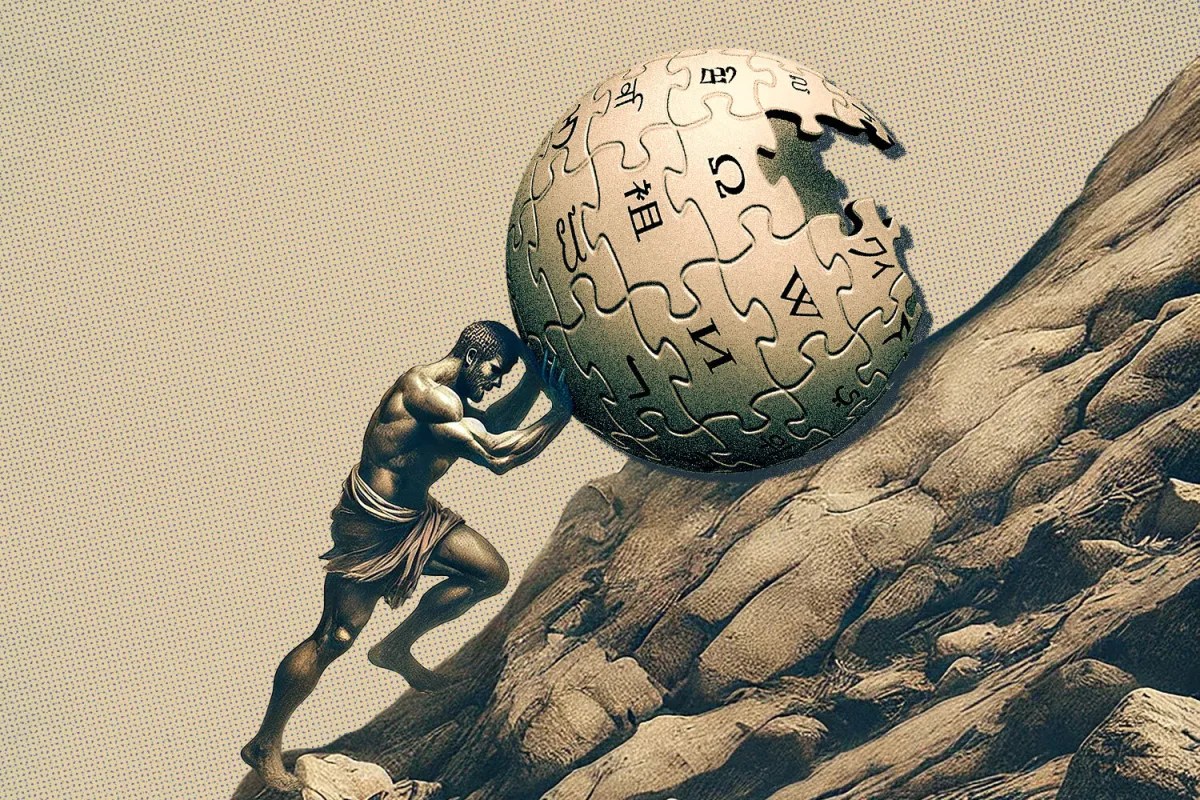
Since it was launched in 2001, Wikipedia has gone from curiosity to “bane of teachers” to cherished resource– the largest and most-read reference work in history, consistently among the top ten websites visited globally. Free and run by a network of volunteers (it’s hosted by the Wikimedia Foundation, an American nonprofit funded mainly by donations from readers), it has always been an anomaly– and has always been under some kind of threat.
Tobias Carroll of Inside Hook interviewed author, tech lawyer, and long-time student of Wikipedia Stephen Harrison on what the future might hold– is a tipping point coming?…
Has there ever been a time when Wikipedia wasn’t controversial? The long-running online encyclopedia has sparked plenty of debates since its founding in 2001, and has at various points been the subject of critiques from all across the political spectrum. It’s also an invaluable resource to millions around the world, host to a wealth of knowledge about everything from military battles to defunct sports teams.
Over the years, Stephen Harrison has written extensively about Wikipedia, including in a series of articles at Slate and his newsletter Source Notes. He’s also the author of a recent thriller, The Editors, about the international intrigue surrounding a Wikipedia-like website in the months leading up to the 2020 pandemic.
Harrison spoke with InsideHook about Wikipedia’s shifting place in internet culture, the many threats to it (including those from Elon Musk) and where he sees the encyclopedia going in the years to come…
… [Carroll] We’re now seeing people like Elon Musk targeting Wikipedia with existential criticism. What do you see as the biggest threats to Wikipedia — do you think it’s AI? Is it powerful people looking to make radical changes to how it works?
[Harrison] To some extent, it’s all of the above. I think it’s always under threat; even at the beginning they wondered if it would last and if people would keep contributing to it. There have been alternatives to it, like Conservapedia and RationalWiki and things like that, but they haven’t gotten the same traction. It’s a question of Joan Didion’s point about whether the center will hold. Hopefully Wikipedia will.
Now we have Elon Musk, who’s taken a pretty negative stance against Wikipedia. Of course, that’s very self-serving on his end because he wants people to go to his platform X, right? And he doesn’t like some of the content on his Wikipedia page, even the content that’s true about him being primarily an investor in a lot of these companies. He just doesn’t want to be couched or described as an investor because he has a certain narrative that he’s trying to put out there.
I think that there was always tension in the site. I think that to some extent people wanted to attack Wikipedia for something else, but it was very convenient to say, “Oh no, it’s all about women and minorities and underrepresented groups.” On the other hand, I want to say it does challenge some notions of what is encyclopedic. Wikipedia has kind of a small-c conservative view on topics that are notable.
The definition of notability has been repeat coverage and mainstream reliable sources, which a lot of people in underrepresented groups didn’t have for a long time. There’ll be people on Wikipedia, old-school editors, who’ll take issue with that. Editors aren’t just young guys in Silicon Valley. There are a lot of people — like the character Ed in The Editors — that have just been with the project for a long time, and they have their own views, too. They’ll say, “We’re an encyclopedia. We’re not here to try to right history’s wrongs.”
I’m not saying that it needs to get to 50-50 in terms of male and female articles. But for a long time, it was less than 10% [biographical articles about] women. Now it’s like climbing up to 20%, so it’s getting a little bit closer…
… I think the issue is that I’m increasingly finding myself asking AI applications questions that I might have initially gone to Wikipedia for. That pushes Wikipedia further into the background. Are humans going to keep contributing to Wikipedia if it’s perceived that all the information is going to ChatGPT or Perplexity or Grok?
I’ll be interested to see how Wikipedia editors overcome that. Maybe if there’s a silver lining it’s that Wikipedia editors have never been that egotistical. They’re always a little bit behind the scenes. So maybe they won’t mind their information going out to other sources as it does with Google knowledge panels or Alexa or Siri or something like that.
On the other hand, I don’t think they like the idea of it just doing free labor for tech companies. It gets to be a really tough problem: should Google or OpenAI donate more money to the Wikimedia Foundation? But you don’t want there to be any editorial control or any undue influence by Big Tech. So It’s a little bit of a mess. I think that part of it will involve requiring that these LLMs start citing or stating that this information comes from Wikipedia to give some sort of provenance to Wikipedia….
… I’ve been concerned that Wikipedia isn’t recruiting the younger generation. But then every time I’ve expressed worry about that, I find new contributors joining. I think that there’s a certain personality dimension that’s attracted to editing Wikipedia. And those people, hopefully, always find the site.
I think that there’s this political-industrial complex right now where everything is being politicized, right? And the right wing has an interest in portraying Wikipedia as left-wing and a kind of liberal media. What I would hope is that Wikipedia can withstand some of those criticisms. I don’t want only half of the readership to think about Wikipedia as a resource that can be used. But if I had to guess, I think it’s going to get worse before it gets better in terms of partisan rhetoric about Wikipedia…
As we look it up, we might recall that it was on this date in 1991 that Tim Berners-Lee showed the world the first web browser (and first WYSIWYGHTML editor), “WorldWideWeb” (the name of which was changed to “Nexus” after the debut of the World Wide Web later that year to avoid confusion between the brower and the network it was browsing).
From Dynomight (and here), an argument that algorithms, while problematic today, aren’t necessarily evil…
What does “algorithmic ranking” bring to mind for you? Personally, I get visions of political ragebait and supplement hucksters and unnecessary cleavage. I see cratering attention spans and groups of friends on the subway all blankly swiping at glowing rectangles. I see overconfident charlatans and the hollow eyes eyes of someone reviewing 83 photo she just made her boyfriend take of her in front of a sunset. Most of all, I see dreams of creative expression perverted into a desperate scramble to do whatever it takes to please the Algorithm.
Of course, lots of people like algorithmic ranking, too.
I theorize that the skeptics are right and algorithmic ranking is in fact bad. But it’s not algorithmic ranking per se that’s bad—it’s just that the algorithms you’re used to don’t care about your goals. That might be an inevitable consequence of “enshittification”, but the solution isn’t to avoid all algorithms, but just to avoid algorithms you can’t control. This will become increasingly important in the future as algorithmic ranking becomes algorithmic everything…
As we rethink rankings, we might recall that on this date in 1969 a group at the top of most lists took it to the roof: The Beatles performed on the rooftop of their Apple Corps headquarters at 3 Savile Row, in central London’s office and fashion district. Joined by guest keyboardist Billy Preston, the band played a 42-minute set before the Metropolitan Police arrived and ordered them to “reduce the volume.” It was the final public performance of their career. The concert ended with “Get Back,” after which John Lennon quipped, “I’d like to say thank you on behalf of the group and ourselves, and I hope we’ve passed the audition.”
Ryan Broderick, with thoughts on reactions to the recent assassination of United Healthcare’s CEO…
Last week, the CEO of UnitedHealthcare, Brian Thompson, was gunned down by an unknown suspect outside of a Manhattan hotel as he was headed to an investor’s meeting. The New York Police Department is now carrying out a manhunt to find the gunman, who is still at large. Authorities released four, unfortunately, dazzling photos of Thompson’s seemingly very handsome masked killer, revealed that his shell casings had the words “deny,” “defend,” and “depose” carved on them, and, also, found a backpack full of Monopoly money believed to belong to the suspect. Oh, also, the hospital Thompson was sent to after the shooting wasn’t in UnitedHealthcare’s network. All of this has only added to the social media frenzy around the murder.
In fact, the overwhelming response to Thompson’s death online could be summed up as “lol, lmao even.” But it, should be noted, that it’s not just chronically online shitposters celebrating Thompson’s death. It’s possible this is the most aligned America — well, aside from the folks in its highest tax brackets — has been about a news story since the invention of the internet.
An announcement on Facebook from UnitedHealthcare had to have reaction counts turned off because of the amount of laughing emojis users were adding to it. Right-wing pundit Ben Shapiro’s viewers were breaking rank in the comments underneath a video of his about the killing. Reddit moderators couldn’t contain a thread about it on r/medicine. There was a lookalike contest for Thompson’s killer in Washington Square Park over the weekend. There’s a ton of merch with “deny,” “defend,” and “depose” popping up. And there are even some fun conspiracy theories…
… Reporter Taylor Lorenz went long over in User Mag about about how, no, this does not mean that an overwhelming amount of the country is pro-murder, or whatever. “Thousands of Americans (myself included) are fed up with our barbaric healthcare system and the people at the top who rake in millions while inflicting pain, suffering, and death on millions of innocent people,” she wrote. And Today In Tabs’ Rusty Foster put it another way, writing, “A nation full of people absolutely parched for consequences and with nothing to look forward to but rising fascism.”
The only recent story like this that you can really point to is the assassination of Japanese Prime Minister Shinzo Abe in 2022. His killer revealed that he carried out the attack because of Abe’s support of the Unification Church, a cult-like religious order that wields a tremendous amount of political influence in Japan. And the overwhelming response from both the Japanese public and lawmakers, alike, was, yeah, actually, he had a point. I don’t think Thompson’s murder is suddenly going to lead to the dismantling of America’s cruel and inhumane healthcare industry, but it’s certainly been a cathartic few days online.
It has also quickly unraveled a decade-plus of right-wing programming in online spaces for young men. Many of whom are suddenly realizing maybe there are meatier subjects to take their anger out on than the racial makeup of Star Wars casting announcements. The best example being a thread yesterday on the subreddit for the edgelord streamer Asmongold, where users were enthusiastically talking about giving up the culture war to focus on a “class war”. The thread was deleted eventually for being “political,” but the same conversations are happening all over the manosphere right now. Which, you know, I don’t think anyone had an anonymous assassin on their list of possible “Leftist Joe Rogan’s,” but it seems like he’s moved to the head of the pack.
As Bluesky user hayao.lol wrote, “However this ends up [as of this writing, authorities have detained “a person of interest”] the guy won, flat out. This has done more damage to the image of the surveillance state, public complacency around healthcare, and ‘cops’ as a concept than any other single act.” Which I suspect is what’s actually making US elites so uncomfortable about all of this.
Thompson’s death [has] been a real shock to the system for America’s ruling class, who seem to be realizing for the first time that the majority of the country will not mourn their deaths. As podcaster and reporter Michael Hobbes wrote a few years ago, “I think we’ll look back on the last decade as a time when social media gave previously marginalized groups the ability to speak directly to elites and, as a result, elites lost their minds.” Which is why a whole bunch of tedious hall monitors are suddenly tut-tutting about all the memes in every major newspaper. I, personally, am not going super hard on the pro-assassination memes — as funny as they are — because we just don’t know what the motive was. We live in a time of mass accelerationist violence and I don’t feel like publicly cheerleading a guy who might have a compound full of deranged far-right ramblings. But I’m also not stupid enough to think that scolding the entire internet for how they’re acting is a meaningful use of my time on planet Earth. Maybe if I had a paid column somewhere — or proper health insurance — I’d feel different…
History suggests that when a political/economic system needs reset, but those who control it resist, the consequence can be an explosive period of painful brutality… that’s to say, “brutal” in that it is too often too bloody, and “brute” in that it is a blunt instrument, inflicting pain and damage much more broadly than just on its ostensible targets… a period of chaos too often followed by an autocracy (a la Napoleon in France and CCP one-party rule in China). The only way to avoid such an explosion is to begin making the changes that can alleviate pressure– to address the real needs of those whose suffering is fueling their growing anger– before that pressure destroys the system entirely.
Fix it, or it fails completely… and quite possibly catastrophically.
As we contemplate consequences, we might recall that it was on this date in 1915 that Chinese president Yuan Shikai proclaimed the Empire of China (AKA the Hongxian Monarchy), an attempt to reinstate the monarchy in China, with himself as emperor. His reign was short-lived: a civil war broke out 10 days later; in March of 1916, Yuan “abdicated,” and the republic was restored. The republican cause was set back by several years, and China entered into a period of fracture and conflict among a number of local warlords.
… Mobile phone companies are doing their best to oblige– and so far over half of the world’s population is connected to mobile internet. But as Khadija Alam and Russell Brandom report (in the indispensable Rest of World) growing that number is getting harder. (Read to the end for a twist)…
When Facebook hit 1 billion users in 2012, CEO Mark Zuckerberg said that when it comes to getting another billion users, “The big thing is obviously going to be mobile.” In an interview at the time, Zuckerberg told Bloomberg, “As more phones become smartphones, it’s just this massive opportunity.”
Clearly, he was correct. A recent survey from Global System for Mobile Communications Association Intelligence (GSMA), the research wing of a U.K.-based organization that represents mobile operators around the world, found that 4.6 billion people across the globe are now connected to mobile internet — or roughly 57% of the world’s population.
Now, the rate of new mobile internet subscriber growth is slowing. From 2015 to 2021, the survey consistently found over 200 million coming online through mobile devices around the world each year. But in the last two years, that number has dropped to 160 million. Rest of World analysis of that data found that a number of developing countries are plateauing in the number of mobile internet subscribers. That suggests that in countries like Pakistan, Bangladesh, Nigeria, and Mexico, the easiest populations to get online have already logged on, and getting the rest of the population on mobile internet will continue to be a challenge. GSMA collects data by surveying a nationally representative sample of people in each country, and then it correlates the results with similar studies.
Max Cuvellier Giacomelli, the head of the Mobile for Development program at GSMA, said that large swaths of the world’s population still don’t have access to mobile internet primarily because of affordability. Although the cost of data has dropped radically in recent years, the International Telecommunication Union, a UN agency focused on information and communications technologies, notes that huge disparities between regions persist. The cost of data in Africa, for example, is more than twice that of the Americas, the second most expensive region…
… In countries including China, the U.S., and Singapore, a high share of the population is already connected to mobile internet — 80%, 81%, and 93%, respectively. So it’s no surprise that the rate of mobile internet subscriptions has slowed.
But the rate of new users has also slowed in countries including Bangladesh, Nigeria, and Pakistan — where only 37%, 34%, and 24% of the population currently use mobile internet.
Coverage continues to be a challenge, although data suggests that the issue is improving relatively quickly. Just 350 million people across the world, or 4% of the global population, still live in areas that are not covered by a mobile broadband network. According to GSMA, sub-Saharan Africa has the highest coverage gap of any global region. But between 2021 and 2023, mobile coverage in this area expanded from 83% to 87%.
Furthermore, recent advances in satellite technology have the potential to close this coverage gap by bringing mobile internet networks to rural or remote areas that lack mobile infrastructure. SpaceX’s Starlink, for example, is now available in over 100 countries and provides a roaming plan…
… Even in countries with high rates of mobile internet subscription, there are still stubborn pockets of people with no mobile internet access. In China, for example, 80% of the population has access to mobile internet. But subscription rates among the remaining 280 million people are slowing. Recent advances in satellite technology could bring mobile internet to new users in the country, especially in rural areas. In August, China began launching a satellite internet network [the Qianfan Constellation], set to rival SpaceX’s Starlink, in an effort to bring everyone online.
Your correspondent finds himself pondering the final sentence in the piece: While the on-boarding of the unconnected 47% may be the result of a patchwork of local efforts, it’s clearly the goal of Starlink and the Qianfan Constellation to centralize connectivity… and the company– or government or culture– that controls the means of communication has a great deal of influence on what gets communicated and how. Nearly half the world’s population is in play, with all that that entails for geopolitics and geoeconomics; for example, see here (and the links therein)…
* E. M. Forster, Howards End
(R)D will be on its traditional Thanksgiving hiatus from today. Regular service will resume when we’re clear of Black Friday…
###
As we contemplate connectivity, we might recall that it was on this date in 1995 that Microsoft released Internet Explorer 2.0…
Nearly 6 months to the day after Bill Gates sent his Internet Tidal Wave memo recognizing the importance of the Internet, and only 3 months after releasing version 1.0, Microsoft releases Internet Explorer 2.0 for Windows 95 and Windows NT 3.5. IE 2.0 was still based on licensed code from Spyglass Mosaic, but was the first IE version to support now-common features such as SSL, JavaScript, and cookies. It was also the first version to allow the importing of bookmarks from Netscape Navigator, which at the time had a virtual monopoly on the web browser market. This was the first inklings of the “browser war” that was soon to erupt over the next few years.






You must be logged in to post a comment.