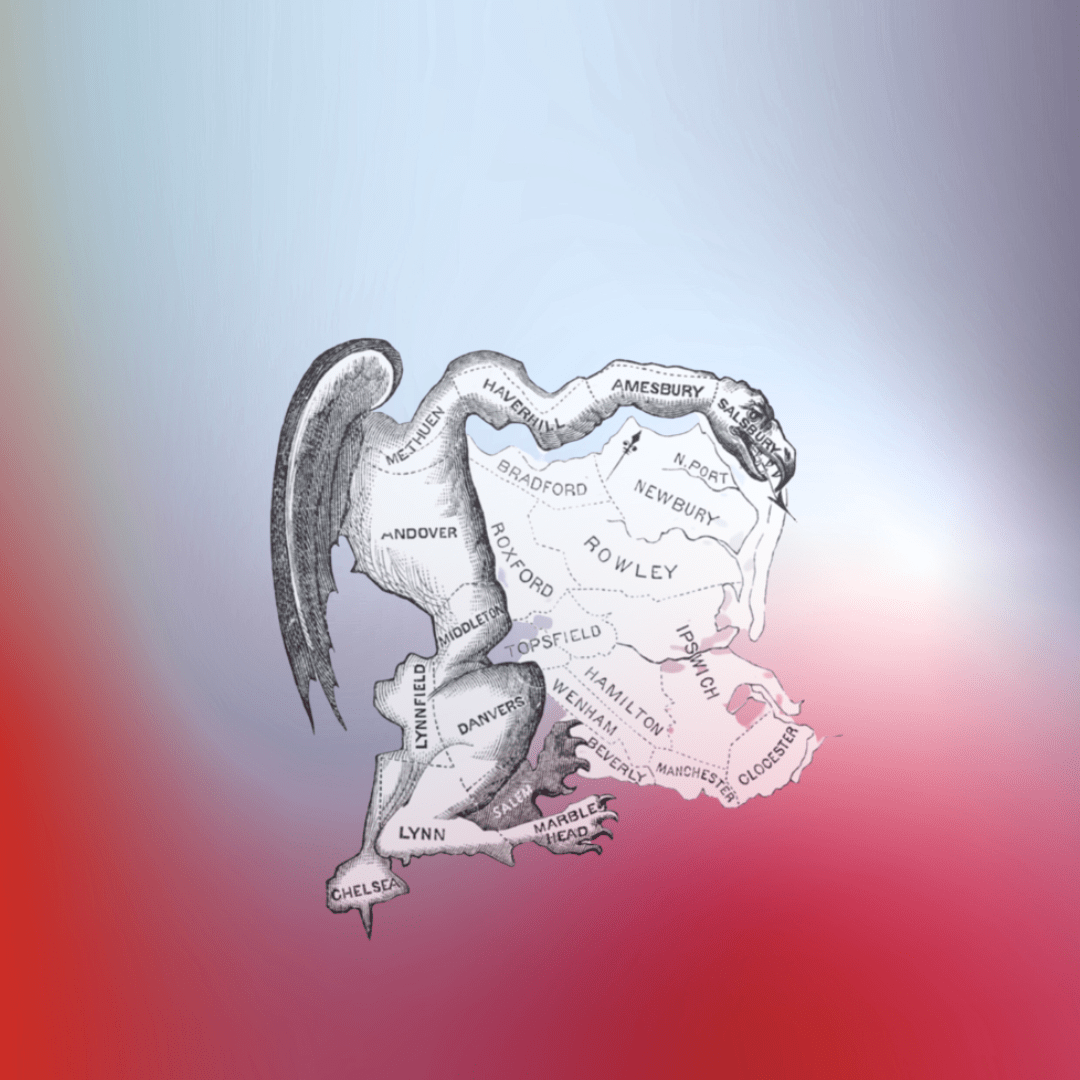
Gerrymandering has been a word since 1812 (when Elbridge Gerry signed a bill that created a partisan district in the Boston area [pictured above] that was compared to the shape of a mythological salamander); but the phenomenon has been an issue pretty much from our nation’s birth– first states, then congressional districts, drawn to favor the party doing the drawing. And, as researchers have shown, the result has been an increase in safe seats, occupied by representatives less responsive to constituents at large, and more atuned to the most vociferously-partisan elements in the disticts.
Redistricting every ten years, to reflect population changes detected in the census taken every decade, is mandated by the Constitution. But managing voting– and the drawing of district boundaries– are a state right and responsibility, usually exercised by a state’s legislature (though a few states have delegated the task to separate commissions). And while most states address the issue every ten years, following the census, the Supreme Court ruled in 2006 (in LULAC v Perry) that states could redistrict at other times and for other reasons as well.
And now, with Texas’ newly-drawn maps enacted and other states both red and blue being pressured by the parties to “counter-plot,” gerrymandering is very much a “thing.” California is, of course, considering a response-in-kind. Republicans in Indiana, Missouri, and Florida have openly discussed the possibility of reworking their maps ahead of the 2026 midterms, while Democratic governors in Illinois, New York, and Maryland have also floated doing the same. Given that Texas’ move– creating five more “safe” Republican seats and making two of the remaining Democractic seats more competitive– looks to make the Democrats’ prospects of regaining control of now almost evenly-divided House much more difficult, California Democrats (even those opposed to gerrymandering) are, however reluctantly, lining up behind an attempt to off-set the impact of Texas’ rejiggering… which is increasing the pressure on Indiana, Missouri, and Florida to act… and on Illinois, New York, and Maryland to react (especially since, some believe, the Democrats might “win”)…
Of course, that rarely works in the long run. Historian Kevin Vrevich has some thoughts on what the onslaught that Texas has unleashed that might mean…
… The history of gerrymandering suggests that the current arms race of redistricting for short-term partisan gains is quite in line with the actions of those in the early republic, indicating a period of political instability akin to the Jacksonian period may be on the way…
[Vrevich unpacks the constitutional and political history of redistricting, culminating in 1812 event, outlined above, that gave the partisan practice its name…]
… The redistricting plans of the current political parties, especially their rapid response nature, feel very similar to the partisan machinations of the early republic and antebellum period. The usage of sophisticated tracking polls and predictive computer models does not change the fact that the goals of today are identical to those of the Massachusetts Republicans in 1812. That suggests that times of rapid party turnover, legitimate third parties, and increased political violence are all on the horizon…
As we regret regression to the mean (pun intended), we might recall that it was on this date in 1963 that an estimated 250,000 people attended the March on Washington for Jobs and Freedom in Washington D.C., which advocated for the civil and economic rights of African Americans. In addition to Martin Luther King Jr.’s “I Have a Dream” speech at the Lincoln Memorial calling for an end to racism, musicians Odetta, Mahalia Jackson, and Marian Anderson, Peter, Paul & Mary, Joan Baez, and Bob Dylan, performed.
In 1995, at the beginning of the last week of August, on the afternoon of an inhumanly hot and intolerably humid day, I arrived at Newark Airport to live in the United States. I was twenty two years old and about to start as a graduate student at Princeton. I have been here more or less the whole time since. I spent six years on an F-1 Visa while getting my PhD. After that, I lived and worked in Tucson for seven years. My conception of what counts as an inhumanly hot day changed. During that time I was on an H1-B Visa sponsored by my employer, the University of Arizona. Subsequently, I was granted Permanent Residency—a Green Card—through marriage. In 2009 I moved to North Carolina. My conception of what counts as an intolerably humid day changed. I am an immigrant to this country. I have made my life here. My two children are Americans. And now, as of yesterday [June 27], so am I.
When I sat down to write something about becoming a citizen, I was immediately tangled up in a skein of questions about the character of citizenship, the politics of immigration, and the relationship of individuals to the state. These have all been in the news recently; perhaps you have heard about it. These questions ask how polities work, how they impose themselves upon us, how power is exercised. They are tied up with deep-rooted principles, claims and myths—as you please—about where authority comes from and how it is or whether it ever has been justly applied. These are not easy matters to understand in principle or resolve in practice. Nor can they simply be dismissed. But I am not writing this note because I want to take on these questions, even though I acknowledge them. I am writing this because I do not want to forget how I felt yesterday.
If you are a legal permanent resident of the United States, you apply to be naturalized as a citizen by filling out Form N-400. Part 1 of the form asks for information about your eligibility for becoming a citizen. Parts 2 and 3 ask about your name, address, country of birth, and also identifying information about you including your race and ethnicity. In Part 4 you list everywhere you have lived in the past five years. In Parts 5 and 6 you tell about your marital history and your children. Part 7 is your employment and schooling. In Part 8 you document all the times you have been outside the United States in the past five years even though, as a Lawful Permanent Resident, the state already knows this about you. Frankly, it already knows all the other stuff about you, too. Every time you enter the country you are photographed and fingerprinted.
Part 9 consists of thirty seven questions designed, in the main, to establish whether you are a person of good moral character and also whether you understand, assent to, and are willing to swear to each component of the Oath of Allegiance to the United States. After filling out the form you go to a biometrics appointment where your identity is once again confirmed and you are once again fingerprinted and photographed. Then your citizenship interview is scheduled. At the interview you are assessed by a USCIS Officer on several points, including whether you can speak, read, and write English at a basic level. They also check once again whether you understand and are willing to take the Oath of Allegiance that will make you a citizen. Finally, you must also pass the Civics Test.
The test has one hundred questions. At the interview you are asked up to ten of them at random and you must get six right. There is a Civics Booklet and Study Guide for the test. It is eighty five pages long. Its index is also a list of all one hundred questions and their acceptable answers. The test covers the Constitution, the branches of government, some elements of U.S. history and geography, the rights and responsibilities of U.S. citizens, and national symbols and holidays.
The ceremony room was the kind of place, if you are an academic like me, you might expect to be named “Salon C” or “Wabash Room” or “Sequoia East” and be the site of a sparsely-attended conference talk. The two main differences were the words stenciled on the slightly dropped ceiling, and the fact that the room was full up and alive with nervous energy. At the front of the room there was a large-screen TV. The person leading the ceremony—who, coincidentally, was the USCIS Officer who had interviewed me a couple of months ago—introduced himself and welcomed everyone. All the staff were dignified and low-key delighted. The ceremony opened with a two-minute video that consisted of Ken Burns effect pans over still images and with W.G. Snuffy Walden music underneath. The Statue of Liberty. Ellis Island. Immigrants arriving in the nineteenth century at various locations. And then photographs of the modern equivalents of those people. I began to worry that I might have something in my eye.
The room filled up. It looked just as you might imagine. Some people looked like me, which is to say a middle-aged Irish guy in a standard-issue blazer and tie. There was a guy from Ghana in an immaculate suit. A couple from Algeria held their baby son. A family from the Republic of the Congo had their three young sons sit in the guest area. The boys all wore identical red-white-and-blue check. A German man looked dapper in a lavender shirt. An Indian woman had a green and gold sari. A Chinese family all in a row. A Romanian delightedly offering to take pictures of anyone in need of a photo. A Mexican man in cream-colored linen. A Peruvian woman’s bold floral dress. A family whose two children were wearing tiny plastic Stars and Stripes cowboy hats. It looked like America.
I know the nationalities of my fellow oath-takers because of the next stage of the ceremony. This was the Roll Call of Nations. I did not know this was going to happen. Every country of origin represented was announced in turn. As your country was named, you were asked to stand up, and remain standing. Afghanistan came first. Then Algeria. The last person to stand, immediately to my left, was from the United Kingdom. There were twenty seven countries in all, out of only fifty or so people. For me this part in particular was enormously, irresistibly moving. It perfectly expressed the principle, the claim, the myth—as you please—that America is an idea. That it does not matter where you are from. That, in fact, America will in this moment explicitly and proudly acknowledge the sheer variety of places you are all from. That built in to the heart of the United States is the republican ideal not just that anyone can become an American, but that this possibility is what makes the country what it is.
But isn’t it more complicated than that? You know as well as I do that it is. So much more complicated. So much more painful. So much more dangerous. So much more messed-up. I will think about and work on strands and threads of that impossible tangle tomorrow, just like I have thought about and worked on bits and pieces of it since I came here. But I will not forget this moment. I will not forget what it felt like.
Now all standing, we raised our hands and took the oath. Once we stopped speaking, we were citizens. We watched a two-minute congratulatory video from President Trump. Even though the video was short, you could see that, in his usual way, he was improvising and riffing around what was on his teleprompter. The result was that he said some odd-sounding things, like how we had U.S. citizenship “like no-one has ever had it before”. It did not matter. The video finished. We filed out of our seats in row order to get our certificate of citizenship. And that was the end.
Afterwards people milled about in the room, delighted, shaking hands, hugging one another. I hugged my daughter. I hugged my friends who had come down from New York at the last minute on an overnight bus to be there. I counted my blessings. There was a little staged area in the corner where people could pose for photographs against a backdrop. At the rear of the room, volunteers were set up and ready to register you to vote if you wanted. People were smiling and crying. Children were running around meeting one another. We were gently reminded that there was another ceremony due to start in twenty minutes.
As Franklin D. Roosevelt enjoined us: “Remember, remember always, that all of us, and you and I especially, are descended from immigrants…”
* George Washington
###
As we remember our roots (and celebrate all that has– and can still- grow from them), we might recall that it was on this date in 1971 that the 26th Amendment to the Constitution, having been ratified by 38 states, was certified as adopted by the Administrator of General Services, Robert Kunzig. The amendment establised a nationally-standardized minimum age of 18 for participation in state and federal elections.
The estimable Claudia Sahm on what the elimination of an obscure advisory committee on economic data says about the administration’s commitment to relevance and accuracy…
In a time of great economic uncertainty, President Donald Trump’s administration quietly took a step last week that could create even more: Secretary of Commerce Howard Lutnick disbanded the Federal Economic Statistics Advisory Committee.
I realize that the shuttering of an obscure statistical advisory committee may not strike anyone as a scandal, much less an outrage. But as an economist who has presented to the committee, known as FESAC, I know how it improved the information used by both the federal government and private enterprise to make economic decisions. Most Americans do not realize how many aspects of their lives rely on timely and accurate government data.
One of FESAC’s official responsibilities was “exploring ways to enhance the agencies’ economic indicators to make them timelier, more accurate, and more specific to meeting changing demands and future data needs.” In the complex and highly dynamic US economy, this is an ongoing effort — not a one-time task that has been “fulfilled,” which was the Commerce Department’s stated reason for terminating the committee.
The 15 members of the advisory committee, who were unpaid, brought deep technical expertise on economic measurement from the private sector, academia and the non-profit world. They were a sounding board for the Census Bureau, Bureau of Labor Statistics, and Bureau of Economic Analysis, which produce much of the nation’s official statistics.
If statistics fail to keep up with the changing economy, they lose their usefulness. When the committee last met in December, one focus was on measuring the use and production of artificial intelligence. Staff from the agencies shared existing findings on AI, such as from the Business Trends and Outlook Survey that began in 2022, and outlined new data collection efforts. AI’s current use among businesses has nearly doubled since late 2023, and even more businesses expect to adopt AI in the next six months.
The committee was asked what data products would be most useful. Expert feedback, including a request to harmonize the definitions of AI across surveys and align with cutting-edge research, is especially valuable at the early stages of data collection. The growth and employment effects of AI are among the most pressing questions facing the economy, and external experts are crucial to supporting the creation of high-quality data.
Enhancing official economic statistics under budget constraints often requires creative approaches. At its meeting last June, the committee discussed using private-sector data to create statistics on regional employment and other outcomes. There is considerable demand among businesses and local governments to have timely geographic detail, but it is cost-prohibitive with current government surveys. Members of FESAC, some of whom work at companies like Indeed and JP Morgan Chase, offered first-hand knowledge of the pros and cons of using private-sector data.
The committee contributed far more than just twice-a-year meetings. It also created relationships with the private sector that government agencies could draw on as part of their continuing effort to improve their statistics.
The National Academies of Sciences, in discussing best practices for statistical agencies, argues that external advisory committees are a good way to engage with users of the data and obtain expert advice. Moreover, external evaluation should be part of regular program reviews to ensure quality, relevance and cost-effectiveness. That’s exactly what FESAC did.
The statistical agencies need more, not fewer, resources now to meet their challenges. During the campaign, Trump repeatedly questioned the credibility of US employment statistics. In particular, he claimed that the downward revisions of monthly payrolls showed political interference. Senators Bill Cassidy and Susan Collins asked the Bureau of Labor Statistics to explain why large revisions were happening and how to avoid them. FESAC could have been a valuable resource for possible improvements.
Disbanding FESAC does not advance the administration’s goal of greater efficiency in the government. In 2024, the committee’s cost was expected to be a modest $120,000, covering travel expenses and minimal staff support. Virtual-only meetings could have reduced those costs still further, if that was a concern. Regardless, the benefits to the millions of data users from regular reviews by external experts far exceed that negligible cost.
Putting a low-cost, high-value committee on the chopping block does not bode well for other investments in the official statistics. Reductions in staff and budget would likely degrade the quality of the official statistics. Even before Trump took office, all three agencies operated in a tight budget environment.
Reduced transparency in official statistics is perhaps the most troubling aspect of disbanding FESAC. Cutting off agency staff from external advisers creates an environment where political interference could occur much more easily — and go undetected. With political officials such as Lutnick arguing publicly that GDP should exclude government spending, it is especially important to have external, independent experts.
And FESAC is not alone. By executive order, the administration is ending several advisory committees in the federal government, reducing transparency and the technical resources for agencies. It’s a short-sighted approach that could undermine essential government services…
(Image above: source… note how many of the data sources cited are are precisely the sorts of government resources being targeted)
* Sherlock Holmes (Arthur Conan Doyle)
###
As we drive with our windows painted over, we might send understanding birthday greetings to Robert Heilbroner; he was born on this date in 1919. An economist and historian of economic thought, he was the author of some two dozen books, the best known of which is The Worldly Philosophers: The Lives, Times and Ideas of the Great Economic Thinkers (1953), a remarkable survey of the lives and contributions of famous economists (perhaps most notably Adam Smith, Karl Marx, and John Maynard Keynes). Your correspondent can also recommend The Future as History (1960).
Heilbroner was considered highly unconventional by those in his field; indeed, he regarded himself a social theorist and “worldly philosopher” (philosopher pre-occupied with “worldly” affairs, such as economic structures) and tended to integrate the disciplines of history, economics, and philosophy into his work. Nonetheless, Heilbroner was recognized by his peers as a prominent economist and was elected vice president of the American Economic Association in 1972.
Every week, Sam Circle reads the New Yorker— closely– and publishes a wonderful review of the contents of each issue in two parts: the primary editorial and the poetry and cartoons. In their most recent missive, the “Random Pick” (an article from the archive) was “This Year’s Model” by Michael Kelly. (June 17, 1996)…
Who’d have guessed that the most blistering take I’ve read on the Democrats’ current travails would be something a centrist wrote in the ‘90s? I have a general sense of Clinton’s deal, but given that I was four when he left office (I know, I know) the details aren’t visceral for me, and it’s hard to know how literally to take leftists when they call him a social conservative. But [while] I wouldn’t exactly call [Kelly] trustworthy in general (here’s Tom Scocca with a blistering and definitive posthumous takedown), I at least grant the trust of contemporaneousness when he says Clinton is, “on social issues,” running “to the left of Pat Buchanan but to the right of, say, George Bush”. It’s sick that Kelly’s issue with Clinton claiming he’s going to gut welfare and put far more cops on the streets is that he maybe can’t be trusted to actually do so; it doesn’t matter, though, because Kelly’s analysis is still sharp, and in many ways Clinton can be seen as a predecessor of Trump: “You vote for Clinton, and who knows what you’ll get? Maybe he’ll turn again – back your way.” There are no principles, there are only deals; it’s a politics of nihilism loosely cloaked in a politics of populism. And centrists still push this “we’re just following the polls” message. This is an uneasy glimpse of the past, clarified by the horrors of the present…
The legacy of the “centrist urge” and faux populism in the 90s…
* “I must confess that over the past few years I have been gravely disappointed with the white moderate. I have almost reached the regrettable conclusion that the Negro’s great stumbling block in his stride toward freedom is not the White Citizen’s Counciler or the Ku Klux Klanner, but the white moderate, who is more devoted to “order” than to justice; who prefers a negative peace which is the absence of tension to a positive peace which is the presence of justice; who constantly says: “I agree with you in the goal you seek, but I cannot agree with your methods of direct action”; who paternalistically believes he can set the timetable for another man’s freedom; who lives by a mythical concept of time and who constantly advises the Negro to wait for a “more convenient season.” Shallow understanding from people of good will is more frustrating than absolute misunderstanding from people of ill will. Lukewarm acceptance is much more bewildering than outright rejection.” – Martin Luther King, Jr., “Letter from Birmingham Jail“
Around half the world’s population live in places that held elections in 2024. Some 1.65bn ballots were cast across more than 70 countries. But while the number of democratic elections in a single year has never been higher, 2024 also brought big challenges. According to the latest democracy index published by EIU, our sister company, on February 27th, global democracy is in worse shape than at any point in the nearly two-decade history of the index.
Since 2006 EIU has scored 167 countries and territories on a scale of zero to ten based on five criteria: electoral process and pluralism, functioning of government, political participation, political culture, and civil liberties. The countries are then grouped into four categories: full democracies, flawed democracies, hybrid regimes and authoritarian regimes.
For the 16th consecutive year, Norway was named the most democratic country in the world, with a score of 9.81. New Zealand and Sweden followed. Afghanistan has been the lowest-ranked country since 2021, scoring just 0.25 points. The biggest change came from Bangladesh, which dropped 25 places. Rebuilding democracy there will be an enormous task after the ouster of Sheikh Hasina, the country’s longtime autocratic ruler. But there is cause for optimism. A temporary technocratic government, led by Muhammad Yunus, a Nobel peace prizewinner, has restored order and stabilised the economy. For those reasons, we named Bangladesh our country of the year in 2024.
The global average dropped to a new record low of 5.17, down from a high of 5.55 in 2015. Just 6.6% of the world’s population now lives in a full democracy, down from 12.5% ten years ago. And a large share of the world’s population—currently two in five people—lives under authoritarian rule.
Despite the promise of a global election extravaganza, some of the ballots were a farce. Polling day in Pakistan, for example, was marred by violence. The most popular politician, Imran Khan, whose own democratic credentials are questionable, was jailed shortly before the election took place. The country’s score dropped from 3.25 in 2023 to 2.84. In Russia another sham election gave Vladimir Putin a fifth term as president—it scored just two points on the index. In other countries—including Burkina Faso, Mali and Qatar—elections were cancelled altogether.
Even Europe—home to nine of the top ten countries in the index—saw some notable declines. France was downgraded from a full democracy to a flawed one. This mostly reflects a deterioration in its confidence-in-government score after president Emmanuel Macron’s snap election in June failed to secure a legislative majority for any single party or bloc. (Four different prime ministers during the course of the year did little to instil confidence either.) Romania was also downgraded after allegations of Russian interference, illegal social-media tactics and campaign-finance violations prompted the constitutional court to annul the presidential election and call for a new vote. In Asia, South Korea dropped out of the full-democracy category after President Yoon Suk Yeol declared—then hastily revoked—martial law, plunging the country into crisis.
America remained a flawed democracy, shifting only slightly from its position in 2023. But it could face bigger problems this year: the first month of President Donald Trump’s second term has already challenged the political independence of the civil service and seen a flurry of executive orders of questionable legal authority.
Mr Trump’s victory in 2024 was part of a broader global backlash against incumbents. The next test for global democracy in 2025 will be how these newly elected leaders choose to govern…
* John Adams, whose own handiwork as a Founding Father has been nicked, but so far evaded the fate he predicted (in an 1814 letter to John Taylor)
###
As we batten the hatches, we might recall that it was on this date in 1933 that RKO‘s King Kong premeired. Directed and produced by Merian C. Cooper and Ernest B. Schoedsack, with special effects by Willis H. O’Brien and music by Max Steiner, it received rave reviews, with praise for its stop-motion animation and score… and has only grown in esteem: in 1991, it was deemed “culturally, historically and aesthetically significant” by the Library of Congress and selected for preservation in the National Film Registry. In 2010 it was ranked by Rotten Tomatoes as the greatest horror film of all time and the fifty-sixth greatest film of all time.




You must be logged in to post a comment.