Posts Tagged ‘geology’
“We can only sense that in the deep and turbulent recesses of the sea are hidden mysteries far greater than any we have solved.”*…

A new study finds that the vast majority of the deep sea floor remains undocumented. Nell Greenfieldboyce report…
Bizarre creatures like vampire squid and blobfish make their home in the dark, cold, depths of the deep sea, but most of this watery realm remains a complete mystery.
That’s because humans have seen less than 0.001% of the globe’s deep seafloor, according to a new study.
In fact, the area of the deep seafloor that’s been directly visualized is roughly equivalent to the state of Rhode Island, researchers report in the journal Science Advances.
Maps created with tools like sonar can show the shape of the seafloor, but it’s much harder to send cameras down beyond 200 meters, or more than 656 feet, where sunlight begins to fade rapidly and the waters turn cold and dark. This is the region of the ocean that’s considered “deep.”
“The fact of the matter is, when you’re down there with a remotely operated vehicle or other sort of deep-submergence vehicle, you can only see a very tiny bit of the deep sea floor at any one time,” says Katy Croff Bell of the nonprofit Ocean Discovery League, who led this new research…
… To try to get a better accounting of the total area of the deep seafloor that’s been observed so far, she and her colleagues created a database of all known efforts. They found records of more than 43,000 trips down, starting in 1958, with everything from robotic vehicles to human-driven subs to simple landers that didn’t move around.
It turns out that most of the exploratory expeditions occurred within 200 nautical miles of the United States, Japan, and New Zealand. Those three countries, along with France and Germany, led nearly all of the efforts.
As a result, scientists really haven’t seen a very representative sample of what’s going on around the globe…
… Bell says we don’t know what habitats might yet be discovered — and that even though the deep ocean might be out of sight and out of mind for most people, the currents down there bring oxygen and key nutrients up towards the surface.
“All of these things are connected, and impact us in so many different ways,” she says.
What little has been explored beneath the deep ocean suggests that it can have dramatically different ecosystems that support very different kinds of living things. Already, in the ocean, explorers have seen hot hydrothermal vents, alkaline vents, and cold seeps.
“But given how little we’ve seen and how biased it is, we can’t really give you a global map of all the habitats of the deep sea, because we just haven’t been to all of them,” she says.
Past explorations to the deep have revealed completely unexpected forms of life. For example, in the 1970’s, researchers discovered microbes at hydrothermal vents that did not depend at all on the sun and photosynthesis, and instead got their energy from chemical reactions.
“That was completely revolutionary and completely rewrote all the science books,” she says.
Geologist and deep sea expert Jeffrey Karson of Syracuse University, who wasn’t part of this research team, says this is the first time he’s ever seen a well-documented number that really encapsulates what’s been seen of the deep ocean floor so far.
He would have assumed the area seen by humanity was less than 1% of the total, he says, but was still surprised the faction would be “such a tiny number.”
“We’re spending a lot of money to try to understand other planets, maybe planets outside of our solar system. And yet right here on our own planet, we know so little of what’s going on in this area that covers about two-thirds of our planet,” says Karson. “Almost every time we go there, we learn something new and exciting, and many of our discoveries on the seafloor have been serendipitous. So, you know, we’re feeling our way in the dark, literally, there.”..
We’re asleep to the deep: “Humans still haven’t seen 99.999% of the deep seafloor,” from @ngreenfieldboyce.bsky.social and @npr.org.
* Rachel Carson, The Sea Around Us (1951)
###
As we dive deep, we might spare a thought for Robert S. Dietz; he died on this date in 1995. A marine geologist, geophysicist, and oceanographer with the United States Coast and Geodetic Survey, he developed (in 1961) a theory of seafloor spreading (a term he coined), in which new crustal material continually upwells from the Earth’s depths along the mid-ocean ridges and spreads outward at a rate of several inches per year.

“All cannot be lost when there is still so much being found”*…

We may be close to rediscovering thousands of texts that had been lost for millennia. As Justin Germain explains, their contents may reshape how we understand the ancient world…
We used to play this game in graduate school: find one, lose one. Find one referred to finding a lost ancient text, something that we know existed at one time because other ancient sources talk about it, but which has been lost to the ages. What if someone was digging somewhere in Egypt and found an ancient Greco-Roman trash dump with a complete copy of a precious text – which one would we wish into survival? Lose one referred to some ancient text we have, but we would give up in some Faustian bargain to resurrect the former text from the dead. Of course there is a bit of the butterfly effect; that’s what made it fun. As budding classicists, we grew up in an academic world where we didn’t have A, but did have B. How different would classical scholarship be if that switched? If we had had A all along, but never had B? For me, the text I always chose to find was a little-known pamphlet circulated in the late fourth century by a deposed Spartan king named Pausanias. It’s one of the few texts about Sparta written by a Spartan while Sparta was still hegemonic. I always lost the Gospel of Matthew. It’s basically a copy of Mark, right down to the grammar and syntax. Do we really need two?
What would you choose? Consider that Homer’s Iliad and Odyssey are only two of the poems that make up the eight-part Epic Cycle. Or that Aristotle wrote a lost treatise on comedy, not to mention his own Socratic dialogues that Cicero described as a ‘river of gold’. Or that only eight of Aeschylus’s estimated 70 plays survive. Even the Hebrew Old Testament refers to 20 ancient texts that no longer exist. There are literally lost texts that, if we had them, would in all likelihood have made it into the biblical canon.
The problem is more complex than the fact that many texts were lost to the annals of history. Most people just see the most recent translation of the Iliad or works of Cicero on the shelf at a bookstore, and assume that these texts have been handed down in a fairly predictable way generation after generation: scribes faithfully made copies from ancient Greece through the Middle Ages and eventually, with the advent of the printing press, reliable versions of these texts were made available in the vernacular of the time and place to everyone who wanted them. Onward and upward goes the intellectual arc of history! That’s what I thought, too.
But the fact is, many of even the most famous works we have from antiquity have a long and complicated history. Almost no text is decoded easily; the process of bringing readable translations of ancient texts into the hands of modern readers requires the cooperation of scholars across numerous disciplines. This means hours of hard work by those who find the texts, those who preserve the texts, and those who translate them, to name a few. Even with this commitment, many texts were lost – the usual estimate is 99 percent – so we have no copies of most of the works from antiquity. Despite this sobering statistic, every once in a while, something new is discovered. That promise, that some prominent text from the ancient world might be just under the next sand dune, is what has preserved scholars’ passion to keep searching in the hope of finding new sources that solve mysteries of the past.
And scholars’ suffering paid off! Consider the Villa of the Papyri, where in the eighteenth century hundreds, if not thousands, of scrolls were discovered carbonized in the wreckage of the Mount Vesuvius eruption (79 AD), in a town called Herculaneum near Pompeii. For over a century, scholars have hoped that future science might help them read these scrolls. Just in the last few months – through advances in computer imaging and digital unwrapping – we have read the first lines. This was due, in large part, to the hard work of Dr. Brent Seales, the support of the Vesuvius Challenge, and scholars who answered the call. We are now poised to read thousands of new ancient texts over the coming years.
But first, a bit of background on the provenance of ancient texts. We don’t have original copies of anything, not of the Iliad, or the Aeneid, or Herodotus, or the Bible. Instead of originals, we find ourselves dealing with copies. These were first written on scrolls but later in books – the Romans called books codexes – starting in the first century AD.
Did I say copies? That’s actually not correct either. We don’t have first copies of anything. What we do have is copies of copies, most of which date hundreds of years after the original was penned. Even many of our copies are not complete copies. Take, for example, the earliest surviving piece of the New Testament: a fragment from the Gospel of John known as P52. Far from a complete copy of the book, this fragment is about the size of a credit card and dates to, in the earliest estimation, 125 AD. That is over 100 years after Christ was crucified. The fragment is without a doubt at least a copy of a copy because its dating is too late to be either an original or a first copy. It was also found in Egypt, far from both Judea or Syria, where John is thought to have originated. Finding a complete copy of a text – let alone an early Christian Bible – is a home run. We have only found two such Bibles, the Codex Sinaiticus and Codex Vaticanus, both dating to the mid-fourth century.
More often than finding such complete copies, scholars instead compile the various fragments of copies and try to reconstruct the original work. Once scholars agree on what the original text should be, and in some cases they never reach agreement, the text is ready for publication in the original language. Where there are still variants in the text, scholars will include an apparatus criticus citing the manuscript from which the text is published and listing manuscripts with variant readings. The last step is to add a translation in the vernacular, and there are bilingual and even polyglot editions. These could range from the Complutensian Polyglot Bible, a magnificent, six-volume work printed in Madrid in 1519 giving the scriptural text in no less than four languages – Greek, Hebrew, Latin, and Aramaic – to the popular Loeb editions printed with both the ancient text and an English translation, for those with some limited knowledge of the ancient languages.
To most fully acclimate the reader to how tenuous this process is, this essay will focus on three different texts. The first will be a very well-known work that was never lost. Nevertheless, almost no one read it in earnest until the nineteenth century. I will then focus on a text that was lost to history, but that we were able to recover from the annals of time. Such examples are fortuitous. Our third example will be a text that we know existed, but of which we have no copies, and consider what important ramifications its discovery could hold. Finally, we’ll turn our attention again to the Villa of the Papyri and the gold mine of texts discovered there that new technologies are currently making available to classicists. By examining the history of the first three texts, I hope to sketch out a picture of how new discoveries from the villa might change our understanding of the ancient world…
[Germain considers Aristotle’s Poetics (“While it’s not accurate to say, as one of Aristotle’s unpublished works, the Politics was ever lost, it was certainly rediscovered”), the Hellenica Oxyrhynchia (a group of fragments that cover Greek history in same period– from the closing years of the Peloponnesian War into the middle of the fourth century BCE– covered by Xenophon, but that tell a different story), and the Constitution of the Spartans, also by Aristotle– a work often cited in other extant texts, but never found (“Imagine an alternate universe where all sources about America were written by Soviets at the height of the Cold War. The historians of the future might get a warped sense of reality. That’s exactly the case with ancient Sparta [e.g., Thucydides]… Although still an outsider and Athenian, Aristotle wrote about the Spartan state in the Politics, and he did not have good things to say. It is safe to assume that whatever Aristotle’s Constitution said, its testimony was not influenced by the Spartan mirage, giving us perhaps a more accurate picture of life inside the city-state.”)]…
… Resurrecting the dead is difficult; Jesus knew that. And the only reason we know that he knew that is because the church saw the preservation of scripture as a core duty. Not one scrap of text from the ancient world has come to us without untold numbers of heroes quietly working to hand down, from generation to generation, the texts that have primarily shaped the modern world. We are thankful for documents like the Politics, documents whose life cycle we can narrate from conception to the present moment. Even then, such texts can fall in and out of fashion, and their knowledge can be lost to entire generations. Texts such as the Hellenic Oxyrhynchia are windfalls of good fortune, ones that are completely forgotten in their own day, then lost a second time to history, buried in some ancient Egyptian trash heap. All the work necessary to make texts like the Politics accessible need also be done for texts like the Hellenica Oxyrhinchia.
Yet there is still another monumental step: the texts must first be discovered. Dwarfed in comparison to the first two groups are texts – such as Aristotle’s Constitution of the Spartans – that were attested to by ancient sources but have been completely lost to the annals of time, like the vast majority of Greek and Latin texts. These sources, while now completely unavailable to us, might yet be discovered at any time, on any dig. On any given day the earth might bestow its blessing, uncovering wonders from the past, as was the case with many of the works of Epicurus, which would have fallen into this latter category of lost works, until we discovered the Villa of the Papyri. Yet even such a fortuitous discovery could not be taken advantage of were new techniques not developed for reading scrolls whose survival depends on not opening them. I always tell my Greek and Latin students that there is a point where the science of translating becomes pure art. Likewise, there is a point at which the recovery, translation, restoration, and, finally, the study of ancient texts becomes treasure seeking. You never know what treasure might be hiding in the next ancient Egyptian trash heap…
Filling in the blanks in ancient history: “Doom Scrolling” in @WorksInProgMag.
For more on the Vesuvius Challenge– its process and progress– see here (source of the image above).
* Lemony Snicket (Daniel Handler)
###
As we revise, we might send carefully excavated birthday greeting to Karl Alfred von Zittel; he was born on this date in 1839. A geologist and paleontologist, he was a pioneer of evolutionary paleontology and was widely recognized as the leading teacher of paleontology in the 19th century. His five-volume Handbuch der Paläonologie (1876-93) was arguably his greatest service to science, and it remains one of the most comprehensive and trustworthy paleontological reference books.
But he also noteworthily proved that the Sahara had not been under water during the Pleistocene Ice Age.

“I want to make a long journey”*…
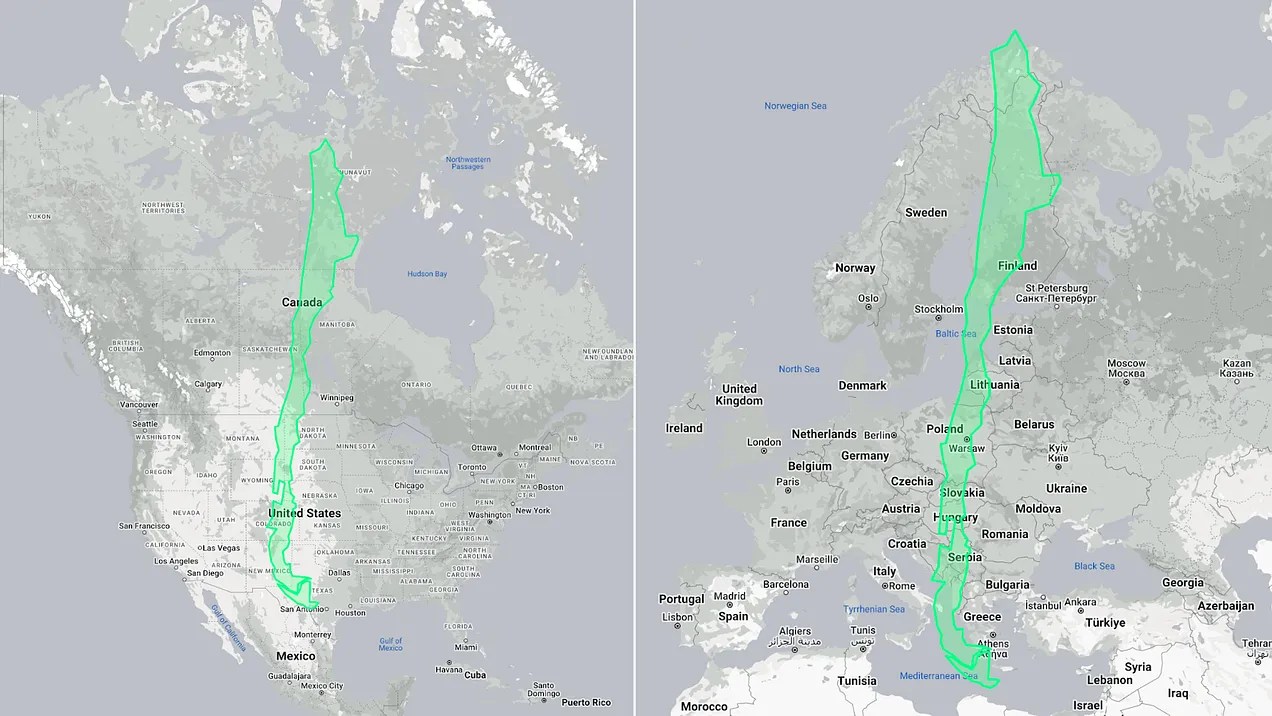
Thomas Pueyo on how geography shaped the longest (and proportionately thinnest) country in the world…
Chile is as long as the [vertical dimensions of]US and Canada combined.
Chile is as long as all of Europe!Chile is so long, it’s curved.

How long is it?
Why not longer?
Why is no other country as thin?
How does that make Chileans incomprehensible?
These questions (and more) answered: “Why Is Chile So Long?” from @tomaspueyo
* (Chilean poet) Pablo Neruda
###
As we stretch, we might recall that it was on this date in 1730 that the Valparaíso earthquake occurred. (As Pueyo explains, Chile’s unique geography and geology have frequently seismic implications.)
The quake had an estimated magnitude of 9.1–9.3 and triggered a major tsunami with an estimated magnitude of Mt 8.75, that inundated the lower parts of Valparaíso and caused severe damage from La Serena to Chillan; the tsunami affected more than 620 mi of Chile’s coastline.
While damage was widespread, only a few deaths were recorded due to the earthquake, reportedly because a strong foreshock had prompted people to leave their homes. Similarly, the subsequent tsunami: inhabitants ran to higher ground after seeing the water recede, so that only a few were killed.

“Adopt the pace of nature. Her secret is patience.”*…

Further, in a way, to last Tuesday’s post, Vincent Ialenti explains how, as the treadmill of life speeds up, sublime outdoor spaces help us tap into timescales that are longer, slower, planetary…
Our experience of time is changing. For the philosopher Byung-Chul Han, the early 21st century has left us ‘whizzing without a direction’. Our world is shaped by the restless, disorienting rhythms of near-term deliverables, social media impression counts, technological obsolescence, shallow electoral cycles, rapid news cycles, frenzied culture wars, sudden stock market shifts, gig economy hustles, and occupational burnout. Though it all seems exhausting and unmanageable, the whizzing isn’t slowing: digital platforms now bombard us, minute by minute, with fragments of information that fail to cohere into meaningful narratives, and algorithms that hijack our neurochemical reward systems.
As the treadmill of post-industrial society speeds up, some of us have become so addicted to the stimulation that we struggle to imagine another way to live: psychological research shows that most people would rather receive electric shocks than sit quietly alone with their own thoughts. In his book The Scent of Time (2017), Han borrows a concept from Marcel Proust – une époche de hâte – to describe our overstimulated moment. The ‘age of haste’ has arrived. And its problems are pervasive.
When time whizzes by, individual moments blur together and we stop contemplating how each fits into broader arcs of history. We forget, Han laments, to engage in slower-moving forms of cognition such as wonder, curiosity and introspection. We forget how to reflect and be still. But what can we really do about the age of haste? For many of us, a slower, more contemplative life often feels unattainable. You may feel trapped by the directionless whizzing of the 21st century – trapped on an accelerating treadmill. Can you forge a new relationship with time?
Perhaps your first impulse is to find ways of escaping the age of haste. This is a mistake. We cannot simply break free by ‘exiting’ the world we inhabit. Confronting time requires more engagement with the wider world. This world, however, is not the one defined by near-term deliverables and neurochemically disrupting algorithms. It is the one that reveals itself when you glimpse the Milky Way on a cloudless night. It is the world that becomes clear when you gaze upon a mountain.
Encountering spectacular natural environments can cause a radical shift in how we think about ourselves and the world. According to the psychologist Dacher Keltner, feelings of awe, especially those inspired by natural scenery, can make us feel more collaborative, less egoistic, more altruistic, and more open to social connection. Over the past two decades, Keltner tested this idea through a series of experiments that examined how a person’s attitudes and behaviours change after experiencing awe-inspiring places or things. He found that natural splendour seems to put us in a headspace that lets us reflect on our short lives as ephemeral organisms dwelling on a fragile planet floating in a vast cosmos. This way of thinking can be transformative, but its power is not a recent discovery. Greco-Roman Stoic philosophers, for instance, encouraged retreats into the countryside to proactively ponder life. Venturing into breathtaking outdoor spaces seems to help us step back, slow down and, most importantly, think in the long term. I call this style of thinking ‘longstorming’ because encounters with sublime geophysical and ecological environments can invite the mind to brainstorm about our long-term futures and pasts…
…
Fortunately, you do not need to visit charismatic ecosystems, like redwood forests, to begin longstorming. Walking down any city street or a country road, you can attune to how the rocks beneath your feet have multimillion- or multibillion-year geological histories. You can attune to how the air you breathe is altered by decades of carbon emissions. You can attune to the evolutionary histories of the chirping birds or even the cells in your body. Contemplating the passage of time is, at some level, available to anyone willing and able to longstorm – to begin wondering about the longer timelines of the universe. When you return to your smartphone afterwards, you might even look differently at the device itself: less attuned to the newsfeeds and pings, and more attuned to the ancient geological histories of the elements and minerals that make it up. After all, many of the metals found in smartphones, such as gold and copper, were formed billions of years ago among distant stars.
That said, certain geophysical features (like mountain vistas or idyllic countryside), certain activities (like hiking or backpacking), and certain mental states (like awe or calm) tend to draw out more enriching temporal experiences than others. This has an unfortunate implication: opportunities to have life-transforming brushes with the deep time of our planet and cosmos are not evenly distributed across society. Not everyone is capable of leisurely neighbourhood walks, let alone treks up to mountaintop vistas. Not everyone has the resources to make such a trip, let alone the time. If we want all of society to resist the age of haste, we first need to reform its entrenched structures of poverty – temporal or otherwise.
In the age of haste, longstorming should be a necessity, not a luxury. Without a deeper attunement to planetary time, the therapies of the 21st century will deliver healing that soothes us only in the moment. The age of haste requires healing of a different kind: longer, slower, planetary…
On the essential role of nature in our lives: “Do you find the 21st century overstimulating? Try ‘longstorming’,” from @vincent_ialenti in @aeonmag. Eminently worth reading in full.
(Image above: source)
* Ralph Waldo Emerson
###
As we reground, we might send tectonic birthday slowly-accumulating birthday greetings to Émile Haug; he was born on this date in 1861. A geologist and paleontologist, he is known for his contributions to the theory of geosynclines (trenches that accumulate thousands of metres of sediment and later become crumpled and uplifted into mountain chains). From the position of the Alp he theorized that geosynclines form between stable continental platforms. He showed that geosynclinal subsidence accompanies marine regressions on the continental platform and that geosynclinal uplift accompanies marine transgressions on the continental platform. His Traité de géologie (1907-11), rapidly became an indispensable reference work. He also produced important works on the fundamentals of paleontology, stratigraphy, and tectonics.

“Some say the world will end in fire, some say in ice.”*…

Ethan Siegel reminds us that the world– the living world– almost did end in ice…
… one event came closer than any other to bringing an end to life on Earth: a catastrophe known as either the Great Oxidation Event or the Great Oxygenation Event. Oxygen, one of the hallmark characteristics of our living Earth, was a tremendous destructive force when it first arrived in any sort of meaningful abundance some ~2 billion years after Earth first took shape. The slow alteration of our atmosphere by the gradual addition of oxygen proved to be fatal to the most common types of organism that were present on Earth at the time. For several hundred million years, the Earth entered a horrific ice age which froze the entire surface: known today as a Snowball Earth scenario. This disaster almost ended life on Earth entirely. Here’s the story of our planet’s near-death, culminating in life’s ultimate survival story…
For roughly 300 million years, the Earth was frozen: “What was it like when oxygen killed almost all life on Earth?” from @StartsWithABang in @bigthink. Eminently worth reading in full.
* Robert Frost, “Fire and Ice“
###
As we contemplate change, we might send chilly birthday greetings to Raoul Pictet; he was born on this date in 1846. Remembered as a pioneer in cryogenics, Pictet was a Swiss chemist who spent much of his career trying to produce very low temperatures (in order to produce ice for refrigeration)– which led him to the creation of liquid oxygen in 1877 (for which he’s credited as co-discoverer, as French scientist Louis-Paul Cailletet, working completely separately, also produced liquid oxygen that year).

You must be logged in to post a comment.