Posts Tagged ‘future’
“Some dreams matter. Most don’t. Often it can be hard to know which might be which.”*…
… So it is with trends and the drivers of fundamental change. One of the canniest spotters of emerging dynamics, Matt Klein, wrestles with some raw material…
I’ve always wanted to play with “conference talk tracks” as a data source, and finally found a moment to do a little analysis.
I took all of the 2025 submitted (not yet accepted) talk titles for SXSW’s “2050” & “Culture” tracks, to identify what patterns exist. I did this via Perplexity AI Pro, an advanced prompt, and detailed profile context.
Note: I don’t necessarily think these talk patterns are “cultural trends,” (although we can debate this). Rather, I see these submitted talk patterns as a pulse on what an industry is finding provocative, discussion-worthy and worth peacocking as thought leadership. That’s a different, valuable sort of insight.
I was particularly interested in surfacing not just the largest common denominators of talks (ex. AI, psychedelics, video games), but instead more specific, smaller and unexpected themes.
What makes SXSW unique (and this data worth analyzing) is that these talk submissions are crowdsourced or “bottoms-up” via industry leaders vs. (biased) invited, brand-focused, or sponsored talks, which many other conferences prioritize. Therefore, I find these SXSW-submissions quite organic and a valuable “pulse” on executive, senior leader, and public thinkers’ minds.
With that, 10 themes from hundreds of talk submissions…
01. Commodification of Authenticity
Can authenticity exist online, let alone from a business? Or is “authenticity” a paradox? This cluster explores how the pursuit of genuine experiences and identities is being packaged, sold, and (likely) diluted in the process, raising questions around the nature of authenticity in a hyper-commercial world.
Ex:
- “Authenticity: The New Social Currency for Brands”
- “Honor Your Root: Building Authentic Brands that Connect”
- “Authenticity + Impact: Native Voices in Film, Food & Beyond”
The other nine at: “10 Patterns from 400+ SXSW ’25 Talk Submissions,” from @KleinKleinKlein.
* Dean Koontz, Saint Odd
###
As we sift for significance, we might send lasting birthday greetings to Hazel Bishop; she was born on this date in 1906. An aspiring doctor, she was forced to drop out of medical school during the Great depression, and instead put her undergraduate degree in chemistry to work. As a senior organic chemist with Standard Oil during World War II, she discovered the cause of deposits affecting superchargers of aircraft engines. Later, in 1949, after a long series of home experiments building on that earlier discovery, in a kitchen fitted out as a laboratory, she perfected a “kiss-proof” “No-Smear Lipstick” that stayed on the lips longer than any other product then available, and began its manufacture. Marketed as the lipstick that “stays on you not on him,” it changed the cosmetic industry, spurring a raft on imitators.

“Our grandfathers lived in a world of largely self-sufficient, inward-looking national economies – but our great-great grandfathers lived, as we do, in a world of large-scale international trade and investment, a world destroyed by nationalism.”*…

There’s a growing chorus of opinion arguing that the era of global trade is ending. To be sure, nationalism and the protectionism it can spawn are on the rise. But is globalization’s decline now locked in? In a recent speech at the University of Tokyo, Bill Emmott questions the conclusions of The Economist (which he used to edit) and others predicting an end to a world in which goods and services flow relatively freely– pointing out the global trade is still very much alive. It’s a provocative talk, eminently worth reading in full; it ends with a framework for thinking about the question…
The history of globalisation that I have outlined has shown the development of international trade in goods and services to have been driven by three main forces:
- Peace, war and international security
- National external trade policies
- Technology, and its effect on transaction costs
It is clear that the biggest discontinuity in the growth of international commerce was caused by what we now know as the two world wars of the 20th century.
Russia’s invasion of Ukraine in 2022 has certainly diverted trade and financial flows considerably, thanks to direct security effects and to sanctions. But neither it nor the other conflicts we can see occurring in the Middle East, Africa or elsewhere have been sufficient to block global trade in a significant way.
Tensions between the US and China similarly have some diversionary effects, and are to some degree echoed in tensions between China and Europe and China and Japan. But those geopolitical tensions would have to get a lot worse to have a major effect on global commerce as a whole, in part because the world economy has become much more complex and multipolar in nature.
The one conflict that would be very likely to have a major “deglobalisation” influence would be a conflict between the US and China over Taiwan, for such a conflict would very likely reach catastrophic proportions and would force many countries to choose sides. We cannot predict how commerce and the exchange of ideas would look after such a conflict, just as my European forebears would have been unable to predict the world after 1918 from the standpoint of 1914 or earlier.
Secondly, nations’ external trade policies. As I commented earlier, there has been a clear trend back towards protectionism since the 2008 financial crisis, one that has lately been reinforced by policies aimed at the energy transition and by US-China tensions.
This has not yet however had a major effect on world trade. It could, of course. The big question is what would happen if Donald Trump is re-elected as US President in November and carries out his promise to impose a 10% tariff on all imported goods, and a 60% tariff on all goods from China.
One quite likely possibility is that other countries – including the EU, the UK, Japan and indeed China – would retaliate by imposing higher tariffs of their own, and we would be in a trade war, one that could escalate higher and higher.
The wider such a trade war became – i.e., taking in more countries – the likelier it would be to make deglobalisation visible in the trade statistics. Nonetheless, we should bear one other thing in mind: this is that services, especially digitally delivered services, have become an increasingly important component of global commerce. How they would be affected is unpredictable.
Third, we need to bring in the related and vitally important force of technology. Falling costs and increasing digital capabilities have been a big factor behind the growth of global commerce. The entry of artificial intelligence means that there is no likelihood of this technological force for cross-border commerce diminishing.
During the pandemic, the science and technology behind vaccine development, production and distribution were all global, even if geopolitics introduced some distortions. Moreover, the basic reason why the US stock market has been driven by the so-called “Magnificent Seven” tech stocks is that the market for all of them is global.
Geopolitics threatens, but as yet it does not decide. External trade policies at present divert, but only an escalatory trade war would be likely to have a major effect. Technology, however, remains the most powerful force in favour of continued globalisation.
The future of globalisation will be determined by the interplay of these three forces. There is no currently pre-determined destiny for globalisation. Many commentators over-play the influence of politics and under-play the role of technology. Extreme outcomes are possible, and need to be prepared for. But we must above all keep an open mind as to what the actual outcome will be…
We see deglobalization everywhere except in trade statistics: “The future of globalisation: a history,” from @bill_emmott and his excellent newsletter, Bill Emmott’s Global View .
(Image above: source)
* Paul Krugman
###
As we tackle trade, we might recall that it was on this date in 1178, about an hour after sunset, that five monks from Canterbury saw “the upper horn [of the Moon] split in two.” They reported their experience to the abbey’s chronicler, Gervase, continuing (as he reports) “From the midpoint of the division a flaming torch sprang up, spewing out, over a considerable distance, fire, hot coals and sparks. Meanwhile the body of the Moon which was below writhed, as it were in anxiety, and to put it in the words of those who reported it to me and saw it with their own eyes, the Moon throbbed like a wounded snake. Afterwards it resumed its proper state. This phenomenon was repeated a dozen times or more, the flame assuming various twisting shapes at random and then returning to normal. Then, after these transformations, the Moon from horn to horn, that is along its whole length, took on a blackish appearance.”
In 1976, a geologist suggested that this was consistent with the location and age of the 22-km lunar crater Giordano Bruno. However, such asteroid impact would have ejected debris causing an astonishing meteor shower, which was never reported. So, while that is plausible, it’s now considered more likely that the sighting of 1178 was an exploding meteor that just happened to line up with their view of the Moon.

“Prediction is very difficult, especially if it’s about the future”*…

But, as Dylan Matthews reports, some are better at it than others…
The question before a group made up of some of the best forecasters of world events: What are the odds that China will control at least half of Taiwan’s territory by 2030?
Everyone on the chat gives their answer, and in each case it’s a number. Chinmay Ingalagavi, an economics fellow at Yale, says 8 percent. Nuño Sempere, the 25-year-old Spanish independent researcher and consultant leading our session, agrees. Greg Justice, an MBA student at the University of Chicago, pegs it at 17 percent. Lisa Murillo, who holds a PhD in neuroscience, says 15-20 percent. One member of the group, who asked not to be named in this context because they have family in China who could be targeted by the government there, posits the highest figure: 24 percent.
Sempere asks me for my number. Based on a quick analysis of past military clashes between the countries, I came up with 5 percent. That might not seem too far away from the others, but it feels embarrassingly low in this context. Why am I so out of step?
This is a meeting of Samotsvety. The name comes from a 50-year-old Soviet rock band — more on that later — but the modern Samotsvety specializes in predicting the future. And they are very, very good at it. At Infer, a major forecasting platform operated by Rand, the four most accurate forecasters in the site’s history are all members of Samotsvety, and there is a wide gap between them and fifth place. In fact, the gap between them and fifth place is bigger than between fifth and 10th places. They’re waaaaay out ahead.
While Samotsvety members converse on Slack regularly, the Saturday meetings are the heart of the group, and I was sitting in to get a sense of why, exactly, the group was so good. What were these folks doing differently that made them able to see the future when the rest of us can’t?…
The “secrets” of superforecasters: “How a ragtag band of internet friends became the best at forecasting world events,” from @dylanmatt in @voxdotcom.
(Image above: source)
* Niels Bohr
###
As we contemplate change, we might recall that it was on this date in 1781 that William Herschel discovered Uranus. The first planet to be discovered with the aid of a telescope, he initially thought that it was a comet.

And on this date in 1930, Clyde Tombaugh discovered Pluto. Originally designated the ninth planet, it has been “demoted” to minor (or dwarf) planet status.

“It is difficult to predict, especially the future”*…

An amusing attempt to take the long view…
W. Cade Gall’s delightful “Future Dictates of Fashion” — published in the June 1893 issue of The Strand magazine — is built on the premise that a book from a hundred years in the future (published in 1993) called The Past Dictates of Fashion has been inexplicably found in a library. The piece proceeds to divulge this mysterious book’s contents — namely, a look back at the last century of fashion, which, of course, for the reader in 1893, would be looking forward across the next hundred years. In this imagined future, fashion has become a much respected science (studied in University from the 1950s onwards) and is seen to be “governed by immutable laws”.
The designs themselves have a somewhat unaccountable leaning toward the medieval, or as John Ptak astutely notes, “a weird alien/Buck Rogers/Dr. Seuss/Wizard of Oz quality”. If indeed this was a genuine attempt by the author Gall to imagine what the future of fashion might look like, it’s fascinating to see how far off the mark he was (excluding perhaps the 60s and 70s), proving yet again how difficult it is to predict future aesthetics. It is also fascinating to see how little Gall imagines clothes changing across the decades (e.g. 1970 doesn’t seem so different to 1920) and to see which aspects of his present he was unable to see beyond (e.g. the long length of women’s skirts and the seemingly ubiquitous frill). As is often the case when we come into contact with historic attempts to predict a future which for us is now past, it is as if glimpsing into another possible world, a parallel universe that could have been (or which, perhaps, did indeed play out “somewhere”)…
More at: “Sartorial Foresight: Future Dictates of Fashion (1893)” in @PublicDomainRev.
Browse the original on the Internet Archive.
* Niels Bohr (after a Danish proverb)
###
As we ponder the problem of prognostication, we might recall that it was on this date in 1934 that producer Samuel Goldwyn bought the film rights to L. Frank Baum’s book, The Wonderful Wizard of Oz, which had been a hit since its publication in 1900 but had until then been considered both inappropriate (as it was a “children’s book”) and too hard to film. Goldwyn was banking on the drawing power of his child star Shirley Temple, the original choice for Dorothy; but (as everyone knows) the role went to Judy Garland who won a special “Best Juvenile Performer” Oscar and made the award-winning song, “Somewhere Over the Rainbow” a huge hit.
The film was only a modest box-office success on release… but has of course become a beloved classic.


“Follow the money”*…
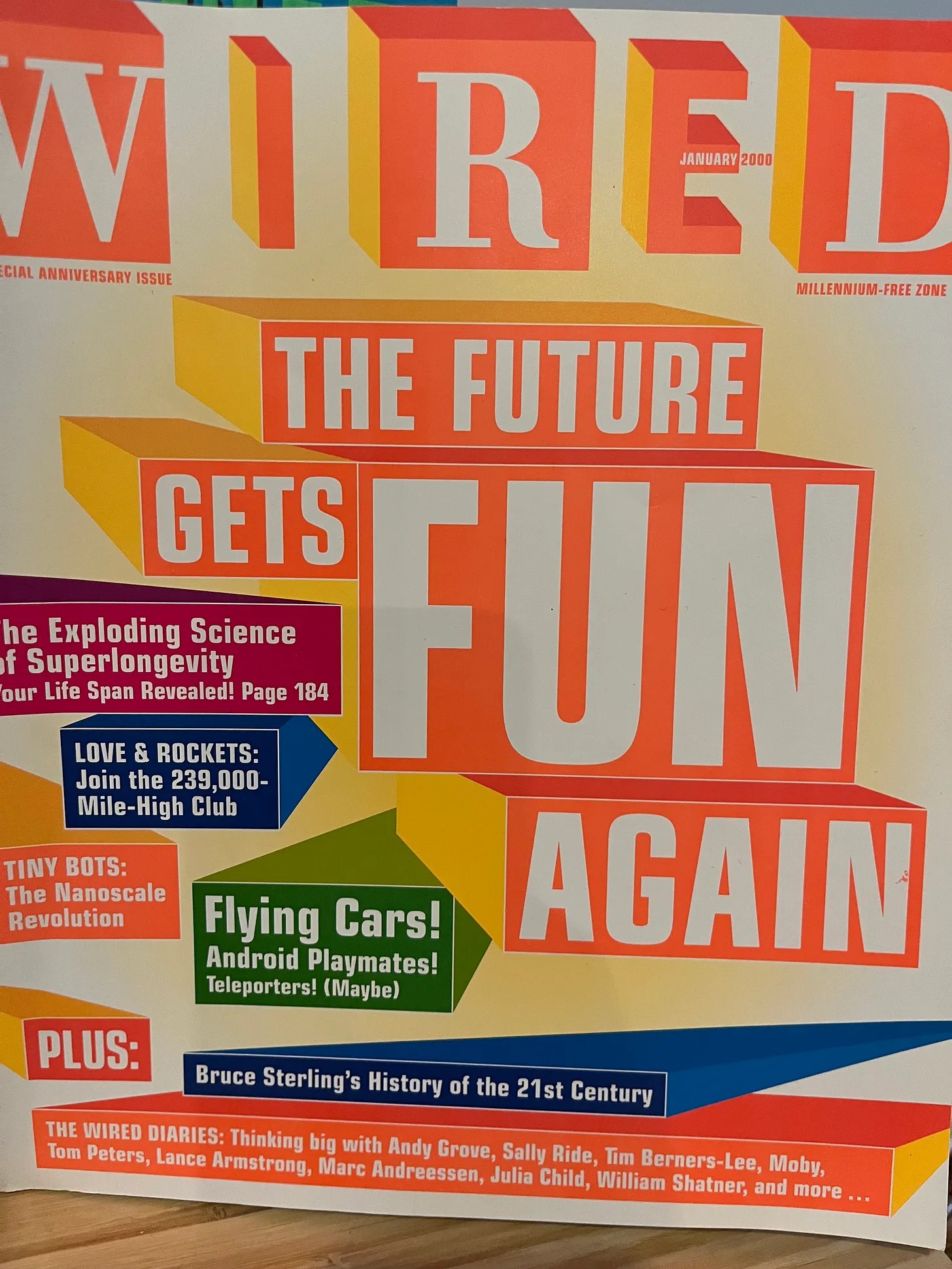
Professor and author Dave Karpf is re-reading the entire WIRED back catalog chronologically (for the second time) for a book project on the “history of the digital future.” A consideration of a 2000 issue devoted to the future has led him to a fascinating insight…
The January 2000 issue is themed around predictions. The magazine did the same thing in January 1999. They ask a ton of experts and celebrities to talk about what the future is going to be like. Some take it seriously, others make jokes. Some are prescient, others notsomuch. It’s a window into what the future looked like back then.
[Karpf reviews a number of the predictions, concluding with…]
…And then there’s this perfect Nathan Myrvhold quote “There won’t be TV per se in three decades. There will be video service over the Internet, but it will be as different from TV today as, say, MTV from the Milton Berle show of the 1950s or from radio plays of the 1940s.”
This is art. I want to frame Myrvhold’s quote and put it in a museum of lopsided tech futurist predictions.
The part that he gets right is the technological development curve. There he is, at the turn of the millennium, five years before the inception of YouTube, telling us that the future of television is going to be video service over the Internet. Yes, absolutely right!
But the part he gets wrong is the industrial, social, and economic impacts of this technological development. We’re seeing this right now, in 2023, as the various streaming services add advertising and strike content-sharing partnership deals with each other. We have these revolutionary new technological developments, and, for about a decade, they were supported by a stock market bonanza. But now that the stocks are no longer ridiculously overvalued, the companies driving these technological developments have settled on a vision of replacing old cable tv with new cable tv. (I wrote about this in July 2022, btw, back when this Substack had a much smaller readership. I think the piece holds up well.)
Technologically, it didn’t have to be this way. But, given all the existing incentive structures established by 21st century capitalism, it was all-but-certain that we would end up here.
I see this time and time again when reading predictions of social transformation from 90s- and 00s-era technologists [cough NicholasNegropontewasconstantlywrong cough]. And I see the same thing today, every time an artificial general intelligence true believer starts opining on the glorious future of education/entertainment/science/manufacturing/art.
I wrote about this phenomenon last year in The Atlantic, where I argued that we won’t be able to tell what the future of AI looks like until we have a sense of where the revenue streams come from. The trajectory of any emerging technology bends towards money.
…
I’m writing a whole book about the lopsided ways in which tech futurists always get their predictions wrong. And one major reason why is that they focus on what the technology could do, given time and mass adoption, rather than considering what capitalism will surely do to those technologies, unless we alter the incentives through regulations.
The trajectory of every emerging technology bends toward revenue streams. If you want to build a better future, you cannot ignore the shaping force of money…
A peek back at some tech predictions from January 2000: “From the WIRED archives: The trajectory of any emerging technology bends toward money,” by @davekarpf (referral account)
See also “The frantic battle over OpenAI shows that money triumphs in the end” (in which Robert Reich argues that, though the revenue streams aren’t yet obvious, protecting their emergence was at the core of the recent battle for control of what was, ostensibly, a not-for-profit) and the oddly apposite “Nerd culture is murdering intellectuals.”
And for more on Karpf’s march through WIRED’s history and what it can tell us about the ways that tech and our culture have changed, see “Notes from #WIRED30.”
* Deep Throat (as portrayed the film adaptation of All the President’s Men)
###
As we pay attention to the profit motive, we might recall that this is an important date in broadcast history. On this date in 1896, Guglielmo Marconi introduced “radio”: he amazed a group at Toynbee Hall in East London with a demonstration of wireless communication across a room. Every time Marconi hit a key beside him at the podium, a bell would ring from a box being carried around the room by William Henry Preece.
Then exactly five years later, on this date in 1901, Marconi confounded those who believed that the curvature of the earth would limit the effective range of radio waves when he broadcast a signal from Cornwall, England to Newfoundland, Canada– over 2,100 miles– and in so doing, demonstrated the viability of worldwide wireless communication.
In the earliest days of radio, when it was essentially a wireless telegraph, there were myriad predictions of what the technology might become– from an internet-like decentralized community of communicators to a provider of education, telemedicine, and other special services… in the event, of course, it followed the money.
You must be logged in to post a comment.