Posts Tagged ‘Food’
“Nothing scares corporate radio like public radio”*…

These are tough times for those who love (and/or depend on) local radio. The Trump administration has eliminated the federal funding on which many local public stations have depended, and consolidation has “homogenized” local commercial radio. And this, at a time when the civic and cultural news and engagement that local radio provides has never been more important.
Still, community-rooted local radio perserveres. Consider ldial, a curated collection from Adam Scott— a list that let’s you sample some of the best independent and community radio stations in the US (and, ideally, encourages you to find your own local options).
Then, remembering that the best local radio is your local radio, consider supporting your local station(s).
* Tom Petty
###
As we tune in, we might recall that it was on this date in 1950 that Hormel registered the name and trademark “Spam” for its canned meat product. It is interesting to note that the company had marketed the product since 1937, and only felt the need to protect the name 13 years later.

“Speak softly and carry a big stick”*…

Vice President Teddy Roosevelt uttered that famous line at the Minnesota State Fair in 1901 (a few days before William McKinley was assasinated and Roosevelt became President). While TR was talking about foreign policy, he might well have been describing the fair-goers… at least as they have evolved. There are very few comestibles that one cannot purchase at the fair, chocolate-dipped and/or fried, on a stick.
Fairs have long been a hotbed of culinary creation. To take just one example, the 1904 World’s Fair in St. Louis introduced the hamburger, the hot dog, peanut butter, iced tea, the club sandwich, cotton candy, and the ice cream cone, among other delights.
Innovation lives on. In advance of this year’s event (August 21-September 1), the Minnesota State Fair is previewing some of the new foods that will be on offer to the roughly 2 million visitors it will host. For example…


And so, so much more.
Via the always enlightening Web Curios, where Matt Muir observes: “On the one hand, food discourse is some of the worst discourse; on the other, it’s impossible not to gawp every year at the astonishing things that North Americans seem able and willing to do with saturated fats and a deepfryer, and to speculate and the deep and significant character flaws that this sort of approach to ‘sustenance’ connotes. THERE IS NO WORLD IN WHICH “a 4 oz. hamburger patty with cheese, pickles and special sauce, sandwiched between two deep-fried peanut butter & grape jelly Uncrustables” [pictured at the top] IS A DESCRIPTION OF A REASONABLE FOODSTUFF! (also, can we just take a moment to consider what has happened to a society in which pre-made crustless sandwiches are a thing? O THE DECLINE OF EMPIRE!)… Would you want to drink this ‘mocktail’? [here] A “Dirty NoTini (lemon, dill pickling spices & olive brine)”? I posit that you would in fact not. ONE OF THESE ‘DISHES’ [here] IS LITERALLY ‘PASTRY SCRAPS WITH SUGAR AND CINNAMON SERVED WITH A SUGAR-BASED DIPPING SAUCE’ FFS! There’s not enough Ozempic in the world, honestly.”
Yeah… but I have to say, the Tandori Chicken Quesdilla sounds pretty good to me…
Browse the entire array of dishes debuting at the Minnesota State Fair: “New Foods for 2025.”
Special bonus: not related (it’s a pointer to– and comment on– a piece in Lit Hub), but also from Web Curios:
Did Shakespeare Write Hamlet Stoned?: To be clear, per Betteridge’s Law [see here], the answer to this is very clearly ‘no, of course he fcuking didn’t, IF HE EVEN WROTE HAMLET IN THE FIRST PLACE (lol)’, but I am including this because the thinness of the argument here presented made me laugh quite a lot – the entire piece hangs on two lines drawn from Sonnet 76, subjected to the following RIGOROUS ANALYSIS: “Many scholars believe the ‘noted weed’ in which the author finds ‘invention’ is a reference to cannabis and its ability to stimulate creativity. Some also think the phrase ‘every word doth almost tell my name’ is a sly reference to the fact that ‘shake’ (as in Shakespeare) is another word for cannabis—specifically, the scraps left over after cannabis buds have been plucked and packaged.” I don’t think Shakespeare was baked, no, but I have my doubts about the author of this piece, bless them.
*Theodore Roosevelt
###
As we taste, we might recall that today celbrates an indisputable delicacy; it is National Peach Ice Cream Day.

“What’s for breakfast?”*…
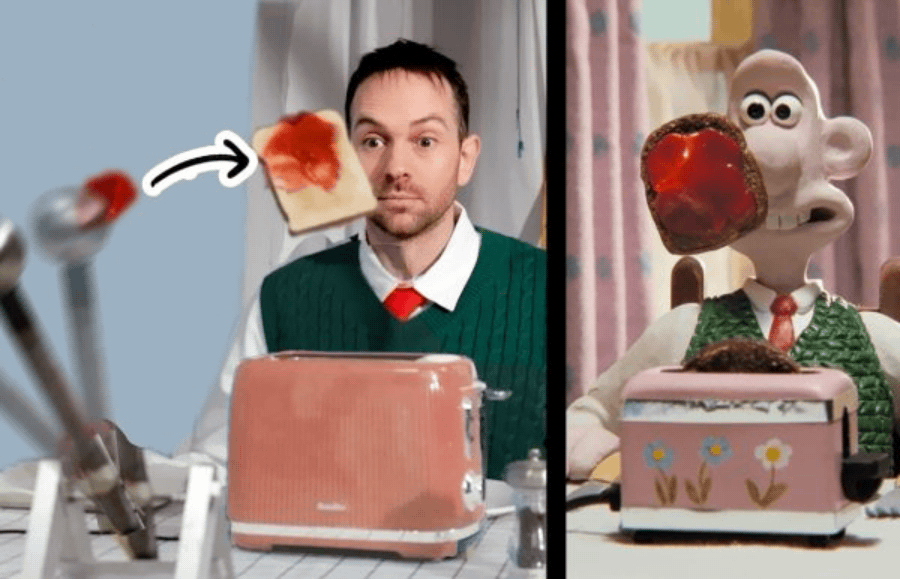
… and, we moderns tend to ask, how can we make it faster and easier?… a tendency lampooned, a la Rube Goldberg, in Aardman‘s Classic Wallace and Gromit outing The Wrong Trousers:
Joseph Herscher, proprietor of the wonderful Joseph’s Machines, put the concept to test: he built it…
I’m sure it comes as no surprise that Wallace & Gromit: The Wrong Trousers was a favourite of mine growing up, so this machine has been extra special to create! This video not only contains TWO different versions of the final result, but I also take you through my process of figuring out dangerous stunts, solving sticky jam complications and treating dog stage fright. Fun fact: The trousers at the very end were lent to me by Aardman Studios!
Modernizing the most important meal of the day: “Joseph’s Machines recreates Wallace & Gromit’s automated breakfast machine,” via the terrific The Kids Should See This.
* “When you wake up in the morning, Pooh,” said Piglet at last, “what’s the first thing you say to yourself?”
“What’s for breakfast?” said Pooh. “What do you say, Piglet?”
“I say, I wonder what’s going to happen exciting today?” said Piglet.
Pooh nodded thoughtfully. “It’s the same thing,” he said.”
– A. A. Milne
###
As we ponder progress, we might recall that today is National Quiche Lorraine Day.

“In the last analysis, a pickle is a cucumber with experience”*…
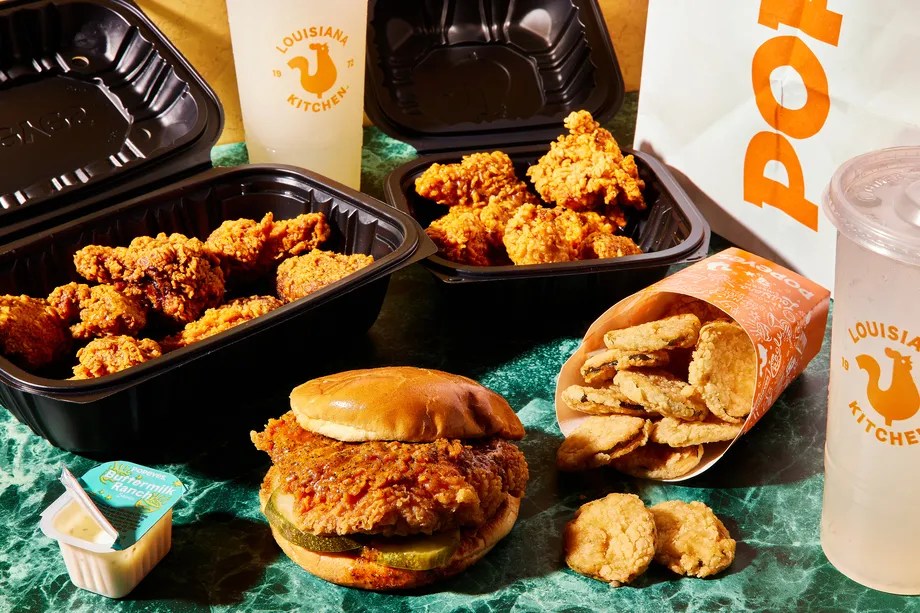
The pickle is Gen Z’s avocado; it’s a passion and a personality. But maybe, Jaya Saxena suggests, that’s missing the point…
In the Top Chef episode “Pickle Me This,” which aired on April 17, host Kristen Kish, in power clashing greens, announces that two teams of chefs must go head to head in creating an all-pickle dinner. The five-course meal was to feature different kinds of pickles in every course — not kimchi or achar necessarily, but instead the cornichons and dill of the European influence. There were charred pickles with cured mackerel, cucumber and celeriac pickle gelee, chef Massimo Piedimonte’s winning fried pickle cannolo, and of course a bread and butter pickle curd with dill ice cream. Individually, each dish sounded great, and judge Tom Colicchio said two of the dishes, including the dessert, were some of the best he’s ever had on the show.
Top Chef contestants often have to create meals utilizing an ingredient that’s in the culinary zeitgeist. Some of those meals are more successful than others. But a successful five-course meal of all things pickles illustrates the strange place in culture the pickle holds now: both cheffy and with diverse-enough flavor profiles to inspire chefs in fierce competition, but obvious and basic enough to also be a little bit of a joke. It’s the food of the moment, both sincerely and ironically.
As Rebecca Jennings wrote in Vox, pickles are Gen Z’s avocado, a viral food that people genuinely enjoy: They “pair well with other contemporary food trends like dirty martinis and canned cocktails, and fit right in with aesthetically pleasing butter boards and “girl dinner” spreads.” But people are also consuming pickles for the meme of it all. There are pickle chips, pickle popcorn, Flamin’ Hot pickle Cheetos, and pickle seltzer. Popeyes recently introduced an entire pickle menu, including pickle lemonade. 21Seeds wants you to make a spicy pickle martini with its tequila, and people are putting pickles in their soda. Sweetgreen has pickle ketchup, and of course Molly Baz has dill pickle mayo. And like any “it” food nowadays, the pickle has moved into fashion and home decor.
Like with any trend, though, it’s kind of exhausting when it’s everywhere. Pickles have become subject to the flavor-ification of actual foods; half the time, pickle-flavored anything is an unsatisfying approximation of the flavor of Central European-style pickled cucumbers — typically a combination of salt, vinegar, and artificial dill which evokes none of the live-culture fizz that hums through the real thing. It’s that complexity we crave, herbs and lactic acid and often spices like coriander.
But for the pickle to be the centerpiece of an entire five-course meal, or for it to be one’s personality to the point that it flavors every snack in one’s house, slightly misses the point of the pickle. A Popeyes meal of fried pickles and pickle glazed wings washed down with a pickle lemonade serves no refreshing alternative to the onslaught of puckering pickle potency. A filthy martini and a bowl of pickle popcorn offers no relief. What makes pickles great on a sandwich or a charcuterie board is usually that the pungent brine and preserving salt make for a great contrast to any creamy, sweet or rich ingredients. Pickles are salt and acid bombs that are delicious on their own, but also enhance every other flavor. It’s why olives are often served with bread and cheese plates have all that cheese. The back and forth is what makes pickles truly shine.
Obviously no one is forcing anyone to only consume pickles, and if that is indeed what your taste buds crave, then congrats on being the moment! But put pickles everywhere and they cease to be a treat, the shining zinging bite to zap you into whatever else you’re eating. Maybe they should stay a sometimes food…
The flavor of the moment: “Is There Too Much Pickle?” from @jayasaxena.com in @eater.bsky.social.
Possibly apposite?: “Will Gen Z’s Pivot to the Republican Party Last?– It’s not only young men who lean conservative. The youngest female voters are also abandoning the Democratic Party.” (gift article)
###
As we test our tastebuds, we might recall that it was on this date in 2009 that 12 year old Catherine Ralston ( a member of Gen Z) was named Easy-Bake “Baker of the Year” for her “Queen of Hearts Strawberry Tart.” The Easy-Bake Oven is, of course, a working toy oven that Kenner introduced in 1963 (more than 16 million Easy-Bake Ovens (in 11 models) had been sold by 1997), and which Hasbro still manufactures.

“Enjoy every sandwich”*…

See how your quick, on-the-go lunch sandwich was produced (and as a bonus, how your big catch at sea becomes a permanent part of your decor)…
* Warren Zevon
###
As we contemplate commercial comestibles, we might send inventive birthday greetings to Benjamin Thompson; he was born on this date in 1753. A supporter of the Tory Loyalist cause during the American Revolution, he fled to England after the war, where his scientific efforts during the conflict had earned him a reputation (and a knighthood). But he soon decamped to Bavaria, where he served as an aide-de-camp to the Prince-elector Charles Theodore. He reorganized Charles Theodore’s army and created the Englischer Garten in Munich, which remains one of the largest urban public parks in the world. For his efforts, in 1791 Thompson was made an Imperial Count, becoming Reichsgraf von Rumford. He took the name “Rumford” after the town of Rumford, New Hampshire, which was an older name for Concord where he had been married.
Relevantly to today’s post, he studied methods of cooking, heating, and lighting, including the relative costs and efficiencies of wax candles, tallow candles, and oil lamps. He invented Rumford’s Soup, a nourishing soup for the poor, and established the cultivation of the potato in Bavaria. And he invented the double boiler, a kitchen range, a coffee percolator– and the Rumford fireplace (which more efficiently heated rooms). He is also credited with the invention of thermal underwear and with creating the “baked Alaska.”

You must be logged in to post a comment.