Posts Tagged ‘film history’
Getting away with murder…

There are loopholes, and then there are loopholes…
A panel of Idaho lawmakers is recommending the Legislature ask Congress to fix a legal loophole that has some calling a portion of Yellowstone National Park the “Zone of Death,” where crimes could arguably go unprosecuted.
The vast majority of the 3,471-square-mile (8,990-square-kilometer) park sits in Wyoming, but about 3% of it stretches into Montana and 1% of the park is in eastern Idaho. When Congress created the park in 1872, the federal court in the District of Wyoming was given jurisdiction over the crimes committed within park borders.
Boise Democratic Rep. Colin Nash, an attorney, told the House Judiciary and Rules Committee on Thursday that he first learned about the “zone of death” in law school. The phrase refers to a legal theory advanced by Michigan State Law professor Brian Kalt in 2005, which says a jurisdictional loophole could force the federal government to dismiss charges against anyone accused of committing a federal crime in the Idaho portion of the park.
In an academic paper titled “The Perfect Crime,” Kalt noted the Sixth Amendment says that people charged with crimes have a right to be tried by a jury of their peers, selected from the state and region where the crime took place.
That’s a problem for Yellowstone, because the only beings living in Idaho’s roughly 50-square-mile portion of Yellowstone are grizzly bears, elk and other wildlife — and they aren’t eligible for jury duty. Kalt theorized that someone who committed a murder in Idaho’s portion of Yellowstone could get away with it, since the federal government would be unable to seat a constitutionally sound jury…
The ‘Zone of Death’: “Lawmaker wants federal fix in Yellowstone’s legal blind spot.”
[image above: source]
###
As we consider the angles, we might recall that it was on this date in 1931 that Dracula— the first in a line line of “classic” monster movies– premiered in New York. Directed by the great Tod Browning and famously starring Bela Lugosi (in what many consider still to be the definitive portrayal of the blood-thirsty Count), the film was based on the 1924 stage play Dracula by Hamilton Deane and John L. Balderston, which in turn is adapted from the 1897 novel Dracula by Bram Stoker. The film was was both a critical and commercial success on its release, and has earned it’s way into the canon, having been selected by the Library of Congress for preservation in the National Film Registry as “culturally, historically, or aesthetically significant.”

.
“History is humankind trying to get a grip. Obviously its not easy. But it could go better if you would pay a little more attention to certain details, like for instance your planet.”*…

A blast from the past…
In 1938, 20-year-old filmmaker Richard H. Lyford directed and starred in As the Earth Turns, a science-fiction silent movie about a mad scientist who purposely induces climate change as a way to end world violence.
But the 45-minute film became “lost,” only to resurface 80 years later, in 2018, when Lyford’s grandniece, Kim Lyford Bishop, discovered it. (After creating the film, Lyford went on to work at Disney and earn an Oscar for the 1950 documentary “The Titan: Story of Michelangelo.”)
Bishop then asked music composer Ed Hartman, who was her daughter’s percussions teacher, to score it.
Although “As the Earth Turns” was finally released in 2019 and took part in 123 film festivals, it will finally premiere on television on Halloween night, this Sunday on Turner Classic Movies at 9pm PST…
From The Seattle Times:
… “As the Earth Turns is the work of an exuberant, ambitious young man: Lyford wrote, directed and shot the film, and managed to corral a stable of actors and crew to capture his vision. You can see his fascination with the craft of filmmaking: Lyford experiments with miniatures and models (then used in Hollywood films, and a remarkable accomplishment for a barely-out-of-his-teens hobbyist), explosions, earthquakes and special makeup effects, all on a budget of next to nothing.”
“A 1938 sci-fi film about climate change was lost. It’s making its TV debut 83 years later,” from Carla Sinclair (@Carla_Sinclair) and @BoingBoing.
* Kim Stanley Robinson, New York 2140
###
As we ponder prescience, we might recall that it was on this date in 2012 that Hurricane Sandy (AKA Superstorm Sandy) hit the east coast of the United States, killing 148 directly and 138 indirectly, wreaking nearly $70 billion in damages, and causing major power outages. In New York City streets, tunnels, and subway lines were flooded.

“Some people worry that artificial intelligence will make us feel inferior, but then, anybody in his right mind should have an inferiority complex every time he looks at a flower”*…

Humor is said to be the quintessential humor capacity, last thing that AI could– will?– conquer…
New Yorker cartoons are inextricably woven into the fabric of American visual culture. With an instantly recognizable formula — usually, a black-and-white drawing of an imagined scenario followed by a quippy caption in sleek Caslon Pro Italic — the daily gags are delightful satires of our shared human experience, riffing on everything from cats and produce shopping to climate change and the COVID-19 pandemic. The New Yorker‘s famous Cartoon Caption Contest, which asks readers to submit their wittiest one-liners, gets an average 5,732 entries each week, and the magazine receives thousands of drawings every month from hopeful artists.
What if a computer tried its hand at the iconic comics?
Playing on their ubiquity and familiarity, comics artist Ilan Manouach and AI engineer Ioannis [or Yiannis] Siglidis developed the Neural Yorker, an artificial intelligence (AI) engine that posts computer-generated cartoons on Twitter. The project consists of image-and-caption combinations produced by a generative adversarial network (GAN), a deep-learning-based model. The network is trained using a database of punchlines and images of cartoons found online and then “learns” to create new gags in the New Yorker‘s iconic style, with hilarious (and sometimes unsettling) results…
Comics artist Ilan Manouach (@IlanManouach) and AI engineer Yiannis Siglidis created The Neural Yorker: “Computer-Generated New Yorker Cartoons Are Delightfully Weird.”
For comparison’s sake, see “142 Of The Funniest New Yorker Cartoons Ever.”
* Alan Kay
###
As we go for the guffaw, we might recall that it was on this date in 1922 that the first chapter in Walt Disney’s career as an animator came to a close when he released the 7th and next-to-last “Laugh-O-Gram” cartoon adaption of a fairy tale, “Jack the Giant Killer.”
Disney’s first animated films began in 1920 as after-work projects when Disney was a commercial artist for an advertising company in Kansas City. He made these cartoons by himself and with the help of a few friends.
He started by persuading Frank Newman, Kansas City’s leading exhibitor, to include short snippets of animation in the series of weekly newsreels Newman produced for his chain of three theaters. Tactfully called “Newman Laugh-O-grams,” Disney’s footage was meant to mix advertising with topical humor…
The Laugh-O-grams were a hit, leading to commissions for animated intermission fillers and coming attractions slides for Newman’s theaters. Spurred by his success, the 19-year-old Disney decided to try something more ambitious: animated fairy tales. Influenced by New York animator Paul Terry’s spoofs of Aesop’s Fables, which had premiered in June 1920, Disney decided not only to parody fairy-tale classics but also to modernize them by having them playing off recent events. With the help of high school student Rudy Ising, who later co-founded the Warner Brothers and MGM cartoon studios, and other local would-be cartoonists, Disney [made 7 animated shorts, of which “Jack, the Giant Killer” was the penultimate].
Walt Disney’s Laugh-O-grams
“Something can always go wrong”*…

When what’s old is new again…
When Dennis Lehane joked in 2011 that the only real difference between Greek tragedy and noir was that in the former characters fall from great heights and in the latter they drop from the curb, he was pinpointing something simultaneously mythic and fatalistic about the American crime fiction tradition: the idea of cautionary tales being told at street level. “Whichever way you turn,” broods the antihero of Edgar G. Ulmer’s axiomatic Detour (1945), “fate sticks out a foot to trip you.” The same anxious malaise inflecting detective stories of Depression-era novelists like Dashiell Hammett and Raymond Chandler—whose twisty plots doubled as picaresque guided tours through a newfangled urban wilderness—would manifest in the flow of postwar thrillers that either literally adapted their contents or else reconfigured their themes for a visual medium. Stories set in moral grey zones and gritty environments were transformed into cinematic shadow plays by filmmakers who recognized and exploited the material’s expressionist potential. A movie like Fritz Lang’s wonderfully wicked The Woman in the Window (1944) sutures the seams between the elegant, sinister poeticism of Weimar-era horror and the hard-driving, irrepressible energy of pre-Code American crime pictures, an unholy matrimony yielding plenty of significant offspring. In 1946, writing about a group of American movies previously banned in France during the Nazi occupation—mostly signed by European émigrés like Lang who’d fled for the Hollywood Hills—critic Nino Frank evocatively referred to them as “dark films,” a coinage whose actual originality has been debated but proved lingeringly evocative. The description was taken as a workable industrial template for decades by Hollywood studios and insurgent independents alike.
Though noir was and remains an amorphous concept, it does have a few instantly identifiable features: like any genuinely red-blooded and pleasurable entertainment, you know it when you see it. The commercial appeal of noir lay primarily in its natural conduciveness to sex and violence, both always lurking and often intertwined in defiance of everyday moralism and official censorship, while its critical viability owed to its existential dimension, a spectrum broad enough to accommodate a muckraker like James M. Cain alongside Albert Camus. The latter famously said that Cain’s 1934 novel The Postman Always Rings Twice was a deep influence on his own 1942 L’étranger; in both books, outwardly mild-mannered protagonists momentarily get away with murder, imagining themselves privy in the act’s aftermath to some secret knowledge about what Camus’s narrator calls “benign indifference of the world.” Or, as a pair of noir addicts put it in The Man Who Wasn’t There (2001), a movie branded with the mark of Cain: “it’s hard to explain, but seeing it whole gives you some peace.”…
“The Same Old Song: A Guide to Neonoir” Adam Nayman (@brofromanother) leads us from Point Blank and Chinatown through Blood Simple and Night Moves to The Last Seduction and Momento.
* “Visser” (M. Emmet Walsh), Blood Simple
###
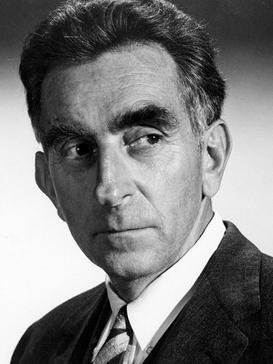
As we get dark, we might send thrilling birthday greetings to Arthur Zwerling; he was born on this date in 1914. Better known by his professional name, Jeff Corey, he was a stage and screen actor and director (whose work included noirs like The Man Who Wouldn’t Die and the radio series The Adventures of Philip Marlowe).
Corey’s career was interrupted when he was blackilisted in the early 1950s, so he turned to teaching– and became one of the most influential acting coaches in Hollywood. His students, at various times, included Robert Blake, James Coburn, Richard Chamberlain, James Dean, Jane Fonda, Peter Fonda, Michael Forest, James Hong, Luana Anders, Sally Kellerman, Shirley Knight, Bruce Lee, Penny Marshall, Jack Nicholson, Roger Corman, Darrell M. Smith, Diane Varsi, Sharon Tate, Rita Moreno, Leonard Nimoy, Sally Forrest, Anthony Perkins, Rob Reiner, Robert Towne, Barbra Streisand, and Robin Williams. He resumed his acting career in the the 60s.
“Poetry is the art of creating imaginary gardens with real toads”*…
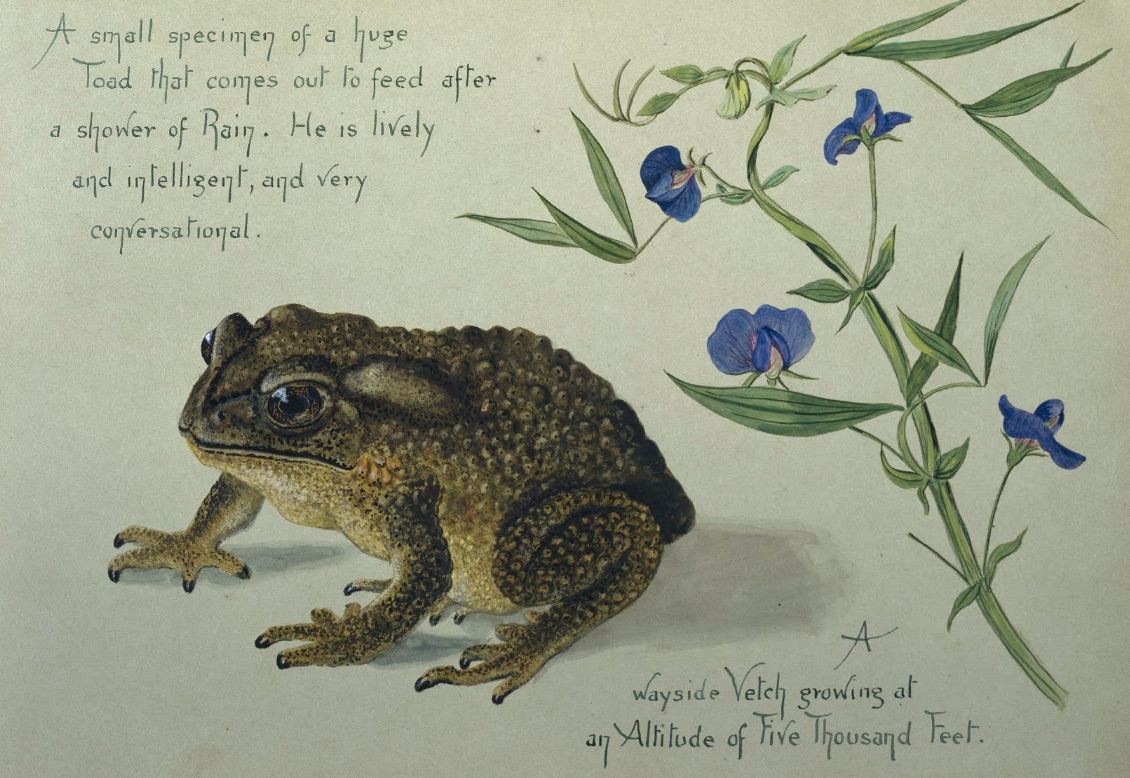
Olivia Fanny Tonge , A Toad, c. 1905
Before the swallow, before the daffodil, and not much later than the snowdrop, the common toad salutes the coming of spring after his own fashion, which is to emerge from a hole in the ground, where he has lain buried since the previous autumn, and crawl as rapidly as possible towards the nearest suitable patch of water. Something – some kind of shudder in the earth, or perhaps merely a rise of a few degrees in the temperature – has told him that it is time to wake up: though a few toads appear to sleep the clock round and miss out a year from time to time – at any rate, I have more than once dug them up, alive and apparently well, in the middle of the summer.
At this period, after his long fast, the toad has a very spiritual look, like a strict Anglo-Catholic towards the end of Lent. His movements are languid but purposeful, his body is shrunken, and by contrast his eyes look abnormally large. This allows one to notice, what one might not at another time, that a toad has about the most beautiful eye of any living creature. It is like gold, or more exactly it is like the golden-coloured semi-precious stone which one sometimes sees in signet rings, and which I think is called a chrysoberyl…
From George Orwell (in 1946): “Some Thoughts on the Common Toad.” From The Orwell Foundation, via Berfrois.
* Marianne Moore
###
As we appreciate amphibians, we might we might recall that it was on this date in 1913 that cartoonist John Randolph (J.R.) Bray first exhibited his animated film, “The Artist’s Dream” (later retitled “The Dachshund and the Sausage” for reasons that will be obvious). Bray was not the first animator; indeed, he was following purposefully in the steps of fellow cartoonist Windsor McCay, who had added animations of “Little Nemo” and “How a Mosquito Operates” to his stage presentations. But Bray earned a place in the history of the art by being among the first– arguably the first– animator to organize his work and his studio according to the principles of industrial production (that’s to say, with division of labor)– an approach that has survived to this day.

You must be logged in to post a comment.