Posts Tagged ‘environment’
“Human nature scares the hell out of me”*…

Henry Gee, paleontologist and senior editor of Nature, argues that we Homo sapiens are setting ourselves up for collapse. He cites population decline, a lack of genetic variation, our socioeconomic fixation on growth (and the way that that’s plundered the planet), among other factors. But he singles out one phenomenon in particular…
The most insidious threat to humankind is something called “extinction debt.” There comes a time in the progress of any species, even ones that seem to be thriving, when extinction will be inevitable, no matter what they might do to avert it. The cause of extinction is usually a delayed reaction to habitat loss. The species most at risk are those that dominate particular habitat patches at the expense of others, who tend to migrate elsewhere, and are therefore spread more thinly. Humans occupy more or less the whole planet, and with our sequestration of a large wedge of the productivity of this planetwide habitat patch, we are dominant within it. H. sapiens might therefore already be a dead species walking.
The signs are already there for those willing to see them. When the habitat becomes degraded such that there are fewer resources to go around; when fertility starts to decline; when the birth rate sinks below the death rate; and when genetic resources are limited—the only way is down. The question is “How fast?”…
Eminently worth reading in full: “Humans Are Doomed to Go Extinct,” from @EndOfThePier in Scientific American (@sciam).
For chorus effect, see also “Headed for a sixth mass extinction? MIT geophysicist warns oceans are on the brink.”
And for a look at the (possible) aftermath, explore “The Earth After Humans.”
* Neil deGrasse Tyson
###
As we remind ourselves that “hope is a discipline,” we might send expansively-creative birthday greetings to Freeman Dyson; he was born on this date in 1923. A theoretical and mathematical physicist, mathematician, and statistician, he made material contributions– both processes and concepts— in quantum field theory, astrophysics, the mathematical formulation of quantum mechanics, condensed matter physics, nuclear physics, and engineering.
He will forever be remembered by SciFi fans as the originator of the idea of (what’s called) the Dyson Sphere (or Dyson Shell): he proposed that a highly advanced technological civilization would ultimately completely surround its host star with a huge shell to capture 100% of the useful radiant energy. This Dyson Sphere would have a gigantic cluster of artificial planetoids (“Dyson cloud”) with billions of billions of inhabitants who would make use of the energy captured by the Dyson Sphere. He also made the intriguing speculation that a Dyson Sphere viewed from other galaxies would have a highly distinctive, unnatural light. He suggested astronomers search for such tell-tale colored stars, which should signify advanced, intelligent life.
Dyson was skeptical of some climate science, believing that the advantages of global warming (e.g., greater crop yields) were underweighted and that climate models were underdeveloped (and thus untrustworthy). Still he sounded the alarm (in a way resonant with Gee’s, above) as to the possibility of humanity poisoning its own future:
In the near future, we will be in possession of genetic engineering technology which allows us to move genes precisely and massively from one species to another. Careless or commercially driven use of this technology could make the concept of species meaningless, mixing up populations and mating systems so that much of the individuality of species would be lost. Cultural evolution gave us the power to do this. To preserve our wildlife as nature evolved it, the machinery of biological evolution must be protected from the homogenizing effects of cultural evolution.
Unfortunately, the first of our two tasks, the nurture of a brotherhood of man, has been made possible only by the dominant role of cultural evolution in recent centuries. The cultural evolution that damages and endangers natural diversity is the same force that drives human brotherhood through the mutual understanding of diverse societies. Wells’s vision of human history as an accumulation of cultures, Dawkins’s vision of memes bringing us together by sharing our arts and sciences, Pääbo’s vision of our cousins in the cave sharing our language and our genes, show us how cultural evolution has made us what we are. Cultural evolution will be the main force driving our future…
“Biological and Cultural Evolution– Six Characters in Search of an Author”

“The wind has its reasons”*…
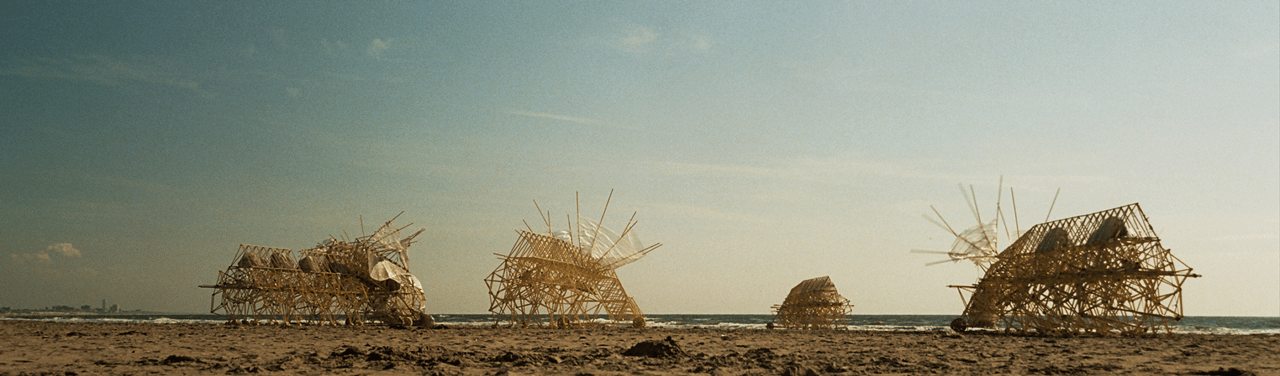
For Theo Jansen, it’s all about the wind…
Many of us hit the beach to enjoy some sunshine or catch a wave. But for Dutch artist Theo Jansen it’s all about the wind. Jansen’s been working with this limitless natural resource for 30 years to create a fabulous array of giant beach creatures—brought to life by the wind. With every gust, his wondrous seaside sculptures become more lifelike, ambling along the coast like creatures in their own right…
Jansen started designing them in the 1990s after reading about rising sea levels threatening the low-lying Netherlands—a country famous for the fact that one third of it is below sea level. He had a dream of creating a herd of wind-powered coastal sentinels, perpetually piling sand high onto the dunes to keep the water at bay.
What he ended up building took a different turn, with Jansen developing the idea to explore evolution as the primary creative force behind all life on Earth, capturing people’s imaginations in the process…
An artist’s moving tribute to nature’s powerful resource: “Fantastic Beasts Brought to Life by the Wind,” @HoeveMarie in @NautilusMag on @StrandBeests.
* Haruki Murakami
###
As we feel the breeze, we might recall that it was on this date in 1896 that Richard Strauss‘ Also sprach Zarathustra (Opus 30) was first performed (in Frankfurt).
“The idea that there might be limits to growth is for many people impossible to imagine”*…

At some level, we all know that nothing lasts forever…
In 1972, a team of MIT scientists got together to study the risks of civilizational collapse. Their system dynamics model published by the Club of Rome identified impending ‘limits to growth’ (LtG) that meant industrial civilization was on track to collapse sometime within the 21st century, due to overexploitation of planetary resources…
The report, authored by Donella Meadows and colleagues (working for Jay Forrester and the Club of Rome), was controversial from its release, with many pundits (often with sponsorship of mining, chemical, and petroleum companies)suggesting that the report’s logic’s flawed. But as scientists like Graham Turner of CSIRO observed in “A Comparison of the Limits to Growth with Thirty Years of Reality” just after after the turn of the century (summarized and updated here), the MIT team’s projections were alarmingly on track. A new study suggests that the LtG projections are holding still…
The analysis has now received stunning vindication from a study written by a senior director at professional services giant KPMG, one of the ‘Big Four’ accounting firms as measured by global revenue.The study was published in the Yale Journal of Industrial Ecology in November 2020 and is available on the KPMG website. It concludes that the current business-as-usual trajectory of global civilization is heading toward the terminal decline of economic growth within the coming decade—and at worst, could trigger societal collapse by around 2040.
The study represents the first time a top analyst working within a mainstream global corporate entity has taken the ‘limits to growth’ model seriously. Its author, Gaya Herrington, is Sustainability and Dynamic System Analysis Lead at KPMG in the United States. However, she decided to undertake the research as a personal project to understand how well the MIT model stood the test of time.
The study itself is not affiliated or conducted on behalf of KPMG, and does not necessarily reflect the views of KPMG. Herrington performed the research as an extension of her Masters thesis at Harvard University in her capacity as an advisor to the Club of Rome. However, she is quoted explaining her project on the KPMG website as follows:
“Given the unappealing prospect of collapse, I was curious to see which scenarios were aligning most closely with empirical data today. After all, the book that featured this world model was a bestseller in the 70s, and by now we’d have several decades of empirical data which would make a comparison meaningful. But to my surprise I could not find recent attempts for this. So I decided to do it myself.”
Titled ‘Update to limits to growth: Comparing the World3 model with empirical data’, the study attempts to assess how MIT’s ‘World3’ model stacks up against new empirical data. Previous studies that attempted to do this found that the model’s worst-case scenarios accurately reflected real-world developments. However, the last study of this nature [Graham Turner’s update, as above] was completed in 2014.
Herrington’s new analysis examines data across 10 key variables, namely population, fertility rates, mortality rates, industrial output, food production, services, non-renewable resources, persistent pollution, human welfare, and ecological footprint. She found that the latest data most closely aligns with two particular scenarios, ‘BAU2’ (business-as-usual) and ‘CT’ (comprehensive technology).
“BAU2 and CT scenarios show a halt in growth within a decade or so from now,” the study concludes. “Both scenarios thus indicate that continuing business as usual, that is, pursuing continuous growth, is not possible. Even when paired with unprecedented technological development and adoption, business as usual as modelled by LtG would inevitably lead to declines in industrial capital, agricultural output, and welfare levels within this century.”
Study author Gaya Herrington told Motherboard that in the MIT World3 models, collapse “does not mean that humanity will cease to exist,” but rather that “economic and industrial growth will stop, and then decline, which will hurt food production and standards of living… In terms of timing, the BAU2 scenario shows a steep decline to set in around 2040.”…
“MIT Predicted in 1972 That Society Will Collapse This Century. New Research Shows We’re on Schedule.” The headline notwithstanding, The MIT team’s study didn’t so much make predictions as it played out a systems dynamics model in order to identify issues that might emerge. And like any model, theirs was rooted in assumptions that could/should have eroded over the last 50 years… which makes the fact that “reality” seems to be tracing the contours thatchy sketched even more notable. Time to revisit those assumptions… Bracing– but important– reading.
[Image above: source]
* Donella Meadows
###
As we get serious, we might send systemic birthday greetings to Thomas Samuel Kuhn; he died on this date in 1996. A physicist, historian, and philosopher of science, Kuhn believed that scientific knowledge didn’t advance in a linear, continuous way, but via periodic “paradigm shifts.” Karl Popper had approached the same territory in his development of the principle of “falsification” (to paraphrase, a theory isn’t false until it’s proven true; it’s true until it’s proven false). But while Popper worked as a logician, Kuhn worked as a historian. His 1962 book The Structure of Scientific Revolutions made his case; and while he had– and has— his detractors, Kuhn’s work has been deeply influential in both academic and popular circles (indeed, the phrase “paradigm shift” has become an English-language staple).
“What man sees depends both upon what he looks at and also upon what his previous visual-conception experience has taught him to see.”
Thomas S. Kuhn, The Structure of Scientific Revolutions

“The Earth is what we all have in common”*…

There’s a pervasive notion in our society that nature is something outside, over there, other, from what we are as humans. From religious texts teaching that God provided humans with dominion over Earth, to futuristic literature pitching nature as our past and human ingenuity and technology as our future, the narrative that humans are beyond – or even superior to – nature is deeply entrenched.
This separation, this othering of nature, has arguably enabled our rampant destruction of the rest of the living world, and even led some to claim that our human nature is incompatible with nature itself.
Now a huge international study involving geography, archeology, ecology, and conservation adds to the wealth of sciences that exposes this idea as the lie it is.
Researchers found that for most of our history, humanity has lived in equilibrium with our world, despite us having altered most of Earth’s terrestrial surface far sooner than we realized. “Societies used their landscapes in ways that sustained most of their native biodiversity and even increased their biodiversity, productivity, and resilience,” said University of Maryland environmental systems scientist Erle Ellis.
Analyzing reconstructions of historic global land use by humans and comparing this to global patterns of biodiversity, the researchers found that by 10000 BCE humans had transformed nearly three-quarters of Earth’s land surface – you can view an interactive map of their findings here.
This upends previous models that suggested most land was still uninhabited as recently as 1500 CE. “Lands now characterized as ‘natural’, ‘intact’, and ‘wild’ generally exhibit long histories of human use,” University of Queensland conservation scientist James Watson explained.
…
“There’s a paradigm among natural scientists, conservationists, and policymakers that human transformation of terrestrial nature is mostly recent and inherently destructive,” said Watson.
In recent times, it’s certainly appeared that way, but clearly this hasn’t always been the case – humanity’s presence hasn’t always caused the life around us to wither away. The researchers note that in many areas, mosaics of diverse landscapes managed by people were sustained for millennia.
They used strategies like planting, animal domestication, and managing the ecosystems in a way that made the landscape not just more productive for us, but helping to support high species richness too. “Our study found a close correlation between areas of high biodiversity and areas long occupied by Indigenous and traditional peoples,” said Max Planck Institute archeologist Nicole Boivin.
“The problem is not human use per se, the problem is the kind of land use we see in industrialized societies – characterized by unsustainable agricultural practices and unmitigated extraction and appropriation.”
…
“We need to recognize that some types of human activity – particularly more traditional land management practices that we see in the archaeological record or practiced today by many Indigenous peoples – are actually really supportive of biodiversity. We need to promote and empower that,” said Bovin.
University of Maine anthropologist Darren Ranco noted that while indigenous people manage around 5 percent of the world’s lands that currently contain 80 percent of the world’s biodiversity, they have been excluded from management and access in protected areas like the US National Parks.
These findings make it clear that we need to empower Indigenous, traditional, and local peoples who know their lands in ways science is only just beginning to understand, explained Ellis. While no one is suggesting we revert to technology-less societies of our past, the idea is to learn from different ways of living that have proven track records of longevity.
From there, we can find new and better ways forward with the help of our advanced technologies, and a big part of this is recognizing that we are part of nature just as nature is a part of us.
Learning from our ancestors: “Humans Shaped Life on Earth For 12,000 Years, And It Wasn’t All Doom And Destruction.” Read the research in full at PNAS.
By way of an illustration of the issue, “Climate crisis has shifted the Earth’s axis, study shows“:
In the past, only natural factors such as ocean currents and the convection of hot rock in the deep Earth contributed to the drifting position of the poles. But the new research shows that since the 1990s, the loss of hundreds of billions of tonnes of ice a year into the oceans resulting from the climate crisis has caused the poles to move in new directions.
Indeed, we’ve moved the poles 4 meters since 1980…
And for a look at just how much the earth has changed, “Google Earth Now Shows You The Consequences of Climate Change For The Past 37 Years.”
[TotH to the ever-illuminating “Nothing Here“]
* Wendell Berry
###
As we find balance, we might spare a thought for Jean Nicot de Villemain; he died on this date in 1604. A diplomat and scholar, he introduced tobacco to the French court (and thus, into wide usage in Europe). In 1560, while serving as ambassador in Portugal, he was shown a tobacco plant in the garden of Lisbon botanist Damião de Goes, who claimed it had healing properties. Nicot applied it to his nose and forehead and found it relieved his headaches.
Nicot sent home seeds and leaves of tobacco, recommending its marvelous therapeutic value. He then sent snuff to Catherine de Medici, the Queen of France to treat her migraine headaches. She was impressed with its results, and became an advocate.
The tobacco plant, Nicotiana tabacum, and its active substance, nicotine, derive their names from his.
Nicot also compiled one of the first French dictionaries, Thresor de la langue françoyse (1606).

“If we pollute the air, water and soil that keep us alive and well, and destroy the biodiversity that allows natural systems to function, no amount of money will save us”*…

Countries around the world depend on a range of vital natural services to help maintain the health and stability of their communities and economies. Better known as biodiversity and ecosystem services, these include food provision, water security and regulation of local air quality among others.
These services underpin all economic activity in our societies globally. Assessing biodiversity risks is complex, however, as there is a massive underlying collection of risks. To build understanding of this global issue and foster dialogue around biodiversity, Swiss Re Institute has developed a new Biodiversity and Ecosystem Services (BES) Index.
Swiss Re Institute’s BES Index reveals that over half (55%) of global GDP is dependent on biodiversity and ecosystem services. It also shows that in a fifth of all countries, ecosystems are in a fragile state for more than 30% of the entire country area…
From SwissRe (the second-largest reinsurance company in the world): “Habitat, water security and air quality: New index reveals which sectors and countries are at risk from biodiversity loss.”
Pair with “The Library at the End of the World,” a bracing and important essay from Australia, one of the “front lines” in the fight against the devastating effects of climate change.
###
As we recall that this is the only earth we get, we might spare a thought for Margaret Thomas “Mardy” Murie; she died on this date in 2003. Called the “Grandmother of the Conservation Movement” by both the Sierra Club and the Wilderness Society, she helped in the passage of the Wilderness Act, and was instrumental in creating the Arctic National Wildlife Refuge. She was the recipient of the Audubon Medal, the John Muir Award, and the Presidential Medal of Freedom—the highest civilian honor awarded by the United States.

source
You must be logged in to post a comment.