Posts Tagged ‘elections’
“As democracy is perfected, the office of president represents, more and more closely, the inner soul of the people. On some great and glorious day the plain folks of the land will reach their heart’s desire at last and the White House will be adorned by downright moron.”*…

This is a year, Niccolo Conte demonstrates, in which that possibility is especially present around the world…
With almost half of the world’s population residing in countries holding executive or legislative elections in 2024, it’s set to be the busiest election year ever recorded…
Many people are already aware of the U.S. presidential and legislative elections set to be held on November 5th, especially due to American influence on the global political stage and media coverage.
But two governments affecting larger populations, India and the European Union, are also slated to have elections in 2024…
A few notable elections have already occurred. Taiwan held general elections on January 13th, with the more anti-China Democratic Progressive Party retaining the presidency but losing its majority in the legislature.
[And in February, Indonesia held general elections; while the results are still being tabulated, early indications are that it could make for some material changes in the world’s third-largest democracy.]
Pakistan also held elections on February 8th, with former Prime Minster Imran Khan’s party and affiliates winning a plurality of seats but losing power to a military-backed coalition.
Pakistan’s election results were cast into doubt by foreign observers and media, with Khan having been arrested and sentenced to prison on corruption charges. It is far from the only country holding controversial and potentially undemocratic elections in 2024.
Bangladesh’s landslide January 7th elections were boycotted by the opposition and voters, and Russia’s March 15th elections had three anti-war presidential candidates barred from competing, including Alexei Navalny before his controversial death in February…
The biggest global election year on record: “Mapped: 2024 Global Elections by Country,” from @Niccoloc in @VisualCap.
* H. L. Mencken
###
As we peruse the polls, we might recall that it was on this date that it was on this date in 12 BCE that Caesar Augustus (AKA Octavian), the first Roman Emperor, was elected Pontifex maximus (the chief high priest of the College of Pontiffs [Collegium Pontificum] in ancient Rome)– adding stature as head of Rome’s state religion to his imperial credentials.

“Oh, down in Mexico / I never really been so I don’t really know”*…
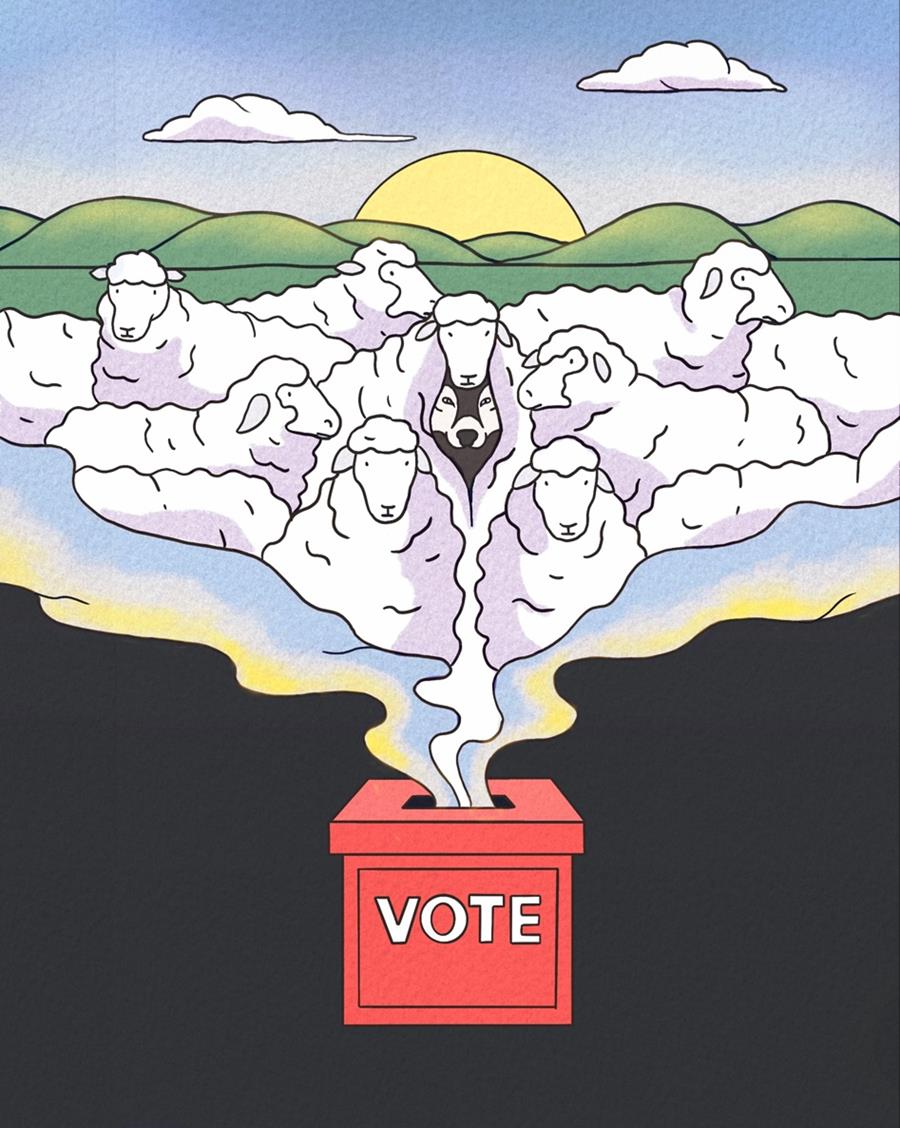
In this moment of altogether appropriate attention to the autocratic threat to Ukraine, it’s too easy to forget that genuine democracy is under threat all around the world. Nathan Gardels cites two examples close to home: Mexico and California…
The core crisis of governance in open societies today is the distrust that has grown between the public and its institutions of self-government. The response to this breach of trust has largely been unfolding in two directions — the autocratic tendency toward decisive strongmen who fashion themselves as tribunes of the people, or seeking to re-legitimize democracy through greater citizen engagement and participation.
Now, a new and concerning hybrid is emerging that exploits the tools of citizen engagement and participation (such as the recall of elected officials, the referendum, and ballot initiative) either to affirm autocratic leanings or to protect and promote the very special interests these tools were meant to challenge…
…
Participatory democracy unmediated by impartial institutions of deliberation or guarded against manipulation by the powers that be poses as significant a risk to citizen control of government as unchecked executive power or rule by those with the most gold. When plebiscitary practices are deployed from the top down to affirm the rule of a present regime, or hijacked by the most monied, instead of initiated from the bottom up, the very notion of citizen empowerment is nullified.
Top-down direct democracy is a wolf in sheep’s clothing: “Mexico: On The Path To A Perfect Autocracy?“, from @NoemaMag.
* James Taylor, “Mexico”
###
As we watch our backs, we might note that not all exercises of direct democracy (even when they are structurally flawed) end badly: on this date in 1992 a referendum to end apartheid in South Africa passed by a vote of 69% to 31%… a margin that would surely had been larger had the election not been restricted to white voters. (Universal suffrage was established two years later.)

“Every decent man is ashamed of the government he lives under”*…

The majority of countries are democracies, but how many people enjoy what we think of as democratic rights? A nifty interactive map from Our World In Data charts the changes in political regimes across the globe, country by country, over the last 200 years. By way of explaining its categories:
• In closed autocracies, citizens do not have the right to choose either the chief executive of the government or the legislature through multi-party elections.
• In electoral autocracies, citizens have the right to choose the chief executive and the legislature through multi-party elections; but they lack some freedoms, such as the freedoms of association or expression, that make the elections meaningful, free, and fair.
• In electoral democracies, citizens have the right to participate in meaningful, free and fair, and multi-party elections.
• In liberal democracies, citizens have further individual and minority rights, are equal before the law, and the actions of the executive are constrained by the legislative and the courts.
As Visual Capitalist observes…
Do civilians get a representative say in how the government is run where you live?
While it might seem like living with a basic level of democratic rights is the status quo, this is only true for 93 countries or territories today—the majority of the world does not enjoy these rights.
It also might surprise you that much of the progress towards democracy came as late as the mid-20th century…
An interactive look at the state of democracy around the world, and how it has evolved. From @OurWorldInData, via @VisualCap.
* H. L. Mencken
###
As we ruminate on representation, we might recall that it was on this date in 1933, the day after an arsonist ignited the Reichstag building, home of the German parliament in Berlin (and four weeks after Nazi leader Adolf Hitler had been sworn in as Chancellor of German), that Adolf Hitler attributed the fire to a conspiracy of Communist agitators.
Marinus van der Lubbe, a Dutch “council communist”, was the apparent culprit; but Hitler insisted on a wider network of villains. He used it as a pretext to claim that Communists were plotting against the German government, and induced President Paul von Hindenburg to issue the Reichstag Fire Decree suspending civil liberties, and to pursue a “ruthless confrontation” with the Communists. A court later found that van der Lubbe had in fact acted alone. But Hitler’s orchestrated reaction to the Reichstag Fire began the effective rule of the Nazi Party and the establishment of Nazi Germany.

“There’s no idea in economics more beautiful than Arrow’s impossibility theorem”*…

Tim Harford unpack’s Kenneth Arrow‘s Impossibility Theorem (which feels a bit like a socio-economic “Monty Hall Problem“) and considers it’s implications…
… if any group of voters gets to decide one thing, that group gets to decide everything, and we prove that any group of decisive voters can be pared down until there’s only one person in it. That person is the dictator. Our perfect constitution is in tatters.
That’s Arrow’s impossibility theorem. But what does it really tell us? One lesson is to abandon the search for a perfect voting system. Another is to question his requirements for a good constitution, and to look for alternatives. For example, we could have a system that allows people to register the strength of their feeling. What about the person who has a mild preference for profiteroles over ice cream but who loathes cheese? In Arrow’s constitution there’s no room for strong or weak desires, only for a ranking of outcomes. Maybe that’s the problem.
Arrow’s impossibility theorem is usually described as being about the flaws in voting systems. But there’s a deeper lesson under its surface. Voting systems are supposed to reveal what societies really want. But can a society really want anything coherent at all? Arrow’s theorem drives a stake through the heart of the very idea. People might have coherent preferences, but societies cannot…
On choice, law, and the paradox at the heart of voting: “Arrow’s Impossibility Theorem,” from @TimHarford in @WhyInteresting. Eminently worth reading in full.
* Tim Harford
###
As we contemplate collective choice, we might send grateful birthday greetings to the man who “wrote the book” on perspective, Leon Battista Alberti; he was born on this date in 1404. The archetypical Renaissance humanist polymath, Alberti was an author, artist, architect, poet, priest, linguist, philosopher, cartographer, and cryptographer. He collaborated with Toscanelli on the maps used by Columbus on his first voyage, and he published the the first book on cryptography that contained a frequency table.
But he is surely best remembered as the author of the first general treatise– Della Pictura (1434)– on the the laws of perspective, which built on and extended Brunelleschi’s work to describe the approach and technique that established the science of projective geometry… and fueled the progress of painting, sculpture, and architecture from the Greek- and Arabic-influenced formalism of the High Middle Ages to the more naturalistic (and Latinate) styles of Renaissance.


“The right of voting for representation is the primary right by which other rights are protected”*…

One of the most insidious obstacles to fair representation is gerrymandering, the practice of re-drawing congressional districts to favor one party or another– long a feature of American politics. With the completion of each decennial census, states redraw their their district boundaries, a process that’s underway now and that will define Congressional elections in 2022.
FiveThirtyEight is maintaining a updated interactive tracker of proposed congressional maps — and whether they might benefit Democrats or Republicans in the 2022 midterms and beyond (pictured above). Explore it to watch national governance shaped before your very eyes.
* Thomas Paine
###
As we fish for fairness, we might send culture-capturing birthday greetings to Norman Percevel Rockwell; he was born on this date in 1894. Famous as a painter and illustrator in the U.S. through much of the 20th Century, Rockwell created such iconic images as the Willie Gillis series, Ros ie the Riveter, Saying Grace (1951), The Problem We All Live With, and the Four Freedoms series.
Perhaps because he published in such settings as Saturday Evening Post and enjoyed so much popular acclaim, Rockwell was dismissed by serious art critics in his lifetime. But as The New Yorker ‘s art critic Peter Schjeldahl said of Rockwell in ArtNews in 1999: “Rockwell is terrific. It’s become too tedious to pretend he isn’t.”


You must be logged in to post a comment.