Posts Tagged ‘elections’
“Suffrage is the pivotal right”*…

… but how we vote matters. We tend to take the electoral system in which we exercise our franchise for granted. Perhaps we should think more broadly. Why Is This Interesting? explains how Venice selected its Doges, and ponders the questions that raises for our own elections…
The way societies make decisions is important. There is a growing understanding that different systems can lead to quite different outcomes. Ireland rejected the British first-past-the-post system after independence and adopted the single transferable vote in 1921. New York City started using ranked-choice voting this summer, with some hiccups. Other countries have moved to full proportional representation where seats are allocated to parties more or less based on national vote share.
There’s also the question of the best level of representation. Should city councils be elected at-large for the whole city (like in Cambridge, Mass.) or in single-member districts, and how would that affect outcomes such as diversity and zoning? Perhaps some decisions should be taken away from the city council, and either moved down to the neighborhood level or up to the regional level? And should some decisions, such as monetary policy, be taken out of democratic control altogether and left to technocrats?
Using sortition to choose government officials, as Venice and Ancient Athens did, is a niche idea these days, but in common-law countries, juries deciding legal cases are (supposed to be) chosen randomly from the population. Nobel laureate Daniel McFadden wants to use “economic juries” of randomly selected people to decide on big public projects, arguing that this can better reflect public opinion than a referendum.
Since these political design choices affect policy outcomes, it would be naive to think this is only about high-minded notions of the “quality” of decisions. But that doesn’t make the question of how societies should make decisions any less interesting.
What’s the best way to hold elections? On Venice, decisions, and policy outcomes: “The Dogal Elections Edition,” from Why is This Interesting? (@WhyInteresting) Eminently worth reading in full.
[Image above: source]
* Susan B. Anthony
###
As we ponder the practice of polling, we we might recall that it was on this date in 1620 that 41 adult male colonists recently arrived in what we now call Massachusetts, including two indentured servants, signed the Mayflower Compact (although it wasn’t called that at the time). Though they intended to reach the Colony of Virginia, storms had forced The Mayflower and its pilgrim passengers to anchor at the hook of Cape Cod in Massachusetts. It was unwise to continue with provisions running short. This inspired some of the non-Puritan passengers (whom the Puritans referred to as ‘Strangers’) to proclaim that they “would use their own liberty; for none had power to command them” since they would not be settling in the agreed-upon Virginia territory. To prevent this, the Pilgrims determined to establish their own government, while still affirming their allegiance to the Crown of England. Thus, the Mayflower Compact was based simultaneously upon a majoritarian model and the settlers’ allegiance to the king. It was in essence a social contract in which the settlers consented to follow the community’s rules and regulations for the sake of order and survival– the first (colonial) document to establish self-government in the New World.

“We all know that an angry electorate is a voting electorate”*…

Further to yesterday’s post…
The final vote tallies still aren’t known, but the media verdict of this presidential election is in: it’s 2016 all over again. Four years ago, in the hours after Donald Trump declared victory on the strength of 306 Electoral College votes and the ballots of nearly sixty-three million Americans, I wrote a column about the failures of the press throughout that campaign, and declared that “journalism’s moment of reckoning” had arrived. “Reporters’ eagerness first to ridicule Trump and his supporters, then to dismiss them, and finally to actively lobby and argue for their defeat have led us to a moment when the entire journalistic enterprise needs to be rethought and rebuilt,” I wrote then.
It is astonishing, today, how little we seem to have learned since. Once again, opinion polls were overhyped and under-scrutinized. Some of them were also wildly off—and, though that’s different from 2016, when the polls were largely accurate but widely misunderstood, it doesn’t let media organizations off the hook for their treatment of the numbers. Newsrooms leaned too heavily on polls as a substitute for on-the-ground reporting, and they were led astray. Journalists spent too much time talking to each other on Twitter, inhabiting an alternate algorithmic reality that bore little resemblance to the life of the country. And major media institutions made it all but impossible to envision that, despite the wealth of reporting on the president’s lies and his racism and his circus—nearly half the country remains beholden to the man and his beliefs. “We can’t go back to assuming, just because we think Donald Trump is an outlier, that he is not connecting to a lot of American people in ways that, frankly, a lot of us cannot understand,” Claire McCaskill, a former Missouri senator, said Wednesday morning on MSNBC. The feeling of déjà vu, and of lost journalistic opportunity, is inescapable…
Kyle Pope (@kylepope), editor of the Columbia Journalism Review on lessons unlearned: “What the polls show, and the press missed, again.”
On the problem(s) with polls, pair with “Of course Trump’s voters lie to pollsters. You call us all racists” (with an eye to the phenomenon it addresses– and the questions raised by the rationale it offers…)
For one (very compelling) account of why Pope’s project matters, see Fintan O’Toole’s “Democracy’s Afterlife.” (For more, see also Ron Brownstein, Roxane Gay, and George Packer on the same family of issues… there are lots of diagnoses abroad in the infosphere at the moment; these are among the best your correspondent has found.)
And for a resonant but different take on the necessary role of “honest journalism” going forward, see also Jay Rosen’s “America’s Press and the Asymmetric War for Truth.”
###
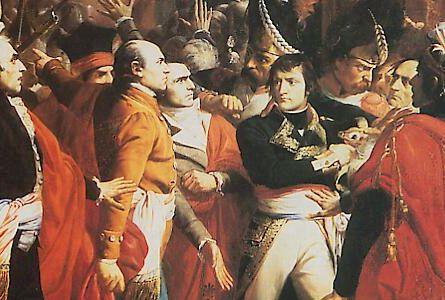
As we look more deeply, we might recall that it was on this date (18 Brumaire in the French Republican Calendar) in 1799 that thirty-year-old Corsican General Napoleon Bonaparte overthrew the Directory in France and established the Consulate, ending the power of the revolutionary oligarchy and creating himself as First Consul… or dictator.
“Indeed, you won the elections, but I won the count”*…

“There’s nothing from the CDC that I can trust,” snapped US coronavirus task-force leader Deborah Birx at a White House meeting earlier this month. According to news reports, Birx was frustrated at the agency’s tally of coronavirus deaths, as she and colleagues worried that reported numbers were up to 25 percent too high. However, if some people inside the Beltway think the counts are inflated, others think they’re too low—and the seemingly simple task of tabulating bodies has become an intensely political act.
It’s a bizarre situation, because in some sense, there’s nothing more inherently impartial than a tally of objects. This is why the act of counting is the gateway from our subjective, messy world of confused half-truths into the objective, Platonic realm of indisputable facts and natural laws. Science almost always begins with counting, with figuring out how to measure or tabulate something in a consistent, reproducible way. Yet even that very first rung on the ladder to scientific understanding is slippery when the act of counting gets entangled with money or power…
With contested vote tallies, concerns over Census data, and now the Covid-19 death toll, 2020 may mark the ugly climax of a long dispute: “The Politics of Counting Things Is About to Explode.”
And for a case study in why the terrifically-difficult underlying mechanics of “counting” lend themselves to politicization, FiveThirtyEight’s “The Uncounted Dead.”
* Nicaraguan dictator Anastasio Somoza, quoted in the Guardian (London), June 17, 1977
###
As we contemplate calculation, we might recall that it was on this date in 1896 that the Dow Jones Average made its first appearance in the Customers’ Afternoon Letter, the precursor to the Wall Street Journal. It was named for two of the Letter‘s three reporters, Charles Dow and Edward Jones. It was originally comprised of 12 companies (now 30). Although it is one of the most commonly followed equity indices, many consider it to be an inadequate representation of the overall U.S. stock market compared to broader market indices such as the S&P 500 Index or Russell 3000 because the Dow only includes 30 large cap companies, is not weighted by market capitalization, and does not use a weighted arithmetic mean.

Historical (logarithmic) graph of the DJIA from 1896 to 2010
“The ignorance of one voter in a democracy impairs the security of all”*…

In a simple democratic election with two candidates, every voter has the same probability of affecting the result of the election. In the United States, the electoral college ensures that this is not the case. Instead, the chance that your vote matters is dependent on which state you live in, and the political composition of voters who happen to live within that state’s borders.
Although Republican presidential candidates have benefited from the electoral college in recent years—2 of their last 3 election winners lost the popular vote—there is nothing about the electoral college that specifically favors Republicans. Its effects are largely random, and can be expected to change over time. One illustration of how arbitrary these effects are is that a state’s status as a swing state can often be eliminated by moving a few counties into a bordering state, instantly devaluing the value of its residents’ votes. It would only take a couple of these changes to shift the advantage of the electoral college to the Democratic party…
David Waldron’s eye-opening analysis: “Who benefits from the electoral college?”
* John F. Kennedy
###
As we exercise our franchise, we might recall that it was on this date in 1882 that nearly 10,000 workers gathered for a parade in New York City to celebrate the first Labor Day in the U.S.

“Troubles hurt the most when they prove self-inflicted”*…

Earlier this year, Georgia’s Secure, Accessible, and Fair Elections Commission held a public meeting at the state capitol to answer a pressing question: What should Georgia do to replace its aging, touchscreen voting machines, as well as other parts of its election system? In the preceding years, security vulnerabilities in the state’s election system had been repeatedly exposed: by Russian operatives, friendly hackers, and even a Georgia voter who, just days ahead of the 2018 midterms, revealed that anyone could go online and gain access to the state’s voter registration database.
Computer scientists and elections experts from around the country had weighed in during the seven months of the commission’s deliberations on the issue. They submitted letters and provided testimony, sharing the latest research and clarifying technical concepts tied to holding safe, reliable elections. Their contributions were underscored by commission member Wenke Lee, co-director of Georgia Tech’s Institute for Information Security and Privacy, and the group’s only computer scientist.
Despite this, the commission ultimately did not recommend measures backed by Lee and his colleagues at places like Stanford, Yale, Princeton, MIT, and Google — including the recommendation that the state return to a system of paper ballots filled out by hand, combined with what scientists call risk-limiting audits. Instead, the commission recommended buying a system that included another, more expensive touchscreen voting machine that prints a paper ballot. Months later, Lee was at a loss to explain: “I don’t understand why they still don’t understand,” he said.
With its decision, Georgia’s counties remain among the 33 percent of counties nationwide that use either machines with no paper trail or machines that print paper ballots, which are then scanned on separate machines. The vast majority of the rest of the counties use paper ballots filled out by hand, which are then scanned or counted by hand…
Georgia is one of many states that is adopting or considering voting technology that some experts say decreases security and election integrity: “Georgia’s New Election System Raises Old Computer Security Concerns.”
[Most of those voting systems run on Windows 7, a dated operating system that’s demonstrably vulnerable to hackers… and that reaches “end of life” in January.]
* Sophocles
###
As we wonder why, we might recall that it was on this date in 1946 that notices were tacked onto the doors of African-American churches in Fitzgerald, Georgia reading “The first n-gger who votes in Georgia will be a dead n-gger” [without the ellision].

You must be logged in to post a comment.