Posts Tagged ‘Drama’
“I’m Your Puppet”*…

Your correspondent is hitting the road again. (Roughly) Daily will be on hiatus until July1…
The first English language history of puppets…
Anybody who grew up with Shari Lewis’ Lamb Chop, Fred Rogers’ King Friday XIII, or Jim Henson’s Muppets will surely feel that they have entered a more expansive puppet realm at the outset of Helen Haiman Joseph’s A Book of Marionettes (1920). Late one evening in Cleveland, Ohio as she makes alterations to their costumes, a cast of stringed characters from Anglo-Irish dramatist Lord Dunsany’s otherworldly drama The Golden Doom — the Chief Prophet of the Stars, the Chamberlain, a pair of Spies, and a Priest — treat Joseph as rudely and defiantly as Pinocchio abused Geppetto. Beating her retreat from this imagined Lilliputian assault, the weary marionette seamstress overhears them vainly reciting their august, cosmopolitan ancestry, from the ancient Indian Ramayana, Japanese jōruri dramas, and medieval Passion plays to pugilistic stars like Pulcinella, Punch, Kasperle and Karaghöz, on down to the devotion of modern immortals spanning from Shakespeare, Voltaire, and Goethe to George Bernard Shaw and Maurice Maeterlinck.
The first comprehensive history of marionette artistry in the English language, A Book of Marionettes appeared at a watershed moment in both American and world puppetry, after a century of artistic and technical innovation, and before the cinema’s global supplanting of human attention and storytelling. Drawing on her field study of European puppetry, Helen Haiman Joseph magisterially surveys the millennia-long world history of string and silhouette marionettes. Born seemingly simultaneously with organized religion, the little creatures never leave their creators’ sides, fully capable of expressing the entire range of human emotion and experience in every corner of the globe, in every age. Enlisted as surrogate actors, marionettes perform with their necessarily circumscribed mechanical gestures deeds of immense gravity, all while barely touching the earth. As Joseph moves adeptly through the ever-dynamic world of marionette theaters, one gets the feeling that she is actually narrating a kind of alternate history of the world, one that is altogether more joyously humane than any epic recounted about mere human beings.
Granted the power to subvert any worldly authority, marionettes, as Joseph proves, perennially overthrow all social, political, religious, and even artistic conventions. When Martin Luther’s Calvinist confrères refused to administer the sacrament to actors, they became puppeteers. On more than a few occasions, both puppeteers and puppets found themselves behind bars, so effective was their satire against oppressive ecclesiastics and governments. Since the modern Western state arose at a time when marionette theaters were ubiquitous, the diminutive legion was always at hand to model courage and stoutheartedness for their momentarily cowed audiences. That Shakespeare’s Julius Caesar, Christopher Marlowe’s Massacre of Paris, and Ben Jonson’s Every Man Out of His Humour were inspired by puppet plays, or that Lord Byron drew his model of Don Juan from a Punch & Judy piece titled The Libertine Destroyed, suggests the deep fraternity of modern drama with its little brother…
More history– and illustrations: “Strings Attached: Helen Haiman Joseph’s A Book of Marionettes (1920)” from @publicdomainrev.bsky.social.
Browse the book in full at the invaluable Internet Archive.
* a song written by Dan Penn and Spooner Oldham, best known in the version recorded by James & Bobby Purify (Hear here)
###
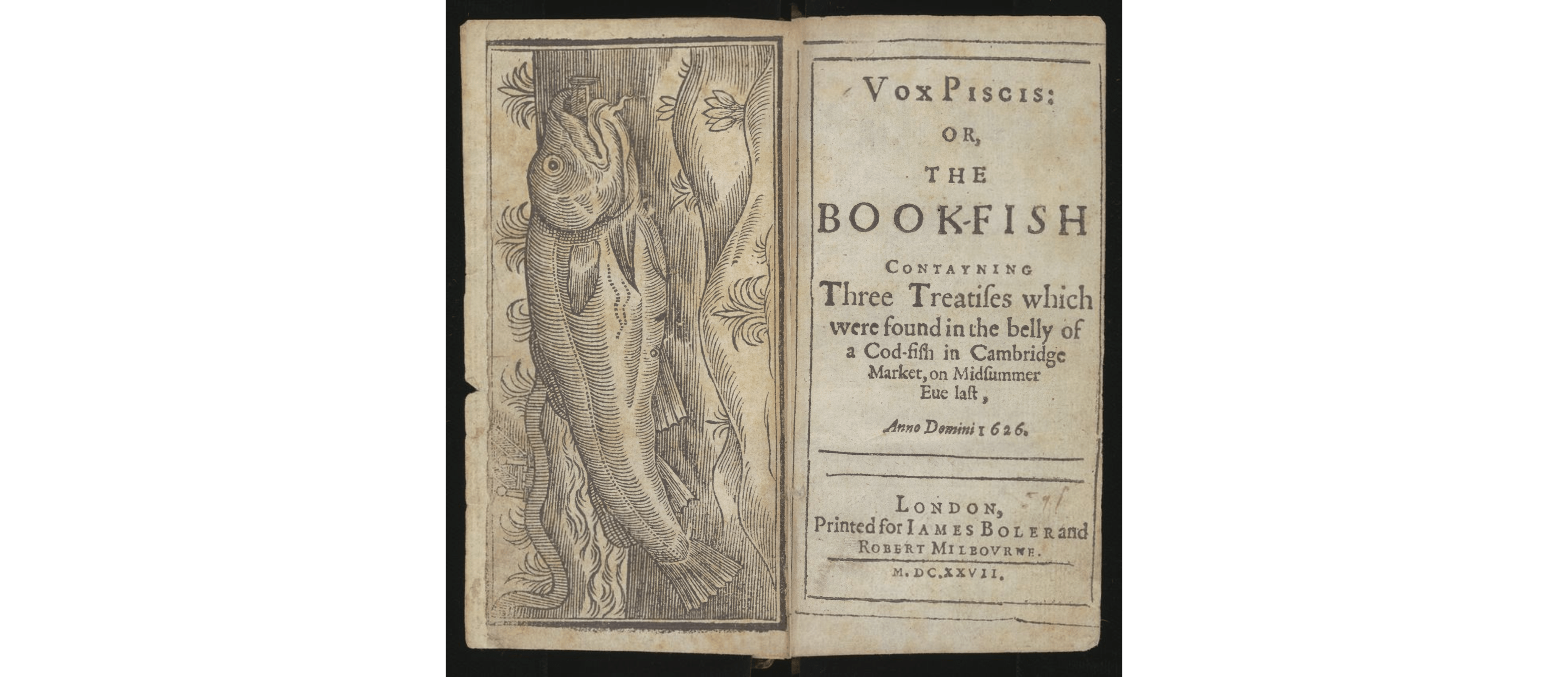
As we untangle the strings, we might recall that it ws on this date in 1623 that a large codfish, split open at a Cambridge market, was found to contain a copy of a book of religious treatises by John Frith.
“We live in an age when the traditional great subjects – the human form, the landscape, even newer traditions such as abstract expressionism – are daily devalued by commercial art”*…

… But it wasn’t always so. A current exhibit at the Metropolitan Museum in New York is devoted to the work of (often anonymous) artists who illustrated commercial catalogs in the late 19th and early 20th centuries…
Art of Commerce: Trade Catalogs in Watson Library features a selection of the library’s extensive holdings of sale catalogs. Watson Library has almost two thousand trade catalogs published in many countries from the eighteenth century to the present. Objects featured include furniture, jewelry, tiles, ironwork, glasswork, lighting, stoves, tableware, textiles, decorative paper, artist’s materials, fashion, typography, automobiles, and musical instruments. Numerous catalogs illustrate works of art or related objects now in The Met collection.
The library has strong holdings of Art Deco trade catalogs including Modern furniture design = Le dessin moderne des meubles—a colorful furniture portfolio by Czech architect Karel Vepřek—and Van Clef Arpels présentent, an elegantly illustrated accessories publication designed by Draeger Frères, the most innovative graphic designers and printers of the period. Both catalogs are on display in the exhibition.
Trade or sale catalogs — also called commercial or manufacturer’s catalogs —are printed publications advertising products of a particular trade or industry. Sale catalogs were often used in shops or showrooms to promote a company’s products. Examples include the massive Reed and Barton catalog Artistic workers in silver & gold plate from 1885 that illustrates the entire inventory of the company…
Among the more unusual and appealing trade catalogs in the exhibition is a German Art Nouveau-inspired cake decorating book from 1910 and a baby carriage catalog from 1934 offering Art Deco styled tubular steel baby prams. These trade catalogs demonstrate the distillation of major art movements applied to quotidian objects.
The earliest trade catalog in the exhibition is Muster zu Zimmer-Verzierungen und Ameublements, a neo-classical interior design catalog by luxury German manufacturer Voss und Compagnie, offering entire rooms that can be bought en masse or as separate pieces. It is illustrated with richly toned hand-colored engravings that detail the design and color of the objects.
One of the library’s most fragile and weighty catalogs is Album des principaux modeles de verres: produits spéciaux en verre coulé. It is a magical trade catalog with sixty-five intact glass samples manufactured by French glassmaker Saint-Gobain. Founded during the time of Louis XIV, the company remains a manufacturer of glass for construction.
The majestic ironwork catalogue of Maison Garnier has pink-tinted papers and was bound in Morocco leather as a special copy for Rémy Garnier, the son of the firm’s founder. The firm’s initials are boldly blind stamped on the cover.
The most unusual and perhaps unexpected catalog, Urinoirs, illustrates the decorative ironwork structures of urinals (or pissoirs) that adorned the streets of Paris from the 1840s to the mid-twentieth century. The ornamentation of these structures demonstrates an impulse to beautify the animated street life of Paris and other cities…
See the items mentioned at the links above, and other articles in the exhibit here.
Beauty in the service of business: “Art of Commerce: Trade Catalogs in Watson Library,” from @metmuseum (where one can see the works on exhibit through March 4, 2025).
* Andy Warhol
###
As we browse, we might spare a thought for Oscar Fingal O’Flahertie Wills Wilde; the novelist, essayist, playwright, poet, and master of the bon mot died on this date in 1900.
As he said: “There are moments when art attains almost to the dignity of manual labor.”

“Man’s first expression, like his first dream, was an aesthetic one”*…

From the new series, “Conjectures,” in the invaluable Public Domain Review, a piece by Octavian Esanu…
What do we want from “school”? Knowledge, surely. But other things too. Experience, perhaps? — the vibrating sense of having been present as new thinking happened, of having been affected by an encounter with ideas? Certain kinds of teaching and learning, anyway, privilege that vaunted nexus of knowing and being. Early in the first session of his seminar on Theodor Adorno’s Aesthetic Theory, the American Marxist literary scholar Fredric Jameson asserts, here below, that “aesthetics” can be thought of as precisely a project that lies “halfway between the cognitive and the artistic” — which is to say, it is the enterprise of trying to understand (conceptually) that which seems to elude reduction to concepts (because we are, somehow, there in aesthetic experiences; and we are not conceptual!). By meticulously translating his recordings of Jameson’s seminars into the theatrical idiom of the stage script, the artist and scholar (and former Jameson student) Octavian Esanu doubles down, playfully and tenderly, on this deep problem. Pedagogy as performance? Teaching and learning, about art — as a work of art?
Series editor D. Graham Burnett‘s introduction
An experiment with historical form and method: “[Door creaks open. Footsteps]: Fredric Jameson’s Seminar on Aesthetic Theory,” from @PublicDomainRev.
###
As we investigate the ineffable, we might send absolutist birthday greetings to Thomas Hobbes of Malmesbury; he was born on this date in 1588. A father of political philosophy and political science, Hobbes developed some of the fundamentals of European liberal thought: the right of the individual; the natural equality of all men; the artificial character of the political order (which led to the later distinction between civil society and the state); the view that all legitimate political power must be “representative” and based on the consent of the people; and a liberal interpretation of law which leaves people free to do whatever the law does not explicitly forbid– all this, though Hobbes was, on rational grounds, a champion of absolutism for the sovereign. It was that, Hobbes reasoned, or the bloody chaos of a “war of all against all.” His 1651 book Leviathan established social contract theory, the foundation of most later Western political philosophy.
Indeed, it was in some large measure Hobbes (and his legacy) that Adorno’s Frankfurt School colleagues Max Horkheimer, Erich Fromm, Herbert Marcuse (et al.) were working to revise.

“Somebody gets into trouble, then gets out of it again. People love that story. They never get tired of it.”*…

Kurt Vonnegut took an early interest in what he considered the fundamental “shapes” of stories…
Stories have very simple shapes, ones that computers can understand.
This was the basic idea behind the master’s thesis that Kurt Vonnegut submitted to the anthropology department at the University of Chicago. It was rejected, however, “because it was so simple and looked like too much fun,” Vonnegut said…
“Kurt Vonnegut on the 8 ‘shapes’ of stories“
He never abandoned the idea. Years later, in a 2004 lecture at Case Western University, he shared his theory– a recording of which has washed around the internet ever sense…
Now, a group of academics have used AI to analyze hundreds of published stories, and have confirmed Vonnegut’s contention (sort of: he argued for 8 “shapes”; they found 6), as they explain in the abstract of their paper…
Advances in computing power, natural language processing, and digitization of text now make it possible to study a culture’s evolution through its texts using a ‘big data’ lens. Our ability to communicate relies in part upon a shared emotional experience, with stories often following distinct emotional trajectories and forming patterns that are meaningful to us. Here, by classifying the emotional arcs for a filtered subset of 1,327 stories from Project Gutenberg’s fiction collection, we find a set of six core emotional arcs which form the essential building blocks of complex emotional trajectories. We strengthen our findings by separately applying matrix decomposition, supervised learning, and unsupervised learning. For each of these six core emotional arcs, we examine the closest characteristic stories in publication today and find that particular emotional arcs enjoy greater success, as measured by downloads…
“The emotional arcs of stories are dominated by six basic shapes” (where you can read/download the full paper).
* Kurt Vonnegut
###
As we agnize archetypes, we might spare a thought for a master of the entertaining tale, Jean-Baptiste Poquelin (or as he’s better known by his stage name, Molière); he died on this date in 1673. A playwright, actor, and poet, he is widely regarded as one of the greatest writers in world history, and possibly the greatest writer in French history. His extant works include comedies, farces, tragicomedies, comédie-ballets, and more. His plays have been translated into every major living language and are performed at the Comédie-Française more often than those of any other playwright today. His influence is such that the French language is often referred to as the “language of Molière.”

“Thou art a monument without a tomb, / And art alive still while thy book doth live / And we have wits to read and praise to give”*…

400 years ago this month, seven years after Shakespeare’s death, his friends John Heminge and Henry Condell published The First Folio, containing 36 of Shakespeare’s plays, (an endeavor which they financed with a bequest that he had left them).
Although 19 of Shakespeare’s plays had been published in quarto before 1623, the First Folio is arguably the only reliable text for about 20 of the plays, and a valuable source text for many of those previously published. Eighteen of the plays in the First Folio, including The Tempest, Twelfth Night, and Measure for Measure among others, are not known to have been previously printed.
It is considered one of the most influential books ever published. Of perhaps 750 copies printed, 235 are known to remain, most of which are kept in either public archives or private collections. More than one third of the extant copies are housed at the Folger Shakespeare Library in Washington, D.C., which is home to a total of 82 First Folios.
It is also, as Alicia Andrzejewski and Carole Levin explain, one of the most stolen…
Late at night on July 13th, 1972, an unknown person entered the University of Manchester’s Library and violently smashed the plate glass top of an exhibition case, stealing the contents. Inside was one of the most famous, most valuable books in existence: the library’s near-perfect edition of one of Shakespeare’s First Folios. This theft is the most mysterious of all the stolen First Folios. More than fifty years have passed, and this First Folio—one of the 750 printed in 1623 and of the estimated 232 known copies across the globe today—is still missing.
This year, 2023, marks the 400th year anniversary of the printing of Shakespeare’s First Folio, deemed one of the most significant books in the English language, “a coveted treasure,” to quote Eric Rasmussen, an expert on the First Folios and author of The Shakespeare Thefts: In Search of the First Folios. Without the First Folio, we would not have many of Shakespeare’s most famous plays, the half that were not printed in his lifetime, including The Taming of the Shrew, Macbeth, Twelfth Night, and The Tempest. In collecting and printing these plays, Shakespeare’s two close friends and fellow actors, John Heminge and Henry Condell, validated that plays are more than entertainment—they have literary value.
The First Folios still in existence are mainly housed in public institutions—their significance is underscored by their rarity, as copies are almost never available for sale, and the most recent one sold in 2020 for almost ten-million dollars. Even in the seventeenth century, when the First Folios were first printed, they were only available to elite members of society: earls, lords, knights, admirals, and the occasional lawyer. To this day, ownership is limited to, and a fetish among, the super wealthy. Because of their elite status, Rasmussen speculates that, of the copies that cannot be located, most “have probably been stolen.”
For some, as Rasmussen suggests, the First Folio is coveted because of its monetary value, an object to steal and eventually attempt to sell. Three First Folios were stolen in the 20th century alone, including the Manchester Library’s copy, and the thieves in the latter two cases are characters as strange as some of those in Shakespeare’s plays, the heists as thrilling as some of his plots. The thefts we describe, and the desires that inspire them, speak to Shakespeare’s foothold in Western civilization—the reverence and awe so many people have for him, that imbue the First Folio with an almost religious power…
Some of the most brazen heists of a historic volume: “Shakespeare’s First Folio has been Stolen Many, Many Times,” in @CrimeReads.
* Ben Jonson, “To the Memory of My Beloved the Author, Mr. William Shakespeare” (in the First Folio)
###
As we linger on literary larceny, we might recall that it was on this date fifty years ago that then-President Richard Nixon made his famous declaration of character:
On Nov. 17, 1973, President Richard M. Nixon held a news conference before Associated Press managing editors in Orlando, Fla., in which he defended himself against a number of allegations. Most of the questions related to the Watergate break-in, which had become even more of a scandal a month earlier with the “Saturday Night Massacre.” Other questions focused on reports that he had cheated on his tax returns.
The Nov. 18 New York Times outlined President Nixon’s many assertions, concluding that the president had acquitted himself well: “The president seemed composed and on top of the subject throughout the session, faltering perceptibly only during the discussion of his taxes. In contrast with some of his recent appearances he did not berate his critics or his political enemies.”
The best-remembered part of the news conference came as the president defended himself against claims that he had illicitly profited from his years in public service. “I made my mistakes, but in all of my years of public life, I have never profited, never profited from public service — I earned every cent,” he said. “And in all of my years of public life, I have never obstructed justice. And I think, too, that I could say that in my years of public life, that I welcome this kind of examination, because people have got to know whether or not their president is a crook. Well, I am not a crook. I have earned everything I have got.”
The news conference did little to end questions over Mr. Nixon’s honesty. His declaration “I’m not a crook” was used against him — and the line would forever be associated with the Watergate era.
In April 1974, the Internal Revenue Service ordered that the president pay more than $400,000 in back taxes for making improper deductions. And the Watergate investigation continued to uncover misconduct. In August 1974, with the House Judiciary Committee having recommended impeachment and the release of a “smoking gun” tape showing that he had approved a cover-up, the president resigned…
“Nixon Declares ‘I Am Not a Crook’”

You must be logged in to post a comment.