Posts Tagged ‘dinosaurs’
“O bliss of the collector, bliss of the man of leisure!… Ownership is the most intimate relationship one can have to objects. Not that they come alive in him; it is he who comes alive in them.”*…
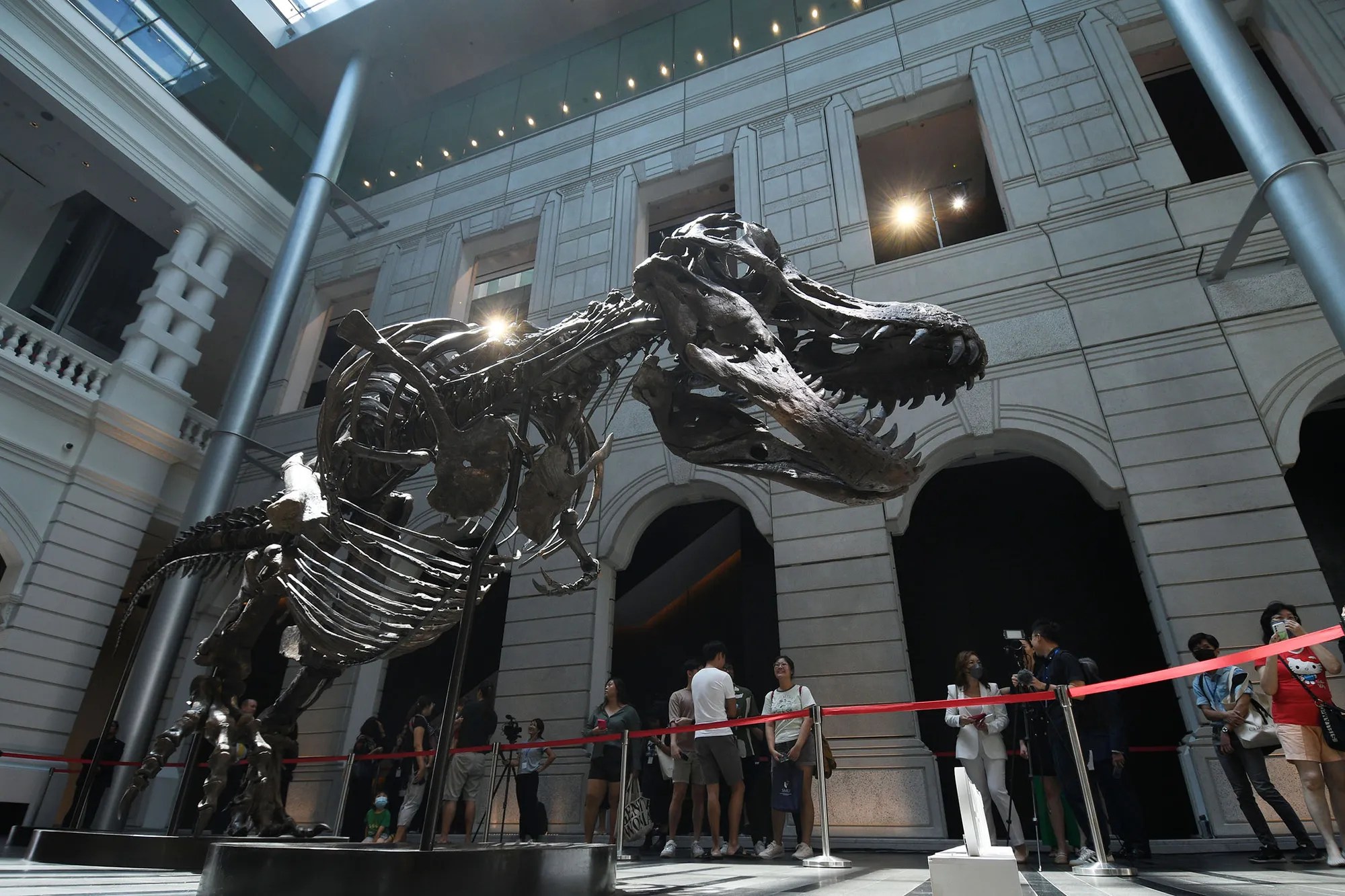
Readers may have seen news of the sale of “Gus,” a T. Rex skeleton that fetched a record $50,130,000 at Sotheby’s in New York last Tuesday. It’s part of a trend.
Devon Pendleton reports that dinosaurs have become an asset class for billionaires, with alarming implications for science… and, unsurprisingly, the market is about as orderly and genteel as a starving T. Rex. She uses a different recent sale, one that went pear-shaped, as an example…
It was supposed to be an unprecedented sale for the world’s wealthiest collectors. Shen, a Tyrannosaurus rex, was set to be the first of its kind ever sold at auction in Asia. The reconstructed creature, whose name means “godlike” in Chinese, was tens of millions of years old and longer than a city bus, frozen midstep with its massive skull cocked, jaws agape, as if ready to snatch up an onlooker. Christie’s was auctioning off Shen in November 2022, alongside works by Picasso, and it was expected to sell for $15 million to $25 million.
Dinosaur skeletons had recently become a hot new asset class, coveted by the ultrarich, not unlike sports franchises or Fabergé eggs. They offered a mix of glamour and primal appeal to a certain type of high-net-worth buyer—someone who might find the conventional art market fussy or convoluted but couldn’t deny the allure of a T. rex. “It could gobble you up in one bite. It’s just an amazing creature,” says billionaire Dan O’Dowd, who bought his T. rex, Samson, for a bargain $600,000 in 2009. “It’s the best trophy kind of thing you could own.”
Two years before the Shen auction, Christie’s had sold a T. rex named Stan, said to be one of the most complete and best-preserved specimens ever found, for $31.8 million, trouncing the top-end presale estimate of $8 million. And two years after the Shen auction, financier Ken Griffin spent $44.6 million on a stegosaurus (“a vegetarian,” O’Dowd notes). Leonardo DiCaprio, Nicolas Cage and other celebrities have gotten in on the dino game too.
A dinosaur’s value, like a painting’s or sculpture’s, derives from a protean mix of provenance, desire and authenticity—the last one hard to define, let alone prove, and in the case of an auction, up to the buyer to verify. Christie’s marketing blitz for Shen included the claim that it was one of the most “scientifically studied T. rex skeletons to come to auction,” featuring it in a short promotional video in which the camera cinematically races in for tight shots of its menacing talons and gaping jaw as eerie electronic music pulses in the background. Christie’s made clear that the winning bidder would also get renaming rights, a tradition in which T. rexes in circulation are often given human names.
A month before Shen was supposed to arrive at Christie’s in Hong Kong, it was put on display at Singapore’s Victoria Theatre and Victoria Concert Hall, a stately neoclassical building with a grand clock tower. Families, tourists and prospective buyers in chauffeured Bentleys came to see the T. rex in the flesh, so to speak. But Shen never made it to the auction block…
[Pendleton unpacks the full–and fascinating– tale of Shen. She concludes…]
… In recent years the dinosaur market has gotten only more exuberant. Last year at Sotheby’s a juvenile Ceratosaurus—smaller than a T. rex, but just as carnivorous—sold for $30.5 million, five times its high estimate. Some collectors, including Abu Dhabi’s new natural history museum and German biotech investor Christian Angermayer, are funding teams of bone hunters to scour the fossil-rich western US. Todd Graves, the billionaire behind Raising Cane’s Chicken Fingers, emerged as a collector when he lent his triceratops skull to the Louisiana Art & Science Museum.
And on July 14 in New York, Sotheby’s held what was hyped to be the hottest T. rex auction yet. Gus, as the creature is named, was described as 61% complete by bone count and 75% to 80% by bone mass with “an exceptionally preserved skull.” As the bids climbed, the auctioneer tempted potential buyers. “Try a bigger bite,” she said. “It’s a T. Rex after all.” Gus sold for $50.1 million, the highest ever paid for a dinosaur at auction.
Billionaires and their toys: “The Bone Rush,” gift article from @bloomberg.com.
###
As we ponder possession, we might recall that it was on this date in 1983 that a new species of flesh‑eating dinosaur nicknamed “Claws,” later formally named Baryonyx walkeri was announced…
A huge new dinosaur skeleton has been unveiled to the media at the Natural History Museum in London.
Plumber and amateur fossil hunter Bill Walker, 55, found a foot-long claw belonging to the flesh-eating beast at a clay pit in Surrey in January.
When he found the rock containing the talon he tapped it and the whole thing cracked.
Palaeontologists reconstructed it and dated the remains at 125 million years old, describing them as the find of the century…
… Nicknamed Claws, the dinosaur would have been slightly smaller than the Tyrannosaurus Rex – with teeth like steak knives – and was probably a sub-species of the Megalosaurus.
– source

“As you sow, so shall you reap”*…

The circle of life, via Nothing Here (@nothinghere_but).
* Galatians 6:7
###
As we watch what goes around come around, we might send very carefully-crafted birthday greetings to Jacques de Vaucanson; he was born on this date in 1709. A mechanical genius, de Vaucanson invented a number of machine tools still in use (e.g., the slide rest lathe) and created the first automated loom (the inspiration for Jacquard). But he is better remembered as the creator of extraordinary automata. Among his most famous creations: The Flute Player (with hands gloved in skin) and The Tambourine Player, life-sized mechanical figures that played their instruments impressively. But his masterpiece was The Digesting Duck; remarkably complex (it had 400 moving parts in each wing alone), it could flap its wings, drink water, eat grain– and defecate.
Sans…le canard de Vaucanson vous n’auriez rien qui fit ressouvenir de la gloire de la France. (Without…the duck of Vaucanson, you will have nothing to remind you of the glory of France)
– Voltaire

“Dinosaurs did not walk with humans. The evolutionary record says different. They gamboled”*…

Emily Graslie, host/writer of the educational YouTube series The Brain Scoop, has branched out to manage the wonderful Tumblr “…is not a dinosaur.”
This blog is a result of an erroneous mistake; one day I referred to Dimetrodon as a mammal-like reptile in front of a vertebrate paleomammalogist. These animals are not at all members of Reptilia; they are Synapsids – four-legged, back-boned animals that span back 315 million years on a completely different evolutionary branch on the tree of life.
Since then, I’ve found Dimetrodon partying with members of Dinosauria across the pages of coloring books and frolicking in the aisles of toy stores, surrounded by lifeforms which evolved some 66 million years after those ancient mammalian relatives…
And she’s shared; for example…

This is one of my favorites – I’ll reblog whomever points out all of the discrepancies in this one image. You’ll also get a puppy*
*probably notUpper-left feathered thing: probably an Archaeopteryx, but they have been proven to have black feathers. Although kudos to the authors/artists for allowing feathered dinosaurs to somewhat grace the cover! (Darn publishing logos)
Left green thing: an aetosaur, most likely. NOT DINOSAURS
Dimetrodon: PELYCOSAUR, NOT A DINOSAUR, SYNAPSID NOT A DIAPSID, UGHHHHHHHH. DIDN’T EVEN LIVE IN THE MESOZOIC.
Stegosaurus: head shape wrong, and dopey tail is not anatomically correct
Blue Ornithomimus thing: FOUR TOES ON THE GROUND? I don’t think so! And pronated wrists, not to mention the lack of feathers…
Protoceratops: legs sprawled out to the side instead of underneath, also missing the lower beak
Velociraptor pair: NO FEATHERS, TOO BIG, BROKEN HIPS (Sauruschian hips followed a 90 degree rule, meaning the femur does not bend back more than 90 degrees), more pronated wrists, wrong skull shape, and what are toe claws
Assumed Pteranodon: wimpy arm and shoulder musculature, missing pyncofibers, and wrong skull shape (although it might be viable, I’m scared to continue going through and trying to find pterosaur skeletals right now because of David Peters and his misleading work).
Also, many of these creatures are geographically misplaced, so even if they weren’t all from different time periods (Permian-Cretaceous), they probably wouldn’t have interacted much.
And, of course, the slightly off-center type of the title of the book is bugging me as a graphic design freak, but oh well.
ETA: More about the Dimetrodon: This illustration shows it with erect legs when it actually had sprawling legs, and the skull/mouth shape is not accurate either.
They just messed up bad with this one.
ETA2: While I do not know that much about paleobotany, I believe that most of the plants presented are fairly accurate.
I’m so proud I could cry.
More disambiguation of the distant past at … is not a dinosaur.
* Steve Martin
###
As we make Jurassic judgements, we might spare a thought for The Right Honorable John Lubbock, 1st Baron Avebury PC FRS DCL LLD; he died on this date in 1913. A banker by trade (and family tradition), Lubbock was an avocational scientist who made significant contributions to ethnography, several branches of biology, and– as a friend and advocate of Darwin– the debate over evolution, and was a central force in establishing archaeology as a scientific discipline.

“Dinosaurs are nature’s special effects”*…

The Lost World, released in 1925, was a silent film adaptation of Arthur Conan Doyle’s 1912 novel of the same name. Public Domain Review elaborates:
Directed by Harry O. Hoyt and featured pioneering stop motion special effects by Willis O’Brien (an invaluable warm up for his work on the original King Kong directed by Merian C. Cooper and Ernest B. Schoedsack). In 1922, Conan Doyle showed O’Brien’s test reel to a meeting of the Society of American Magicians, which included Harry Houdini. The astounded audience watched footage of a Triceratops family, an attack by an Allosaurus and some Stegosaurus footage. Doyle refused to discuss the film’s origins. On the next day, the New York Times ran a front page article about it, saying “(Conan Doyle’s) monsters of the ancient world, or of the new world which he has discovered in the ether, were extraordinarily lifelike. If fakes, they were masterpieces”.
It is a film of many firsts: first film to be shown to airline passengers, in April 1925 on a London-Paris flight by the company Imperial Airways; first feature length film made in the United States, possibly the world, to feature model animation as the primary special effect, or stop motion animation in general; first dinosaur-oriented film hit, and it led to other dinosaur movies, from King Kong to the Jurassic Park trilogy.

See The Lost World at The Internet Archive, or download it: Ogg | MPEG4 | Torrent
* paleontologist Robert T. Bakker
###
As we lavish love on lizards, we might send dusty birthday greetings to paleontologist Barnum Brown; he was born on this date in 1873 in Carbondale, Kansas. Brown (who was named after the famous showman) discovered the first documented remains of Tyrannosaurus rex during a 66-year career in which he became the most famous fossil hunter in the world.
Though most of his work was sponsored by the American Museum of Natural History (where most of his finds reside), some was underwritten by the Sinclair Oil Company– which adopted an image of the Apatosaurus (then known as Brontosaurus) in its logo.

Brown, who often worked on-site in fur coat, tie, and fedora, in the field in Montana in 1914
Re-extinction…

East Berlin’s Kulturpark Plänterwald had been the only amusement park in the German Democratic Republic (GDR)– a kind of Coney Island for socialists. There was no real coordination nor theme – it was a mix of attractions and rides. But when the GDR collapsed in 1989, Kulturpark Plänterwald– suddenly exposed to market forces– quickly followed. It had a brief renaissance (as “Spreepark”) in the early 90s– but promptly fell victim to a lack of available parking.
Since then, the park has been closed… and the dinosaurs that “roamed” its expanse have fallen victim to the German version of “cow tipping.”

See more derelict dinosaurs at Kuriositas. [TotH to Dangerous Minds]
As we keep watch for falling comets and asteroids, we might recall that it was on this date in 1916 that Robert Stroud stabbed and killed a prison guard at Leavenworth Penitentiary– resulting his being moved to “segregated” confinement for the balance of his sentence. While serving his solitary tme, Stroud– who’d been assessed by prison psychologists as “a psychopath with an IQ of 134”– began to work with birds (largely canaries). Ultimately his research, conducted entirely in his cell, resulted in two books, Diseases of Canaries, and a later edition, Stroud’s Digest on the Diseases of Birds, with updated specific information. He made several important contributions to avian pathology, most notably a cure for hemorrhagic septicemia.
In 1942, Stroud was transferred to Alcatraz, where policies against animals in cells meant an end to his research. Still, he is remembered as “The Birdman of Alcatraz.”


You must be logged in to post a comment.