Posts Tagged ‘billionaires’
“Always create more value than you capture”*…

There are, of course, myriad ways to rank people. Increasingly these days, the preferred scale seems to be one’s wealth. The Forbes 400, which ranks the richest Americans by their wealth, has become the scorecard of our zeitgeist. But one of its denizens (currently #4), Jeff Bezos, suggested in 2024, “somebody needs to make a list where they rank people by how much wealth they’ve created for other people.”
Sakshyam Patro has obliged…
… this is that list: [It ranks] founders by Wealth Created For Others (WCFO): the dollar value their companies generated for shareholders other than themselves…. every number traceable to an SEC filing, an academic dataset, or a named data source — refreshed every fifteen minutes while markets are open. Each figure is the shareholder wealth a founder’s company created, now held by index funds, pensions, employees and co-founders, minus what the founder kept. It’s not a claim that one person built the company alone…
See the list here. (Teaser: as of this writing, Bezos moves up one slot, from #4 to #3); the current Forbes #1, Elon Musk, drops to #28 (his wealth is $798B; his investors have lost $243B). And see the details of the methodology here.
Patro adds some important context– the first point especially:
- It is the Forbes billionaires list, re-sorted — not a ranking of humanity’s benefactors. The universe is living billionaires with a trackable public company. Norman Borlaug, Linus Torvalds, vaccine developers, and public-sector reformers created enormous value and belong at the top of a different list; they are absent here because they are not billionaires with public equity, not because the metric judges them small. This list answers exactly one question Bezos posed: among the people Forbes already ranks by personal wealth, who created the most for others versus kept for themselves?
- Not a measure of consumer surplus, wages, or societal value beyond shareholders (those are larger still — Nordhaus [see here] estimates innovators capture only ~2.2% of the social surplus they create — but they are not reliably measurable per person, so we do not headline them).
- Not a moral scoreboard. It measures one thing: dollars of shareholder wealth created beyond a risk-free benchmark, minus dollars kept.
- Not affiliated with Forbes or with any prior ranking site.
Ranked by the wealth they built for other investors: “The Anti‑Forbes List.”
To observe the obvious, the numbers at play here are big… so big as to be hard to understand. Amanda Shendruk urges us to make the effort and offers some helpful tips: “Understanding large values: It’s our ethical duty.”
###
As we re-evaluate, we might recall that it was on this date in 1598 that Shakespeare’s The Merchant of Venice was entered on the Stationers’ Register. By decree of Queen Elizabeth, the Stationers’ Register licensed printed works, giving the Crown tight control over all published material. In those days, “copyright” mainly meant “the right to make copies”; secondarily, it conferred intellectual property rights (though in those days, mainly to the guild printers who got the permissions).
In some cases, the companies of actors appear to have registered plays through co-operative stationers, with the express purpose of forestalling the publication of a play when publication was not in their interest. This seems to have been the case with The Merchant of Venice and Shakespeare’s company, The Lord Chamberlain’s Men: the copyright was granted to James Roberts, who printed the company’s playbills and held copyrights on five of their plays (two by Shakespeare). But Roberts transferred the copyright to fellow stationer Thomas Heyes in 1600, and Hayes published first quarto edition of the play before the end of the year.

“O bliss of the collector, bliss of the man of leisure!… Ownership is the most intimate relationship one can have to objects. Not that they come alive in him; it is he who comes alive in them.”*…
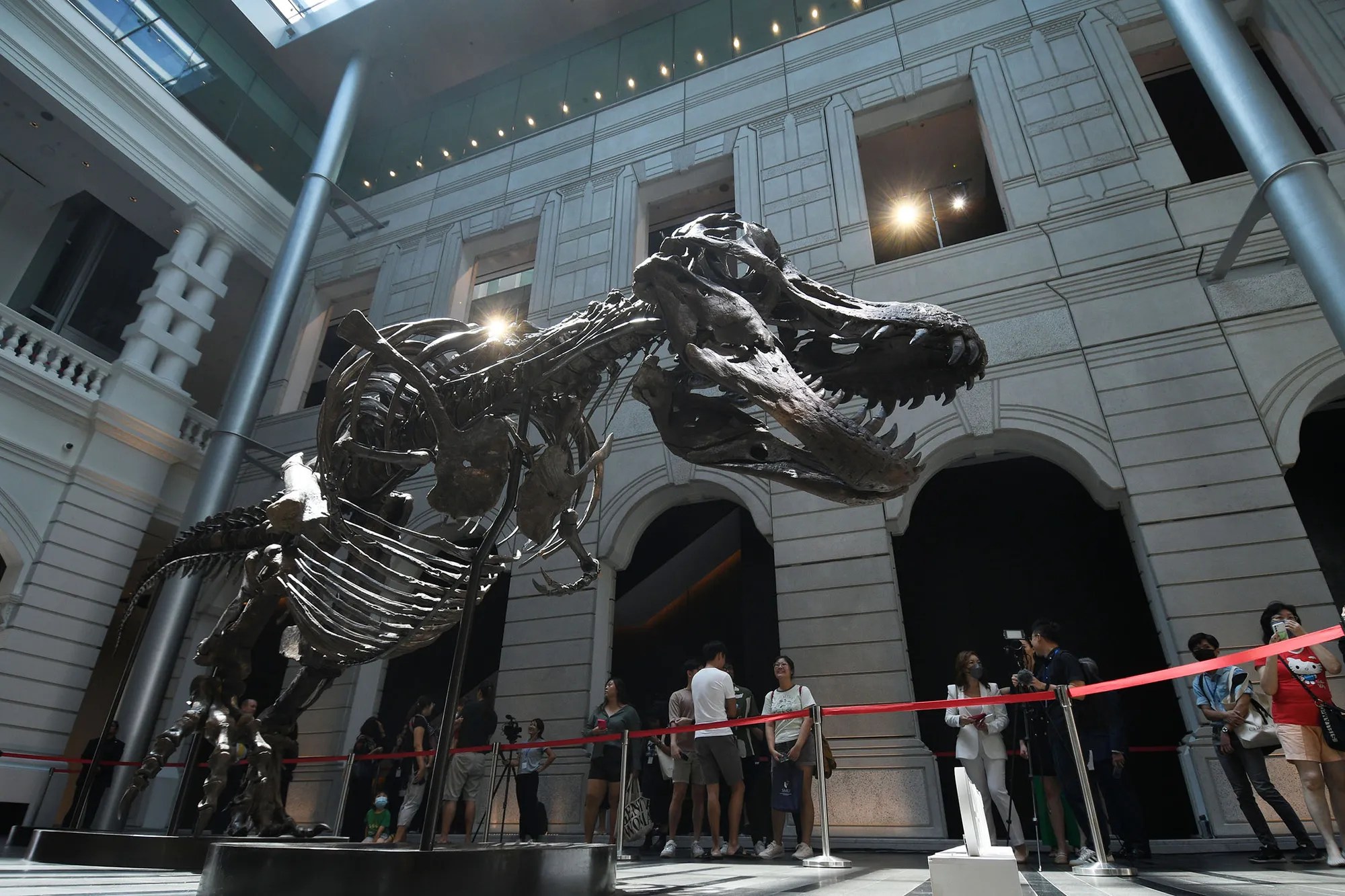
Readers may have seen news of the sale of “Gus,” a T. Rex skeleton that fetched a record $50,130,000 at Sotheby’s in New York last Tuesday. It’s part of a trend.
Devon Pendleton reports that dinosaurs have become an asset class for billionaires, with alarming implications for science… and, unsurprisingly, the market is about as orderly and genteel as a starving T. Rex. She uses a different recent sale, one that went pear-shaped, as an example…
It was supposed to be an unprecedented sale for the world’s wealthiest collectors. Shen, a Tyrannosaurus rex, was set to be the first of its kind ever sold at auction in Asia. The reconstructed creature, whose name means “godlike” in Chinese, was tens of millions of years old and longer than a city bus, frozen midstep with its massive skull cocked, jaws agape, as if ready to snatch up an onlooker. Christie’s was auctioning off Shen in November 2022, alongside works by Picasso, and it was expected to sell for $15 million to $25 million.
Dinosaur skeletons had recently become a hot new asset class, coveted by the ultrarich, not unlike sports franchises or Fabergé eggs. They offered a mix of glamour and primal appeal to a certain type of high-net-worth buyer—someone who might find the conventional art market fussy or convoluted but couldn’t deny the allure of a T. rex. “It could gobble you up in one bite. It’s just an amazing creature,” says billionaire Dan O’Dowd, who bought his T. rex, Samson, for a bargain $600,000 in 2009. “It’s the best trophy kind of thing you could own.”
Two years before the Shen auction, Christie’s had sold a T. rex named Stan, said to be one of the most complete and best-preserved specimens ever found, for $31.8 million, trouncing the top-end presale estimate of $8 million. And two years after the Shen auction, financier Ken Griffin spent $44.6 million on a stegosaurus (“a vegetarian,” O’Dowd notes). Leonardo DiCaprio, Nicolas Cage and other celebrities have gotten in on the dino game too.
A dinosaur’s value, like a painting’s or sculpture’s, derives from a protean mix of provenance, desire and authenticity—the last one hard to define, let alone prove, and in the case of an auction, up to the buyer to verify. Christie’s marketing blitz for Shen included the claim that it was one of the most “scientifically studied T. rex skeletons to come to auction,” featuring it in a short promotional video in which the camera cinematically races in for tight shots of its menacing talons and gaping jaw as eerie electronic music pulses in the background. Christie’s made clear that the winning bidder would also get renaming rights, a tradition in which T. rexes in circulation are often given human names.
A month before Shen was supposed to arrive at Christie’s in Hong Kong, it was put on display at Singapore’s Victoria Theatre and Victoria Concert Hall, a stately neoclassical building with a grand clock tower. Families, tourists and prospective buyers in chauffeured Bentleys came to see the T. rex in the flesh, so to speak. But Shen never made it to the auction block…
[Pendleton unpacks the full–and fascinating– tale of Shen. She concludes…]
… In recent years the dinosaur market has gotten only more exuberant. Last year at Sotheby’s a juvenile Ceratosaurus—smaller than a T. rex, but just as carnivorous—sold for $30.5 million, five times its high estimate. Some collectors, including Abu Dhabi’s new natural history museum and German biotech investor Christian Angermayer, are funding teams of bone hunters to scour the fossil-rich western US. Todd Graves, the billionaire behind Raising Cane’s Chicken Fingers, emerged as a collector when he lent his triceratops skull to the Louisiana Art & Science Museum.
And on July 14 in New York, Sotheby’s held what was hyped to be the hottest T. rex auction yet. Gus, as the creature is named, was described as 61% complete by bone count and 75% to 80% by bone mass with “an exceptionally preserved skull.” As the bids climbed, the auctioneer tempted potential buyers. “Try a bigger bite,” she said. “It’s a T. Rex after all.” Gus sold for $50.1 million, the highest ever paid for a dinosaur at auction.
Billionaires and their toys: “The Bone Rush,” gift article from @bloomberg.com.
###
As we ponder possession, we might recall that it was on this date in 1983 that a new species of flesh‑eating dinosaur nicknamed “Claws,” later formally named Baryonyx walkeri was announced…
A huge new dinosaur skeleton has been unveiled to the media at the Natural History Museum in London.
Plumber and amateur fossil hunter Bill Walker, 55, found a foot-long claw belonging to the flesh-eating beast at a clay pit in Surrey in January.
When he found the rock containing the talon he tapped it and the whole thing cracked.
Palaeontologists reconstructed it and dated the remains at 125 million years old, describing them as the find of the century…
… Nicknamed Claws, the dinosaur would have been slightly smaller than the Tyrannosaurus Rex – with teeth like steak knives – and was probably a sub-species of the Megalosaurus.
– source

You must be logged in to post a comment.