Posts Tagged ‘cartoons’
“To the vector belong the spoils”*

Long-time readers will know of your correspondent’s love for animator extraorinaire Chuck Jones (e.g., here). “Ellsworth Toohey” in Boing Boing reminds us that the master’s range was broad…
In 1965 animator Chuck Jones adapted a short picture book called The Dot and The Line: a romance in lower mathematics as a 9-minute cartoon. It follows a rigid blue line who adores a carefree red dot; she, however, swoons for a swaggering squiggle.
Rejected, the line enrolls in self-improvement boot camp, bending, flexing and inventing dazzling angles until he can sketch cathedrals with a single stroke. When the squiggle tries to match the precision, his chaotic scribbles collapse, and the dot chooses discipline over disorder.
Narrated with champagne-dry wit by Robert Morley, the film unfolds on spare backgrounds that feel lifted from a Mondrian canvas, while the squiggle’s jittery form was drawn on rice paper so the ink could literally misbehave. Norton Juster, author of the 1963 book, adapted his own text, seasoning math jokes with romantic wisdom: “To the vector belong the spoils.”
The short captured the 1965 Oscar for Best Animated Short, one of MGM’s final cartoons and proof that Jones could do more than torment coyotes. Decades later, its crisp pop-art minimalism still inspires…
“Chuck Jones’ 1965 Oscar-winning cartoon about a lovesick like and a dallying dot,” from @boingboing.net.
* Norman Juster
###
As we learn from the best, we might recall that it was on this date in 1967 that Chuck Jones gave AFI Report an edited and slightly abridged copy of the speech he had just given at the the World Animation Retrospective, held in Montreal in 1967. (That year was Canada’s 100th birthday and the country celebrated by hosting Expo ’67 in Montreal. The animation retrospective, curated by Louise Beaudet for the Cinémathèque Québecoise was part of the celebration.) The quarterly publication of the American Film Institute subsequently published it, under the title “Animation is a Gift Word,” in a 1974 issue devoted to animation.
Animation festivals were a relatively new idea at the time. Annecy had started in 1960, but festivals in Zagreb and Hiroshima were still in the future. The Montreal event may have been the first international animation gathering on North American soil. Close to 200 animation professionals attended from North America, Europe and Asia.
The list of attendees can only be described as impressive. The U.S. was represented by people from both coasts: Chuck Jones, Bob Clampett, Ward Kimball, Ub Iwerks, Abe Levitow, Pete Burness, June Foray, Paul Frees, Bill Hurtz, Steven Busustow, Les Goldman, Dave Hilberman, Jimmy Murakami, Milt Gray, Michael Lah, Fred Wolf, Walter Lantz, Bill Littlejohn, Art Babbitt, Bill Tytla, J.R. Bray, Otto Messmer, Pepe Ruiz, Edith Vernick, Shamus Culhane, John Culhane, I. Klein, Ruth Gench, Arnold Gillespie, Grim Natwick, Tissa David, Barrie Nelson, Dave Fleischer, Paul Terry, Mordi Gerstein, Ed Smith, Robert Breer, Richard Rauh, Phil Klein, Al Stahl, and Ruth Kneitel.
Canadian attendees included Norman McLaren, Grant Munro, Gerry Potterton, Mike Miller, and Ron Tunis.
Europeans included Len Lye, Peter Foldes, Fedor Khitruk, Jean Image, Bretislaw Pojar, John Halas, Bruno Bozzetto, Dusan Vukotic, Zelimir Matko, Ivan Ivanov-Vano, and S. Mancian.
A historian present on the site could have written a history of animation just by talking to the attendees…
– source
For photos of that remarkable crowd, see the link just above and here.
And for the text of the speech, see here.

“Dada was a bomb… can you imagine anyone, around half a century after a bomb explodes, wanting to collect the pieces, sticking it together and displaying it?”*…
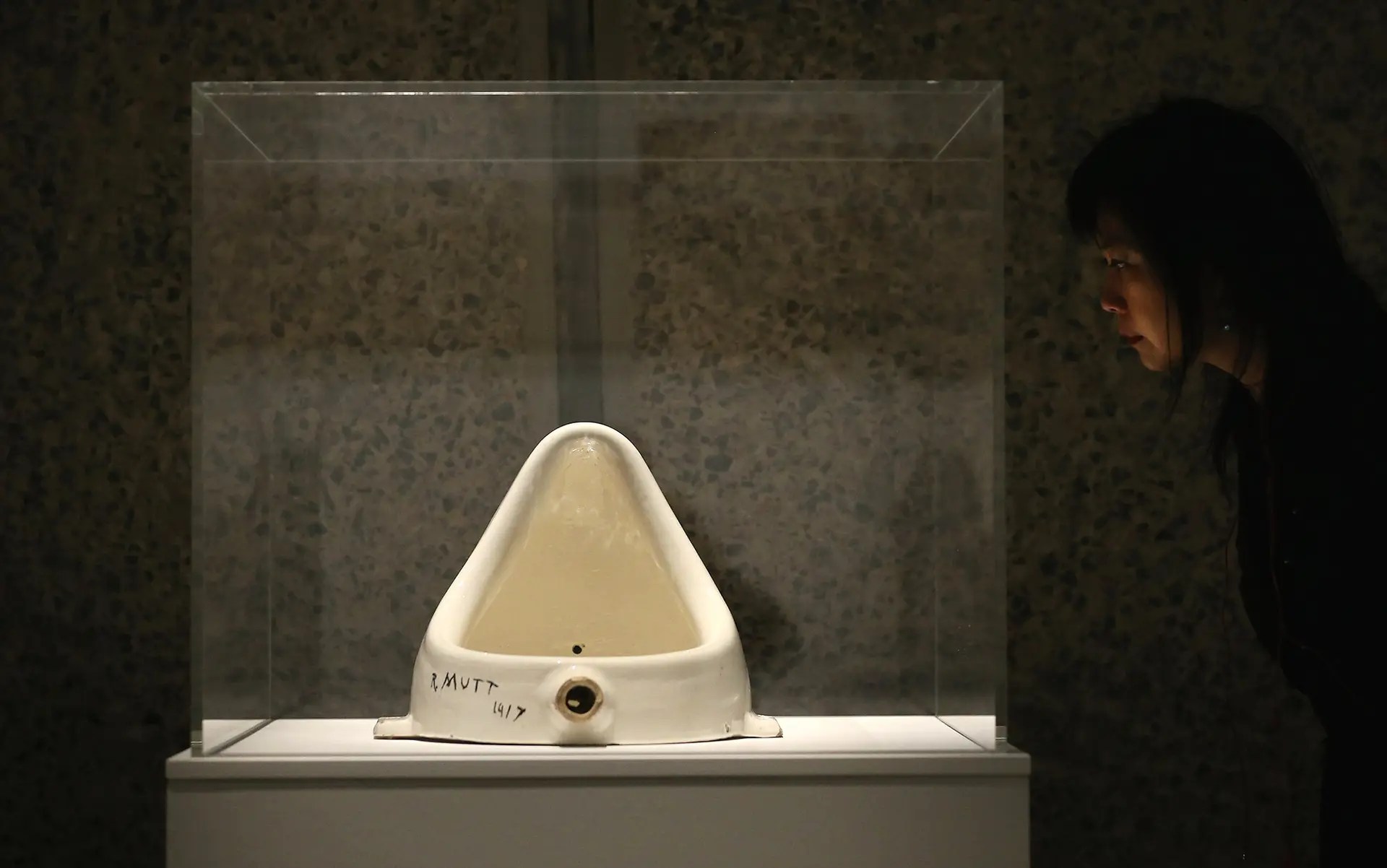
Marcel Duchamp was hugely influential in the revolutionary developments in the arts in the early 20th century. After helping establish Cubism, he turned to what he called “Readymades,” “found objects” which he selected and presented as art. By far the most famous of these was the piece he entitled “Fountain.” Damon Young and Graham Priest recount the stir that ensued… and unpack the work’s philosophical comment, making a case for why it resonates to this day…
In 1917 a pivotal event occurred for art and philosophy: Marcel Duchamp unveiled his artwork Fountain in Alfred Stieglitz’s New York studio. This was simply a porcelain urinal, signed ‘R. Mutt’.
Fountain was notorious, even for avant-garde artists. It has become one of the most discussed works of art of the 20th century. The Society of Independent Artists rejected it, though every artist who paid the exhibition fee was supposed to have their work shown. For almost a century, it has remained a difficult artwork. The philosopher John Passmore summed up Fountain as: ‘a piece of mischief at the expense of the art world’, though many have taken it very seriously.
No doubt there was some tomfoolery involved – Duchamp did not choose a urinal randomly. Yet there is more to Fountain than nose-thumbing. What makes this artwork so striking is its philosophical contribution.
Commentators often highlight the influence of Fountain on conceptual art, and this most ‘aggressive’ readymade, as Robert Hughes put it, has certainly had an enduring legacy. In 2004, it was voted the most important 20th-century work by hundreds of art experts. From Andy Warhol to Joseph Beuys to Tracey Emin, this urinal inspired artists to reconsider the traditional artwork. Instead of paintings and sculptures, art was suddenly Brillo boxes, an unmade bed, or a light-bulb plugged into a lemon: ordinary objects, some readymade, removed from their original contexts and placed on display in art galleries. The art critic Roberta Smith sums it up this way: ‘[Duchamp] reduced the creative act to a stunningly rudimentary level: to the single, intellectual, largely random decision to name this or that object or activity “art”.’ As we will see, Duchamp’s choice was not random at all, but Smith’s description points to the broader shock that Duchamp’s work prompted: if this can be art, then anything can.
Since then, scholars have discussed Fountain to demonstrate a shift away from aesthetics to thought. As the philosopher Noël Carroll notes, it’s possible to enjoy thinking about Duchamp’s work without actually looking at it, which cannot be said for Henri Matisse’s vivid paintings or Barbara Hepworth’s dignified stone sculptures.
These traditional ideas, as we will see, are all important to Fountain. But they do not go far enough. They treat Fountain as art, but of a mocking sort: a kind of intellectual heckling that nudged artists to taunt and scoff more academically at their own field. Our explanation of the artwork’s power is much more controversial: we believe that Fountain is art only insofar as it is not art. It is what it is not – and this is why it is what it is. In other words, the artwork delivers a true contradiction, what’s called a dialetheia. Fountain did not simply usher in conceptual art – it afforded us an unusual and intriguing concept to consider: a work of art that isn’t really a work of art, an everyday object that is not just an everyday object…
Marcel Duchamp’s ‘Fountain’ is not just a radical kind of art; it’s a philosophical dialetheia: a contradiction that is true: “It is and it isn’t,” from @damonyoung.com.au and Graham Priest @aeon.co. Eminently worth reading in full.
We might note that it’s not altogether clear that the dialetheia which the authors celebrate was what Duchamp had in mind. In any case (in line with the quote at the top) Duchamp, a father of Dada, was not entirely pleased with the influence that his work had:
This Neo-Dada, which they call New Realism, Pop Art, Assemblage etc. [Duchamp is referring to Andy Warhol and Roy Lichtenstein], is an easy way out and lives on what Dada did. When I discovered readymades I thought to discourage aesthetics. In Neo-Dada they have taken my readymades and found aesthetic beauty in them. I threw the bottle-rack [here] and the urinal in their faces as a challenge and now they admire them for their aesthetic beauty…
– Duchamp in a 1962 letter to Hans Richter
And as this is the centenniel of Dada’s “child,” Surrealism, we might peruse “The Small Magazines That Birthed Surrealism.”
###
As we ponder paradox, we might raise a glass in celebration of National Cartoonists Day, observed on this day each year. The date was chosen to recognize the first appearance (in color) of the mischievous cartoon character “The Yellow Kid” in the New York World newspaper (on May 5, 1895).

“I was conscious that I knew practically nothing”*…

As Joshua Rothman reminds us, we have a lot to learn from studying our ignorance…
… The truth, of course, is that we’re ignorant about the future. Who will win the election in November? Will we lose our jobs because of A.I.? Will the planet boil or merely simmer? What will skyscrapers, or smartphones, or schools look like in thirty years? We’re not in the dark about these questions; we can make educated guesses or predictions. But there’s an odd way in which, the more informed our speculations become, the more they serve to highlight what we don’t know. “The knowledge we possess determines the degree of specificity of the ignorance we recognize,” the philosopher Daniel DeNicola writes, in his book “Understanding Ignorance.” The more you know, the more precisely you can say what you don’t.
DeNicola’s book is an entry in a subfield of philosophy called “agnotology”—the study of ignorance. As philosophical subfields go, agnotology sounds abstract and even a little contradictory: what could it even mean to study what’s unknown? And yet, because ignorance is actually an everyday condition from which we all suffer, the study of it is quite down to earth. Have you ever been in a bookstore, leafed through a weighty tome, and then returned it to the shelf? You are practicing “rational ignorance,” DeNicola writes, by making “the more-or-less conscious decision that something is not worth knowing—at least for me, at least not now.” (In an information-rich society, he notes, knowing when to maintain this kind of ignorance is actually an important skill.) Have you ever tuned out a gossipy friend because you don’t want to know who said what about whom? Deciding that you’d rather be above the fray is “strategic ignorance”; you embrace it because it will make life better, deploying it when you decide not to read the reviews before seeing a movie, or conduct a hiring process in which the names of the candidates are obscured. There’s a big difference between strategic ignorance and what DeNicola calls “involuntary” ignorance: “In the iconic image, Justice is blindfolded, not blind,” he writes.
My wife’s parents have a box of letters that were sent between her grandfather and her grandmother while he was serving in the Navy during the Second World War. The box is in the basement; no one has read the letters, and no one plans to. This reflects a valid concern for privacy, but it also involves what DeNicola calls “willful ignorance”—the persistent, long-term maintenance of a gap in one’s knowledge that could easily be filled in. Willful ignorance isn’t necessarily bad; it might be wise to avoid learning the disturbing details of a half-forgotten traumatic event, for instance, lest they keep the trauma fresh. But we should be wary of willful ignorance, DeNicola argues, because it often flows from fear. “Consider a mother who is so upset about her son’s military service that she refuses to discuss it while he remains on active duty,” DeNicola writes. Or a voter who refuses to read about a favored candidate’s ongoing scandal. “The benefits of willful ignorance tend to be overestimated by those who exhibit it”; knowledge can be a path to overcoming fear.
DeNicola argues that, even when we don’t choose ignorance, there are ways in which we must “dwell in ignorance,” no matter what we do. We’re ignorant of most of what happened in the past because, despite our efforts at historical reconstruction, “worlds disappear” in the flow of time. We’re ignorant about the future not just because we don’t know what will happen but because we lack the ideas needed to comprehend future knowledge: “Galileo could not have known that solar flares produce bursts of radiation,” for example, because the very idea of radiation depends on a “framework of theoretical concepts” that wasn’t developed until hundreds of years after he lived. It turns out that there’s a special word, “ignoration,” which describes the condition of people who “do not even know that they do not know.” In a broad, almost existential sense, we all live in ignoration all the time. Recognizing this makes knowing what you don’t know feel like a step forward—even an opportunity to be seized…
… In a recent book called “Sense, Nonsense, and Subjectivity,” a German philosopher named Markus Gabriel argues that our personhood is partly based on ignorance—that “to be someone, to be a subject, is to be wrong about something.” It’s intuitive to hold the opposite view—to say that we are the sum of what we know. But Gabriel points out that, even when you know something to be true, you probably also know that there are aspects of it about which you’re probably wrong. I encountered this phenomenon recently when my son asked me to explain the meaning of “E=mc2”—but, also, when I tried to tell him about how I’d met his mom. “We were riding up in an elevator, and we started talking, and then she got off,” I said. “And then, later, when I was riding down, she got back on.”
This story is true, but also wreathed in inevitable uncertainties. What exactly did we say to one another? What were we wearing, or thinking, or feeling, before and after? There are limits to recollection, and to noticing in the moment; life is short, and you can’t know it all, not even about yourself. But you can know, at least to some extent, what you chose not to know and what you wished you’d found out. You can understand what you looked away from, and toward…
“What Don’t We Know?” from @joshuarothman in @NewYorker.
* Socrates, from Plato, Apology 22d
###
As we noodle on nescience, we might send bodacious birthday greetings to that most fabulous of flappers, Betty Boop; she made her first appearance on this date in 1930. The creation of animator Max Fleischer, she debuted in “Dizzy Dishes” (in which, still unevolved as a character, she is drawn as an anthropomorphic female dog).
“You see much more of your children after they leave home”*…

… And so, American parents are seeing less of their 18-24 year-old kids. From David Crowther, a graphic reminder that a historic rite of passage for young people and their parents has changed…
As we enter the peak summer months, many students and newly-minted college graduates are taking their first steps into the big bad world of work. In decades gone by, a wave of weddings often followed and young newlyweds shacked up to leave a huge cohort of “empty nesters” behind. That is no longer the case.
In the late 1960s, nearly 40% of 18-24 year-olds lived with their spouse. Last year, just 6% did.
Indeed, data plotted from the Census Bureau (and inspired by reddit user u/theimpossiblesalad) reveals how dramatically the living arrangements of America’s youngest adults have changed in the last 50+ years…

More on how we now live: “Who do Gen Z and Millennials live with in America?” from @ChiefChartmaker in @chartrdaily.
* Lucille Ball
###
As we ruminate on residence, we might recall that it was on this date in 1910 that those epic enactors of the human condition Krazy Kat (and Ignatz Mouse) first appeared in print, in New York Journal (as the “downstairs” strip in George Herriman’s predecessor comic, The Dingbat Family (later, The Family Upstairs). Krazy, Ignatz, and Offisa Pup stepped out on their own in 1913 and ran until 1944– but never actually succeeded financially. It was only the admiration (and support) of publisher William Randolph Hearst that kept those bricks aloft.

“A public-opinion poll is no substitute for thought”*…

Opinion polls are a key accelerant in the inflamed civil discourse of our time. And, as Teresa Carr explain, that’s a problem…
Last December, a joint survey by the Economist and the polling organization YouGov claimed to reveal a striking antisemitic streak among America’s youth. One in five young Americans thinks the Holocaust is a myth, according to the poll. And 28 percent think Jews in America have too much power.
“Our new poll makes alarming reading,” declared the Economist. The results inflamed discourse over the Israel-Hamas war on social media and made international news.
There was one problem: The survey was almost certainly wrong. The Economist/YouGov poll was a so-called opt-in poll, in which pollsters often pay people they’ve recruited online to take surveys. According to a recent analysis from the nonprofit Pew Research Center, such polls are plagued by “bogus respondents” who answer questions disingenuously for fun, or to get through the survey as quickly as possible to earn their reward.
In the case of the antisemitism poll, Pew’s analysis suggested that the Economist/YouGov team’s methods had yielded wildly inflated numbers. In a more rigorous poll posing some of the same questions, Pew found that only 3 percent of young Americans agreed with the statement “the Holocaust is myth.”
These are strange times for survey science. Traditional polling, which relies on responses from a randomly selected group that represents the entire population, remains the gold standard for gauging public opinion, said Stanford political scientist Jon Krosnick. But as it’s become harder to reach people on the phone, response rates have plummeted, and those surveys have grown exponentially more expensive to run. Meanwhile, cheaper, less-accurate online polls have proliferated.
“Unfortunately, the world is seeing much more of the nonscientific methods that are put forth as if they’re scientific,” said Krosnick…
…
… headlines as outrageous as they are implausible continue to proliferate: 7 percent of American adults think chocolate milk comes from brown cows; 10 percent of college graduates think Judge Judy is on the Supreme Court; and 4 percent of American adults (about 10 million people) drank or gargled bleach to prevent Covid-19. And although YouGov is one of the more respected opt-in pollsters, some of its findings — one third of young millennials aren’t sure the Earth is round, for example — strain credulity.
Amidst a sea of surveys, it’s hard to distinguish solid findings from those that dissolve under scrutiny. And that confusion, some experts say, reflects deep-seated problems with new methods in the field — developed in response to a modern era in which a representative sample of the public no longer picks up the phone.
The fractious evolution in polling science is likely to receive fresh attention as the 2024 elections heat up, not least because the consequences of failed or misleading surveys can go well beyond social science. Such “survey clickbait” erodes society’s self-esteem, said Duke University political scientist Sunshine Hillygus: It “undermines people’s trust that the American public is capable of self-governance.”
Veteran pollster Gary Langer compares traditional randomized polling methods, known as probability polling, to dipping a ladle into a well-stirred pot of minestrone soup. “We can look in and see some cannellini beans, little escarole, chunks of tomato,” he said. “We get a good representation of what’s in the soup.”
It doesn’t matter if the pot is the size of Yankee Stadium, he said. If the contents are thoroughly mixed, one ladle is enough to determine what’s in it. That’s why probability surveys of 1,000 people can, in theory, represent what the entire country thinks.
The problem is that getting a truly representative sample is virtually impossible, said YouGov’s Douglas Rivers, who pointed out that these days a good response rate to a randomized poll is 2 percent…
…
… with the appropriate guardrails against fraud, YouGov chief scientist Rivers said, such methods offer a practical alternative to conventional probability sampling, where the costs are too high, and the response rates are too low. In some sense, he suggested, most polling is now nonprobability polling: When only 2 out of 100 people respond to a survey, it’s much harder to claim that those views are representative, said Rivers. “Sprinkling a little bit of randomness at the initial stage does not make it a probability sample.”
“Our approach has been: Let us assemble a sample systematically based on characteristics,” said Rivers. “It’s not comparable to what the census does in the current population survey, but it’s performed very well in election polling.” Rivers pointed to YouGov’s high ranking on the website FiveThirtyEight, which rates polling firms based on their track record in predicting election results and willingness to show their methods.
Gary Langer was not particularly impressed by high marks from FiveThirtyEight. (His own firm, Langer Research Associates, also gets a top grade for political polling they conduct on behalf of the partnership between ABC News and The Washington Post.) “Pre-election polls, while they get so much attention, are the flea on the elephant of the enterprise of public opinion research,” he said. The vast majority of surveys are concerned with other topics. They form the basis of federal data on jobs and housing, for example, and can reflect the public’s views on education, climate change, and other issues. “Survey data,” he said, “surrounds us, informs our lives, informs the choices we make.”
Given the stakes, Langer relies exclusively on probability polling. Research shows that opt-in polls just don’t produce the same kind of consistent, verifiable results, said Langer…
Research suggests that widely used nonprobability methods, in particular online opt-in polls such as the Economist/YouGov survey, have inherent vulnerabilities.
The prospect of cash or rewards can incentivize some people to complete surveys quickly and with as little effort as possible. “They’re giving you data and answers that just can’t possibly be true,” said Kennedy.
For example, in one test of opt-in polling, 12 percent of U.S. adults younger than 30 claimed that they were licensed to operate a nuclear submarine. The true figure, of course, is approximately 0 percent…
…
… Media consumers should be skeptical of implausible findings, said Krosnick. So should reporters, said Langer, who spent three decades as a journalist, and who said news outlets have a responsibility to vet the polls they report on: “Every newsroom in the country — in the world — should have someone on their team evaluate surveys and survey methodologies.”
In the end, people need to realize that survey research involves some degree of uncertainty, said Joshua Clinton, a political scientist at Vanderbilt University, who noted that polls leading up to the 2024 election are bound to get something wrong. “My concern is what that means about the larger inferences that people make about not only polling, but also science in general,” he said. People may just dismiss results as a predictable scientific failure: “‘Oh, the egghead screwed up again.’” Clinton said he wants people to recognize the difficulty of doing social science research, rather than to delegitimize the field outright.
Even Rivers, whose firm produced the Economist poll that made headlines, acknowledged that readers should be cautious with eye-catching headlines. “We’re in a challenging environment for conducting surveys,” he said. That means that people need to take survey results — especially those that are provocative — with a grain of salt.
“The tendency is to overreport polls,” said Rivers. “The polls that get reported are the ones that are outliers.”…
It’s very difficult to get anyone to answer a phone call—and that’s skewing data on everything from chocolate milk to antisemitism: “We’re in a New Era of Survey Science,” from @TeresaRCarr in @undark via @Slate. Eminently worth reading in full.
* Warren Buffett
###
As we take it with a grain of salt, we might recall that it was on this date in 1941 that Tom and Jerry first appeared on screen with those names in the MGM cartoon “The Midnight Snack,” though it was in fact their second screen appearance.
In 1940, MGM had produced “Puss Gets the Boot,” based on Hanna’s and Barbera’s pitch for a story rooted in two “equal characters who were always in conflict with each other.” It was the first collaboration between William Hanna and Joseph Barbera (founding a partnership that would last over 50 years and yield such treasures as The Flintstones, Huckleberry Hound, The Jetsons, Scooby-Doo, Top Cat, and Yogi Bear); at over nine minutes in length, it’s the longest T&J ever produced– and the first of three T&J essays (with “Puss n’ Toots” and “Puss ‘n’ Boats”) to pun it’s title on the fairy tale “Puss in Boots.” “Puss Gets the Boot” was nominated for an Academy Award– the first of Hanna and Barbera’s many Oscar nominations.
The cat in “Puss Gets the Boot” was actually named “Jasper”; the mouse, “Jinx.” But when the pilot got the go-ahead to become a series, animator John Carr won a studio-wide naming contest with his suggestion: “Tom and Jerry.” The cat’s owner, “Mammy Two-Shoes,” was voiced by June Foray— who later earned immortality as the voice of Rocky J. Squirrel.
You must be logged in to post a comment.