Posts Tagged ‘cartoons’
“Populist victors continue to behave like victims; majorities act like mistreated minorities”…

… and, as Rachel Kleinfeld explains, that doesn’t work out well for their economies…
In the 20th century, economic and political systems could be situated on a simple 2×2 grid. Economic policies ran from left to right, while political systems could be arrayed from authoritarian to democratic.
Most U.S. business pegged themselves easily on this spectrum: they wanted favorable regulation and management-friendly policies of the sort generally pursued by the right. And while a few opened up shop behind the Iron Curtain, CEOs knew business prospered most under classically liberal democratic systems that upheld the rule of law and inalienable rights—including property rights.
The rise of populism in the 21st century has overturned this game board. Today, even supposedly right-wing populists exploit distrust, pessimism, and anger to make the case that government should wield a heavy—and often retaliatory—hand in markets. But while such interference by authoritarian leaders could once be portrayed as undemocratic, modern populists often bask in electoral support. Voters cheer as their elected leaders undermine rights and the rule of law.
Populism, in other words, has shaken the kaleidoscope of 20th century political and economic identities—and acting as if those labels still apply could be catastrophic for market economies. Modern populists from the right use right-wing rhetoric to sell what used to be left-wing economic ideas. And many marry the electoral aspects of democracy with authoritarian tactics to undermine the rights, institutions, and norms that create a stable business environment.
Economic and historical studies show that even supposedly pro-business populism is bad for business; countries that elect one populist tend to elect others, its effects creep well past a single election cycle.
This matters because populists are getting elected at a rate last seen in the 1930s. In 2018, they presided over nearly a third of global GDP, including mega-countries like India. Next year, with 40 countries (accounting for 44% of global GDP) going to the polls, they could control even more. Some come from the left, particularly in Latin America. But as in the turbid 1930s, many populist leaders like Jair Bolsonaro in Brazil, Narendra Modi in India, and Donald Trump in the United States hail from the right—deploying a trio of political strategies that characterize populists regardless of their avowed ideology.
First, populists win elections by deepening existing social divisions. By turning nearly every political question into a fight between a virtuous “us” and a deceitful, dangerous, disloyal “them” they create an intense base that is personally loyal to the leader and not any particular ideology. That base lets populists maintain strong voter support even as they centralize and personalize power, their second go-to tactic. Finally, by redefining democracy as majority rule, they can claim that anything that stands against their desires (as the embodiment of the majority) is anti-democratic. This rhetorical jujitsu lets them undermine checks and balances, once-independent institutions from judiciaries to statistical bodies, and the rule of law itself, depicting them as obstacles to taking radical steps to implement the majority’s wishes.
The dire economic effects of left-wing populism are well-researched. Leaders from Argentina’s Juan Perón to Mexico’s Andrés Manuel López Obrador nationalize businesses, politicize their management, and fill their ranks with supportive political appointees. They shower voters with government money come election time and overheat their economies. The result is often a short-term economic boom followed by a long, inflationary bust…
Using Victor Orbán and Hungary as an example, Kleinfeld demonstrates that right-wing populists are just as disastrous for their countries; the problem is not that the leader comes from the left or the right, it’s that they pursue the populist playbook.
Eminently worth reading in full. Aspiring autocrats keep ruining their countries’ economies: “The Economic Cost of Right-Wing Populism,” from @RachelKleinfeld in @JoinPersuasion.
[Image above from the co-published version of the article]
Apposite: Zeynep Tufekci with a diagnosis of the attractiveness of autocratic leaders: “A Strongman President? These Voters Crave It.” (gift article). Not sure that I buy her sense that Trump has been working a careful and canny strategy from the start (2016); but her focus is on his adherents’ grievances and their response to his charisma and his self-anointed status as “the only one who can save [us]”… a provocative read.
* Jan-Werner Müller, What Is Populism?
###
As we contemplate civics, we might recall that it was on this date in 1870 that pioneering political cartoonist Thomas Nast gave the Democratic Party its mascot:
On January 15, 1870, Nast published the cartoon [see below] that would forever link the donkey to the Democrat. A few ideas should be clear for the cartoon to make sense: First, “republican” and “democrat” meant very different things in the 19th century than they do today (but that’s another article entirely); “jackass” pretty much meant the exact same thing then that it does today; and Nast was a vocal opponent of a group of Northern Democrats known as “Copperheads.”
In his cartoon, the donkey, standing in for the Copperhead press, is kicking a dead lion, representing President Lincoln’s recently deceased press secretary (E.M. Stanton). With this simple but artfully rendered statement, Nast succinctly articulated his belief that the Copperheads, a group opposed the Civil War, were dishonoring the legacy of Lincoln’s administration. The choice of a donkey –that is to say, a jackass [understood at the time to be a play on “Jackson,” as populist Andrew Jackson was an inspiration to the Copperheads]– would be clearly understood as commentary intended to disparage the Democrats. Nast continue to use the donkey as a stand-in for Democratic organizations, and the popularity of his cartoons through 1880s ensured that the party remained inextricably tied to jackasses…
“Political Animals: Republican Elephants and Democratic Donkeys”- Smithsonian

“It is a good morning exercise for a research scientist to discard a pet hypothesis every day before breakfast. It keeps him young.”*…

The Chimp-Pig Hypothesis is, to put it mildly, a revolutionary proposition. Uri Bram suggests that we use it– whether we believe it or not– to stretch ourselves…
In this post I’m going to explain, as best I can, an idea about evolution that many of my friends find (to say the least) outlandish.
I’m not very knowledgeable about genetics, and I can’t really vouch for how plausible the hypothesis is. (But note: on the same grounds, I can’t really vouch for how plausible Darwinian evolution is).
My interest is actually in something else: what does it feel like to have your beliefs overturned? You know the story: as was true for every previous generation, some of the things we believe today must be entirely wrong, and yet very few of us ever make a 180 on anything. It’s easier to accept we must be wrong about something than to actually admit we are wrong about anything. Which ought to worry us.
I’m frankly more interested in moral wrongs than scientific one. But the tricky thing is that successful moral revolutions are so complete that once they’re over we struggle to imagine how anyone ever believed X. (Kazuo Ishiguro is the only person I know to have actually captured what this probably feels like, but my co-blogger and I also made an attempt in this piece for WIRED).
Fear not: I’m coming back to the chimps and pigs. To me, the Chimp-Pig hypothesis is a rare theory that is 1) internally consistent and coherent enough not to be ridiculous, 2) overturns everything we think we know about a major area of knowledge, and 3) doesn’t have any meaningful implications for our current lives, so it won’t really hurt anyone if you give it some credence and it turns out to be false.
Which is all to say: to me, the most interesting interaction you can have with the Chimp-Pig hypothesis is to let yourself believe it, at least briefly, and then observe what it feels like to have your world overturned. The Chimp-Pig hypothesis may not be one of the great revolutions of your lifetime, but I think it’s one of the best practice cases I’ve ever seen. And when your real moment of truth comes, it’d be good to have some practice…
Fascinating– and challenging: “The Chimp-Pig Hypothesis,” from @UriBram.
* Konrad Lorenz
###
As we rehearse, we might spare a thought for Rube Goldberg; he died on this date in 1970. A cartoonist, sculptor, author, engineer, and inventor, he is best remembered as a satirist of the American obsession with technology; his series of “Invention” cartoons used a string of outlandish tools, people, plants, and steps to accomplish simple, everyday tasks in the most complicated possible way. (His work has inspired a number of “Rube Goldberg competitions,” the best-known of which, readers may recall, has been profiled here.)

Goldberg was a founder and the first president of the National Cartoonists Society, and he is the namesake of the Reuben Award, which the organization awards to the Cartoonist of the Year.

“He offered alternative facts”*…

When reach exceeds grasp (in both senses of the word), from @ryanqnorth in Dinosaur Comics.
* Kellyanne Conway (defending Sean Spicer)
###
As we have it our way, we might we might send an amusing birthday verse to Ogden Nash; he was born on this date in 1902. A poet best known for his light verse, Nash wrote over 500 pieces published, between 1931 and 1972, in 14 volumes. At the time of his death in 1971, he was, The New York Times averred, “the country’s best-known producer of humorous poetry.” The following year, on his birthday, the U.S. Postal service celebrated him with a commemorative stamp.
- Candy
Is Dandy
But liquor
Is quicker.- “Reflections on Ice-Breaking” in Hard Lines (1931); often misattributed to Dorothy Parker
- It is common knowledge to every schoolboy and even every Bachelor of Arts,
That all sin is divided into two parts.
One kind of sin is called a sin of commission, and that is very important
And it is what you are doing when you are doing something you ortant…- “Portrait of the Artist as a Prematurely Old Man” in The Family Album of Favorite Poems (1959)

“Animation isn’t the illusion of life; it is life”*…
A unsung pioneer…
A decade before Walt Disney Productions came into existence, making its name synonymous with animated films, there was another pioneer of the art form — Lotte Reiniger.
Reiniger’s filmmaking career spanned 60 years, during which she created more than 70 silhouette animation films, including versions of “Cinderella,” “Puss in Boots” and “Hansel and Gretel.” She’s perhaps best known for her 1926 silent film “The Adventures of Prince Achmed,” a fantastical adaptation of “The Arabian Nights” that was among the first full-length animated features ever made [and the oldest still in existence]…
Beginning with “Prince Achmed,” she also created an early version of the multiplane camera, which gave two-dimensional animation a hitherto unexplored depth, movement and complexity. She called her device a tricktisch, or trick table…
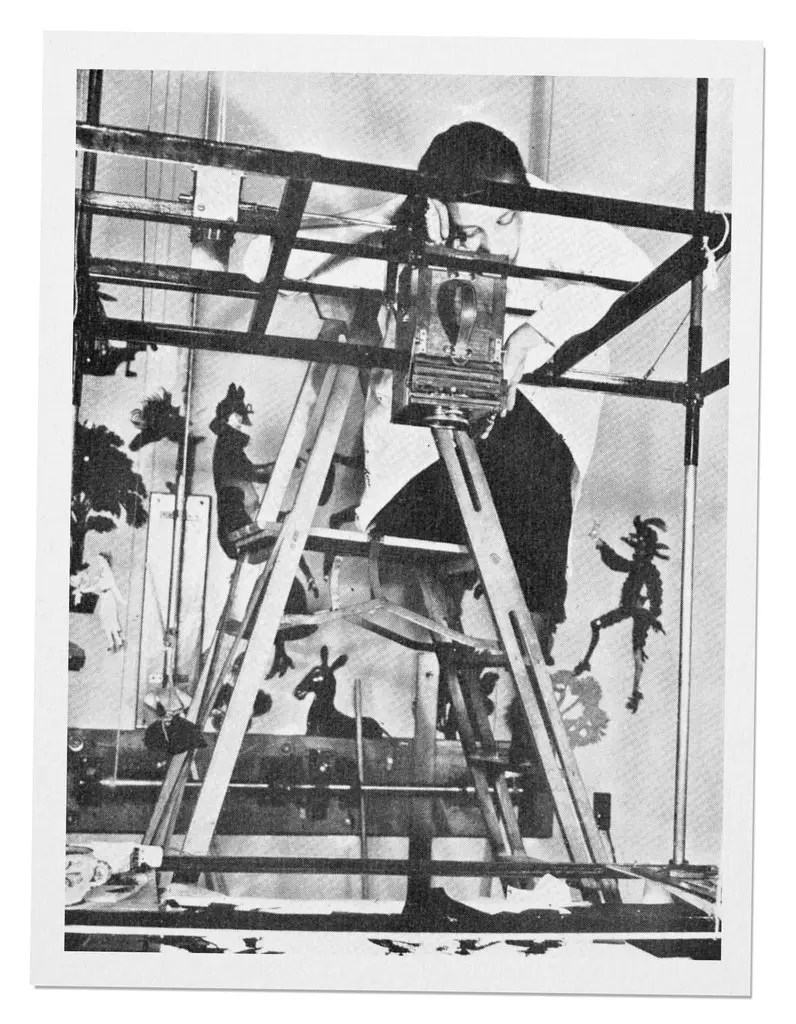
More of Reiniger’s work: The Adventures of Prince Achmed (1926) and a Nivea commercial (1920).
More of Reiniger’s remarkable story: “Overlooked No More: Lotte Reiniger, Animator Who Created Magic With Scissors and Paper” (gift article) from @nytimes, and on Wikipedia.
###
As we sit with the shadows, we might recall that it was on this date in 1935 that Mickey’s Garden was released. Directed by Wilfred Jackson, it was the second Mickey cartoon produced in color and the first color appearance of Pluto. It is also, notably, the first short on which Ollie Johnston (a cleanup artist at the time, ultimately, one of Disney’s “Nine Old Men“) worked.
“All good things must come to an end”*…

Rusty Foster reports that…
Matt Bors announced that The Nib is shutting down after its retroactively ironically themed final issue, “The Future.” “The Nib has published more than 6,000 comics and paid out more than $2 million to creators.” It will be replaced by: nothing, just another void where independent cultural criticism used to be…
Today in Tabs
The Nib will be online through August; you can still enjoy it’s extraordinary offerings (and buy its issues) until then. Happily Rusty’s Today in Tabs continues– one hopes for a long, long time…
[Image above: from KC Green‘s “This Is Not Fine,” on The Nib]
* Geoffrey Chaucer, Troilus and Criseyde
###
As we bid a fond adieu, we might recall that it was on this date in 1844 that inventor (and celebrated painter) Samuel F.B. Morse inaugurated the first technological competitor to the post when he sent the first telegraph message: “What hath God wrought?” Morse sent the famous message from the B&O’s Mount Clare Station in Baltimore to the Capitol Building. (The words were chosen by Annie Ellsworth, the daughter of the U.S. Patent Commissioner, from Numbers 23:23.)

You must be logged in to post a comment.