Mark Twain (the author of the observation above) was more correct than he may have understood. Alex Wakeman explains that, while most other plants have a single “most useful” element, wild cabbage has many. This makes it perfect for breeding….
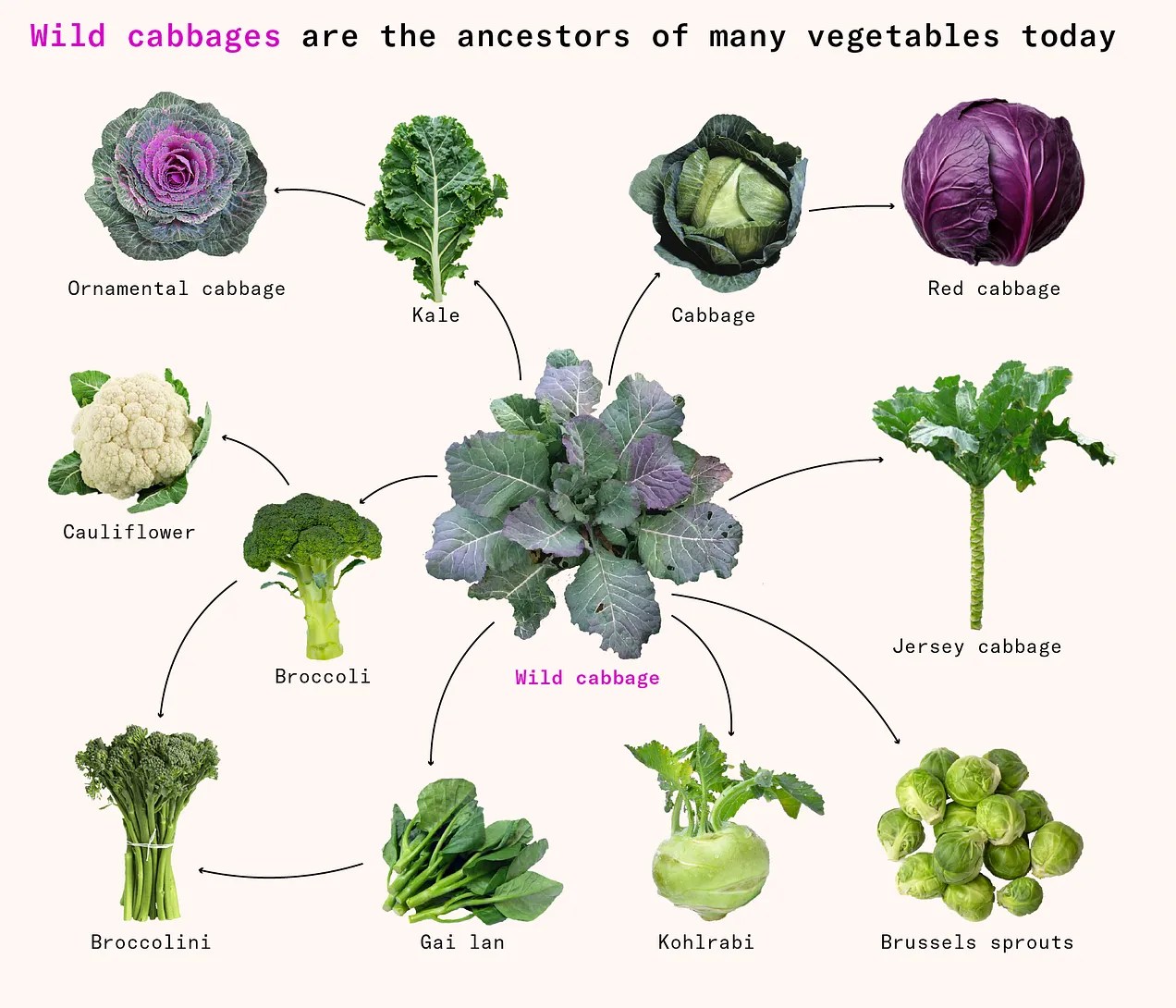
Every crop we consume came from a wild ancestor. Through breeding, people selected for bigger grains, juicier fruit, more branches, or shorter stems – gradually turning wild plants into improved yet recognizable versions of their originals. The rare exception is Brassica oleracea, wild cabbage: the origin of cabbage, bok choy, collard greens, broccoli, Brussels sprouts, cauliflower, and much else.
Wild cabbage is unassuming: some untidy leaves and a few thick, coarse stems on the browner side of purple that poke out from the soil. Nothing about it looks appetizing.
Wild cabbage (Brassica oleracea) growing in Northumberland. Source
Nevertheless, many cultures have recognized something special in this plant. By selecting plants with denser layers of leaves, ancient people created modern cabbage and kale. Others bred for the inflorescence, a dense bundle of small flowers that forms the head of cauliflower and broccoli. By favoring large, edible buds, thirteenth-century farmers living around modern day Belgium created Brussels sprouts. Under different selection pressures, Brassica oleracea has become German kohlrabi, or Chinese gai lan, or East African collard greens.
This level of morphological diversity is unusual. Modern tomatoes, for example, vary in size, shape, and color, but are all recognizably tomatoes. Since the 1920s, scientists have worked to understand how Brassica oleracea was domesticated and to deepen our knowledge of evolution and artificial selection.
By combining modern genetics, genomics, and molecular biology with linguistic, historical, and sociological sources, researchers are now beginning to develop conclusive answers…
In an excerpt from his book, The F-Word, Lexicographer Jesse Sheidlower on the f-bomb, its origins and development, and its illimitable uses…
In all of English there are few words rich enough in their history and variety of use to warrant a dedicated dictionary that runs to hundreds of pages and multiple editions. That fuck is at the same time one of the most notorious, popular, and emotive words in the language makes it all the more fascinating…
… How has this word, which has been around for many hundreds of years, maintained both its intense interest and its uncommon power?
There is no simple answer to this question; too many factors come into play. Sex is certainly one factor. The vast majority of uses of fuck in modern English are nonsexual, but it has retained its sexual meanings and connotations across many centuries, and sex is something that’s always hovering around our consciousness. The word has amassed a great many other uses, though, and so the reasons for its singular force and appeal are likewise diverse and complex.
Fuck has an enormous range of uses across many parts of speech, as this dictionary details: sexual and nonsexual, positive and negative, literal and figurative, funny and violent. For any situation, there’s probably some sense, some expression or catchphrase, some proverb, some intonation that can be brought to the table.
And it just feels good to say. It feels good in the mouth, giving shape to catharsis; it can also feel good in the brain, satisfying a strong emotional need or a desire for personal expression. It can help us bond with peers, gain or direct attention, persuade listeners, and establish or test intimacy.
Psycholinguistic research shows that using certain kinds of swear words can even improve the body’s physical strength and resistance to pain. (But the more you swear in daily life, the smaller the analgesic effect.)
Words such as fuck are often criticized for being “bad,” or we are told that we should avoid them. But what is appropriate depends on context—and sometimes we want to be inappropriate. This word is an important part of our culture, our vocabulary, and our heritage, and that is always something worth knowing more about…
[Sheidlower explores its etymology (where it’s from), its cultural history (especially its taboo status), and its current status…]
… In its recent reports, older people are more likely to rate the F-word as a strong swear, while middle-aged people consider it moderate, and young people see it as becoming more acceptable in public use. Equivalent research in New Zealand shows “significant declines in unacceptability of fuck– words” even from 2018 to 2022.
While a few publications still refuse to print fuck regardless of the circumstances, most have no such qualms. The more literary magazines have printed the word for some time, and by the early 2000s even Newsweek and Time had started to do so; the publication of the Starr Report in the New York Times, and a notable comment from Vice President Dick Cheney in the Washington Post, has meant that even the proper papers consider fuck fit to print.
Even commercial television, though still subject to Federal Communications Commission (FCC) regulations, is becoming more open in its use…
As we ponder profanity, we might spare a thought for Albert Francis Blakeslee; he died on this date in 1954. A botanist, he is best remembered for his discovery (while still a graduate student) that Mucors (bread molds), thought at the time to be homothallic (that’s to say, had a single “mating type” that replicated asexually) actually had two mating types and reproduced sexually. His findings revolutionized the understanding of the sexual reproduction of the lower plants. In fact, his discovery was so influential that the fungi Phycomyces blakesleeanus and Blakeslea trispora were named after him.
Reality feels “stable” enough to talk about it– though all logic seems to point away from that possibility. Marco Giancotti unpacks what he suggests is the only line of reasoning that resolves that paradox…
What is the source of what we call order? Why do many things look too complex, too perfectly organized to arise unintentionally from chaos? How can something as special as a star or a flower even happen? And, for that matter, why do some natural phenomena seem designed for a purpose?
We live in a universe of forces eternally straining to crush things together or tear them apart. There is no physical law for “forming shapes”, no law for being separated from other things, no law for staying still.
Boundaries are in the eye of the beholder, not in the world out there. Out there is only tumult, clashing, and shuffling of everything with everything else.
And yet, our familiar world is filled with things stable and consistent enough for us to give them names—and to live our whole lives with.
In this essay we’ll tackle these questions at the very root. We need good questions to get good answers, so we’ll begin by clarifying the problem. It has to do with probabilities—we’ll see why those natural objects seem so utterly unlikely to happen by chance, and we’ll find the fundamental process that solves the dilemma.
This will take us most of the way, but we’ll have one final obstacle to overcome, a cognitive Last Boss: living things still feel a little magical in some way, imbued with a mysterious substance called “purpose” that feels qualitatively different from how inanimate things work. This kind of confusion runs very deep in our culture. To remove it, I’ll give a name to something that, as far as I know, hasn’t been named before: phenomena that I’ll be calling—enigmatically, for now—“Water Lilies.”…
As we explore existence, we might spare a thought for Francis Simpson; he died on this date in 2003. An English naturalist, conservationist, and chronicler of the countryside and wild flowers of his native Suffolk, he became a botanist at Ipswich Museum, where he worked until his retirement in 1977.
He published one of the most highly regarded county floras, simply entitled Simpson’s Flora of Suffolk, and in 1938 saved a small meadow, famous for its snakeshead fritillaries, from being drained and ploughed into farmland. Using donations amounting to £75, he was able to purchase the field, Mickfield Meadow, for the Society for the Promotion of Nature Reserves. Today, it is one of the oldest nature reserves in the country, protecting the meadow flowers now surrounded by farmland.
Stefan Washietl collected the shortest scientific papers. Some are unvarnished mathematical proofs, some are humor to amusing or incisive ends, others are clever-dickery that shoves the conclusion into the abstract. All are wonderful!…
As we go for the gist, we might send voluminous birthday greetings to Constantine Samuel Rafinesque; he was born on this date in 1783. An autodidact naturalist, traveler, and writer who, in spite of work of variable reliability, substantially expanded knowledge via his extensive travels, collecting, cataloging, and naming huge numbers of plants and some animals. Among these are many new species he is credited with being the first to describe.
Years ahead of Charles Darwin’s theory of evolution, Rafinesque conceived his own ideas. He thought that species had, even within the timeframe of a century, a continuing tendency for varieties to appear that would diverge in their characteristics to the point of forming new species. Accordingly, he was over-enthusiastic at distinguishing what he called new species.
Rafinesque wrote prolifically, and often self-published. His work varied from brilliant insightfulness to carelessness, and raised the eyebrows– and sometimes the ire– of his scientific contemporaries. Indeed, he so incensed John James Audubon with his belief that Audubon has included unnamed species in his sketches of birds, that Audubon pranked him, feeding him sketches of imaginary fish… which Rafinesque believed and included in his writings, where (for 50 years or so) they remained as part of the scientific record.
John Lewis-Stempel recounts a day in the life of an oak and the creatures that call it home…
Our friends the trees have an unremarkable life, or so it seems to us. They come into leaf, their fruit drops, or is gorged on by birds and the winds of autumn strip them of their dressing to leave them as the cold, bare sentinels of winter.
However, if we were to stand, tree-like ourselves, in a British copse and watch a single oak tree for an entire 24 hours — say when spring hatches out of winter — what would we see?…
As we deliberate on the deciduous, we might send fertile birthday greetings to John Bartram; he was born on this date in 1699. An American botanist, horticulturist, and explorer, based in Philadelphia for most of his career, he was judged by Swedish botanist and taxonomist Carl Linnaeus to be the “greatest natural botanist in the world.”
He started what is known as Bartram’s Garden in 1728 at his farm in Kingsessing (now part of Philadelphia)– considered the first botanic garden in the United States. His sons and descendants operated it until 1850; it still operates under a partnership between the city of Philadelphia and a non-profit foundation, and was designated a National Historic Landmark in 1960.


You must be logged in to post a comment.