Posts Tagged ‘autocracy’
“I failed in some subjects in exams, but my friend passed in all. Now he is an engineer in Microsoft and I am the owner of Microsoft.”*…

And that, Yasheng Huang argues, is not something likely to happen in China, for a reason that dates back to the 6th century…
On 7 and 8 June 2023, close to 13 million high-school students in China sat for the world’s most gruelling college entrance exam. ‘Imagine,’ wrote a Singapore journalist, ‘the SAT, ACT, and all of your AP tests rolled into two days. That’s Gao Kao, or “higher education exam”.’ In 2023, almost 2.6 million applied to sit China’s civil service exam to compete for only 37,100 slots.
Gao Kao and China’s civil service exam trace their origin to, and are modelled on, an ancient Chinese institution, Keju, the imperial civil service exam established by the Sui Dynasty (581-618). It can be translated as ‘subject recommendation.’ Toward the end of its reign, the Qing dynasty (1644-1911) abolished it in 1905 as part of its effort to reform and modernize the Chinese system. Until then, Keju had been the principal recruitment route for imperial bureaucracy. Keju reached its apex during the Ming dynasty (1368-1644). All the prime ministers but one came through the Keju route and many of them were ranked at the very top in their exam cohort…
Much of the academic literature focuses on the meritocracy of Keju. The path-breaking book in this genre is Ping-ti Ho’s The Ladder of Success in Imperial China (1962). One of his observations is eye catching: more than half of those who obtained the Juren degree were first generation: ie, none of their ancestors had ever attained a Juren status. (Juren was, at the time, the first degree granted in the three-tiered hierarchy of Keju.) More recent literature demonstrates the political effects of Keju. In 1905, the Qing dynasty abolished Keju, dashing the aspirations of millions and sparking regional rebellions that eventually toppled China’s last imperial regime in 1911.
The political dimension of Keju goes far beyond its meritocracy and its connection to the 1911 republican revolution. For an institution that had such deep penetration, both cross-sectionally in society and across time in history, Keju was all encompassing, laying claims to the time, effort and cognitive investment of a significant swathe of the male Chinese population. It was a state institution designed to augment the state’s own power and capabilities. Directly, the state monopolised the very best human capital; indirectly, the state deprived society of access to talent and pre-empted organised religion, commerce and the intelligentsia. Keju anchored Chinese autocracy.
The impact of Keju is still felt today, not only in the form and practice of Gao Kao and the civil service exam but also because Keju incubated values and work ethics. Today, Chinese minds still bear its imprint. For one, Keju elevated the value of education and we see this effect today. A 2020 study shows that, for every doubling of successful Keju candidates per 10,000 of the population in the Ming-Qing period, there was a 6.9 per cent increase in years of schooling in 2010. The Keju exams loom as part of China’s human capital formation today, but they also cultivated and imposed the values of deference to authority and collectivism that the Chinese Communist Party has reaped richly for its rule and legitimacy…
An ultimate autocracy is one that reigns without society. Society shackles the state in many ways. One is ex ante: it checks and balances the actions of the state. The other is ex post. A strong society provides an outside option to those inside the state. Sometimes, this is derisively described as ‘a revolving door’, but it may also have the positive function of checking the power of the state. State functionaries can object to state actions by voting with their feet, as many US civil servants did during the Donald Trump administration, and thereby drain the state of the valuable human capital it needs to function and operate. A strong society raises the opportunity costs for the state to recruit human capital but such a receptor function of society has never existed at scale in imperial China nor today, thanks – in large part, I would argue – to Keju.
Keju was so precocious that it pre-empted and displaced an emergent society. Meritocracy empowered the Chinese state at a time when society was still at an embryonic stage. Massive resources and administrative manpower were poured into Keju such that it completely eclipsed all other channels of upward mobility that could have emerged. In that sense, the celebration by many of Keju’s meritocracy misses the bigger picture of Chinese history. It is a view of a tree rather than of a forest…
…Its impressive bureaucratic mobility demolished all other mobility channels and possibilities. Keju was an anti-mobility mobility channel. It packed all the upward mobility within one channel – that of the state. Society was crowded out, and over time, due to its deficient access to quality human capital, it atrophied. This is the root of the power of Chinese autocracy and, I would argue, it is a historical development that is unique to China and explains the awesome power of Chinese autocracy…
…
There was, however, a massive operational advantage to the Neo-Confucianist curriculum: it standardised everything. Standardisation abhors nuance and the evaluations became more straightforward as the baseline comparison was more clearly delineated. There was objectivity, even if the objectivity was a manufactured artefact. The Chinese invented the modern state and meritocracy, but above all the Chinese invented specialised standardised testing – the memorisation, cognitive inclination and frame of references of an exceedingly narrow ideology.
Ming standardised Keju further: it enforced a highly scripted essay format, known as the ‘eight-legged essay’, or baguwen in Chinese (八股文), to which every Keju candidate had to adhere. A ‘leg’ here refers to each section of an essay, with a Keju essay requiring eight sections: 1) breaking open the topic; 2) receiving the topic; 3) beginning the discussion; 4) the initial leg; 5) the transition leg; 6) the middle leg; 7) the later leg; and 8) conclusion. The eight-legged essay fixed more than the aggregate structure of exposition. The specifications were granular and detailed. For example, the number of phrases was specified in each of the sections and the entire essay required expressions in paired sentences – a minimum of six paired sentences, up to a maximum of 12. The key contribution of the eight-legged essay is that it packed information into a pre-set presentational format.
Standardisation was designed to scale the Keju system and it succeeded brilliantly in that regard, but it had a devastating effect on expositional freedom and human creativity. All elements of subjectivity and judgment were taken out. In his book Traditional Government in Imperial China (1982), the historian Ch’ien Mu describes the ‘eight-legged essay’ as ‘the greatest destroyer of human talent.’…
In his book The WEIRDest People in the World (2020), Joseph Henrich posited that the West prospered because of its early lead in literacy. Yet the substantial Keju literacy produced none of the liberalising effects on Chinese ideas, economy or society. The literacy that Henrich had in mind was a particular kind of literacy – Protestant literacy – and the contrast with Keju literacy could not have been sharper. Keju literacy was drilled and practised in classical and highly stratified Chinese, the language of the imperial court rather than the language of the masses, in sharp contrast to Protestant literacy. Protestant literacy empowered personal agency by embracing and spreading vernaculars of the masses. Henrich’s liberalising ‘WEIRD’ effect – Western, educated, industrialised, rich and democratic – was a byproduct of Protestant literacy. It is no accident that Keju literacy produced an opposite effect…
Not everyone sees the Western/WEIRD definition of creativity and innovation as the only important one (c.f., here and here), nor that China is as lacking in what Westerners call creativity and innovation (c.f., here— possible soft paywall, and here). Still, Huang’s essay on Keju, China’s incredibly difficult civil service test, and how it strengthened the state at the cost of freedom and creativity, is eminently worthy of reading full: “The exam that broke society,” from @YashengHuang in @aeonmag.
And for the amazing (and amusing) story of how the Keju was instrumental in the introduction of Catholicism into China, see Jonathan Spence’s wonderful The Memory Palace of Matteo Ricci.
* Bill Gates
###
As we study, we might recall that it was on this date in 4004 BCE that the Universe was created… as per calculations by Archbishop James Ussher in the mid-17th century.
When Clarence Darrow prepared his famous examination of William Jennings Bryan in the Scopes trial [see here], he chose to focus primarily on a chronology of Biblical events prepared by a seventeenth-century Irish bishop, James Ussher. American fundamentalists in 1925 found—and generally accepted as accurate—Ussher’s careful calculation of dates, going all the way back to Creation, in the margins of their family Bibles. (In fact, until the 1970s, the Bibles placed in nearly every hotel room by the Gideon Society carried his chronology.) The King James Version of the Bible introduced into evidence by the prosecution in Dayton contained Ussher’s famous chronology, and Bryan more than once would be forced to resort to the bishop’s dates as he tried to respond to Darrow’s questions.
“Bishop James Ussher Sets the Date for Creation”

“Those who believe that politics and religion do not mix, understand neither”*…

Authoritarian leaders who play the religious card are not mere hypocrites, Suzanne Schneider suggests; there’s something far more troubling going on…
Viktor Orbán reportedly does not attend church. Benjamin Netanyahu eats at non-kosher restaurants. New York libertine Donald Trump lacks all manner of evident religious virtue.
Yet it is a fact that today’s crop of aspiring authoritarians invoke religious themes and symbols, despite not being strict adherents to their respective traditions. Of course, there is nothing new about the opportunistic use of religion by politicians. The scholars Garret Martin and Carolyn Gallaher have remarked that ‘Orbán’s use of religion is no different from Ronald Reagan’s embrace of Christian evangelicals in the late 1970s.’ According to these explanations, such figures cynically appeal to religion, despite not being true believers. Given this purported sincerity deficit, a conversation in this register toggles between accusations of hypocrisy and instrumentalism. How can such obviously corrupted figures claim to speak on behalf of a Christian or Jewish nation? And how can voters who claim to be animated by religious values be so blind?
Tempting as it is, the hypocrisy diagnosis does not quite map onto the emerging social landscape. There is instead a deeper and more interesting shift occurring in the world toward a new post-liberal or illiberal order of religion and politics. Understanding the nature of this transformation enables critics to break out of the cycle of allegations of hypocrisy or inconsistency, and to grasp an emergent worldview that is both coherent and deeply troubling…
Read on for her (troubling) explication: “An unholy alliance,” from @suzy_schneider in @aeonmag.
For the Washington Post‘s examination of the global tilt toward authoritarian nationalism: “Leaders of democracies increasingly echo Putin in authoritarian tilt” (gift article, so no paywall).
Apposite: “When the Hindu Right Came for Bollywood” (“The industry used to honor India’s secular ideals—but, since the rise of Narendra Modi, it’s been flooded with stock Hindu heroes and Muslim villains…”)

* Albert Einstein (also attributed to Gandhi)
###
As we take the measure of the metamorphosis, we might recall that it was on this date in 1789 that John Jay was sworn in as the first Chief Justice of the U.S. Supreme Court. A founding father (co-author of The Federalist Papers with Hamilton and Madison, and President of the second Continental Congress), he had previously served as the young nation’s Secretary of Foreign Affairs (in which position he helped negotiate the Treaty of Paris), as the first Secretary of State, then as Governor of New York.
Jay was an ally of Hamilton, a proponent of a strong national government. While Governor of New York, he presided over a state constitutional convention in which religious tolerance was enshrined… within limits: he succeeded in adding special provisions for Catholics to the constitution’s article on the naturalization of foreigners. Under Jay’s amendment, aliens were required to take an oath of allegiance to the state that included renunciation of all allegiance and subjection to “all and every foreign king, prince potentate and state, in all matters ecclesiastical as well as civil.” Scholars suggest that the persecution of Jay’s Huguenot ancestors by the Catholic Church and his adherence to traditional Whig views identifying Protestantism with liberty and Catholicism with oppression, foreign influence, and sedition motivated his actions.

“Oh, down in Mexico / I never really been so I don’t really know”*…
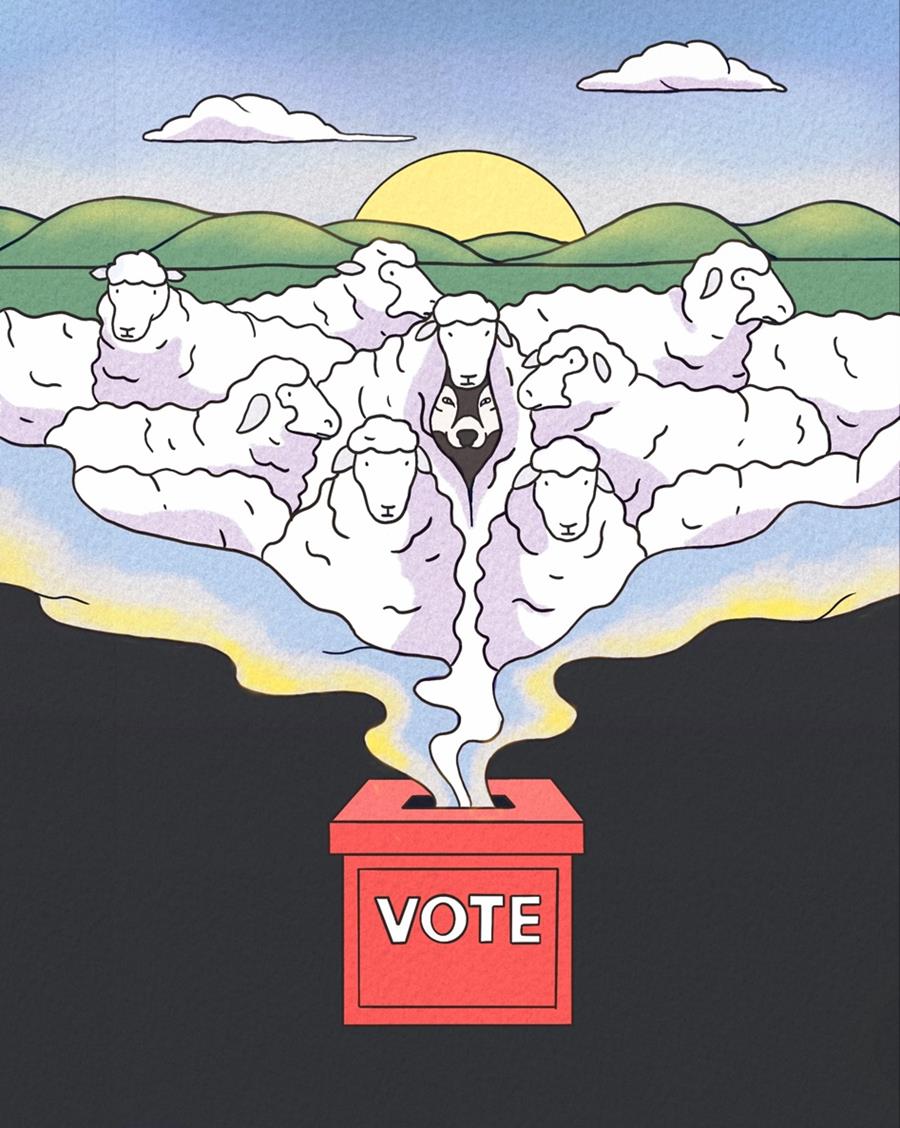
In this moment of altogether appropriate attention to the autocratic threat to Ukraine, it’s too easy to forget that genuine democracy is under threat all around the world. Nathan Gardels cites two examples close to home: Mexico and California…
The core crisis of governance in open societies today is the distrust that has grown between the public and its institutions of self-government. The response to this breach of trust has largely been unfolding in two directions — the autocratic tendency toward decisive strongmen who fashion themselves as tribunes of the people, or seeking to re-legitimize democracy through greater citizen engagement and participation.
Now, a new and concerning hybrid is emerging that exploits the tools of citizen engagement and participation (such as the recall of elected officials, the referendum, and ballot initiative) either to affirm autocratic leanings or to protect and promote the very special interests these tools were meant to challenge…
…
Participatory democracy unmediated by impartial institutions of deliberation or guarded against manipulation by the powers that be poses as significant a risk to citizen control of government as unchecked executive power or rule by those with the most gold. When plebiscitary practices are deployed from the top down to affirm the rule of a present regime, or hijacked by the most monied, instead of initiated from the bottom up, the very notion of citizen empowerment is nullified.
Top-down direct democracy is a wolf in sheep’s clothing: “Mexico: On The Path To A Perfect Autocracy?“, from @NoemaMag.
* James Taylor, “Mexico”
###
As we watch our backs, we might note that not all exercises of direct democracy (even when they are structurally flawed) end badly: on this date in 1992 a referendum to end apartheid in South Africa passed by a vote of 69% to 31%… a margin that would surely had been larger had the election not been restricted to white voters. (Universal suffrage was established two years later.)

“Every decent man is ashamed of the government he lives under”*…

The majority of countries are democracies, but how many people enjoy what we think of as democratic rights? A nifty interactive map from Our World In Data charts the changes in political regimes across the globe, country by country, over the last 200 years. By way of explaining its categories:
• In closed autocracies, citizens do not have the right to choose either the chief executive of the government or the legislature through multi-party elections.
• In electoral autocracies, citizens have the right to choose the chief executive and the legislature through multi-party elections; but they lack some freedoms, such as the freedoms of association or expression, that make the elections meaningful, free, and fair.
• In electoral democracies, citizens have the right to participate in meaningful, free and fair, and multi-party elections.
• In liberal democracies, citizens have further individual and minority rights, are equal before the law, and the actions of the executive are constrained by the legislative and the courts.
As Visual Capitalist observes…
Do civilians get a representative say in how the government is run where you live?
While it might seem like living with a basic level of democratic rights is the status quo, this is only true for 93 countries or territories today—the majority of the world does not enjoy these rights.
It also might surprise you that much of the progress towards democracy came as late as the mid-20th century…
An interactive look at the state of democracy around the world, and how it has evolved. From @OurWorldInData, via @VisualCap.
* H. L. Mencken
###
As we ruminate on representation, we might recall that it was on this date in 1933, the day after an arsonist ignited the Reichstag building, home of the German parliament in Berlin (and four weeks after Nazi leader Adolf Hitler had been sworn in as Chancellor of German), that Adolf Hitler attributed the fire to a conspiracy of Communist agitators.
Marinus van der Lubbe, a Dutch “council communist”, was the apparent culprit; but Hitler insisted on a wider network of villains. He used it as a pretext to claim that Communists were plotting against the German government, and induced President Paul von Hindenburg to issue the Reichstag Fire Decree suspending civil liberties, and to pursue a “ruthless confrontation” with the Communists. A court later found that van der Lubbe had in fact acted alone. But Hitler’s orchestrated reaction to the Reichstag Fire began the effective rule of the Nazi Party and the establishment of Nazi Germany.

You must be logged in to post a comment.