Posts Tagged ‘autocracy’
“The most effective way to destroy people is to deny and obliterate their own understanding of their history”*…

… and of their present. Anne Applebaum explores the ways in which autocrats in China, Russia, and elsewhere are now making common cause with MAGA Republicans to discredit liberalism and freedom around the world…
… Even in a state where surveillance is almost total, the experience of tyranny and injustice can radicalize people. Anger at arbitrary power will always lead someone to start thinking about another system, a better way to run society. The strength of these demonstrations, and the broader anger they reflected, was enough to spook the Chinese Communist Party into lifting the quarantine and allowing the virus to spread. The deaths that resulted were preferable to public anger and protest.
Like the demonstrations against President Vladimir Putin in Russia that began in 2011, the 2014 street protests in Venezuela, and the 2019 Hong Kong protests, the 2022 protests in China help explain something else: why autocratic regimes have slowly turned their repressive mechanisms outward, into the democratic world. If people are naturally drawn to the image of human rights, to the language of democracy, to the dream of freedom, then those concepts have to be poisoned. That requires more than surveillance, more than close observation of the population, more than a political system that defends against liberal ideas. It also requires an offensive plan: a narrative that damages both the idea of democracy everywhere in the world and the tools to deliver it…
…
… the story of how Africans—as well as Latin Americans, Asians, and indeed many Europeans and Americans—have come to spout Russian propaganda about Ukraine is not primarily a story of European colonial history, Western policy, or the Cold War. Rather, it involves China’s systematic efforts to buy or influence both popular and elite audiences around the world; carefully curated Russian propaganda campaigns, some open, some clandestine, some amplified by the American and European far right; and other autocracies using their own networks to promote the same language…
…the convergence of what had been disparate authoritarian influence projects is still new. Russian information-laundering and Chinese propaganda have long had different goals. Chinese propagandists mostly stayed out of the democratic world’s politics, except to promote Chinese achievements, Chinese economic success, and Chinese narratives about Tibet or Hong Kong. Their efforts in Africa and Latin America tended to feature dull, unwatchable announcements of investments and state visits. Russian efforts were more aggressive—sometimes in conjunction with the far right or the far left in the democratic world—and aimed to distort debates and elections in the United States, the United Kingdom, Germany, France, and elsewhere. Still, they often seemed unfocused, as if computer hackers were throwing spaghetti at the wall, just to see which crazy story might stick. Venezuela and Iran were fringe players, not real sources of influence.
Slowly, though, these autocracies have come together, not around particular stories, but around a set of ideas, or rather in opposition to a set of ideas. Transparency, for example. And rule of law. And democracy. They have heard language about those ideas—which originate in the democratic world—coming from their own dissidents, and have concluded that they are dangerous to their regimes…
The origins and the operations of today’s all-too-successful authoritarian disinformation efforts: “The New Propaganda War” (gift article) from @anneapplebaum in @TheAtlantic. Eminently worth reading in full.
Apposite: “‘Everyone is absolutely terrified’: Inside a US ally’s secret war on its American critics,” @zackbeauchamp on India’s campaign to threaten and discredit critics of the Modi regime, in @voxdotcom. Plus: “India’s YouTubers take on Narendra Modi” (gift link to @TheEconomist).
* George Orwell
###
As we analyze agitprop, we might recall that it was on this date in 1998 that Michael Fortier was sentenced to 12 years in prison and fined $200,000 for failing to warn authorities about the plot to bomb the Alfred P. Murrah Federal Building in Oklahoma City.
Carried out by right-wing (white supremacist- and militia-sympathizing) anti-government extremists Timothy McVeigh and Terry Nichols, the bombing (on April 19, 1995, at 9:02 AM) killed 168 people, injured 680, and destroyed more than one-third of the building, which had to be demolished. The blast destroyed or damaged 324 other buildings and caused an estimated $652 million worth of damage. It was the deadliest act of terrorism in U.S. history before the September 11 attacks in 2001, and still the deadliest act of domestic terrorism in U.S. history.
McVeigh had shared his plans with Fortier (his Army roommate); Fortier had accompanied McVeigh on a scouting trip to the building in advance of the blast; and Fortier had failed to warn officials of the attack.

“My spirit will arise from my grave”*…
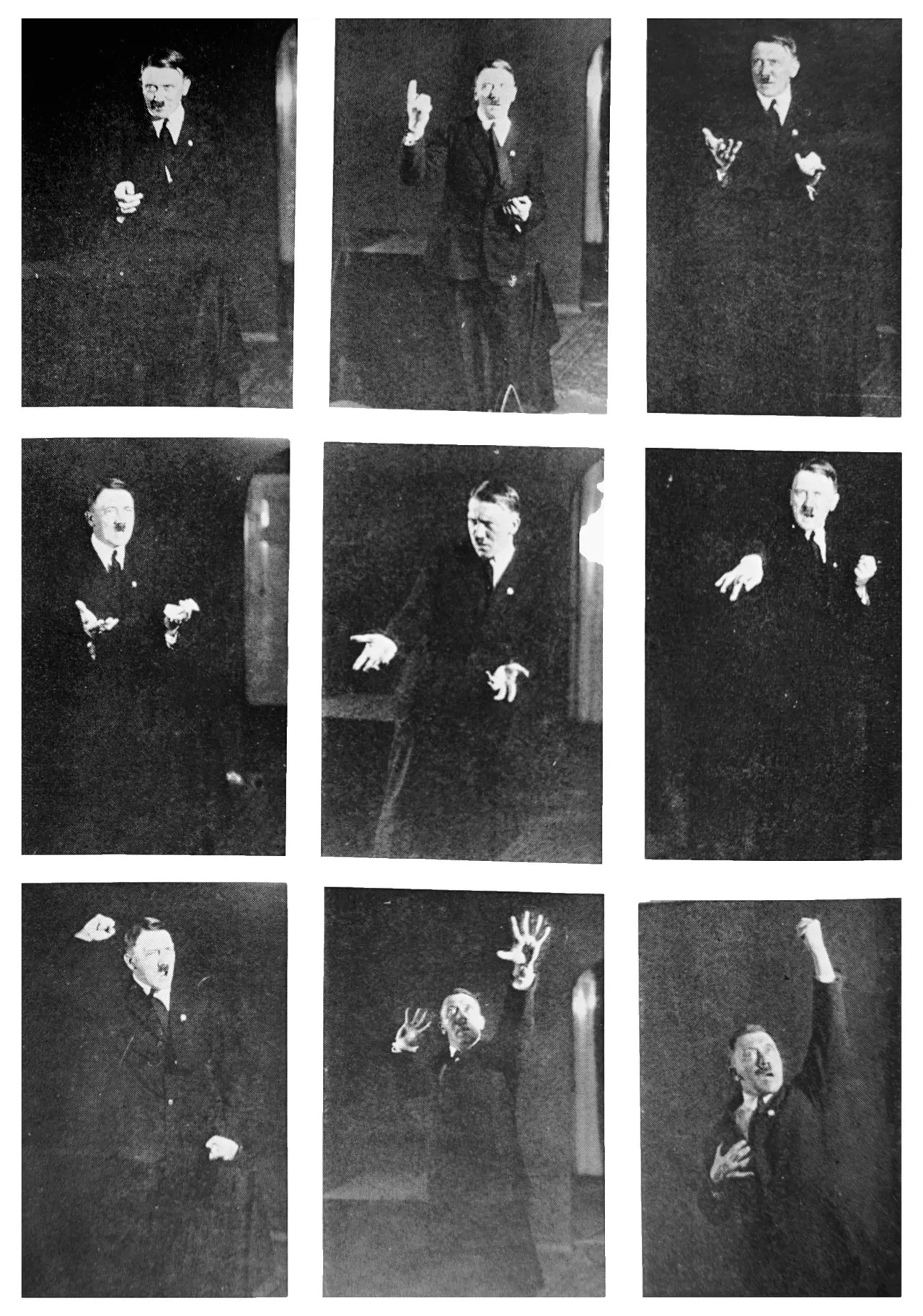
Hitler didn’t seize power; he was given it. As Adam Gopnik reports in a review of Tim Ryback‘s important new book, media lords thought that they could control him; political schemers thought that they could outwit him. The mainstream left had become a gerontocracy. And all of them failed to recognize his immunity to shame…
Hitler is so fully imagined a subject—so obsessively present on our televisions and in our bookstores—that to reimagine him seems pointless. As with the Hollywood fascination with Charles Manson, speculative curiosity gives retrospective glamour to evil. Hitler created a world in which women were transported with their children for days in closed train cars and then had to watch those children die alongside them, naked, gasping for breath in a gas chamber. To ask whether the man responsible for this was motivated by reading Oswald Spengler or merely by meeting him seems to attribute too much complexity of purpose to him, not to mention posthumous dignity. Yet allowing the specifics of his ascent to be clouded by disdain is not much better than allowing his memory to be ennobled by mystery.
So the historian Timothy W. Ryback’s choice to make his new book, “Takeover: Hitler’s Final Rise to Power” (Knopf), an aggressively specific chronicle of a single year, 1932, seems a wise, even an inspired one. Ryback details, week by week, day by day, and sometimes hour by hour, how a country with a functional, if flawed, democratic machinery handed absolute power over to someone who could never claim a majority in an actual election and whom the entire conservative political class regarded as a chaotic clown with a violent following. Ryback shows how major players thought they could find some ulterior advantage in managing him. Each was sure that, after the passing of a brief storm cloud, so obviously overloaded that it had to expend itself, they would emerge in possession of power. The corporate bosses thought that, if you looked past the strutting and the performative antisemitism, you had someone who would protect your money. Communist ideologues thought that, if you peered deeply enough into the strutting and the performative antisemitism, you could spy the pattern of a popular revolution. The decent right thought that he was too obviously deranged to remain in power long, and the decent left, tempered by earlier fights against different enemies, thought that, if they forcibly stuck to the rule of law, then the law would somehow by itself entrap a lawless leader. In a now familiar paradox, the rational forces stuck to magical thinking, while the irrational ones were more logical, parsing the brute equations of power. And so the storm never passed. In a way, it still has not…
Both the review and the book on which it focuses are eminently worth reading in full: “The Forgotten History of Hitler’s Establishment Enablers” (possible paywall; in which case, archived copy here), from @adamgopnik in @NewYorker.
* Hitler, as quoted in a letter from von Ribbentrop (to Churchill and Atlee) sent just before von Ribbentrop was captured at the end of the war
###
As we hear the echo, we might spare a thought for Ludwig van Beethoven; he died on this date in 1827. A crucial figure in the transition between the Classical and Romantic eras in Western music, he remains one of the most famous and influential of all composers. His best-known compositions include 9 symphonies, 5 concertos for piano, 32 piano sonatas, and 16 string quartets. He also composed other chamber music, choral works (including the celebrated Missa Solemnis), a single opera (Fidelio), and numerous songs.
Relevantly to the piece above…
Beethoven admired the ideals of the French Revolution, so he dedicated his third symphony to Napoleon Bonaparte… until Napoleon declared himself emperor. Beethoven then sprung into a rage, ripped the front page from his manuscript and scrubbed out Napoleon’s name. Some modern reproductions of the original title page have scrubbed out Napoleon’s name to create a hole for authenticity’s sake!
Beethoven’s temper and Symphony No. 3 ‘Eroica’
But, of course, it was too late…

“Is it not always the way of the people to put forward one man as its special champion and protector and cherish and magnify him?”*…

Matt Gatton on the clash of two Athenians, Alcibiades and Callias, half-brothers and students of Socrates, one of whom flirted with becoming the ancient city-state’s tyrant after leading a successful passage past Athens’ enemy Sparta…
… The road to Eleusis is open, and Alcibiades is a hero. The army is exalted in spirit and feels itself invincible under his command. The people are so captivated by his leadership that they are filled with an amazing passion for him to be their tyrant. (A tyrant is, of course, a person with sole political power, which, when matched with his sole military power as autocrat, would make Alcibiades more like a king than a general.)…
What Alcibiades thinks about the idea of being named tyrant is unknown, but it frightens many of Athens’s most influential citizens. Perhaps Callias most of all: imagine the sort of dread that would be triggered by the thought of a psychopath being given the power of a tyrant, particularly since this would-be tyrant has already profaned your religion, stolen your money, punched your father, possibly murdered your sister, and certainly plotted your own assassination. Anyone, but especially Callias, must have grave concerns about what Alcibiades would do with unchecked power. Callias had grown up with Alcibiades, they were “half” brother after all, and he knew him better than anyone else, knew his nature and his malevolence.
There is no word on Socrates’s feelings about the chatter of Alcibiades being named tyrant, but Socrates’s perspective on tyrants in general is well recorded by Plato. To Socrates, the flaw of democracy is its vulnerability to tyrants. The populace—the mob, as he calls them—are gullible and can easily fall under the spell of a charismatic leader. Alcibiades certainly fits the bill. In Socrates’s estimation, the tyrant first appears as a protector. The people have something they fear, either inside or outside of the state, either real or imagined, from which the tyrant claims he can guard them. He will make them the “victors.” The people flock to him of their own accord, for he pays them in lies, lies they want to hear, lies they want to believe. They are “superior”; they are “true patriots.” His favorite tools are false accusations and unleashing his mob against the “threat.” In time, the tyrant erases any and all opposition, “with unholy tongue and lips tasting the blood of his fellow citizens.” He and his supporters are empowered by the purge, “and the more detestable his actions . . . the greater devotion he requires from his followers.” These words are as true in the modern world as they were in ancient Athens.
Many countries today still struggle with this structural defect of democracy: the majority of the populace in a democracy may elect a tyrant, who will invariably disassemble the democracy that elected him—a democracy can make a tyrant, but a tyrant can unmake a democracy. The weak portion of the populace yearns to be strong, so they attach themselves to a strong man; such is the allure of the bully, the appeal of the despot, the attraction of the tyrant. Ancient Athens is where democracy first began and first fell, and so can teach us lessons that are, unfortunately, still applicable…
A lesson from the past: “The Bloody Rivalry That Led to the Fall of Democracy in Athens,” in @CrimeReads. Excerpted from Gatton’s recent book, The Shadows of Socrates: The Heresy War, and Treachery Behind the Trial of Socrates.
* Socrates, in Plato’s Republic
###
As we avoid autocracy, we might recall that it was on this date in 197 that Emperor Septimius Severus defeated usurper Septimius Severus in the Battle of Lugdunum, the bloodiest battle between Roman armies– 150,000 Roman soldiers engaged for both sides.

“Populist victors continue to behave like victims; majorities act like mistreated minorities”…

… and, as Rachel Kleinfeld explains, that doesn’t work out well for their economies…
In the 20th century, economic and political systems could be situated on a simple 2×2 grid. Economic policies ran from left to right, while political systems could be arrayed from authoritarian to democratic.
Most U.S. business pegged themselves easily on this spectrum: they wanted favorable regulation and management-friendly policies of the sort generally pursued by the right. And while a few opened up shop behind the Iron Curtain, CEOs knew business prospered most under classically liberal democratic systems that upheld the rule of law and inalienable rights—including property rights.
The rise of populism in the 21st century has overturned this game board. Today, even supposedly right-wing populists exploit distrust, pessimism, and anger to make the case that government should wield a heavy—and often retaliatory—hand in markets. But while such interference by authoritarian leaders could once be portrayed as undemocratic, modern populists often bask in electoral support. Voters cheer as their elected leaders undermine rights and the rule of law.
Populism, in other words, has shaken the kaleidoscope of 20th century political and economic identities—and acting as if those labels still apply could be catastrophic for market economies. Modern populists from the right use right-wing rhetoric to sell what used to be left-wing economic ideas. And many marry the electoral aspects of democracy with authoritarian tactics to undermine the rights, institutions, and norms that create a stable business environment.
Economic and historical studies show that even supposedly pro-business populism is bad for business; countries that elect one populist tend to elect others, its effects creep well past a single election cycle.
This matters because populists are getting elected at a rate last seen in the 1930s. In 2018, they presided over nearly a third of global GDP, including mega-countries like India. Next year, with 40 countries (accounting for 44% of global GDP) going to the polls, they could control even more. Some come from the left, particularly in Latin America. But as in the turbid 1930s, many populist leaders like Jair Bolsonaro in Brazil, Narendra Modi in India, and Donald Trump in the United States hail from the right—deploying a trio of political strategies that characterize populists regardless of their avowed ideology.
First, populists win elections by deepening existing social divisions. By turning nearly every political question into a fight between a virtuous “us” and a deceitful, dangerous, disloyal “them” they create an intense base that is personally loyal to the leader and not any particular ideology. That base lets populists maintain strong voter support even as they centralize and personalize power, their second go-to tactic. Finally, by redefining democracy as majority rule, they can claim that anything that stands against their desires (as the embodiment of the majority) is anti-democratic. This rhetorical jujitsu lets them undermine checks and balances, once-independent institutions from judiciaries to statistical bodies, and the rule of law itself, depicting them as obstacles to taking radical steps to implement the majority’s wishes.
The dire economic effects of left-wing populism are well-researched. Leaders from Argentina’s Juan Perón to Mexico’s Andrés Manuel López Obrador nationalize businesses, politicize their management, and fill their ranks with supportive political appointees. They shower voters with government money come election time and overheat their economies. The result is often a short-term economic boom followed by a long, inflationary bust…
Using Victor Orbán and Hungary as an example, Kleinfeld demonstrates that right-wing populists are just as disastrous for their countries; the problem is not that the leader comes from the left or the right, it’s that they pursue the populist playbook.
Eminently worth reading in full. Aspiring autocrats keep ruining their countries’ economies: “The Economic Cost of Right-Wing Populism,” from @RachelKleinfeld in @JoinPersuasion.
[Image above from the co-published version of the article]
Apposite: Zeynep Tufekci with a diagnosis of the attractiveness of autocratic leaders: “A Strongman President? These Voters Crave It.” (gift article). Not sure that I buy her sense that Trump has been working a careful and canny strategy from the start (2016); but her focus is on his adherents’ grievances and their response to his charisma and his self-anointed status as “the only one who can save [us]”… a provocative read.
* Jan-Werner Müller, What Is Populism?
###
As we contemplate civics, we might recall that it was on this date in 1870 that pioneering political cartoonist Thomas Nast gave the Democratic Party its mascot:
On January 15, 1870, Nast published the cartoon [see below] that would forever link the donkey to the Democrat. A few ideas should be clear for the cartoon to make sense: First, “republican” and “democrat” meant very different things in the 19th century than they do today (but that’s another article entirely); “jackass” pretty much meant the exact same thing then that it does today; and Nast was a vocal opponent of a group of Northern Democrats known as “Copperheads.”
In his cartoon, the donkey, standing in for the Copperhead press, is kicking a dead lion, representing President Lincoln’s recently deceased press secretary (E.M. Stanton). With this simple but artfully rendered statement, Nast succinctly articulated his belief that the Copperheads, a group opposed the Civil War, were dishonoring the legacy of Lincoln’s administration. The choice of a donkey –that is to say, a jackass [understood at the time to be a play on “Jackson,” as populist Andrew Jackson was an inspiration to the Copperheads]– would be clearly understood as commentary intended to disparage the Democrats. Nast continue to use the donkey as a stand-in for Democratic organizations, and the popularity of his cartoons through 1880s ensured that the party remained inextricably tied to jackasses…
“Political Animals: Republican Elephants and Democratic Donkeys”- Smithsonian

“Remember that all through history, there have been tyrants and murderers, and for a time, they seem invincible. But in the end, they always fall. Always.”…

Indeed, they fall; they very rarely go willingly. And as autocrats rise in a growing number of countries, this is an increasingly valent issue. The estimable Branko Milanovic on why they hang on…
In an interesting paper he tweeted yesterday, Kaushik Basu discusses, using a mathematical model, an old problem: how rulers once they are in power cannot leave it even if they wish to do so, because their road to power, and in power, is littered with corpses that will all (metaphorically) ask revenge if the ruler were to step down. Furthermore, since the number of misdeeds and of rulers’ real or imagined enemies multiplies with each additional period in power, they need to resort to increasingly greater oppression to stay in power. Thus, even the originally well-meaning or tolerant rulers become, with the duration of their rule, tyrants. Basu is aware of the millennial nature of the problem; he cites Shakespeare’s Macbeth. He could have also cited Tacitus’ description of Tiberius’ descent into murderous suspiciousness and folly.
Basu terms this issue “temporal inconsistency” because his assumption is that the ruler would like at one point to leave and spend the rest of his life in affluence and leisure. (I write in “his” life because all individuals listed in Basu’s paper are men, and he strangely resorts to the use of “she” and “her” in the mathematical part of the paper.) This assumption of a ruler who wants to retire is unrealistic, and I will explain why below, But before I do so, I need to note that there is no inconsistency in the ruler’s or dictator’s behavior in each individual period. (Basu acknowledges this in the latter part of the paper by stating that fully rational maximizing behavior in each individual period may still lead to on overall suboptimal outcome.). Assume that the ruler plays an annual game where he wonders: am I better off if I retire now or if I commit another crime which would make my retirement next year more difficult but my rule this year safer? The answer is simple: he is better off committing another crime in the expectation that this would make his overthrow less likely. He replays that game every year and every year he reaches the same conclusion. Thus, the ruler’s decisions are not at all irrational or even inconsistent…
When power as such becomes the objective, as it is among all politicians, and autocratic rulers especially, there is no amount of worldly goods that could substitute for power. Rulers cannot be cajoled (as Basu seems to believe) into leaving power. And this is not just because of the possible punishment that may await them in retirement, but because they crave, and they need, the exercise of, power…
The same applies to ideologues. Or perhaps even more so because ideologues believe that they are on a unique mission to save their nation or the world, and obviously then being in power is a necessary condition for such a salvation…
… there is nothing that can be offered to dictators to make them step down. They have to continue to rule until they either die peacefully in their beds and after death became either vilified or celebrated (or at times, both), or until they are overthrown, or meet an assassin’s bullet. Once on the top, there is no exit. They have become prisoners like many others they have thrown in jail…
What drives autocrats: “There is no exit for dictators,” a sobering read from @BrankoMilan.
* Mahatma Gandhi, Gandhi: An Autobiography
###
As we ponder power and its products, we might recall that on this date in 1965 the number #1 song on the U.S. pop charts was “Get Off of My Cloud,” by the Rolling Stones (lyrics by Jagger; melody, Richards)
You must be logged in to post a comment.