Posts Tagged ‘autocracy’
“All that is solid melts into air”*…

Paul North finds a prescient analysis of the (still only possible) end of the American republic in Karl Marx’s The Eighteenth Brumaire of Louis Bonaparte…
An autocrat takes over. Why does the legislature permit him to hijack government, pervert institutions and norms, and unburden them of their legitimate power? Why would a representative body like the US Congress willingly injure its own authority? Karl Marx gave an answer in 1852, in his fiery postmortem for the French Republic, The Eighteenth Brumaire of Louis Bonaparte.
Marx’s answer to the question of why the powerful willingly abandon their own power is unusual because it does not find a rational plan behind the move. A legislature, faced with a potential autocrat, is caught between two impulses and ends up following the wrong one—one that is, in fact, self-destructive. That Democratic legislators do not stand up to Trump is one thing, but the litmus test, according to Marx, was not the actions of the centrists or leftists but of the true Right. Putatively at least, the Right is in power, as it was in the French Second Republic. While Democrats may see what’s going on but are cowardly or weak, the Right is either simply blind or making a dangerous but rational calculation. In his century, Marx called the Right blind, for interesting reasons.
It is hard to imagine what drives the Right today to support the Trump regime. Take Tom Cole, the 10th-term Republican from Oklahoma’s fourth district, poster child for conservative principles and head of the Appropriations Committee, arguably the most powerful position in the House—at least formerly. Regarding Social Security, Cole’s website states that his goal is to “sustain and protect the program for current beneficiaries and future retirees.” Yet, as a recent article by Russell Berman demonstrates, “even Tom Cole is defending DOGE,” which has the hallowed safety net in its sights…
… It is common to think of The Eighteenth Brumaire as the chronicle of a self-aggrandizing, power-hungry “serious buffoon,” Louis Napoleon Bonaparte. He had failed twice to take power through coups d’état, in 1836 and again in 1840. No one who knew him could deny that coups were his thing. Then, in the confusion after the revolutions of 1848 and on the strength of his name and dynastic ties to his uncle, Louis Napoleon returned to France and, third try’s the charm, became leader of France. No coup was needed this time—he won the new republic’s first presidential election by a wide margin.
In the years that followed, Louis Napoleon engineered a repeal of universal male suffrage, hobbled parliament, and manipulated ministers and generals to his purposes. When it became clear that the Constituent Assembly would not amend the constitution to extend his term in office, he decided (surprise, surprise) to instigate yet another coup: he had opponents arrested by the thousands, constrained the press, and, in November 1852, became emperor of France…
… A coup d’état in miniature every day, to hold the public gaze—parallels between Louis Napoleon and Donald Trump are vivid and many. Peter Gordon drew out the important ones in an essay for the Boston Review. At the most basic level, Trump and Louis Napoleon dress up restoration in the tunic of revolution: both leaders rode in on the backs of the disenfranchised, and both promised a return to a golden age that never existed.
Yet The Eighteenth Brumaire is not primarily the anatomy of an autocrat. For most of its approximately 100 pages, Marx analyzes in detail how other actors in the republic misidentified Louis Napoleon as good for their interests. He focuses particularly on members of the Constituent Assembly, whose influence flowed directly from the existence of the republic itself. Marx skewers assembly members, ministers, and military leadership for their ignorant, self-destructive complicity. The first lesson of his depressing and hilarious pamphlet is not to focus on the autocrat, since it takes a nation to make one, after all…
… New interests do produce vigorous sap, and that sap needs to flow, vigorously, toward something concrete. If we concentrate, as Marx does, not on the Caesar but on the political parties, their platforms, and their representatives in the Constituent Assembly, we can ask how they failed to foresee the obvious and forestall the republic’s end.
All the drama in The Eighteenth Brumaire happens in the assembly. Louis Napoleon may be farcical, but the legislature is tragic. “The history of the Constituent National Assembly since the June days is the history of the domination and the disintegration of the republican faction of the bourgeoisie,” Marx tells us. To avoid a real republic, right-wing elements circumvented checks and balances, first and foremost the constitution. And then, when Louis Napoleon circumvented the assembly itself in 1851 in order to extend his rule, conservatives suddenly remembered the republic. It was republicanism, they realized, that had brought them to power, and republicanism that had allowed them to exercise it. With its end, they ended.
Just a few years before, the Revolution of 1848 had brought down the French king and introduced liberal freedoms of press, speech, association, and assembly, all secured through a liberal constitution. It also brought about universal, unpropertied male suffrage. Some of these freedoms and entitlements were then progressively taken away by the assembly, the rest by the emperor. It wasn’t Louis Napoleon that caused the demise, however. Parliament dissected itself. It took away the basis of its own power by going around the constitution. Marx’s poignant lines evoke a feeling many of us have today that can only be called “rue.” On one side, Marx rues the way “the collective will of the nation” seeks “its appropriate expression through the inveterate enemies of the interests of the masses, until at length it finds it in the self-will of a freebooter.” The people stood with Louis Napoleon, although he was antithetical to their interests. On the other side, the assembly used its power to do away with its power. Two errors made a fatal combination…
… It is a general truth that an autocrat gets into power not by himself but through those who let him. Louis Napoleon came to power by legal means (at least the third time he tried), but he stayed in power through the complicity of those around him. What did they have to ignore in order to continue in their complicity? Marx does not mince words: “If ever an event has, well in advance of its coming, cast its shadow before, it was Bonaparte’s coup d’état.” The coming coup was so obvious, no one could have denied it and remained honest with themselves. This raises some questions. Why did the Right ignore what was in front of their faces? Why, in the presence of real danger, whose long-term effects would be devastating to their political goals, did this group default? Why did they defer to a lesser danger at the cost of denying the existence of a much greater one?…
… What holds a body of consummately rational actors in such an irrational state that they take losses as victories? What allowed the Right in mid-19th-century France to believe the steps they were taking toward irrelevance were in fact steps toward the triumph of their political vision? Marx has two answers. On one hand, behind the self-deception, he sees a simple wish: the bourgeoisie as a whole “longed to get rid of its own political rule in order to get rid of the troubles and dangers of ruling.” On this view, the Party of Order made a semirational choice—that a roiling populace would be worse for order than an autocratic fool. In the end, assembly members could relinquish governing and go back to the business of making money—which, according to Marx, was their material desire anyway: “[T]he bourgeois madly snorts at his parliamentary republic: ‘Rather an end with terror than terror without end!’”
This is a psychoanalysis not of complicity, however, but of capitulation. Marx may be correct about the way things ended. He is talking about the Right’s eventual acceptance of autocratic rule, after it became a fait accompli. Once it was clear that they had lost, they could say “There’s nothing we could have done. This way is better for business. It is what we wanted.” They could declare their actions to have been rational all along and go back to their farms or their industries. But why had parliament succumbed to this debacle in the first place? How did they catch the peculiar malady cretinism?…
Read on for an answer: “He’s a Cretin but We’ll Manage Him,” from @lareviewofbooks.bsky.social. Indeed, eminently worth reading in full.
* “All that is solid melts into air, all that is holy is profaned, and man is at last compelled to face with sober senses, his real conditions of life, and his relations with his kind.” – Karl Marx
###
As we contemplate capitulation, we might ponder the pre-history of the events in question and spare a thought for Louis Joseph, Dauphin of France (the second child and first son of King Louis XVI and Marie Antoinette); he died of tuberculosis on this date in 1789 at age 7… 40 days before the storming of the Bastille. At his death, the title of Dauphin passed to his younger brother Louis Charles, Duke of Normandy (1785–1795), who died during the French Revolution, at the Temple prison in Paris.

“Firmness, utility, and beauty”*…
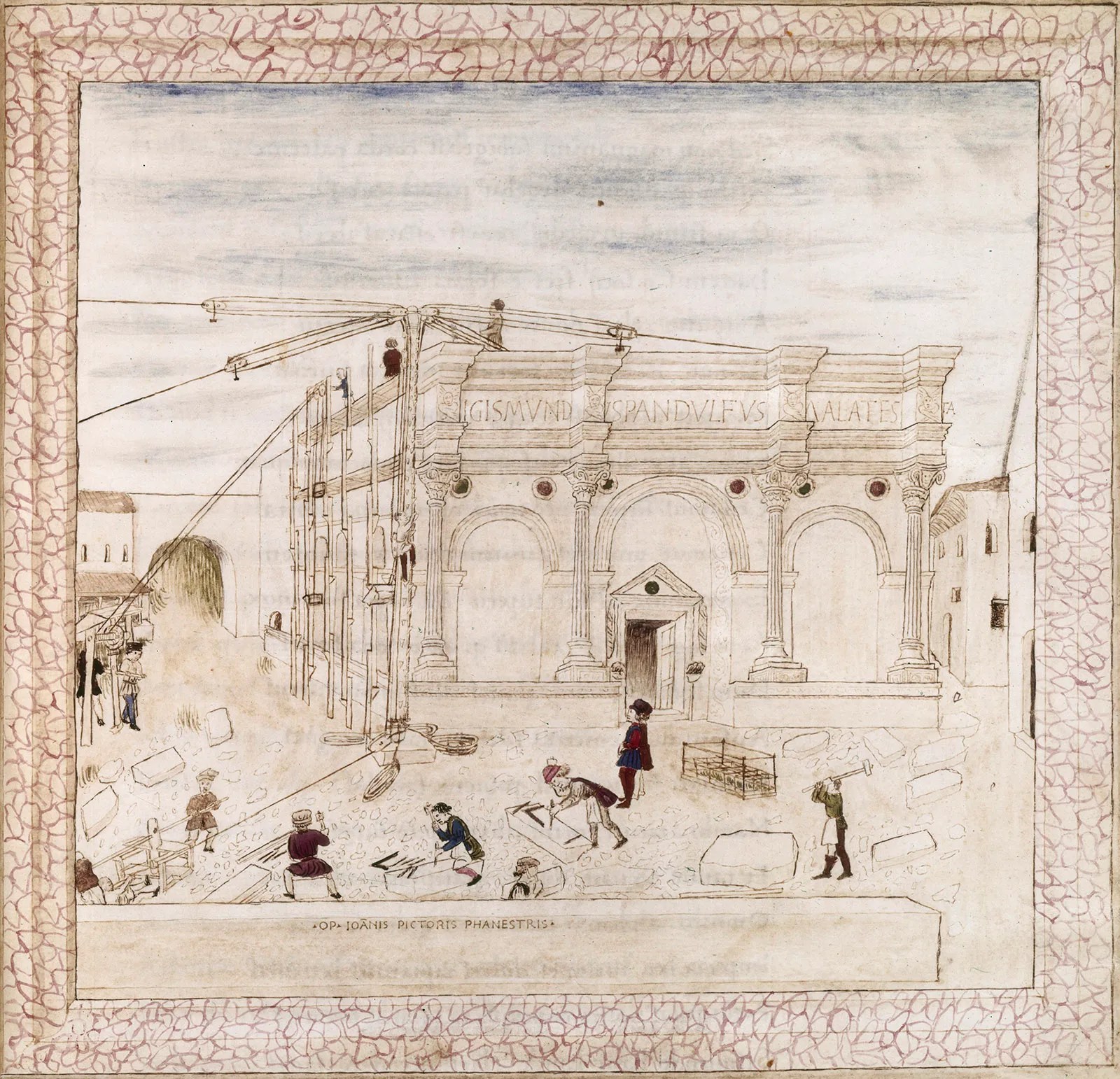
In a review of Indra Kagis McEwen‘s book All the King’s Horses- Vitruvius in an Age of Princes, Ingrid Rowland examines the ways in which Vitruvius’s Ten Books on Architecture [AKA De Architectura] was not only a manual of the building arts but a treatise on how to extend and consolidate the Roman Empire, and lent itself all too well to the autocratic ambitions of Renaissance princes…
As perennial best sellers go, the treatise known as Ten Books on Architecture by the Roman writer Vitruvius is not, perhaps, the most predictable. It includes some gripping stories, certainly, many of them military, like the the Carian queen Artemisia’s surprise naval attack on Rhodes aboard the Rhodians’ own ships or the thwarted siege of the same city by the Macedonian general Demetrius Poliorcetes, the proverbial “Sacker of Cities,” whose gigantic war machine, the “City-seizer” (Helepolis), churns to an ignominious halt in a pool of muck created overnight by the mass emptying of Rhodian chamber pots.
These vignettes, however, are little gems inserted to brighten long passages about what kind of wood to use for different parts of a building, the proportions of temples, and the marvels of waterproof concrete, as well as instructions on how to build, among many other wonders and amenities, sundials, aqueducts, water clocks, and catapults. Its storehouse of practical information helped to ensure that Vitruvius’s handbook, written around 25 BCE, was one of the few ancient Greek and Latin works to survive what the fifteenth-century pundit Leon Battista Alberti called the “shipwreck” of the Middle Ages, along with the poetry of Vergil and Ovid, the prose of Cicero, a Latin translation of Plato’s Timaeus, the Bible, and some other surprisingly durable texts. Ever since the papal printer Eucharius Silber brought out his edition in Rome in 1486, Ten Books on Architecture has never gone out of print.
One of the chief reasons for the enduring interest in On Architecture, aside from its treasury of practical instructions, is the ambitious educational program that Vitruvius puts forth in the first of his ten books (each of which originated as a single papyrus scroll, closer to the length of a modern chapter than an entire book, just as his chapters are approximately the size of a paragraph). Architects, he argues, can only complete their work properly (in his words, “perfect” it) if they are well informed about every one of the subjects that the art of building brings into play—if not as well informed as a specialist, then at least well enough to make the right decisions. A competent practitioner, therefore, must not only master drawing but also have a good grasp of literature, music, mathematics, and law…
… It seems likely that the connection between education, architecture, and empire inspired the creation of the earliest known manuscript of Vitruvius, copied on parchment in the ninth century, perhaps for Charlemagne, perhaps by the hand of his learned adviser Alcuin of York, almost certainly as part of the Frankish king’s project of resurrecting the glories of ancient Rome in a Christian spirit. It is through this same clever wedge, education, that Vitruvius has driven himself and his treatise into the very heart of the way the contemporary world still thinks about any number of things, from human scale to beauty to liberal education to the best methods of town planning. Whether you have read Vitruvius or not, his influence is still palpable in the fabric of modern urban life, and that is why he has been translated as recently as 2017 into Chinese…
… In All the King’s Horses: Vitruvius in an Age of Princes, Indra Kagis McEwen, a Canadian architect and historian, brings out a more chilling aspect of Vitruvius and his millennial tradition: his fatal attractiveness to despots. The “princes” of her title are the princes of whom Machiavelli wrote: strongmen who seized and maintained one-man rule over medieval and early modern Italian city-states by force of arms and charisma. Augustus served these princes as an inspiring model because his trajectory so closely resembled their own—except, of course, for its colossal scale. Like the Italian lords who revered him, the future Imperator rose to his august heights by doing whatever would ensure his own survival, eventually completing a process that Machiavelli attributes to Augustus’s adoptive father, Julius Caesar: supplanting the ancient Roman Republic with one-man rule…
Fascinating… and too timely: “Vitruvius & the Warlords” from @nybooks.com.
* “Firmitas, utilitas, venustas”– the three principles of good architecture, as described by Vitruvius in De Architectura
###
As we analyze the architecture of authoritarianism, we might recall that it was on thsi date in 1527, during the War of the League of Cognac (a dispute between the Holy Roman Empire and the Papacy), that Rome was captured and sacked by the mutinous troops of Charles V, Holy Roman Emperor. Charles V had intended only to threaten military action to make Pope Clement VII come to his terms. But most of Charles’ Imperial army (14,000 Germans, including Lutherans, 6,000 Spaniards, and some Italians) were unpaid, and took matters into their own hands. Despite being ordered not to storm Rome, they broke into the scarcely defended city and began looting, killing, and holding citizens for ransom. Clement VII took refuge in Castel Sant’Angelo after the Swiss Guard were annihilated in a delaying rear guard action; he remained there until a ransom was paid to the pillagers. Benvenuto Cellini witnessed the Sack and described the it in his works.
The Sack of Rome impacted the histories of Europe, Italy, and Christianity, creating lasting ripple effects throughout European culture and politics. Before the sack, Rome had been a center of Italian High Renaissance culture and patronage, and the main destination for any European artist eager for fame and wealth, thanks to the prestigious commissions of the papal court. In the sack, Rome suffered depopulation and economic collapse, sending artists and writers elsewhere.
The Sack of Rome also permanently shifted the balance of power between Church and State. Before the sack, Pope Clement VII opposed the ambitions of Emperor Charles V. Afterward, he no longer had the military or financial resources to do so. To avert more warfare, Clement adopted a conciliatory policy toward Charles. The power shift – away from the Pope, toward the Emperor – also produced lasting consequences for Catholicism.
And the Sack of Rome also contributed to making permanent the split between Catholics and Protestants. (After the sack, Clement acceded to Charles’ wishes, agreeing to call a Church Council to decide how to address the Protestant Reformation and naming the city of Trent, Italy as its site. In 1545, eleven years after Clement’s death, his successor Pope Paul III convened the Council of Trent. As Charles predicted, it reformed the corruption present in certain orders of the Catholic Church. But by 1545, the moment for reconciliation between Catholics and Protestants – arguably a possibility during the 1520s, given cooperation between the Pope and Emperor – had passed.)
The Sack of Rome is widely identified by historians as the the end of the Italian High Renaissance.

“Power always reveals”*…

Apposite to yesterday’s post, a provocative piece by Ben Ansell, who is reacting to a [terrific] piece by Henry Farrell in which Farrell, as he contemplates Trump’s moves, unpacks the “coordination” problems facing– and, Farrell suggests, often limiting– autocratic rulers…
… But you will notice an assumption I and Henry have been making – that Trump is like any other authoritarian leader. I suspect that in lots of ways Trump does wish to behave like one – certainly the treatment of Kilmar Abrego Garcia and his current refusal to follow court judgments meets that mark.
But Trump is attempting this in an otherwise democratic system and I think there is a risk that we overstate the degree to which that system has already deteriorated by assuming that the language and logic that we use to describe authoritarianism fits his case. Part of the risk is we give up on democracy while it’s still here. But the other danger is that we think Trump behaves like a rational authoritarian leader, a la Svolik, when it’s all just bluntly a lot dumber than that…
… In an earlier post I referred to Donald Trump as a ‘chaotic authoritarian’. I don’t think it’s implausible that a democracy could have such a figure as a leader, though I do think it’s unlikely that it would remain democratic indefinitely under such leadership.
But in the absence of already having subverted elections, stymied courts, shut down the media, banned opponents and the other types of effective institutional backsliding that are the tell-tale signs of a democracy dying, I think we might do better to think about how such a figure operates in, what for now, is a democracy.
The temptation when talking about dictators is to reach for Thomas Hobbes. We depict them as the Leviathan – imposing order on the body politic to prevent chaos but also any rivals. Hobbes’ vision was after all a painstaking justification for monarchical absolutism.
If you are not familiar with Leviathan, well do read it, it’s a banger. But the very basic gist is a theory of government built from the ground up. Hobbes even starts with a slightly rococo account of how we process sensations. But his core mechanism is to imagine a world without government – his famous state of nature – in which every individual was essentially on their own. A self-help system if you will, but not the kind in the woo-woo psychology section of the bookstore – the kind where if you don’t look after number one, you’ll get an axe in the back of the head.
The Hobbesian state of nature is anarchy and life in it is – say it with me – ‘solitary, poor, nasty, brutish and short’. And so anyone living in this state would seek to escape this ceaseless terror and have some entity that could guarantee security. Hobbes is a social contract theorist, and the contract upon which we could all be presumed to agree is a third party that can ruthlessly crush insecurity. An absolute sovereign power that would protect its subjects…
… The Hobbesian vision of the state is draconian of course and in… err… pretty sharp contrast with the social contract theories of John Locke or Jean Jacques Rousseau. But one way it has come down to us is in how we think about authoritanism. As about order and control, crushing dissent mercilessly, but also preventing anarchy, rebellion, and so forth. It is governing with an iron fist. Rational authoritarianism if you will.
Whatever Trump is trying to achieve, it’s not hitting this mark. Instead of authoritarianism containing chaos, it is chaos personified. Instead of quelling the anarchic state of nature, it is spreading anarchy and confusion. Hobbes’ frontispiece Leviathan is a steady ruler, holding sword and staff, made up out of their ordered subjects [In contrast to the disintegrating beast in the illustation above]…
… Hence, it’s not clear to me that the standard tools we use to think about authoritarianism accordingly make that much sense with Trump. Is he really thinking about how to coordinate among the elites to keep his support base? Because he’s not doing a brilliant job here having already lost the support of the Wall Street journal editorial board, a litany of very conservative judges, and increasingly corporate elites…
… what I find most interesting about Trump’s anti-Leviathan is that his rule is creating anarchy everywhere else too. And that means not only are his promises not credible but nor are his threats…
[Ansell reviews Trumps’ attack on universities, his approach to tariffs, and trade policy, his “crackdown” on immigration, and his foreign policy (or lack thereof)…]
… We will spend a lot of time over the next few years trying to figure out if Trump’s America remains a democracy. Already the main indices we use are starting to downgrade the USA. I struggle as to whether that coding is premature or not – we will of course know much more by the midterms about the stability and freedom of elections, though by then it could be too late.
It is very clear that Trump wishes to act as an authoritarian. But it is not yet obvious to me that analysing him using the logic of dictatorship makes sense. Because he lacks the control, the ruthlessness, and the rationality of normal authoritarian leaders. As Henry says in his post, ‘absolute power can be a terrible weakness.’ True. However, for many – perhaps most – dictators, absolute power is a terrible (in the original sense of that word) strength. Think to the horrors of the twentieth century.
That, however, is not Donald Trump. He may be the master of chaos. But he is not the Leviathan…
What if we abandoned the social contract for the state of nature? “Donald Trump’s Anti-Leviathan,” from @benansell.bsky.social (with @himself.bsky.social).
* “Power doesn’t always corrupt. Power always reveals. When you have enough power to do what you always wanted to do, then you see what the guy always wanted to do.” – Robert Caro (riffing on Lord Acton: “Power tends to corrupt and absolute power corrupts absolutely”) Or as David Brin put it: “it is said that power corrupts, but actually it’s more true that power attracts the corruptible.”
###
As we rein in reigns, we might recall that it was on this date in 1945 that Hermann Göring, head of the Luftwaffe and Adolf Hitler’s designated successor as leader of Nazi Germany, wired the Führer asking permission to assume leadership of the crumbling regime. The telegram caused an infuriated Hitler to strip Göring of power and to appoint new successors, Joseph Goebbels and Karl Dönitz, as chancellor and head of state, respectively.

“A republic, if you can keep it.”*

Just over a decade ago, Nils Gilman wrote an essay, The Twin Insurgency,” in which he warned of an emerging confluence of strategies between the rising global plutocratic class, on the one hand, and transnational criminal organizations, on the other. For all our sins, as you’ll see in his piece, he nailed the fundamental disposition of the tech-libertarian broligarch class. And…
One other thing I think I correctly intuited a decade ago was that a key politico-spatial implication of the Twin Insurgency was that the space of the national was fragmenting into “kaleidoscopic microsovereignties,” an argument that my friend Quinn Slobodian has recently developed at monographic length in his marvelous book Crack-Up Capitalism.
Quinn’s thesis is that the ultimate goal of what I called the plutocratic insurgents (and their intellectual and high-end service-economy henchmen) is to end the constraints that democratic nation-states impose on the privileges of the rich. These are rich men (and it is almost entirely men) who believe that their wealth should be untouchable, and that the privileges that this wealth buys should be unlimited. With Elon Musk’s DOGE, the mask is off: they are hell-bent on destroying any institutions of social care or risk-sharing that might touch their money or their privileges.
I cannot recommend Crack-Up Capitalism enough. Methodologically, is an intellectual history of the most notorious radical libertarians — from well-known assholes** like Milton Friedman and Peter Thiel to a congeries of even more colorful crackpots and kakistocrats — and their quest to craft for the perfect space for unfettered capitalism by shattering the map of allegedly sovereign territories into a variety of “exceptional” legal spaces: free ports, tax havens, special economic zones, etc. It is also an historical travelogue, taking the reader (as its cover blurb says) “from Hong Kong in the 1970s to South Africa in the late days of apartheid, from the neo-Confederate South to the former frontier of the American West, from the medieval City of London to the gold vaults of right-wing billionaires, and finally into the world’s oceans and war zones, charting the relentless quest for a blank slate where market competition is unfettered by democracy.” Best of all, Crack-Up Capitalism is wonderfully written: erudite and droll in equal measure (as the punning title itself suggests).
** I use the term “assholes” in the technical sense elaborated by Aaron James, chair of the UC Irvine philosophy department, in his 2012 book Assholes: A Theory, namely someone who “allows himself to enjoy special advantages in social relations out of an entrenched sense of entitlement that immunizes him against the complaints of other people.” I was reading the book when I wrote “The Twin Insurgency” and, even though I didn’t cite it (the anxiety of influence?), I realize now looking back how much it informed my understanding of phenomenon of the plutocratic insurgency. Conversely, I suspect the empirical fact of the rising plutocratic insurgency may well have been part of what inspired James to write his own book.
– Nils’ thoughts in full: “Revisiting the Plutocratic Insurgency.”
So, what can we expect? Steven Levitsky and Lucan A. Way paint a pretty grim picture…
… Democracy survived Trump’s first term because he had no experience, plan, or team. He did not control the Republican Party when he took office in 2017, and most Republican leaders were still committed to democratic rules of the game. Trump governed with establishment Republicans and technocrats, and they largely constrained him. None of those things are true anymore. This time, Trump has made it clear that he intends to govern with loyalists. He now dominates the Republican Party, which, purged of its anti-Trump forces, now acquiesces to his authoritarian behavior.
U.S. democracy will likely break down during the second Trump administration, in the sense that it will cease to meet standard criteria for liberal democracy: full adult suffrage, free and fair elections, and broad protection of civil liberties.
The breakdown of democracy in the United States will not give rise to a classic dictatorship in which elections are a sham and the opposition is locked up, exiled, or killed. Even in a worst-case scenario, Trump will not be able to rewrite the Constitution or overturn the constitutional order. He will be constrained by independent judges, federalism, the country’s professionalized military, and high barriers to constitutional reform. There will be elections in 2028, and Republicans could lose them.
But authoritarianism does not require the destruction of the constitutional order. What lies ahead is not fascist or single-party dictatorship but competitive authoritarianism—a system in which parties compete in elections but the incumbent’s abuse of power tilts the playing field against the opposition. Most autocracies that have emerged since the end of the Cold War fall into this category, including Alberto Fujimori’s Peru, Hugo Chávez’s Venezuela, and contemporary El Salvador, Hungary, India, Tunisia, and Turkey. Under competitive authoritarianism, the formal architecture of democracy, including multiparty elections, remains intact. Opposition forces are legal and aboveground, and they contest seriously for power. Elections are often fiercely contested battles in which incumbents have to sweat it out. And once in a while, incumbents lose, as they did in Malaysia in 2018 and in Poland in 2023. But the system is not democratic, because incumbents rig the game by deploying the machinery of government to attack opponents and co-opt critics. Competition is real but unfair.
Competitive authoritarianism will transform political life in the United States. As Trump’s early flurry of dubiously constitutional executive orders made clear, the cost of public opposition will rise considerably: Democratic Party donors may be targeted by the IRS; businesses that fund civil rights groups may face heightened tax and legal scrutiny or find their ventures stymied by regulators. Critical media outlets will likely confront costly defamation suits or other legal actions as well as retaliatory policies against their parent companies. Americans will still be able to oppose the government, but opposition will be harder and riskier, leading many elites and citizens to decide that the fight is not worth it. A failure to resist, however, could pave the way for authoritarian entrenchment—with grave and enduring consequences for global democracy.
The second Trump administration may violate basic civil liberties in ways that unambiguously subvert democracy. The president, for example, could order the army to shoot protesters, as he reportedly wanted to do during his first term. He could also fulfill his campaign promise to launch the “largest deportation operation in American history,” targeting millions of people in an abuse-ridden process that would inevitably lead to the mistaken detention of thousands of U.S. citizens.
But much of the coming authoritarianism will take a less visible form: the politicization and weaponization of government bureaucracy. Modern states are powerful entities. The U.S. federal government employs over two million people and has an annual budget of nearly $7 trillion. Government officials serve as important arbiters of political, economic, and social life. They help determine who gets prosecuted for crimes, whose taxes are audited, when and how rules and regulations are enforced, which organizations receive tax-exempt status, which private agencies get contracts to accredit universities, and which companies obtain critical licenses, concessions, contracts, subsidies, tariff waivers, and bailouts. Even in countries such as the United States that have relatively small, laissez-faire governments, this authority creates a plethora of opportunities for leaders to reward allies and punish opponents. No democracy is entirely free of such politicization. But when governments weaponize the state by using its power to systematically disadvantage and weaken the opposition, they undermine liberal democracy. Politics becomes like a soccer match in which the referees, the groundskeepers, and the scorekeepers work for one team to sabotage its rival…
[The authors explore the ways in which the government bureaucracy could be politicized: the threat of targeted prosecution, the weaponization of the IRS, and the mobilization of other executive departments to further the adminsistration’s agenda– which can, among them, punish identified opponents, reward loyalists, and operate like a “protection racket” on everyone else. For alll of that, they see a limit to the damage…]
… The Trump administration may derail democracy, but it is unlikely to consolidate authoritarian rule. The United States possesses several potential sources of resilience. For one, American institutions are stronger than those in Hungary, Turkey, and other countries with competitive authoritarian regimes. An independent judiciary, federalism, bicameralism, and midterm elections—all absent in Hungary, for instance—will likely limit the scope of Trump’s authoritarianism.
Trump is also weaker politically than many successful elected autocrats. Authoritarian leaders do the most damage when they enjoy broad public support: Bukele, Chávez, Fujimori, and Russia’s Vladimir Putin all boasted approval ratings above 80 percent when they launched authoritarian power grabs. Such overwhelming public support helps leaders secure the legislative supermajorities or landslide plebiscite victories needed to impose reforms that entrench autocratic rule. It also helps deter challenges from intraparty rivals, judges, and even much of the opposition.
Less popular leaders, by contrast, face greater resistance from legislatures, courts, civil society, and even their own allies. Their power grabs are thus more likely to fail. Peruvian President Pedro Castillo and South Korean President Yoon Suk-yeol each had approval ratings below 30 percent when they attempted to seize extraconstitutional power, and both failed. Brazilian President Jair Bolsonaro’s approval rating was well below 50 percent when he tried to orchestrate a coup to overturn his country’s 2022 presidential election. He, too, was defeated and forced out of office.
Trump’s approval rating never surpassed 50 percent during his first term, and a combination of incompetence, overreach, unpopular policies, and partisan polarization will likely limit his support during his second. An elected autocrat with a 45 percent approval rating is dangerous, but less dangerous than one with 80 percent support.
Civil society is another potential source of democratic resilience. One major reason that rich democracies are more stable is that capitalist development disperses human, financial, and organizational resources away from the state, generating countervailing power in society. Wealth cannot wholly inoculate the private sector from the pressures imposed by a weaponized state. But the larger and richer a private sector is, the harder it is to fully capture or bully into submission. In addition, wealthier citizens have more time, skills, and resources to join or create civic or opposition organizations, and because they depend less on the state for their livelihoods than poor citizens do, they are in a better position to protest or vote against the government. Compared with those in other competitive authoritarian regimes, opposition forces in the United States are well-organized, well-financed, and electorally viable, which makes them harder to co-opt, repress, and defeat at the polls. American opposition will therefore be harder to sideline than it was in countries such as El Salvador, Hungary, and Turkey.
Civil society is another potential source of democratic resilience. One major reason that rich democracies are more stable is that capitalist development disperses human, financial, and organizational resources away from the state, generating countervailing power in society. Wealth cannot wholly inoculate the private sector from the pressures imposed by a weaponized state. But the larger and richer a private sector is, the harder it is to fully capture or bully into submission. In addition, wealthier citizens have more time, skills, and resources to join or create civic or opposition organizations, and because they depend less on the state for their livelihoods than poor citizens do, they are in a better position to protest or vote against the government. Compared with those in other competitive authoritarian regimes, opposition forces in the United States are well-organized, well-financed, and electorally viable, which makes them harder to co-opt, repress, and defeat at the polls. American opposition will therefore be harder to sideline than it was in countries such as El Salvador, Hungary, and Turkey.
Weaponized states create a difficult collective action problem for establishment elites who, in theory, would prefer democracy to competitive authoritarianism. The politicians, CEOs, media owners, and university presidents who modify their behavior in the face of authoritarian threats are acting rationally, doing what they deem best for their organizations by protecting shareholders or avoiding debilitating lawsuits, tariffs, or taxes. But such acts of self-preservation have a collective cost. As individual actors retreat to the sidelines or censor themselves, societal opposition weakens. The media environment grows less critical. And pressure on the authoritarian government diminishes.
The depletion of societal opposition may be worse than it appears. We can observe when key players sideline themselves—when politicians retire, university presidents resign, or media outlets change their programming and personnel. But it is harder to see the opposition that might have materialized in a less threatening environment but never did—the young lawyers who decide not to run for office; the aspiring young writers who decide not to become journalists; the potential whistleblowers who decide not to speak out; the countless citizens who decide not to join a protest or volunteer for a campaign.
America is on the cusp of competitive authoritarianism. The Trump administration has already begun to weaponize state institutions and deploy them against opponents. The Constitution alone cannot save U.S. democracy. Even the best-designed constitutions have ambiguities and gaps that can be exploited for antidemocratic ends. After all, the same constitutional order that undergirds America’s contemporary liberal democracy permitted nearly a century of authoritarianism in the Jim Crow South, the mass internment of Japanese Americans, and McCarthyism. In 2025, the United States is governed nationally by a party with greater will and power to exploit constitutional and legal ambiguities for authoritarian ends than at any time in the past two centuries.
Trump will be vulnerable. The administration’s limited public support and inevitable mistakes will create opportunities for democratic forces—in Congress, in courtrooms, and at the ballot box.
But the opposition can win only if it stays in the game. Opposition under competitive authoritarianism can be grueling. Worn down by harassment and threats, many of Trump’s critics will be tempted to retreat to the sidelines. Such a retreat would be perilous. When fear, exhaustion, or resignation crowds out citizens’ commitment to democracy, emergent authoritarianism begins to take root…
See also: “There’s a Term for What Trump and Musk Are Doing- How regime change happens in America,” from Anne Applebaum in The Atlantic (gift article), “Trump As Sovereign Decisionist,” from Nathan Gardels and Noema, and this elaboration on Applebaum’s piece by Gilman, “What Comes after the Cleansing Fire of MAGA?“
Happily, there are some signs of the opposition for which Levitsky and Way call, among them: state’s Attorneys General, some major priviate law firms, even some red-state universities. Let us fervently hope that this is just the beginning. (Indeed, here, from the estimable Henry Farrell, a suggestion as of a step each of us can take: “Trump is weaponizing financial payments: here’s what you can do.”)
* Benjamin Franklin, in response to Elizabeth Willing Powel’s question: “Well, Doctor, what have we got, a republic or a monarchy?“
###
As we deliberate on democracy, we might recall that it was on this date in 1945 that the first anti-discrimination law in the United States, the Alaska Equal Rights Act of 1945, was signed and went into effect. The product of the Alaska Native fight against segregation and other forms of discrimination, it abolished Jim Crow laws in Alaska, then a territory (not yet a state). One wonders if such an Act will be legal in our future…

“We’ve created an entire global generation of people who were raised within a context in which the very meaning of communication, the very meaning of culture, is manipulation”*…

… and in some cultures, Nathan Gardels observes, that that phenomenon is picking up pace, as the ruling parties of the world’s two largest nations are fusing high-tech tools with old-fashioned patronage and local wardens…
The more we know or learn through connected networks, the more is known and learned about us.
The same apparatus that enables unprecedented connectivity enables unprecedented surveillance.
Such systems are invasive by design, recording and storing every digital transaction from an online purchase to chatbot queries to uploaded photos in giant databases that are searchable, not least by snooping governments, aggressive marketers and the large language models of Big Tech.
The other side of the coin of connectivity is sousveillance, the capacity of citizens and consumers to monitor authorities, professions and businesses from below to expose abuse, corruption, complacency, incompetence, dissembling or outright lies. (One recent example that springs to mind is the fracas over pro-Palestinian encampments on the U.C.L.A. campus where journalists and students correlated online personal data with facial recognition tools to identify violent counter-demonstrators while law enforcement dawdled.)
Information gathered through connective surveillance is also a means for tracking the pressing concerns, discontent or shifting attitudes of publics that out-of-touch private companies disregard at the risk of their consumer appeal and unresponsive governments or ruling parties ignore at the peril of losing popular legitimacy.
Inundated by junk emails and pop-up ads, most of us are all too familiar with how surveillance capitalism works. But something more is going on in China and India, where the state and ruling parties are wiring a new kind of body politic for the digital age by combining connective capacity with the old stalwarts of allegiance and control — local wardens and the spoils system of patronage…
[Gardels explains the all-too-effective efforts of the Chinese and Indian governments and comes to an alarming (at least to your correspondent) conclusion…]
… To the extent that what we may call “autocratic connectivity” remains an adaptive two-way street where feedback from below is heard and heeded, such a system appears politically sustainable without the liberal freedoms so cherished in the West.
If it works in the two largest nations on the planet, others may see it as their future as well…
Eminently worth reading in full: “‘Autocratic Connectivity’ In China and India,” from @NoemaMag.
* Jaron Lanier
###
As we muse on manipulation, we might send persuasive birthday greetings to Carl Hovland; he was born on this date in 1912. A psychologist, he was a pioneer in the study of pioneered in the study of social communication and the modification of attitudes and beliefs. Hovland was the first to record the “sleeper effect,” the observation that individuals exposed repeatedly to what they know is propaganda– e.g., a political smear ad, paid for by an opponent), forget over time that the message is propaganda. (Note that, while the effect has been widely acknowledged and studied, it has been notoriously difficult to reproduce, leading to some doubt over its existence.)
Hovland also developed the social judgment theory of attitude change. He thought that the ability of someone to resist persuasion by a certain group depended on his/her degree of belonging to the group. And he collaborated closely with Irving Janis who would later become famous for his theory of groupthink.

You must be logged in to post a comment.