Posts Tagged ‘art history’
“The vivacity and brightness of colors in a landscape will never bear any comparison with a landscape in nature when it is illumined by the sun, unless the painting is placed in such a position that it will receive the same light from the sun as does the landscape”*…

Plein air painting: the practice of painting entire finished pictures out of doors…
When painting in plein air, artist Jeremy Sams scours the landscapes around his home in Archdale, North Carolina, for a spot that rouses all of his senses…
He then paints sublime interpretations of the nearby landscape, relying on a realistic color palette in acrylic to render slightly blurred edges and the location’s generally serene qualities: overlaid by a dreamy haze, brooks reflect the surrounding trees, a small brood of chickens pecks at spring grass, and snow melts into a rocky stream….
Sams tends to photograph his finished paintings against their original source…

See more sublime plein air paintings by Jeremy Sams, photographed against the lush North Carolina landscapes they depict. See even more on Sam’s Instagram feed.
* Leonardo da Vinci
###
As we find our place, we might send artful birthday greetings to Ellen Day Hale; she was born on this date in 1855. An American Impressionist painter and printmaker from Boston, she exhibited at the Paris Salon and the Royal Academy of Arts.


“Every picture tells a story”*…
The author’s own images…
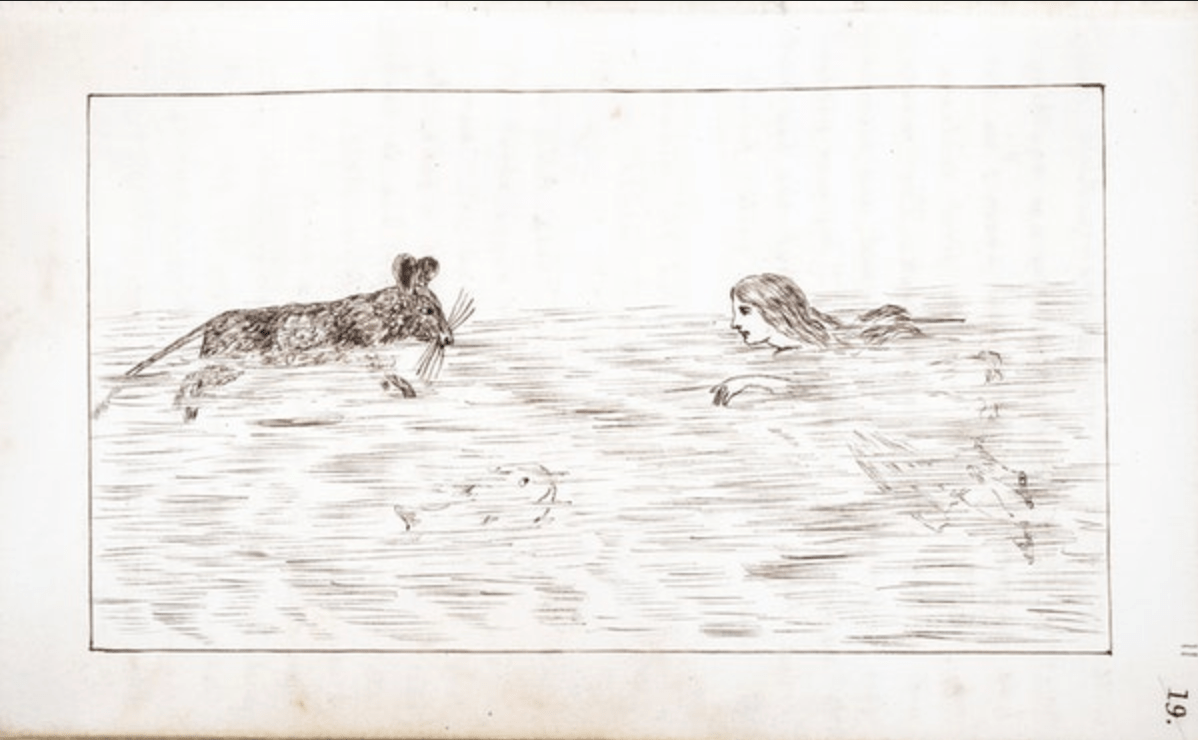
“What is the use of a book”, asks Alice in the opening scene to Lewis Carroll’s Alice’s Adventures in Wonderland, “without pictures or conversations?” This question from Alice is at once a critique of her sister’s pictureless tome, and a paving the way for the delight of words and images to follow. Indeed, John Tenniel’s famous illustrations — for both the first edition of Wonderland and its sequel Through the Looking-Glass — have become integral to how we experience the story, in both books and film. Tenniel, however, was not the first to illustrate the tale. That honor belongs to Carroll himself, whose original manuscript of the story (then titled “Alice’s Adventures Under Ground”) is littered with thirty-seven of his own sepia-ink drawings. It seems this entwining of word and image — so important to the published version — was there from the beginning…
More of the backstory- and all 37 drawings– at “Lewis Carroll’s Illustrations for Alice’s Adventures Under Ground,” via @PublicDomainRev.
For more of Carroll, Alice, and her adventures, see here and here.
* Cheshire Cat
###
As we believe impossible things, we might spare a thought for Robert Smirke; he died on this date in 1845. A painter and illustrator, he specialized in small pieces that depicted scenes in literature— for which he was elected to the Royal Academy.

“I began to paint chiefly still lifes, because in nature there is a tactile, I would almost say a manual space… that was the earliest Cubist painting – the quest for space.”*…

Between 1907 and 1914, Georges Braque and Pablo Picasso painted side-by-side– often literally, in the same studio– as they created the form we now know as Cubism, the most influential art movement of the 20th century.
Picasso has become the avatar of the Modern turn in the first half of 20th century. Braque… not so much…
Why is this show by Georges Braque such a quiet, hole-in-corner sort of affair? I find myself wondering as I wander around The Poetry of Things, a new exhibition at Bernard Jacobson Gallery of 14 magnificent still life paintings (and a single collage) by the man who is best known as the co-creator, with Picasso, of Cubism.
They span 30 years of his steady output, from the middle 1920s to the middle 1950s, enabling us to root out at least a partially satisfactory answer to a question that seems to be on so many lips: Whatever happened to Braque after Cubism had had its moment in the sun?…
There is no one else in the gallery during my visit barring the director, who is leaning too deeply into his reading matter even, it seems, to notice that another human being is currently sharing this basement gallery space with him.
Is it not a little odd that the first significant show by Braque in London for decades should be so lightly attended at 1:30 p.m. on a Saturday afternoon, in such a well-placed West End Gallery as this one, at the top of Duke Street St James, London’s oldest dealing street?
…
The fact is that Braque’s afterlife has been rather neglected. Henri Laurens inherited the estate, but has enough really been done to keep him in the public eye? And if not, why not? The fact is that his reputation has not been nurtured, massaged, and noised abroad — not when compared, for example, with the afterlife of Picasso. Was Picasso lucky? He had luck and skillful management, you could say. He was certainly a tremendous self-publicist in a way that Braque was not. Think of the Catalogues Raisonnés that he created with Christian Zervos, for example, and how early all that started. The first volume was published in 1932. Picasso knew what it was to be looked at. He also had the advantage of being perpetually, eye-catchingly restless. What transformations he underwent! And the Picasso story has been so effectively told and retold under the careful custodianship of the Picasso Foundation…
Braque looks and feels like a quietist by comparison, a swimmer against the currents. He did not have that lubricious Catalan stare. He did not rise up in indignation against any eye-catching war. He merely got on with it, year after year, making still life paintings of such restraint and subtlety, and much else too. None of the paintings on these walls shouts at us. They speak of self-containment, of a quietly impassioned, ongoing dedication to the task at hand. If anything, they seem to live and breathe, and even be in defiance of any easy notion of modernity…

“The Neglected Afterlife of the Great Georges Braque,” by Michael Glover, in @hyperallergic.
* Georges Braque
###
As we reflect on reputations, we might recall that it was on this date in 2007 that Picasso’s Portrait of Suzanne Bloch was stolen from the São Paulo Museum of Art (along with Portinari‘s O lavrador de café). One of the final paintings of Picasso’s Blue Period (valued in 2007 at roughly $50 million), it was recovered and returned undamaged to the museum the following January.

“Man is unique not because he does science, and he is unique not because he does art, but because science and art equally are expressions of his marvelous plasticity of mind”*…

As Einstein once said, “After a certain high level of technical skill is achieved science and art tend to coalesce in aesthetics, plasticity, and form”…
Scientists have often invited the public to see what they see, using everything from engraved woodblocks to electron microscopes to explore the complexity of the scientific enterprise and the beauty of life. Sharing these visions through illustrations, photography and videos has allowed laypeople to explore a range of discoveries, from new bird species to the inner workings of the human cell.
As a neuroscience and bioscience researcher, I know that scientists are sometimes pigeonholed as white lab coats obsessed with charts and graphs. What that stereotype misses is their passion for science as a mode of discovery. That’s why scientists frequently turn to awe-inducing visualizations as a way to explain the unexplainable…
Professor Christine Curran explains how “Art illuminates the beauty of science – and could inspire the next generation of scientists young and old,” from @ConversationUS.
For more wonderful examples (in the realm of health and medicine), explore The Wellcome Collection.
* Jacob Bronowski
###
As we visualize, we might recall that it was on this date in 1910 that French chemist, engineer, and inventor Georges Claude switched on the first public display of neon lights– two large (39 foot long), bright red neon tubes– at the Paris Motor Show. Over the next decade, Claude lit much of Paris. Neon came to America in 1923 when Earl Anthony purchased signage from Claude, then transported it to Los Angeles, where Anthony installed it at his Packard dealership… and (literally) stopped traffic.

“All familiar things can open into strange worlds”*…

A thoughtful consideration of a modern master…
In the summer of 1953, after a stint in the army, Jasper Johns, aged 23, moved back to New York City. There, a few months later, he met Robert Rauschenberg. Their artistic and romantic partnership would last until 1961; the company they kept included John Cage and Merce Cunningham. In this heady atmosphere, Johns chose, in autumn 1954, to destroy all his prior work, and to begin the paintings that made his name when they were shown four years later: flags, targets and numbers crafted in encaustic (pigment mixed in hot wax) with collage (often mere newspaper) on canvas…
Johns made an exceptional entrance in early 1958: his first show at the new Leo Castelli Gallery nearly sold out, with three paintings immediately purchased by MoMA, and one piece appearing on the cover of ARTnews. Then 27, he had sized up the New York art world precisely, dominated as it then was by the formalist model of ‘modernist painting’ used by Clement Greenberg to champion Abstract Expressionism, and deftly deflected its discourse towards what Leo Steinberg would term ‘other criteria’.
…
In a studied phrase Johns spoke of his position as one of ‘shunning statement’. This suggests an aversion to polemics, political as well as artistic, that goes beyond temperament, a fatigue with the heated ideologies of the period (the Korean conflict, the McCarthy hearings, the Cold War). And Johns did muffle his subjects along with his gestures; his large White Flag (1955) is literally whited out. Might this intimate a ‘painting degree zero’ in line with the ‘writing degree zero’ posed by Roland Barthes against Sartrean commitment at around this time? ‘I can’t imagine my work being used to accomplish anything socially,’ Johns said. This is less negation than neutrality à la Barthes, for whom ‘the neutral’ was a way to baffle conceptual binaries, to undo ideological oppositions, to mess with ‘the paradigm’…
On the occasion of the Whitney’s (@whitneymuseum) show (through February 13) “Jasper Johns: Mind/Mirror,” Hal Foster‘s “Which red is the real red?,” from @LRB.
* Jasper Johns
###
As we look closely, we might spare a thought for Francis Picabia (Francis-Marie Martinez de Picabia); he died on this date in 1953. A French avant-garde painter, poet and typographist, Picabia experimented with Impressionism and Pointillism before becoming a Cubist. He then became one of the early major figures of the Dada movement in the United States and in France, and was later briefly associated with Surrealism.
See his work at the record of a major retrospective hung at the Museum of Modern Art in New York in 2017 on their web site.

You must be logged in to post a comment.