Posts Tagged ‘art history’
“All is vanity”*…
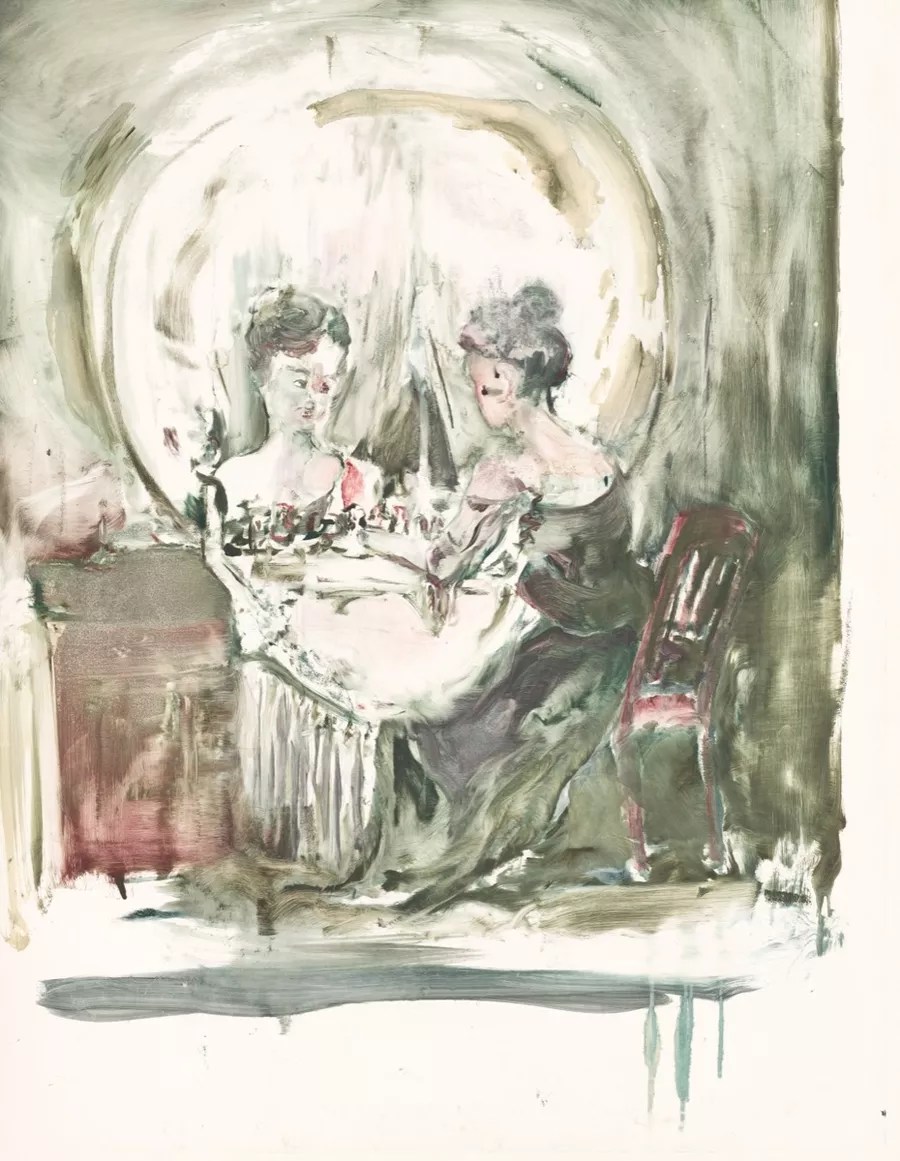
A growing number of modern artists would have us reflect on our lives and their meanings. Charlotte Jansen offers an example…
Oysters, lobsters, Louboutins—and death. At Cecily Brown’s current exhibition at the Metropolitan Museum Museum of Art, “Death and the Maid” (through December 3rd), the trappings of capitalist society seem to slip into oblivion under her lively, vigorous brushwork and lucid tableaus. Skulls, mirrors, and references to paintings of the past remind us of the madness of materialism and the certainty of death, recasting the classic theme of vanitas for the contemporary age.
Historically, the aim of a vanitas painting was to point out the vain pursuits of our mortal existence. Evolving out of a distaste for decadence and wealth, fueled by Calvinist attitudes in 16th-century Europe, these paintings imparted a clear moral message. The burgeoning middle classes had suddenly been able to afford jewels, quills, luxurious fabrics, sheet music, and books. But, these paintings warned, no matter how much pleasure those material possessions may bring, all is futile in the face of death. In these still-life compositions, the transience of life was commonly represented in depictions of skulls, burning candles, flowers, and soap bubbles.
Unlike memento mori—another genre of painting designed to remind the viewer of their mortality—vanitas works can be distinguished for their inclusion of displays of luxury and collections of items alluding to pleasure. It’s perhaps no surprise that vanitas is making its way into the works of contemporary artists—especially in bodies of work produced during the pandemic that are now being seen in public for the first time…
The human condition: “Contemporary Artists Are Reviving Vanitas, Reflecting on Death and Decadence,” in @artsy.
* Ecclesiastes 2:2
###
As we muse on mortality, we might send authentic birthday greetings to Hermann Hesse; he was born on this date in 1877. A book seller, poet, and painter, he is best known as a novelist– especially for Demian, Steppenwolf, Siddhartha, and The Glass Bead Game, all of which are animated by a search for meaning and self-knowledge (that’s thematically related to the Vanitas painters to the past and today). In 1946, he received the Nobel Prize in Literature.
You can find many of his paintings here.

“There is often a decades-long time lag between the development of powerful new technologies and their widespread deployment”*…

Jerry Neumann explores the relevance of Carlota Perez‘s thinking (her concept of Techno-Economic Paradigm Shifts and theory of great surges, which built on Schumpeter’s work on Kondratieff waves) to the socio-economic moment in which we find ourselves…
I’ve been in the technology business for more than thirty years and for most of that time it’s felt like constant change. Is this the way innovation progresses, a never-ending stream of new things?
If you look at the history of technological innovation over the course of decades or centuries, not just years, it looks completely different. It looks like innovation comes in waves: great surges of technological development followed by quieter periods of adaptation.
The past 240 years have seen four of these great surges and the first half of a fifth…

Economist Carlota Perez in her 2002 book Technological Revolutions and Financial Capital puts forward a theory that addresses the causes of these successive cycles and tries to explain why each cycle has a similar trajectory of growth and crisis. Her answers lie not just in technological change, but in the social, institutional, and financial aspects of our society itself…
Perez’ theory divides each cycle into two main parts: the installation period and the deployment period. Installation is from irruption to the crisis, and deployment is after the crisis. These are the ying and the yang of the cycle. Some of the differences between the two periods we’ve already mentioned—creative destruction vs. creative construction, financial capital vs. production capital, the battle of the new paradigm with the old vs. acceptance of the new TEP, etc…

We like theory because it tells us why, but more than that, a good theory is predictive. If Perez’ theory is correct, it should allow us to predict what will happen next in the current technological cycle…
A crisp distillation of Perez’s thinking and a provocative consideration of its possible meaning for our times: “The Age of Deployment,” from @ganeumann.
* Carlota Perez (@CarlotaPrzPerez)
###
As we ride the waves, we might recall that it was on this date in 1901, 11 years after the suicide of Vincent Van Gogh (and as his vision and its impact flowered in its “Deployment Age”) a large retrospective of his work (71 paintings) was held at the Bernheim-Jeune Gallery. It captured the excitement of André Derain and Maurice de Vlaminck— and thus contributed to the emergence of Fauvism.

“What makes photography a strange invention is that its primary raw materials are time and light”*…

There are myriad ways to understand photography and its history: by content, by style, by technique, by use, by creator…
Luminous-Lint is used worldwide by curators, educators, photography students, photohistorians, collectors and photographers to better understand the many histories of photography.
Luminous-Lint uses 125,613 photographs from 4,030 different collections around the world to create detailed and well structured histories of photography.
Luminous-Lint includes 1,032 distinct, but interlinked, histories of photography that are evolving on a regular basis.
The connections between photographs are critical to understanding and Luminous-Lint includes 14,701 visual indexes to assist.
Explore the histories of photography: Luminous-Lint.
* John Berger
###
As we consider the framing, we might send thoughtfully-composed birthday greetings to Ansel Adams; he was born on this date in 1902. A photographer who specialized in landscapes, especially in black-and-white photos of the American West, he was hugely influential both in photography and in environmentalsim.
Adams helped found Group f/64, an association of photographers advocating “pure” photography which favored sharp focus and the use of the full tonal range of a photograph; was a key advisor in establishing the photography department at the Museum of Modern Art in New York, and a founder of the photography journal Aperture.
His love of photography was born when, at age 12, he visited Yosemite and took his first shots. He became a life-long advocate for environmental conservation, a commitment deeply intertwined with his photographic practice. At one point, he contracted with the United States Department of the Interior to make photographs of national parks. For his work and his persistent advocacy, which helped expand the National Park system, he was awarded the Presidential Medal of Freedom in 1980.


“When somebody says it’s not about the money, it’s about the money”*…

Further to yesterday’s post (about the relevance of Edith Wharton’s observations of her Gilded Age to ours), Dorinda Evans takes a look at rough contemporary of Wharton’s, and at his (similarly relevant) work…
After supposedly stealing 500,000 francs from his bank, the mysterious Victor Dubreuil (b. 1842) turned up penniless in the United States and began to paint dazzling trompe l’oeil images of dollar bills. Once associated with counterfeiting and subject to seizures by the Treasury Department, these artworks [are nowconsidered] unique anti-capitalist visions among the most daring and socially critical of his time…

The fascinating story of Victor Dubreuil’s cryptic currencies and the questions they raise about value and values: “Illusory Wealth,” in @PublicDomainRev.
For an illuminating look at Dubreuil’s spiritual successor, see Lawrence Weschler’s wonderful Boggs: A Comedy of Values.
For a loosely analogous artist: “Nobody knows what a dollar is, what the word means, what holds the thing up, what it stands in for… what the hell are they? What do they do? How do they do it?”
And for an appreciation of trompe l’oeil (and its influence on Cubism), see “Feinting Spells.”
* H.L. Mencken
###
As we contemplate currency, we might pour a cup of birthday tea for English mathematician, logician, photographer, and Anglican cleric, Charles Lutwidge Dodgson– better known as the author Lewis Carroll– born on this date in 1832.
“There is no use in trying,” said Alice; “one can’t believe impossible things.”
“I dare say you haven’t had much practice,” said the Queen. “When I was your age, I always did it for half an hour a day. Why, sometimes I’ve believed as many as six impossible things before breakfast.”
– Alice in Wonderland (nee “Alice’s Adventures Underground,” then “Alice’s Adventures in Wonderland”)

Oh, and… Happy Mozart’s Birthday!
“Dada is ‘nothing'”*…

Marcel Duchamp, Francis Picabia, and Beatrice Wood, 1917
Working from Marcel Duchamp’s concept of anti-art, Tristan Tzara and Hugo Ball conjured “Dada” in Europe in the early 20th century; it gestated in France, then it found it’s footing in New York in 1915, and ignited in Paris in 1920… Key figures in the movement included Duchamp, Tzara, Ball, and the likes of Jean Arp, Johannes Baader, Max Ernst, Richard Huelsenbeck, Francis Picabia, Man Ray, Hans Richter, Kurt Schwitters… and Beatrice Wood.
We need to talk about Beatrice Wood. The last surviving member of the Dada movement, the ceramicist, the artist, the writer, the actress, the lover, and let’s not leave out, the inspiration behind the headstrong character of “Rose” in the movie Titanic. Beatrice was born at the end of the 19th century, and died at the end of the 20th, and in between she lived an incredible life. The sign on her ceramics studio read “Reasonable and Unreasonable”, and was a pretty spot-on description of her life…
The remarkable story: “Meet The Mama of Dada” in @MessyNessyChic
See also: “Beatrice Wood” @Artforum
* Marcel Duchamp
###
As we appreciate art, we might send carefully-composed birthday greetings to a very different kind of artist (one against whom the Dadaists were rebelling), John Singer Sargent; he was born on this date in 1856. One of the leading portrait painters of his time, he moved in the same social circles as his subjects (Presidents [e.g., Teddy Roosevelt), nobility (e.g., Lady Agnew), tycoons and their heirs [e.g., numerous Vanderbilts, Isabella Stewart Gardner), celebrity authors (e.g, Robert Louis Stevenson, Kenneth Grahame), even other artists (e.g., Claude Monet), and so was admired in his time for his evocation of Edwardian luxury. He was prodigiously prolific: he created roughly 900 oil paintings and more than 2,000 watercolors, as well as countless sketches and charcoal drawings.

Sargent in his studio with his personal favorite of his works, Portrait of Madame X, c. 1885 (source)
You must be logged in to post a comment.