Posts Tagged ‘collection’
“I was reading the dictionary. I thought it was a poem about everything.”*…

That seminal semanticist Samuel Johnson suggested, “dictionaries are like watches, the worst is better than none and the best cannot be expected to go quite true.” From “unabridged” to “slanguage,” Madeline Kripke’s library of lexicons is a logophile’s heaven (or hell)…
Madeline Kripke’s first dictionary was a copy of Webster’s Collegiate that her parents gave her when she was a fifth grader in Omaha in the early 1950s. By the time of her death in 2020, at age 76, she had amassed a collection of dictionaries that occupied every flat surface of her two-bedroom Manhattan apartment—and overflowed into several warehouse spaces. Many believe that this chaotic, personal library is the world’s largest compendium of words and their usage.
“We don’t really know how many books it is,” says Michael Adams, a lexicographer and chair of the English department at Indiana University Bloomington. More than 1,500 boxes, with vague labels such as “Kripke documents” or “Kripke: 17 books,” arrived at the school’s Lilly Library on two tractor-trailers in late 2021. The delivery was accompanied by a nearly 2,000-page catalog detailing some 6,000 volumes. But that’s only a fraction of the total. In summer 2023, the library hired a group of students to simply open each box and list its contents. By the fall, their count stood at about 9,700. “And they’ve got a long way to go,” says Adams. “20,000 sounds like a pretty good estimate.”
…
“This is my favorite wall,” Madeline Kripke told Narratively reporter Daniel Kreiger when he visited her West Village apartment in 2013. She shined a flashlight on glass-fronted shelves jammed with dictionaries full of the slanguage and cryptolect of small and likely overlooked communities. Kreiger listed some of the groups represented at that time, among them cowboys and flappers, mariners and gamblers, soldiers, circus workers, and thieves.
Among the first tomes Adams pulled from the boxes was a well-known example of the slang genre: The Canting Academy. This 17th-century dictionary by Richard Head is a guide to “cant,” the jargon of London’s criminal class or, as the subtitle to the second edition puts it, “The Mysterious and Villainous Practices Of that wicked Crew, commonly known by the Names of Hectors, Treppaners, Gults, &c.” (Adams wonders if a first edition is also hidden in the banker’s boxes.) With The Canting Academy, one can learn to translate the cant of the “priggs” (“all sorts of thieves”) to English: “lour” to “money,” “pannam” to “bread,” “lage” to “water.” Most of the language is indecipherable without this key, but Adams notes some usages that are common today. “To plant” something is, in centuries-old cant or modern-day English, “to lay, place, or hide.”
…
Much of what Adams has unpacked has a far less storied (and pricey) past, but, he says, the quirky and unexpected volumes in Kripke’s collection might be the most valuable to future lexicographers and historians. A bright red pamphlet with a doodle of heart on the cover might seem disposable, but it is an artifact of a particular place and time, Adams says. “Dictionaries are made by people, so they’re not just language books,” he says, “they’re culture books.”

Printed in 1962 as a marketing tool for a CBS sitcom, that slim pamphlet featuring a big heart around the faces of two 20-something actors is Dobie Gillis: Teenage Slanguage Dictionary, filled with “teen-age antics and terms.” It’s the type of thing that might have been stuffed into a cereal box or inserted in a teen magazine, says Adams. “I’m pretty sure that most people threw the copy they had away, and so this one is a fairly rare item that says something important about the representation of teen language and culture in the 1950s and 1960s.” Thanks to Kripke’s copy we know that this, at least according to the marketers behind The Many Loves of Dobie Gillis, was the era of the “keen teen” (“well-liked person”), the “cream puff” (“conceited person”), the “meatball” (“a dull guy”), and the “mathematician” (“teen who can put two and two together and get SEX”).
…
Kripke—“the mistress of slang,” in the words of one colleague—dedicated decades of her life to curating this collection of words, including countless ones we might like to forget. When she passed away without a will, the fate of her overwhelming library, plus a trove of documents on the history of dictionary making, was uncertain. Auctioning it off in lots could have brought the highest bids, but Kripke’s family worked in conjunction with the lexicographic community to preserve what Adams calls “her legacy.” That it was ultimately purchased in total by Indiana University Bloomington, a state university that committed to making the works accessible to the public, seems in keeping with the way Kripke herself viewed the collection, as a resource for the curious.
“You would go to see her in her Village apartment, and it was filled from top to bottom and side to side with books,” Adams says. It would have taken some digging but, “she would have the book that you need to see out for you and always some other specimens, too.”…
“The Low Down on the Greatest Dictionary Collection in the World,” in @atlasobscura.
* Steven Wright
###
As we look it up, we might recall that it was on this date in 1660, at Gresham College in London, that twelve men, including Christopher Wren, Robert Boyle, John Wilkins, and Sir Robert Moray decided to found a “Colledge for the Promoting of Physico-Mathematicall Experimentall Learning” to promote “experimental philosophy” (which became science-as-we-know-it). Six months later, Robert Hooke‘s first publication, a pamphlet on capillary action, was read to the group.
The Society subsequently petitioned King Charles II to recognize it and to make a royal grant of incorporation. The Royal Charter, which was passed in July, 1662 created the Royal Society of London.
In 1665, the society introduced the world’s first journal exclusively devoted to science in 1665, Philosophical Transactions (and in so doing originated the peer review process now widespread in scientific journals). Its founding editor was Henry Oldenburg, the society’s first secretary. It remains the oldest and longest-running scientific journal in the world.

“What is the pattern that connects the crab to the lobster and the primrose to the orchid, and all of them to me, and me to you?”*…

Crab-like body plans have evolved independently at least five times. As Jason P. Dihn explains, biologists are still trying to figure out exactly why…
In 1989, paleontologist Stephen Jay Gould proposed a thought experiment: What would the world look like if we turned back time and replayed the evolutionary tape? “I doubt that anything like Homo sapiens would ever evolve again,” he concluded. Maybe not. But crabs might.
Evolution just can’t stop creating crabs. Believe it or not, the flat-and-wide body plan has evolved at least five different times. The process is called carcinization, and it’s inspired comics, memes and entire subreddits.
Still, biologists don’t know why crabs keep evolving. Figuring it out would satisfy the online masses, sure, but it would also be a step toward solving other important scientific mysteries. For instance, why some species share evolutionary paths while others forge unique ones (looking at you, platypus)…
Convergent evolution: “Evolution Only Thinks About One Thing, and It’s Crabs,” from @JasonPDinh in @DiscoverMag.
Will crabs need to (re-)evolve a sixth time? “Alaska’s snow crabs have disappeared. Where they went is a mystery.”
(Image above: source)
* Gregory Bateson
###
As we fiddle with phylogeny, we might spare a thought for Walter Rothschild, 2nd Baron Rothschild; he died on this date in 1937. A British banker, politician and soldier, he is best remembered for his pursuit of his passion— zoology and his collection of species. At its largest, Rothschild’s collection included 300,000 bird skins, 200,000 birds’ eggs, 2,250,000 butterflies and 30,000 beetles, as well as thousands of specimens of mammals, reptiles, and fishes. They formed the largest zoological collection ever amassed by a private individual (and are now part of the Natural History Museum). He named dozens of animal taxa, published Novitates Zoologicae, and authored or co-authored scores of scientific papers.
Related: “How Bird Collecting Evolved Into Bird-Watching.”

“I’ve always thought of the T-shirt as the Alpha and Omega of the fashion alphabet”*…
Haruki Murakami on the semiotics of casual accumulation…
I’m not particularly interested in collecting things, but there is a kind of running motif in my life: despite my basic indifference, objects seem to collect around me. Stacks and stacks of LPs, so many I’ll never listen to them all; books I’ve already read and will probably never open again; a ragtag assemblage of magazine clippings; dinky little pencils, so worn down they don’t fit into a pencil sharpener anymore. All sorts of things just keep on piling up.
T-shirts are one of those things which naturally pile up. They’re cheap, so whenever an interesting one catches my eye I buy it. People give me various novelty T-shirts from around the world, I get commemorative T-shirts whenever I run a marathon, and when I travel I often pick up a few, instead of bringing along extra clothes. Which is why the number of T-shirts in my life has skyrocketed, to the point where there’s no room in my drawers anymore and I have to store the overflow in stacked-up cardboard boxes.
Whenever I go to the U.S., after I leave the airport and get settled in town I invariably find myself wanting to go out and grab a hamburger. It’s a natural urge, but you could also see it as a kind of ritual I go through. Either one’s O.K.
Ideally, I go to a hamburger joint around one-thirty, after the lunch crowd has left, plunk myself down at the counter, and order a Coors Light on tap and a cheeseburger. I like the burger cooked medium, and I always get raw onions, tomatoes, lettuce, and pickles. Plus an order of French fries and, like an old buddy I’m visiting, a side of coleslaw. Critical partners in all this are mustard (it’s got to be Dijon) and Heinz ketchup. I sit there, quietly sipping my Coors Light, listening to the voices of the people around me and the clatter of dishes, attentively imbibing the atmosphere of this different land, as I wait for my cheeseburger to emerge. Which is when it finally hits me that, yes, I really am in America.
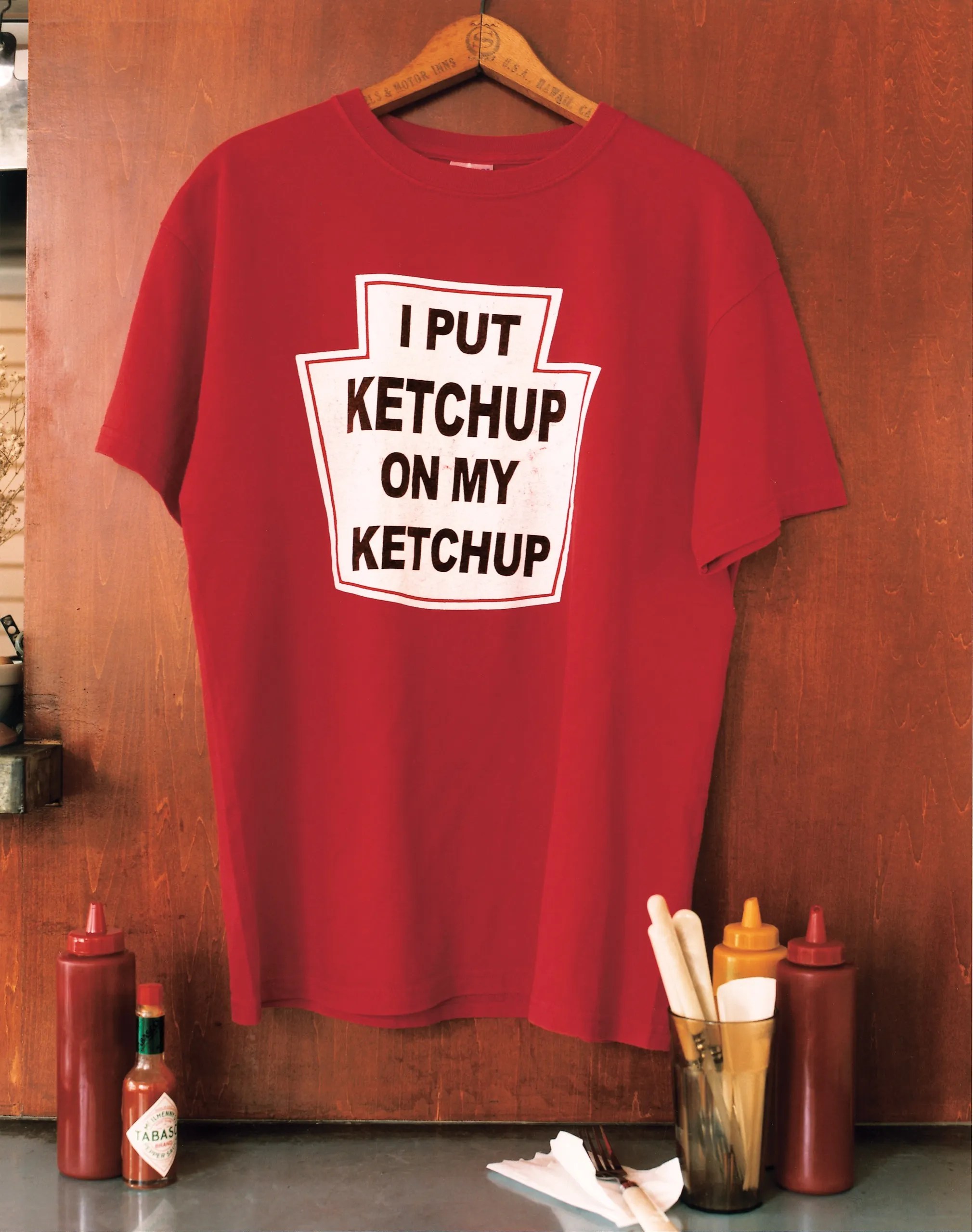
This T-shirt has a straightforward message: “i put ketchup on my ketchup.” Now, that’s the statement of somebody who is seriously in love with ketchup. It kind of teases those Americans who put ketchup on everything, but I find it interesting that one of the companies that distribute these shirts is none other than Heinz. A little self-deprecatory humor going on here, but you can’t help feeling the American spirit in it, the optimistic, cheerful lack of introspection that says, “Who cares about being sophisticated! I’m gonna do what I want!”
When I walk around town in this shirt, Americans sometimes call out, “Love the shirt!” The ones who do this usually have that “I love ketchup” look about them. Sometimes I feel like coming back with a “Hey, don’t lump me in with you guys,” but usually I just give a cheerful “Yeah, pretty nice, huh? Ha-ha.” This kind of T-shirt communication does a lot to liven things up. You’d never find that happening in Europe. For one thing, Europeans by and large hardly ever eat ketchup.
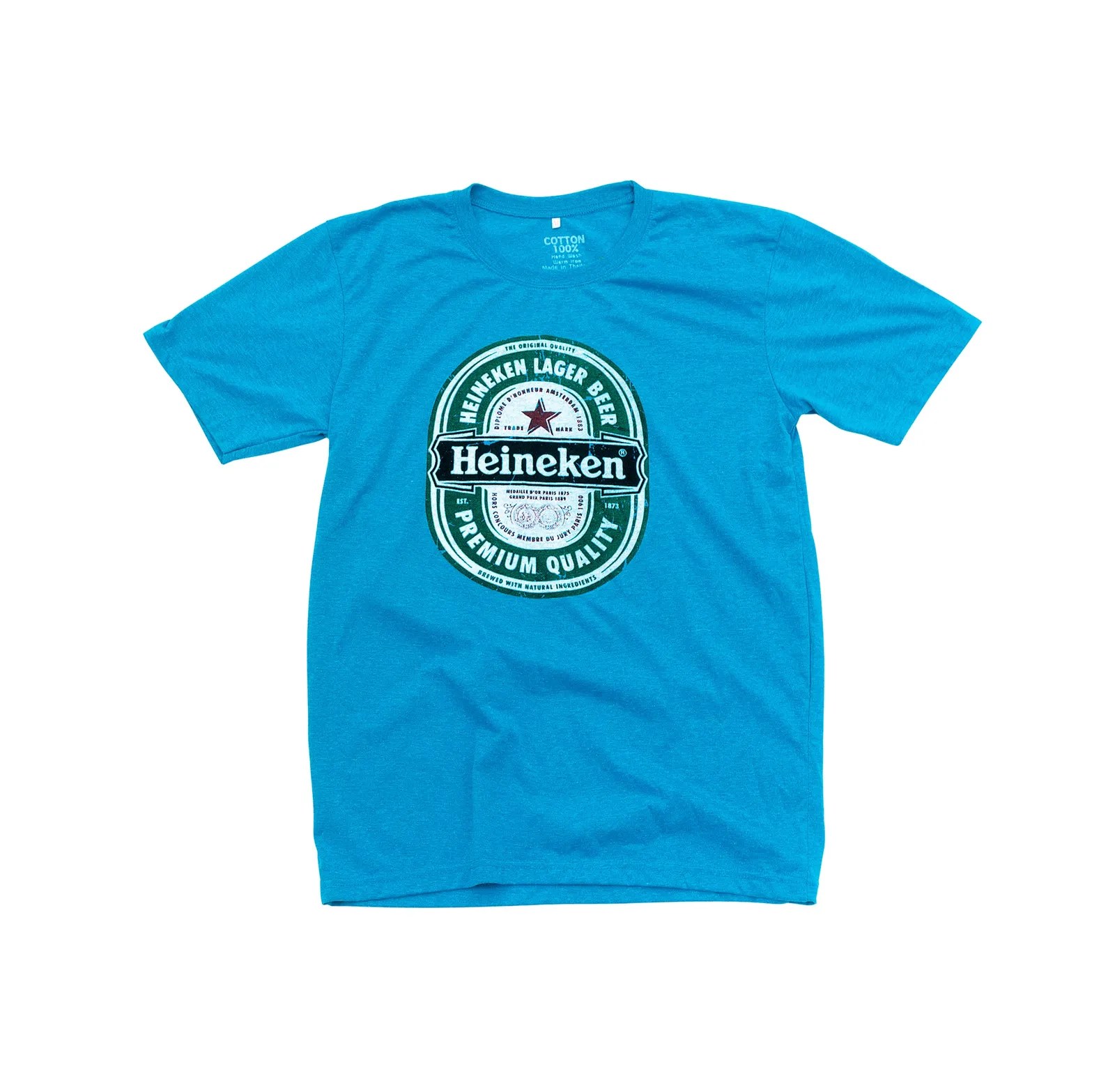
How (and why) @harukimurakami_ amassed more T-shirts than he can store (and more examples): “An Accidental Collection,” from @NewYorker.
* Giorgio Armani
###
As we slip it on, we might send stream of consciousness birthday greetings to William Cuthbert Faulkner; he was born on this date in 1897. A writer of novels, short stories, poetry, essays, screenplays, and one play, Faulkner is best remembered for his novels (e.g., The Sound and the Fury, As I Lay Dying, and Light in August) and stories set in “Yoknapatawpha County,” a setting largely based on Lafayette County, Mississippi, where Faulkner spent most of his life. They earned him the 1949 Nobel Prize for Literature.
The past is never dead. It’s not even past.
From Requiem for a Nun, Act I, Scene III, by William Faulkner

“That tactile feel of flipping through a stack of vinyl remains one of life’s simple pleasures”*…

Nearly everyone interested in records will have, at some point heard the news that there is a Brazilian who owns millions of records. Fewer seem to know, however, that Zero Freitas, a São Paulo-based businessman now in his sixties, plans to turn his collection into a public archive of the world’s music, with special focus on the Americas. Having amassed over six million records, he manages a collection similar to the entire Discogs database. Given the magnitude of this enterprise, Freitas deals with serious logistical challenges and, above all, time constraints. But he strongly believes it is worth his while. After all, no less than a vinyl library of global proportions is at stake…
An interview with master collector Zero Freitas: “Inside the World’s Biggest Record Collection.”
* Billy Gibbons (ZZ Top)
###
As we drop the needle, we might send harmonious birthday greetings to Jean-Philippe Rameau; he was born on this date in 1683. One of the most important French composers and music theorists of the Baroque era, he replaced Jean-Baptiste Lully as the dominant composer of French opera and is also considered (with François Couperin) the leading French composer for the harpsichord of his time.

“History, Stephen said, is a nightmare from which I am trying to awake”*…

In the wake of the conventions of the last two weeks, and the Fourth Estate’s first draft of history, we might pause to ponder the task facing more traditional historians. Consider, for example, “How Do Smithsonian Curators Decide What to Collect at the Political Conventions?”
* James Joyce, Ulysses
###
As we revel in the falling balloons, we might recall that it was on this date in 1981, with the words “Ladies and Gentlemen, rock and roll,” that MTV premiered. The first video featured on the new cable channel was The Buggles’ “Video Killed the Radio Star.” Indeed.

You must be logged in to post a comment.