Posts Tagged ‘higher education’
“Of course there’s a lot of knowledge in universities: the freshmen bring a little in; the seniors don’t take much away, so knowledge sort of accumulates”*…

Professor Paul Musgrave on the wacky world of university fundraising…
I would like you to buy me a chair. Not just any chair: an endowed chair.
Let me explain.
Universities have strange business models. The legendary University of California president Clark Kerr once quipped that their functions were “To provide sex for the students, sports for the alumni, and parking for the faculty.” These days, the first is laundered for public consumption as “the student experience” and the third is a cost center (yes, many to most professors have to pay, rather a lot, for their parking tags). (The second remains unchanged.)
You can tell that Kerr was president during a time of lavish support because he didn’t include the other function of a university: to provide naming opportunities for donors.
…
Presidents, chancellors, and provosts seek to finagle gifts because the core business of universities—providing credits to students in exchange for tuition—is both volatile and insufficient to meet the boundless ambitions of administrators and faculty alike. (Faculty might protest that their ambitions are quite modest, as they include merely limitless research budgets and infinite releases from course time—but other than that, they ask only for cost of living adjustments as well as regular salary increases.) Trustees expect presidents to bring in new buildings and new chairs; presidents expect trustees to help dun their friends and acquaintances for donations. The incentives even trickle down to deans, directors, and chairs, all of whom live with increasingly austere baseline budgets and a concomitant incentive to find and cultivate donors to expand, or even just support, their operations.
It’s easy, and wrong, for faculty to be cynical about this. First, these operations reflect the gloriously incongruous medieval nature of the university. Higher education in its upper reaches resembles medieval monasteries, and such monasteries provided not just seclusion and sanctity for their initiates but the possibility of the purchase of virtue for the wealthy. So, too, do universities offer grateful alumni and those sentimental about the generation of knowledge opportunities to turn worldly wealth into tax-deductible noblesse oblige.
Second, donors are the customers for the other product of the university: the social proof of good works. Universities offer donors solicitous for the future of the less fortunate opportunities to subsidize tuition, and they offer donors more interested in the benefits of knowledge the opportunity to subsidize research. The reward comes in some combination of the knowledge that such works are being done and the fact that the donor’s name will be associated with it. (Few large university buildings are named the Anonymous Center for Cancer Research.)
…
The bar for giving continues to rise. Nine-figure gifts were once unheard of; nowadays, they are striking but no longer unprecedented. For such a sum you can have a constituent college named for yourself. The next frontier must be the billion, or multi-billion, dollar gift. For that level, of course, the reward would have to be commensurate. Given that Harvard was named for a donor who left some books and a few hundred pounds to his eponymous university, one wonders whether someone in Harvard’s charitable receiving arm hasn’t calculated how much it would cost to become, say, the Zuckerberg-Harvard University. (I would wager that an earnest offer of $10 billion would at least raise the issue.)…
[There follows a price list for endowed/named Chairs at different universities, and an analysis of their economics. The author suggest that a chair for him would run $2.5-3 million…]
Fascinating: “Buy Me a Chair,” from @profmusgrave.
* A. Lawrence Lowell (legal scholar and President of Harvard University from 1909 to 1933)
###
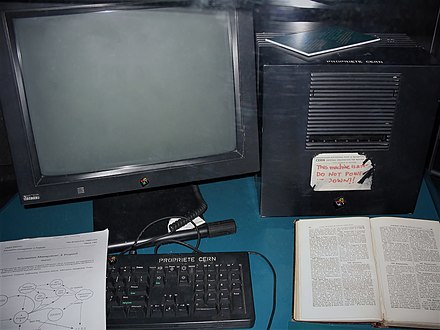
As we dig deep, we might recall that it was on this date in 1991 that the World Wide Web was introduced to the world at large.
In 1989, Tim Berners-Lee (now Sir Tim) proposed the system to his colleagues at CERN. He got a working system implemented by the end of 1990, including a browser called WorldWideWeb (which became the name of the project and of the network) and an HTTP server running at CERN. As part of that development, he defined the first version of the HTTP protocol, the basic URL syntax, and implicitly made HTML the primary document format.
The technology was released outside CERN to other research institutions starting in January 1991, and then– with the publication of this (likely the first public) web page— to the whole Internet 32 years ago today. Within the next two years, there were 50 websites created. (Today, while it is understood that the number of active sites fluctuates, the total is estimated at over 1.5 billion.)
“You can never be overdressed or overeducated”*…

So many choices…
Take online courses from the world’s top universities for free. Below, you will find 1,700 free online courses from universities like Yale, MIT, Harvard, Oxford and more. Our site also features collections of Online Certificate Programs and Online Degree & Mini-Degree Programs…
From Open Culture (@openculture), “1,700 Free Online Courses from Top Universities.”
A personal fave: MIT’s “Gödel, Escher, Bach: A Mental Space Odyssey.”
[image above: source]
* Oscar Wilde
###
As we hit the e-books, we might recall that it was on this date in 1922 that the United States paid tribute to the man instrumental in the technology that enables on-line education, Alexander Graham Bell…
There were more than 14 million telephones in the United States by the time Alexander Graham Bell died. For one minute on August 4, 1922, they were all silent.
The reason: Bell’s funeral. The American inventor was the first to patent telephone technology in the United States and who founded the Bell Telephone System in 1877. Though Bell wasn’t the only person to invent “the transmission of speech by electrical wires,” writes Randy Alfred for Wired, achieving patent primacy in the United States allowed him to spend his life inventing. Even though the telephone changed the world, Bell didn’t stop there.
Bell died on August 2, 1922, just a few days after his 75th birthday. “As a mark of respect every telephone exchange in the United States and Canada closed for a minute when his funeral began around 6:30 p.m. Eastern Standard Time,” Alfred writes.
On the day of the funeral, The New York Times reported that Bell was also honored by advocates for deaf people. “Entirely apart from the monumental achievement of Professor Bell as the inventor of the telephone, his conspicuous work in [sic] behalf of the deaf of this country would alone entitle him to everlasting fame,” said Felix H. Levey, president of the Institution for the Improved Instruction of Deaf Mutes.
In fact, Bell spent much of his income from the telephone on helping deaf people. The same year he founded the Bell Telephone System, 1880, Bell founded the Volta Laboratory. The laboratory, originally called Volta Associates, capitalized on Bell’s work and the work of other sound pioneers. It made money by patenting new innovations for the gramophone and other recorded sound technologies. In 1887, Bell took his share of the money from the sale of gramophone patents and founded the Volta Bureau “as an instrument for the increase and diffusion of knowledge relating to the Deaf,’” writes the National Park Service. Bell and Volta continued to work for deaf rights throughout his life.
Volta Laboratory eventually became Bell Laboratories, which was home to many of the twentieth century’s communication innovations.
Smithsonian

Some pens are mightier than others…


More of Timothy Leo Taranto‘s “Literary Puns,” via The Rumpus, here, here, and here.
###
As we rethink our reading lists, we might recall that it was on this date in 1973 that first graduates from the Open University (OU) were awarded their degrees after two years studying from home. Britain’s (and one of the world’s) first “distance learning” universities, Open University opened in 1971 with 25,000 students– at a time when the entire student population of conventional universities in the U.K. was only about 130,000. OU currently has over 250,000 students on its rolls, 50,000 from overseas, and has so far served over 1.5 million learners. It was ranked 43rd (second quartile) in the Times Higher Education Table of Excellence in 2008 (between the University of Reading and University of the Arts London); it was ranked overall as a nationally top forty, and globally top five hundred university by the Academic Ranking of World Universities in 2011; and it has regularly ranked #1 among U.K. universities in student satisfaction.

Putting Mr. Lincoln to work…

“The place for people to share things they’re willing to do for $5”: Fiverr… (Also worth checking out: the source of the image above, Vandalize George.)
As we try to divine whether we’re the victims of inflation or deflation, we might recall that it was on this date in 1636 that Utrecht University was founded. It’s alumni include scholar Perizonius , mathematician and philosopher René Descartes, biographer James Boswell, zoologist Frans de Waal, and Nobel Laureates (Physics) Tjalling Charles Koopmans and Wilhelm Röntgen… and it’s still going strong.

“…what remains after one has forgotten everything he learned at school.”*
A guest post from Scenarios and Strategy (here, with an almanac entry)…
The Bureau of Labor Statistics reminds us that it’s smart to stay in school:

But as Calculated Risk reports, while unemployment among the best educated is still lowest, it’s increased as much in percentage terms for them during this current recession as for any other group.
 click to enlarge
One notes that all four groups** were slow to rebound after the 2001 recession– not an encouraging reminder if one is hoping for a brisk employment-led, consumption-fueled recovery this time around.
But in some ways more striking is a difference we might expect, but that hasn’t yet emerged. Calculated Risk:
I’d expect the unemployment rate to fall faster for workers with higher levels of education, since their skills are more transferable, than for workers with less education. I’d also expect the unemployment rate for workers with lower levels of education to stay elevated longer in this “recovery” because there is no building boom this time. Just a guess and it isn’t happening so far … currently the unemployment rate for the highest educated group is still increasing.
Clearly, from an individual’s point-of-view, it’s still smarter to get more education than less. But the perturbations of past periods remind us that the gearing between between academic degrees and financial success isn’t always perfectly tight… Indeed, those with sharply-defined professional credentials in fields– e.g, finance– that are unlikely even in the intermediate term (if ever) to recover their bubble-fueled growth rates, may find their advanced degrees at best unhelpful; at worst, downright prejudicial.
Economic recovery and growth will be driven to some large extent by innovation; that innovation will create new– and new kinds of– jobs. Looking even just five years out, much less ten, one has to admit that it’s just not possible to predict what these emergent jobs, nor their requirements, will be. (Consider, e.g., the hottest topic– and job category– in marketing/advertising these days: “social media marketing”… which wasn’t even a glimmer a decade ago, and was just being born five year ago.) This is a challenge for those new to the work force, who have to wrangle the product of their schooling and their personal experience into a shape that can fit the entry-level positions they seek. It is a much bigger challenge for those mid-career who find themselves needy of making a move: these more mature folks have not only to learn new fields, they also have to re-direct the considerable momentum of perception and habit that characterized their old– and they have to do those things, usually, in ways that justify salaries way north of entry-level.
All of which underlines for your correspondent the extraordinary value of a liberal arts education. When one is faced with a “working adulthood” that is one transitional challenge after another, no skill is more valuable than the capacity to adapt. And no capability is more central to that adaptation than the ability effectively and efficiently to learn.
This is precisely what, at its core, a liberal arts education is about: learning to learn.
There are many, many other reasons, rooted in personal and societal benefits, to pursue a liberal arts education, and top support a strong foundation of liberal arts in higher education. But the lessons of the last couple of years– indeed, of the last several decades– suggest that the economic rationale is plenty strong as well…
And besides, it’s fun.
* “Education is what remains after one has forgotten everything he learned in school.”
– Albert Einstein
** To put these cohorts into perspective, the Census Bureau suggests that, of these folks “25 yrs. and over” (in 2008):
– 13.4% had less than a high school diploma.
– 31.2% were high school graduates, no college.
– 26.0% had some college or associate degree.
– 29.4% had a college degree or higher.
UPDATE: Reader JK directs our attention to another treatment of the data, in the NY Times. As he suggests, even more dramatic.
As we revisit our course catalogues, we might recall that it was on this date in 1933 that Congress passed the Emergency Banking Act, the first major legislative step in Franklin Delano Roosevelt’s New Deal program. The sense of urgency was sufficiently high– four days earlier Roosevelt had declared a “Banking Holiday,” closing all of the nation’s banks– that most legislators passed the Act without even reading the single copy that was available for review. The EBA gave the government authority to shutter insolvent banks; that, coupled with the Federal Reserve’s informal-but-explicit pledge to guarantee the deposits of banks allowed to reopen (de facto deposit insurance), eased the crisis of public confidence: within two weeks of banks’ re-opening on March 13, Americans had re-deposited over half the cash they’d withdrawn and hoarded through the period of bank failures that marked the first chapter of the Great Depression. Later that year, the (more considered and embracing) Banking Act of 1933 replaced the EBA, and established such lasting practices and institutions as the FDIC.

You must be logged in to post a comment.