Posts Tagged ‘War of the Worlds’
“I am not Cinna the conspirator”*…

As Philip Goldfarb Styrt explains, Shakespeare’s Julius Caesar offers a telling parable about the administration of justice—and rife mishandling thereof—in our day…
American politics has a long history of referencing William Shakespeare’s The Tragedy of Julius Caesar, from Abigail Adams, who identified with Portia, the wife of Brutus, as Betsy Erkkila has noted, to the assassination of Abraham Lincoln, which “both was and was not reenacting” the play, in Cary M. Mazer’s words. These references are likely due to the intersection of American identification with Roman republicanism, which the play dramatizes, and the long history of American interest in Shakespeare specifically. More recently, a great deal of ink was spilled during Donald Trump’s first term comparing the president to Caesar. But while an excellent hook for contemporary stagings of the play, this kind of parallel has limitations. King George III and Abraham Lincoln weren’t Caesar, and neither is Donald Trump, even if a lead actor sports a distinctive red tie. This history does, however, raise the question of what Shakespeare’s play might have to tell us about our current historical moment.
One overlooked area of governance that has become increasingly important in the early days of the current administration is due process: what procedures does the government have to go through and what kinds of hearings must be held, particularly in immigration cases, in order to arrest someone? To remove or deport someone from the country? From the Mahmoud Khalil case at Columbia University to the Rümeysa Öztürk case at Tufts, the Secretary of State has been personally marking individual visas and green cards for revocation; in addition, in cases like the one that centers on the removal of alleged gang members to El Salvador, whole categories of people are being removed without a hearing or a trial and with at least some allegations that the individuals removed aren’t even part of the targeted class.
Julius Caesar treats these issues directly. The play focuses on the assassination of the title character by a conspiracy headed by Brutus and Cassius and the defeat of the conspirators in battle by Caesar’s successors, the triumvirate of Marc Antony, Octavian, and Lepidus. Along the way, the play presents punishment as a major theme: First, the punishment of Caesar for the perceived sin of royal ambition, and second, the punishment of the conspirators for his murder. Because of this, a close look at the play and the scholarship surrounding it can help make clear the stakes of due process. While the term itself wouldn’t have been used in Shakespeare’s time, his era was one in which the procedures of law we now call due process were being formalized, and his plays show a consistent interest in whether that proper procedure is being followed.
A pair of crucial scenes related to this issue immediately follow the play’s most famous parts (Caesar’s assassination and the speeches delivered by Brutus and Antony over his body, in Act 3, Scenes 1 and 2, respectively) and may be sometimes overlooked. But when considered together, they give insight into why arbitrary executive action without due process is dangerous, whether it technically operates within the law or not.
The first of these two scenes—in Act 3, scene 3—features mob violence. Incited by Marc Antony to seek revenge, the citizens seek out conspirators to murder, and they mistake the poet Cinna for a conspirator of the same name. They tear him to pieces. Though this act is hardly the same as an official arrest, which might seem to distance it from discussions of due process, this moment isn’t just about the mob, as Martin Mueller points out; it’s about how power acts, whether through masses or through government. It’s a case of enacting punishment in a case of mistaken identity, particularly one where despite that mistake having been corrected in real time, the damage is done. “I am not Cinna the conspirator,” are the victim’s last words, but the play gives neither time nor opportunity for his insistence to convince anyone to keep him alive. Due process would allow for potential Cinnas to demonstrate innocence and remove themselves from the unwarranted threat; without it, everyone is imperiled.
There’s another element of the current concern regarding due process that relates to the fate of poor Cinna. His death isn’t merely the result of mistaken identity; as Jeffrey J. Yu writes, after he tries to identify himself the mob changes its tune, declaring that they’ll kill him for being a bad poet instead. Absent due process, there’s no pause to decide whether this person should be condemned or if the reason given for condemnation is legitimate. This episode serves as a reminder that due process doesn’t merely protect people from mistaken identification; it also requires those who would mete out punishment to specify, up front, the reason for it.
The Trump administration’s refusal to give key information to multiple judges in the removal cases recalls this danger. By refusing to specify details of the case, the government keeps the possibility alive of changing their reasoning or their claims to have the same effect for different reasons—just as the mob changes its reasoning for killing Cinna. This belies the question of whether those who are looking to deliver punishment are acting in good faith, a concern that became part of the appeals court decision in the El Salvador case and has subsequently been raised in other courtrooms as well. Just as Shakespeare’s mob finds new justifications for why Cinna the Poet should die, the government keeps open the possibility of producing a different reason for removing the people it currently claims are alien enemies—a process they have already begun with individual visa revocations. Due process requires a commitment to the reasons punishment is sought and thus allows those reasons to be addressed and countered.
As Nicholas Royle argues, the scene of Cinna’s death can easily be treated as a version of Julius Caesar in miniature. The play as a whole is about categorical error: killing someone because you think they are one thing only to find out you were wrong. This, in turn, centers the idea of due process, because only through it can deliberative decisions about identity, guilt, and punishment be properly engaged. The lynching of (the wrong) Cinna is the madness of a mob; the murder of (the right) Caesar is a conspiracy of nobles; the removal of hundreds of (alleged) Venezuelan gang members is the action of ICE. Each is a distinct entity, but they hold in common a lack of judicial process to determine what is to be done and to whom.
If the death of Cinna is a microcosm of the play, the other moment that reinforces the importance of due process in Julius Caesar is even more compressed, lasting a mere eight lines at the start of the fourth act. That’s all the time it takes for Marc Antony, Octavius (the future Augustus Caesar), and Lepidus to choose the Romans who will die by proscription in order to keep their triumvirate in power while they war against Caesar’s assassins. This is an arbitrary and impersonal form of execution: the triumvirs check off the names of those they want dead: “these many, then, shall die; their names are pricked.” As Robert Kalmey observes, this moment encapsulates what Roman historians thought of as the worst of all of Octavius’s crimes against the state before becoming emperor. This “tyrannical ruthlessness and cruelty,” in Robert Miola’s words, reveals that the triumvirate will be no better than Caesar’s assassins or the mob; they too will kill at whim to stay in power.
There’s something disturbing about these proscriptions, which is why both Kalmey and Miola identify them as critical. The triumvirate make a cold-blooded choice to kill many Romans; it has neither targeted motivation, as did the assassination of Caesar, nor does it possess the emotional if not legal justification embraced by the inflamed mob in its misdeeds. This isn’t to justify those prior murders. Rather, it’s to point out that the proscriptions somehow exceed even them in horror because of how they’re administered. There’s no due process here, either; the three triumvirs don’t get their hands dirty, their decisions can’t be appealed, and there’s no public process by which those to be killed will be identified before the decision is final.
In this there’s a distinct echo of the process currently in use for determining which visas (permanent or temporary) will be revoked under the current administration. The decision lies solely with Secretary of State Marco Rubio, who has the power to determine if a particular immigrant poses a threat to national security; if he makes that determination, then the immigrant in question can be picked up off the street without hearing or appeal. Thus far, there’s no venue for disputing such a determination nor is there a published list of those whose visas have been revoked, even though Rubio claims to have revoked as many as 300 (coincidentally, as Kalmey details, the number of senators proscribed by the triumvirate).
Of course, deportation or removal from the United States isn’t the same as death; Rubio’s unilateral visa revocation isn’t the same as the proscription. But the lack of transparency and due process are similar, and there are few to no guarantees of the safety of people whom ICE agents remove, often without identifying themselves, and move around without notifying the family or lawyers of the detained. In fact, the government has argued in court that it has no responsibility to return those who might be removed incorrectly or by accident.
In Julius Caesar Shakespeare demonstrates the extreme consequences of a lack of due process. Not every such deprivation becomes a literal matter of life and death as in the play, but making use of such scenarios enables Shakespeare to highlight more effectively the danger of arbitrary action. Whether we imagine ourselves, like Cinna the Poet, hunted for a crime of which we are innocent or, like the Roman dignitaries proscribed by the triumvirs, marked out for condemnation, the drama asserts that some kind of due process is a necessity for a free state. If, as Lloyd Matthews has argued, America’s founding ideals of liberty are intimately linked to Julius Caesar, that connection should remind us that such liberty requires due process to function properly…
“The Lessons of Due Process in Julius Caesar,” from @jstordaily.bsky.social.
Pair with: “Brush Up Your Shakespeare” (“A Harvard Law class uses the Bard’s plays to explore legal themes and concepts past and present”)
* Shakespeare, Julius Caesar, Act 3, Scene 3
###
As we recognize rights, we might recall that it was on this date in 1938 that the Mercury Theater broadcast the Halloween episode of their weekly series on the WABC Radio Network, Orson Welles’ adaptation of H.G. Wells’ War of the Worlds. The first two-thirds of the show (which was uninterrupted by ads) was composed of simulated news bulletins… which suggested to many listeners (a huge number of whom joined in progress, after tuning over from the Edgar Bergen show on NBC) that a real Martian invasion was underway.
While headlines like the one below suggest that there was widespread panic, research reveals that the fright was more subdued. Still there was an out-cry against the “phony-news” format… and Welles was launched into the notoriety that would characterize his career ever after.

“A good bookshop is just a genteel Black Hole that knows how to read”*…

FT writers nominate awe-inspiring places to get your literary fix, from Mumbai to Buenos Aires…

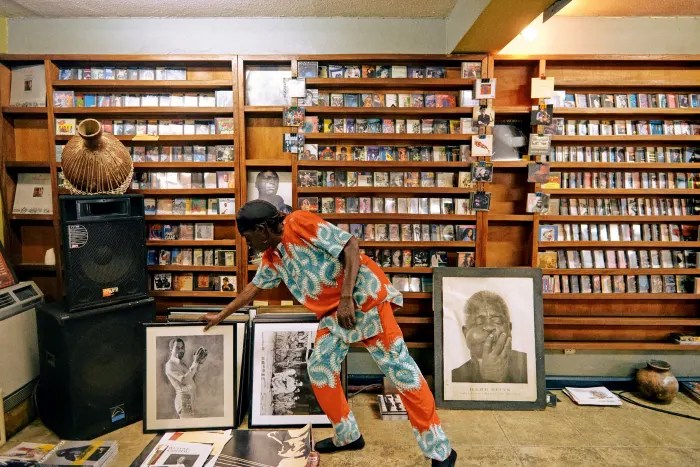
And so many more: “The most brilliant bookshops in the world.”
* Terry Pratchett
###
As we browse, we might recall that it was on this date in 1938 that the Mercury Theater broadcast the Halloween episode of their weekly series on the WABC Radio Network, Orson Welles’ adaptation of H.G. Wells’ War of the Worlds. The first two-thirds of the show (which was uninterrupted by ads) was composed of simulated news bulletins… which suggested to many listeners (a huge number of whom joined in progress, after tuning over from the Edgar Bergen show on NBC) that a real Martian invasion was underway.
While headlines like the one below suggest that there was widespread panic, research reveals that the fright was more subdued. Still there was an out-cry against the “phony-news” format… and Welles was launched into the notoriety that would characterize his career ever after.

“Ladies and gentlemen, this is the most terrifying thing I have ever witnessed!”*…

As a teenager I was completely suckered in by a television documentary hoax (Forgotten Silver, by Peter Jackson pre-Lord of the Rings). For many years it was quite a sore spot for me that I was duped. I imagine the many people who believed that The War of the Worlds depicted an actual Martian invasion felt the same way. And twelve years before Orson Welles’ famous 1938 radio play another hoax on the airwaves was terrifying the innocent public.
Broadcasting the Barricades by the mystery writer [and Catholic priest] Ronald Knox was performed on BBC Radio in early 1926. Styled like a news report, it described a Bolshevik revolution running through the streets of London. Government ministers were captured and strung up; the Savoy Hotel and the Palace of Westminster were both blown up (thus toppling the Clock Tower and Big Ben too).
Now, there were plenty of clues that it was a hoax. Not least of which was that they told everyone it was not real at the start. Not everyone caught that [as was the case with World of the Worlds], or the many announcements to the same effect on the same channel later that night. Complicating matters, a snowstorm prevented the next day’s newspapers getting out of London, stoking fears that the capital city was in ruins or occupied by revolutionary forces. And 1926 UK was a tense place already: four months after Broadcasting the Barricades, 1.7 million workers joined a general strike in support of locked out coal miners…
The radio hoax that presaged– and inspired– Orson Welles’ The War of the Worlds: “From the Barricades.”
The BBC’s own account of the occasion (the source of the image above) is here. And here is the amusing tale of an Australian variation on the theme, broadcast a year after Knox’s pioneering effort.
Oh, and Forgotten Silver is wonderful!
* “Reporter Carl Phillips” (Frank Readick), The War of the Worlds
###
As we check our sources, we might recall that it was on this date in 1843 that John Browne Bell published the first of his London-based newspaper, The News of the World. Bell’s competitive strategy was to focus on the sensational and the lurid– basically, crime and vice… a strategy that served him and subsequent owners, most recently Rupert Murdoch and News Corp., extremely well. Indeed, its long suit in celebrity scoops, gossip, and populist news– especially its somewhat prurient focus on sex scandals– gained it the nickname News of the Screws.
In 2011, 25 years after Murdoch had made it into the Sunday edition of his paper The Sun, The News of the World was closed… sort of. In its last decade it had developed a reputation for exposing celebrities’ drug use, sexual peccadilloes, or criminal acts, by using insiders and journalists in disguise to provide video or photographic evidence, and covert phone hacking in ongoing police investigations. Many of these allegations proved true. On July 4, 2011 it was revealed that, nearly a decade earlier, a private investigator hired by the newspaper had intercepted the voicemail of missing British teenager Milly Dowler, who was later found murdered. Amid a public backlash and the withdrawal of advertising, News International announced the closure of the newspaper three days later.
After a brief hiatus, the fun continued in The Sunday Sun (with many former News of the World staffers), but without several senior News of the World editors, who were arrested and indicted for illegal wiretapping, bribing police officers for information, and other offenses.

“Total annihilation has a way of sharpening people’s minds”*…

HG Wells was the great modern prophet of apocalypse…
In five fecund years, from 1895 to 1900, he wrote 12 books, including the ‘scientific romances’ that made his name and laid the foundations of modern science fiction — The Time Machine, The War of the Worlds, The Island of Dr Moreau, The Invisible Man. He paved the way for so much of what came after — the sci-fi of Huxley, Orwell, Olaf Stapledon, Arthur C. Clarke, JG Ballard and Michael Crichton, and his books have inspired over 30 films, with The Invisible Man set for another remake this year…
His books — both fiction and non-fiction — are tales of apocalypse, which in the ancient Greek etymology means ‘the unveiling or unfolding of things not previously known and which could not be known apart from the unveiling’.
What you meet in Wells’ books, again and again, is the violent uncovering of the new, the ripping back of the lace curtain of Victorian customs. Like Ballard, Wells had a sense of how suddenly and utterly things can change, how long familiar and ingrained customs can disappear in a moment. Victorian England must have seemed like it would stay the same forever and ever. And then, suddenly, Queen Victoria is removed ‘like a great paperweight’, and everything is in flux.
Australians are learning that today — how everything we take for granted — homes, food supplies, electricity, water, clean air, even law and order — can be taken from one in an instant. Likewise, The War of the Worlds gave complacent imperial Victorians a sudden sense what it’s like to be conquered and humiliated, to be scrabbling for survival. ‘I felt a sense of dethronement, a persuasion that I was no longer a master, but an animal among the animals, under the Martian heel’…
What can he teach us about our present moment? How can we survive and endure the apocalyptic unravelling of hydrocarbon capitalism, which is what (I suggest) we vividly see happening today. The most important lessons he gave us are (1) take the Long View and (2) don’t turn away from technological innovation, however dangerous and unsettling it is…
Jules Evans (on a return visit, having supplied yesterday’s subject) explains: “What HG Wells can teach us about surviving apocalypse.”
* 21 Lessons for the 21st Century
###
As we batten down the hatches, we might recall that it was on this date in 749 that a devastating earthquake struck parts of Palestine and the Transjordan, epicentered in Galilee. The cities of Tiberias, Beit She’an, Hippos, and Pella were largely destroyed, while many other cities across the Levant were heavily damaged; the casualties numbered in the tens of thousands.

Scythopolis (Beit She’an) was one of the cities destroyed in the earthquake of 749
“What goes around, comes around”*…

Much as internet surfers — i.e. everyone in 2018 — enjoy sharing silly and picturesque JPEGs with one another that feature clever quips or inspirational sayings, Americans of a century ago passed around similar memes. They were called postcards, or souvenir cards, and mailing them to friends and relatives was immensely popular for sharing a gilded, snowy holiday scene or even a lolcat.
One hundred years before e-mail inboxes crowded with pictures of cats adorned with text like “I CAN HAS CHEEZBURGER?” and “CEILING CAT IS WATCHING YOU,” lolcats (and loldogs and lolrabbits) were already at the height of fancy. The rise of postcards at the turn of the century enabled Pennsylvanian Harry Whittier Frees to build a career out of photographing cute animals donning hats and britches…
More of Frees’ story– and work– and a reminder that there’s very little truly new under the sun: “The Cat Meme Photographer from a Century Ago.”
###
As we pass it along, we might spare a thought for Edgar John Berggren– better known by his stage name, Edgar Bergen– he died on this date in 1978. Perhaps best known today as the father of Candice Bergen, he was a huge star in his own time, performing as an actor, comedian, and radio performer, most famously as a ventriloquist working with his side-kicks Charlie McCarthy and Mortimer Snerd.
Indeed, some attribute Bergen’s massive popularity with “saving the world”: on the night of October 30, 1938, when Orson Welles performed his War of the Worlds radio play, panicking many listeners, most of the American public had tuned instead to Bergen and McCarthy on another station. (Dissenters note that Bergen may inadvertently have contributed to the hysteria: when the musical portion of Bergen’s show [The Chase and Sanborn Hour] aired about twelve minutes into the show, many listeners switched stations– to discover War of the Worlds in progress, with an all-too-authentic-sounding reporter detailing a horrific alien invasion.)

You must be logged in to post a comment.