Posts Tagged ‘Julius Caesar’
“Self-control is the chief element in self-respect, and self-respect is the chief element in courage”*…

To observe the obvious, power– and the exercise of power– is having a moment. It’s a little surprising that there’s not a broader discussion of Michel Foucault (and here) afoot… but then, the subjects and terms of our civic discourse are effectively being set by the powerful; and it’s hard to read Foucault as anything but a thorough-going critic.
It’s not so surprising that Thucydides is much discussed; it’s been easier for the powerful to find consoling, justifying “lessons” in his History of the Peloponnesian War, which recounts the 5th century BC war between Sparta and Athens— “Thucydides Trap” and so much more. Indeed, even critics are invoking Thucydides.
But, David Polansky and Daniel Schillinger argue, we need to listen wisely, not too well: the powerful wielding Thucydides are misreading him…
It’s almost never a good sign when Thucydides is in the news. The ancient Greek historian of the Peloponnesian War is typically invoked either to alert us to the possible return of a bygone age of terrifying great-power conflict, or to confirm that strong states can and should advance their own material interests, irrespective of justice.
Earlier this year, the Canadian prime minister Mark Carney earned much acclaim when he quoted, at Davos, the most famous lines in Thucydides’ History of the Peloponnesian War: ‘The strong can do what they can, and the weak must suffer what they must.’ While Carney intended his reference to be a critique of US behaviour under the Trump administration, Thucydides is also invoked in defence of aggressive or even imperialistic policies, especially in the United States. Yet those who look to Thucydides for either a justification or a critique of empire should be disappointed. Thucydides pulls no punches: he writes to expose the delusions of both the strong and the weak, the unjust and the just. Self-deception is a leitmotif of his History. Because self-deception is perennial, and because it can prove disastrous to victors and vanquished alike, Thucydides’ work remains timely and timeless, as he expected it would…
[The authors outline the war between the Athenians and the Peloponnesians and Thucycides’ vantage…]
… The line Carney invoked is often associated with ‘realism’ in world politics. This is a somewhat woolly term that encompasses both a moral position of scepticism about the possibility of justice in political life and an analytical approach to understanding political events in terms of material power and interest. Thucydides is a plausible originator of realism inasmuch as he offers an unvarnished and unsentimental account of the operation of political power among Greek cities. His realism may be contrasted with the ‘liberal institutionalism’ of a thinker such as Immanuel Kant, who holds out hope for mutual cooperation and even perpetual peace among states.
During the 20th century, these lines of ideological disagreement came to define discussions of international politics in both academic and political discourse. For example, the British historian E H Carr warily observed, during the Second World War, the spread of what he called ‘utopianism’, as reflected in the excessive hopes that international institutions such as the League of Nations might foster world peace. In response, Carr offered a qualified defence of realism for providing a pragmatic and flexible guide to politics in a dangerous world: ‘realism is the necessary corrective to the exuberance of utopianism, just as in other periods utopianism must be invoked to counteract the barrenness of realism.’
Thucydides’ own relationship to realism is more ambiguous than his reputation might suggest, however. For one thing, he never uses the term itself (which does not much predate the 20th century – in fact, it was Friedrich Nietzsche who first applied the term to Thucydides). He also rarely issues judgments under his own name. Many of the most notorious lines in his History are spoken by historical figures. Would anyone suppose that lines spoken by Richard III contain clear statements of William Shakespeare’s own views?
No doubt, Thucydides provides ample material for those who hope to find realist perspectives in his work. It is also true, however, that his History elicits a range of searching reflections on war’s causes and consequences. Note that Thucydides emphasises, humanely, the suffering occasioned by the Peloponnesian War. Some of this suffering was caused by disasters coinciding with war, not least the plague at Athens, which killed as many as a quarter of Athenian citizens by 425 BCE. But much suffering was caused by the Greeks themselves, including the Athenians and Spartans, whom one might have thought too ‘civilised’ to become so violent. In Thucydides’ words: ‘Never had so many cities been taken and laid desolate … never was there so much banishing and blood-shedding, now on the field of battle, now in factional strife.’
Thucydides himself was hardly exempt from events that shook the Hellenic world. He suffered from the terrible plague that struck Athens. He served in the war as an Athenian general, only to be exiled by his fellow citizens as punishment for failing to prevent the revolt of Amphipolis in 424 BCE. Yet Thucydides writes about the war with sobriety and restraint. There is little editorialising in his History; the author all but effaces himself. Thomas Hobbes, who was the first to translate him directly from Greek to English, observes: ‘Thucydides is one, who [does not] digress to read a lecture, moral or political, upon his own text, nor enter into men’s hearts further than the acts themselves evidently guide him.’ It is this same reserve, meanwhile, that seems to invite readers to impose their own interpretations upon the work.
The most well-known line in Thucydides’ History – and the one still encountered by undergraduates the world over, not to mention the attendees of Davos – is the one delivered by the Athenians to the Melians: ‘The strong do what they can and the weak suffer what they must.’ This episode, the Melian Dialogue, occurs in 416 BCE (more than halfway through the war), when the Athenians send an expedition to the neutral island of Melos to compel the Melians to submit to Athenian rule. Prior to the siege, nameless representatives from both cities meet for parley.
Note, however, that the standard translation of the famous line is more ominous than the Greek verb, συγχωρέω, really warrants. A more accurate rendering of the line would be: ‘Those who are superior do what they can, and the weak yield.’ Perhaps the translation issue explains, in part, why many readers suppose that the Athenians here say that ‘might makes right.’ What the Athenians actually say is that the language of justice only has a place in negotiations among relative equals in power. Between the powerful Athenians and the weak Melians, the Melians must yield to Athenian interests. So, even if the Athenians’ line contains a threat, it also invites the Melians to speak without pretences.
The Melians reject this offer to find common ground on the basis of shared interests. Although we do not hear from the Melian people but only from their oligarchic rulers, these announce that the Melians will fight the far-more-powerful Athenians, even as the Athenians ask only that the Melians become tributary allies of Athens, supporting the Athenian empire with cash and ships. The Melians even seem to expect that they will defeat the Athenians – because they will receive the help of the gods (as just men) and the Spartans (as Spartan colonists). In their own words: ‘We trust that the gods may grant us fortune as good as yours, since we are just men fighting against unjust, and that what we want in power will be made up by the alliance of the [Spartans], who are bound, if only for very shame, to come to the aid of their kindred.’
The Athenians explain to the Melians that neither nature, the gods nor the Spartans will protect them: ‘As you have staked most on, and trusted most in, the [Spartans], your fortune, and your hopes [for justice], so will you be most completely deceived.’ And the Melians were deceived: the Athenians destroyed the island, killing all the men and enslaving the women and children.
The Athenians would soon suffer a similar fate. On the heels of the Melian massacre, within six months’ time, the Athenians would launch an expedition to Sicily, ending in the total destruction of their forces – about 40,000 men, the size of a whole city. For many readers, the Athenian disaster in Sicily represents punishment for the annihilation of Melos.
In one of his rare direct statements on the war, Thucydides himself declines to blame its outcome on any particular military encounter – not even the Sicilian expedition – nor upon the Athenians’ pursuit of empire. More broadly, the Athenian response to the Melians holds true for other cities. There is nothing in Thucydides’ History that refutes the Athenians’ central claim: the strong are simply in a greater position to impose their preferences, which the weak disregard at their peril. Every city rules to the limits of its power.
The question, rather, is whether any city does so wisely, without illusions. What, after all, did the Athenians gain – except infamy – by destroying tiny Melos? Why did the Melian rulers prevent the Athenians from speaking to the people, and why did they insist on self-destruction when they needed only to pay tribute to Athens? The pathos of the Melian dialogue, for Thucydides, lies in the self-deceptions of both the Melians and the Athenians – and the disastrous consequences to which these give rise.
he Melians represent one instance of a broader psychological phenomenon depicted by Thucydides: a fervid attachment to justice, especially in times of war, can carry with it certain delusions. In Thucydides, the just are self-deceived, both because they think that they will prosper on account of their justness, and because they overrate their own attachment to justice.
Sparta is a case in point. The Spartans and their allies insist on the justness of their war against Athens. To hear them tell it, the Athenian empire imposes slavery on its subject cities, since these are compelled to contribute tribute and ships to Athens. By contrast, the Spartans call themselves ‘the liberators of Hellas’.
This rhetoric of justice masks the Spartans’ true motivations, which Thucydides unmasks. Thucydides comments on the Spartan decision to declare war against Athens in the first place: ‘The [Spartans] voted that the treaty had been broken, and that the war must be declared, not so much because they were persuaded by the arguments of the allies, as because they feared the growth of the power of the Athenians.’ While the Spartans denounce the injustice of the Athenians and proclaim the freedom of all Greek cities, they act as they do because they see their own hegemony on the Peloponnesus threatened. At the very moment the Spartans vote for war and prepare to invade Attica, they remain nominally in treaty with the Athenians. Evidently the Spartans do not care about the injustice of breaking the treaty so much as they care about protecting their interests, whatever they may think or say – though they do make sure to say, as a pretext, that the Athenians have broken the treaty.
The Spartans also commit many of the worst atrocities reported by Thucydides…
… At best, the Spartans are hypocrites, trumpeting the causes of justice and liberation while quietly acting out of fear and self-interest. Yet the truth is worse and more complicated. The Spartans are moved by a passion for justice, which burns hot when they mete out punishment. Those who threaten the interests of the city – including their own best slaves, whose only fault is their excellence – incur the wrath of the Spartans. They are self-deceived because they do not seem to realise that their passion for justice has grown into a monstrous taste for punishment. The crimes of the Spartans receive a fraction of the attention paid to the fate of the Melians, partly because the Spartans committed their atrocities without the Athenians’ famous (or infamous) rhetorical flourishes.
Meanwhile, the Athenians may appear not to be self-deceived. After all, they talk tough about the weakness of justice in affairs among cities, and aren’t shy about pointing it out to others. In a conference at Sparta before the outbreak of the war, envoys from Athens offer a tripartite defence of the Athenian empire. First, human passions – especially fear, but also desires for honour and profit – compel cities to rule to the limits of their power. Second, experience confirms this account of the psyche. Only weaker cities appeal to justice; the strong simply act, securing their interests as they can. Third, because human nature and experience together compel cities to seek expansive rule, no city should be blamed for so acting. Necessity excuses the Athenian empire.
Yet, Thucydides exposes the delusions of the Athenians no less than those of the Spartans. If the Athenians grasp the weakness of justice among cities, they overestimate the power of reason – including their own. It was the Athenians, after all, who insisted on a dialogue with the Melian elites, trusting (mistakenly) that they would be able to persuade the Melians to accept Athenian rule. By destroying the island in the end, the Athenians school the Melians in the weakness of justice, but they commit two blunders of their own: they lose the resources that Melos might have provided to their empire; and their massacre of the people hurts their reputation as the ally of the people in oligarchic cities.
Likewise, in the war conference at Sparta, the exposition of the Athenian position works not at all to dissuade the Spartans from declaring war (indeed, it seems almost calculated to enrage them). Again and again in the History, the Athenians browbeat their enemies at the bargaining table. It is unclear whether the Athenians care more about realising their strategic aims or vindicating their own cleverness.
It is not enough, in other words, for the Athenians to realise their ambitions; they also want the satisfaction of seeing the other cities acknowledge the truth of their worldview. But its truth should not require other cities to grasp it. Silent conquest would work just as well – or better, insofar as it avoids needlessly offending those whose acquiescence would be of benefit to them.
Finally, for all their vaunted realism, and even when they focus their deliberations on material realities, the Athenians make bad decisions, or fail to understand their own motivations. For example, when the Athenians decide, under the influence of the charismatic Alcibiades, to invade faraway Sicily, there is surprisingly little discussion of the actual strategic value of this venture. Rather, the citizens of Athens vote as they do for a variety of more personal incentives, with the older men seeing opportunities for vicarious victory, and the young seeking glory and adventure with little fear for their lives. And yet, as though mistrusting their own judgments, they elect to place the cautious Nicias in charge of the expedition, as if his personal moderation would somehow balance out their immoderate goals. In the event, this mismatch leads to disaster.
More broadly, this misunderstanding of their situation extends to the nature of their empire itself. Pericles, the pre-eminent Athenian statesman, admits that the Athenian empire is ‘like a tyranny’. Yet he does so only in the final speech (before his death), with the plague raging through his city. Even then, he cannot help urging the Athenians to hope for glory. He claims that, even in defeat, Athens will be remembered for having ruled over more Greeks than any other city.
In one sense, at least, Pericles was not mistaken: we do still recall the exploits of the Athenians. Yet our remembrance is owed less to Pericles than to Thucydides. But, where Pericles poetically declares that ‘heroes have the whole earth for their tomb,’ Thucydides depicts the end of the Sicilian expedition: the Athenians leaving behind the unburied and the wounded, drinking their own blood in the river Assinarus, and dying, ignominiously, in the stinking quarries of Syracuse. And where Pericles promises his fellow citizens that they will leave behind them ‘imperishable monuments’, Thucydides leaves us his far more ambiguous History of the war.
Thucydides saw in the Peloponnesian War ‘a rough master, that brings most men’s characters to a level with their fortunes.’ Observing the United States’ present conflict with Iran, which has increasingly severe implications for the global economy, it is evident that those who embarked on the war had outsized expectations of success at minimal cost, and the tough talk that accompanied its outset was a reflection of those same expectations rather than a true apprehension of events. This kind of faux-realism has a way of excluding the subject from the harsh logic of their own claims about political life.
Meanwhile, others routinely predict the decline of US power as a cosmic punishment for its repeated aggression against other countries. While decline may be inevitable over a long enough timeline, the many announcements of it are also a form of wish-casting for a just universe, in which the unjust inevitably receive their comeuppance. After referencing Thucydides, Carney offered some tough-minded talk of ‘middle powers’ banding together, which was rather vague on actual power analysis: how sure are we that these states really do constitute middle powers (as opposed to small ones)? And what do their aggregated capacities really amount to?
A similar self-deception pervades the Hellenic world throughout the war. The Athenians deceive themselves as to their true capacity to rule over their fellow Greeks, especially as to the power of their reason to control events and persuade others. And they even go so far as to deceive themselves as to how their exploits will be remembered by those they conquered. The Spartans deceive themselves as to the justness of their cause, no matter their own acts of manifest injustice. Finally, the Melians deceive themselves that their own just cause in facing a stronger invader will be rewarded through salvation by either their Spartan allies or the gods themselves.
By contrast, Nietzsche accords Thucydides the highest praise for his ‘unconditional will not to deceive [himself]’. He sees the world as it is, and he does not attempt to find in it confirmation of what he already believes he knows. Thucydides’ self-knowledge defines the distance between him and us, which is not merely temporal but psychological. It is ironic, then, that so many with greater confidence and less self-awareness apply their own purposes to a work concerned with the vast human capacity for self-deception…
As Thucydides said, “Ignorance is bold, and knowledge is reserved.”
On learning from a still-timely ancient history: “Thucydides the perspicacious,” from @aeon.co.
See also: “Thucydiocies: How Not to Read Thucydides in Contemporary Political Discourse.”
* Thucydides, History of the Peloponnesian War
###
As we fumble with force, we might recall that on this date in 48 BCE, Julius Caesar‘s forces defeated the Roman Republican army led by Pompey in the Battle of Pharsalus. A climactic event in “Caesar’s Civil War,” the victory boosted Caesar’s power and legitimacy. While the civil war dragged on until 45 BC, Caesar grew steadily stronger until his ultimate victory, after which he was appointed “Dictator,” and set into motion the conversion of Rome into an imperial state, completed by his heir Octavian (or as we also know him, Augustus).
Scholars disagree as to whether the Battle of Pharsalus was the inciting event for the collapse of the republic or a symptom of the republic’s collapse. Either way, Caesar’s victory there was the turning point from republic to imperial rule.

“I am not Cinna the conspirator”*…

As Philip Goldfarb Styrt explains, Shakespeare’s Julius Caesar offers a telling parable about the administration of justice—and rife mishandling thereof—in our day…
American politics has a long history of referencing William Shakespeare’s The Tragedy of Julius Caesar, from Abigail Adams, who identified with Portia, the wife of Brutus, as Betsy Erkkila has noted, to the assassination of Abraham Lincoln, which “both was and was not reenacting” the play, in Cary M. Mazer’s words. These references are likely due to the intersection of American identification with Roman republicanism, which the play dramatizes, and the long history of American interest in Shakespeare specifically. More recently, a great deal of ink was spilled during Donald Trump’s first term comparing the president to Caesar. But while an excellent hook for contemporary stagings of the play, this kind of parallel has limitations. King George III and Abraham Lincoln weren’t Caesar, and neither is Donald Trump, even if a lead actor sports a distinctive red tie. This history does, however, raise the question of what Shakespeare’s play might have to tell us about our current historical moment.
One overlooked area of governance that has become increasingly important in the early days of the current administration is due process: what procedures does the government have to go through and what kinds of hearings must be held, particularly in immigration cases, in order to arrest someone? To remove or deport someone from the country? From the Mahmoud Khalil case at Columbia University to the Rümeysa Öztürk case at Tufts, the Secretary of State has been personally marking individual visas and green cards for revocation; in addition, in cases like the one that centers on the removal of alleged gang members to El Salvador, whole categories of people are being removed without a hearing or a trial and with at least some allegations that the individuals removed aren’t even part of the targeted class.
Julius Caesar treats these issues directly. The play focuses on the assassination of the title character by a conspiracy headed by Brutus and Cassius and the defeat of the conspirators in battle by Caesar’s successors, the triumvirate of Marc Antony, Octavian, and Lepidus. Along the way, the play presents punishment as a major theme: First, the punishment of Caesar for the perceived sin of royal ambition, and second, the punishment of the conspirators for his murder. Because of this, a close look at the play and the scholarship surrounding it can help make clear the stakes of due process. While the term itself wouldn’t have been used in Shakespeare’s time, his era was one in which the procedures of law we now call due process were being formalized, and his plays show a consistent interest in whether that proper procedure is being followed.
A pair of crucial scenes related to this issue immediately follow the play’s most famous parts (Caesar’s assassination and the speeches delivered by Brutus and Antony over his body, in Act 3, Scenes 1 and 2, respectively) and may be sometimes overlooked. But when considered together, they give insight into why arbitrary executive action without due process is dangerous, whether it technically operates within the law or not.
The first of these two scenes—in Act 3, scene 3—features mob violence. Incited by Marc Antony to seek revenge, the citizens seek out conspirators to murder, and they mistake the poet Cinna for a conspirator of the same name. They tear him to pieces. Though this act is hardly the same as an official arrest, which might seem to distance it from discussions of due process, this moment isn’t just about the mob, as Martin Mueller points out; it’s about how power acts, whether through masses or through government. It’s a case of enacting punishment in a case of mistaken identity, particularly one where despite that mistake having been corrected in real time, the damage is done. “I am not Cinna the conspirator,” are the victim’s last words, but the play gives neither time nor opportunity for his insistence to convince anyone to keep him alive. Due process would allow for potential Cinnas to demonstrate innocence and remove themselves from the unwarranted threat; without it, everyone is imperiled.
There’s another element of the current concern regarding due process that relates to the fate of poor Cinna. His death isn’t merely the result of mistaken identity; as Jeffrey J. Yu writes, after he tries to identify himself the mob changes its tune, declaring that they’ll kill him for being a bad poet instead. Absent due process, there’s no pause to decide whether this person should be condemned or if the reason given for condemnation is legitimate. This episode serves as a reminder that due process doesn’t merely protect people from mistaken identification; it also requires those who would mete out punishment to specify, up front, the reason for it.
The Trump administration’s refusal to give key information to multiple judges in the removal cases recalls this danger. By refusing to specify details of the case, the government keeps the possibility alive of changing their reasoning or their claims to have the same effect for different reasons—just as the mob changes its reasoning for killing Cinna. This belies the question of whether those who are looking to deliver punishment are acting in good faith, a concern that became part of the appeals court decision in the El Salvador case and has subsequently been raised in other courtrooms as well. Just as Shakespeare’s mob finds new justifications for why Cinna the Poet should die, the government keeps open the possibility of producing a different reason for removing the people it currently claims are alien enemies—a process they have already begun with individual visa revocations. Due process requires a commitment to the reasons punishment is sought and thus allows those reasons to be addressed and countered.
As Nicholas Royle argues, the scene of Cinna’s death can easily be treated as a version of Julius Caesar in miniature. The play as a whole is about categorical error: killing someone because you think they are one thing only to find out you were wrong. This, in turn, centers the idea of due process, because only through it can deliberative decisions about identity, guilt, and punishment be properly engaged. The lynching of (the wrong) Cinna is the madness of a mob; the murder of (the right) Caesar is a conspiracy of nobles; the removal of hundreds of (alleged) Venezuelan gang members is the action of ICE. Each is a distinct entity, but they hold in common a lack of judicial process to determine what is to be done and to whom.
If the death of Cinna is a microcosm of the play, the other moment that reinforces the importance of due process in Julius Caesar is even more compressed, lasting a mere eight lines at the start of the fourth act. That’s all the time it takes for Marc Antony, Octavius (the future Augustus Caesar), and Lepidus to choose the Romans who will die by proscription in order to keep their triumvirate in power while they war against Caesar’s assassins. This is an arbitrary and impersonal form of execution: the triumvirs check off the names of those they want dead: “these many, then, shall die; their names are pricked.” As Robert Kalmey observes, this moment encapsulates what Roman historians thought of as the worst of all of Octavius’s crimes against the state before becoming emperor. This “tyrannical ruthlessness and cruelty,” in Robert Miola’s words, reveals that the triumvirate will be no better than Caesar’s assassins or the mob; they too will kill at whim to stay in power.
There’s something disturbing about these proscriptions, which is why both Kalmey and Miola identify them as critical. The triumvirate make a cold-blooded choice to kill many Romans; it has neither targeted motivation, as did the assassination of Caesar, nor does it possess the emotional if not legal justification embraced by the inflamed mob in its misdeeds. This isn’t to justify those prior murders. Rather, it’s to point out that the proscriptions somehow exceed even them in horror because of how they’re administered. There’s no due process here, either; the three triumvirs don’t get their hands dirty, their decisions can’t be appealed, and there’s no public process by which those to be killed will be identified before the decision is final.
In this there’s a distinct echo of the process currently in use for determining which visas (permanent or temporary) will be revoked under the current administration. The decision lies solely with Secretary of State Marco Rubio, who has the power to determine if a particular immigrant poses a threat to national security; if he makes that determination, then the immigrant in question can be picked up off the street without hearing or appeal. Thus far, there’s no venue for disputing such a determination nor is there a published list of those whose visas have been revoked, even though Rubio claims to have revoked as many as 300 (coincidentally, as Kalmey details, the number of senators proscribed by the triumvirate).
Of course, deportation or removal from the United States isn’t the same as death; Rubio’s unilateral visa revocation isn’t the same as the proscription. But the lack of transparency and due process are similar, and there are few to no guarantees of the safety of people whom ICE agents remove, often without identifying themselves, and move around without notifying the family or lawyers of the detained. In fact, the government has argued in court that it has no responsibility to return those who might be removed incorrectly or by accident.
In Julius Caesar Shakespeare demonstrates the extreme consequences of a lack of due process. Not every such deprivation becomes a literal matter of life and death as in the play, but making use of such scenarios enables Shakespeare to highlight more effectively the danger of arbitrary action. Whether we imagine ourselves, like Cinna the Poet, hunted for a crime of which we are innocent or, like the Roman dignitaries proscribed by the triumvirs, marked out for condemnation, the drama asserts that some kind of due process is a necessity for a free state. If, as Lloyd Matthews has argued, America’s founding ideals of liberty are intimately linked to Julius Caesar, that connection should remind us that such liberty requires due process to function properly…
“The Lessons of Due Process in Julius Caesar,” from @jstordaily.bsky.social.
Pair with: “Brush Up Your Shakespeare” (“A Harvard Law class uses the Bard’s plays to explore legal themes and concepts past and present”)
* Shakespeare, Julius Caesar, Act 3, Scene 3
###
As we recognize rights, we might recall that it was on this date in 1938 that the Mercury Theater broadcast the Halloween episode of their weekly series on the WABC Radio Network, Orson Welles’ adaptation of H.G. Wells’ War of the Worlds. The first two-thirds of the show (which was uninterrupted by ads) was composed of simulated news bulletins… which suggested to many listeners (a huge number of whom joined in progress, after tuning over from the Edgar Bergen show on NBC) that a real Martian invasion was underway.
While headlines like the one below suggest that there was widespread panic, research reveals that the fright was more subdued. Still there was an out-cry against the “phony-news” format… and Welles was launched into the notoriety that would characterize his career ever after.

“I like to pay taxes. With them, I buy civilization.”*…

The United States and Britain had a treaty under which they agreed not to tax each other’s companies’ profits. Such double-taxation treaties are foundational to the globalised economy because they ensure that a company that operates in more than one country isn’t taxed twice on the same money… this treaty extended to Britain’s overseas colonies, which exposed a flaw at the heart of this system: if one country undercuts the other on tax rates, companies that base themselves there can dramatically reduce the amount of tax they pay in the other.
Most big countries won’t play this game, because it would destroy their tax bases. The BVI, being small and having a weak economy, had no such considerations because it didn’t have much tax revenue to lose: the new business the islands attracted from relocating companies gained them more in fees than they lost in taxes. Such countries are now understood and referred to as tax havens, but back in the 1970s they were a new phenomenon and businesses were exploring them with relish.
In the 1970s, corporations in the BVI paid 15 per cent tax on their profits, while in the United States they paid 50 per cent. If an American incorporated her business in the Caribbean she could export her dividends and cut her effective tax rate by more than half. All she needed was a local lawyer. And, dating from 1976, when US clients first found him, that lawyer was Michael Riegels…
The extraordinary story of the British ex-pat in the British Virgin Islands who founded the now-global off-shore tax haven “industry,” currently estimated to hold $7-10 trillion in assets (up to 10% of global assets) anonymously and outside the reach of home country authorities: “The Second Career of Michael Riegels.”
*
###
As we salt it away, we might recall that it was on this date, the Ides of March, in 44 BCE that Julius Caesar, who was reputedly “born of the knife” (via cesarean section), died by the knife– stabbed to death by Brutus, Casca, and 58 others in the Roman Senate.
In fact, the early history of cesarean section remains shrouded in myth and is of dubious accuracy. Even the origin of “cesarean” has apparently been distorted over time. It is commonly believed to be derived from the surgical birth of Julius Caesar, however this seems unlikely since his mother Aurelia is reputed to have lived to hear of her son’s invasion of Britain. At that time the procedure was performed only when the mother was dead or dying, as an attempt to save the child for a state wishing to increase its population. Roman law under Caesar decreed that all women who were so fated by childbirth must be cut open; hence, cesarean. Other possible Latin origins include the verb “caedare,” meaning to cut, and the term “caesones” that was applied to infants born by postmortem operations. [source]

The Death of Caesar, Jean-Léon Gérôme, 1867
“A great library contains the diary of the human race”*…
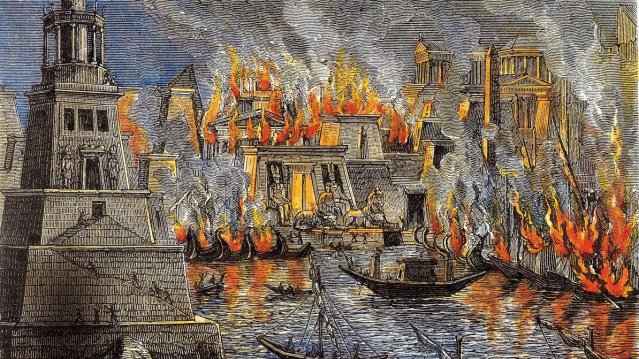
In 48 BCE, embroiled in a campaign against his rival Pompey, Julius Caesar laid siege to the Egyptian city of Alexandria…
The Roman ruler laid siege to the city and decided there was only one way to break the stalemate and maintain military control of the harbor — he lit his docked fleet on fire.
The ensuing blaze quickly spread through the city as fires were wont to do in the days of wooden ships and nonexistent fire departments. The flames soon reached the beloved Library of Alexandria. It is believed that nearly 10 percent of the building went up in flames that day, although the specifics of what was burned and the extent of the damage are unknown.
It was the first time the library — a grand church of universal knowledge and scholarship the likes of which the world had never seen — was attacked. It wouldn’t be the last… [source]
But what if things had unfolded differently?
Julius Caesar’s Egyptian excursion almost ended in catastrophe. Battles broke out in Alexandria, and from the burning ships, the flames moved to the structure of the great, famous library. Already a good 200 years old, it contained the entirety of ancient knowledge and culture. It’s frightening just to think what dark ages would have fallen on the Earth if we had lost this invaluable collection of books.
We owe the rescue of this treasure to Julius Caesar himself. It was he, seeing that the building with tens of thousands of books was threatened, who ordered the Roman soldiers to halt their attack, and threw himself into the battle against the flames. While putting out the fire he was severely burned, losing his left thumb. It was then that he said the famous words: “When books are burning, it’s time to lay down the sword.” Ever since that moment, the divine Julius has been sculpted and painted without his left thumb. And the Roman salute – the left hand raised, with the thumb hidden – gained popularity as a sign of people who are educated and hungry for wisdom….
In this engaging alternative history, the literature preserved in the library, notably Greek writings about steam power, are enough to kick-start an industrial revolution in ancient Rome. Roman steamships cross the Atlantic and discover America. The great historic event of 1492 was the first Moon landing. Contemplate it in its entirety: “Empire of the Alexandrinas: An alternative literary history.” [Via The Browser]
For more on the actual history of Alexandria’s amazing library, see “The Library of Alexandria Is Long-Gone – And All Around Us.”
###
As we explore the road not taken, we might recall that it was on this date in 1520 that Martin Luther burned his copy of the papal bull Exsurge Domine outside Wittenberg’s Elster Gate. The Bull had been published the prior June, in response to Luther’s teachings (which, of course, opposed the views of the Church). It censured forty one propositions extracted from Luther’s Ninety-five Theses and subsequent writings, and threatened him with excommunication unless he recanted. Luther refused and responded instead by composing polemical tracts lashing out at the papacy– and by publicly torching a copy of the bull. As a result, Luther was indeed excommunicated in 1521.

Title page of the first printed edition of Exsurge Domine
“Veni, vidi, vici”*…

A young (and unshaven) Julius Caesar
In chapter 2 of his Life of Julius Caesar, the Greek historian Plutarch of Chaeronea (46-c.120) describes what happened when Caesar encountered the Cilician pirates, who infested the Aegean Sea, in 75 BCE. To that point, the Cilician’s had regularly offered the Roman senators slaves, which the nobles needed for their plantations in Italy– and which the Senate accepted as tribute, refraining from sending the Roman navy against the pirates.
The translation below was made by Robin Seager.
First, when the pirates demanded a ransom of twenty talents, Caesar burst out laughing. They did not know, he said, who it was that they had captured, and he volunteered to pay fifty. Then, when he had sent his followers to the various cities in order to raise the money and was left with one friend and two servants among these Cilicians, about the most bloodthirsty people in the world, he treated them so highhandedly that, whenever he wanted to sleep, he would send to them and tell them to stop talking.
For thirty-eight days, with the greatest unconcern, he joined in all their games and exercises, just as if he was their leader instead of their prisoner. He also wrote poems and speeches which he read aloud to them, and if they failed to admire his work, he would call them to their faces illiterate savages, and would often laughingly threaten to have them all hanged. They were much taken with this and attributed his freedom of speech to a kind of simplicity in his character or boyish playfulness.
However, the ransom arrived from Miletus and, as soon as he had paid it and been set free, he immediately manned some ships and set sail from the harbor of Miletus against the pirates. He found them still there, lying at anchor off the island, and he captured nearly all of them. He took their property as spoils of war and put the men themselves into the prison at Pergamon. He then went in person to [Marcus] Junius, the governor of Asia, thinking it proper that he, as praetor in charge of the province, should see to the punishment of the prisoners. Junius, however, cast longing eyes at the money, which came to a considerable sum, and kept saying that he needed time to look into the case.
Caesar paid no further attention to him. He went to Pergamon, took the pirates out of prison and crucified the lot of them, just as he had often told them he would do when he was on the island and they imagined that he was joking.
* (“I came, I saw, I conquered”) Julius Caesar, in a letter to the Roman Senate, 46 BCE (after his short war against Pharnaces II of Pontus)
###
As we exclaim “Great Caesar’s Ghost!”, we might recall that it was in this date in 1914 that Franz Ferdinand, 51 year old heir to the Austro-Hungarian Empire, was assassinated in Sarajevo, then the capital of Bosnia and Herzegovnia, where he was visiting to inspect the Empire’s troops. A member of the Black Hand nationalist group, Gavrilo Princip, shot and killed both the Crown Prince and his wife as they were being driven through the city. The assassination– triggering, as it did, competing accusations and the “calling” of interlocking alliances– ignited World War I, which broke out one month later.

Franz Ferdinand
You must be logged in to post a comment.