Posts Tagged ‘Library of Alexandria’
“Sex and death are the only things that can interest a serious mind”*…

As Greg Woolf observed, “The Epic of Gilgamesh is one of the earliest examples of what is sometimes termed a “Mirror of Princes,” a book that illustrates the conduct of both bad and good rulers, and makes clear the difference between them.”
Nicolas Liney reviews a new verse translation of the 4,000-year-old text by Simon Armitage and considers its remarkable power, its extraordinary history, and its profound relevance to our moment…
There are two stories of Gilgamesh, the ancient Mesopotamian epic written in the second millennium BCE. First, there’s the story of Gilgamesh himself, the semidivine king of Uruk. He is 11 cubits tall and four cubits from nipple to nipple (roughly 16 by six feet). He is hyperactive and priapic. He is not a good ruler. The gods create the wild Enkidu out of clay to keep him in check. The pair clash mightily, and then become inseparable. Restless and hungry for glory, they journey to the Forest of Cedar to defeat the monster Humbaba. Then they slay the Bull of Heaven sent by Ishtar, the god of sex and war whose advances Gilgamesh rejects. The gods deem that Enkidu must die, and so he does, slowly and unheroically. Gilgamesh watches over Enkidu’s body until a maggot falls from his nostril, a fantastically intense image that drives home death’s finality.
At this point, the register of the poem shifts, and Gilgamesh’s triumphs are replaced by sorrow and an overwhelming awareness of his own mortality. Alone and anguished, he journeys to the underworld to visit Uta-napishti, the immortalized survivor of a cataclysmic flood, intent on unlocking the secret to eternal life. Inevitably, he is disappointed and returns to Uruk. Gilgamesh is an epic about power, about self-knowledge, about passionate companionship and the unquenchable pain of its loss. Fundamentally, it is an epic about death. Rilke labeled it “das Epos der Todesfurcht”—the epic of the fear of death—and this is what gave it its vital appeal: “It concerns me,” he confessed. “Thousands of years later death is no less bewildering to humankind,” the poet Simon Armitage says in the introduction to his new translation of the epic; “there is no more relatable subject.”
The second story of Gilgamesh is about the text itself, one of the world’s oldest surviving long-form poems. Like Homeric epic, its roots are most likely oral, and questions of authorship are futile. The earliest version was a Sumerian cycle of five poems from around 2100 BCE, probably part of a larger group of stories about the heroic dynasty of Uruk. Sumerian eventually died out, and the five episodes were replaced by one unified version in Akkadian. This was recorded in cuneiform script, often carved in clay tablets, and spread throughout Mesopotamia and the Levant. Sometime between 1300 and 1000 CE, a man called Sin-leqi-unninni created a heavily revised edition organized into 11 “tablets”—referred to now as the Standard Version—which was copied widely and included in the great library of Ashurbanipal, the Assyrian king, built in Nineveh in the seventh century.
And then … silence. By the new millennium, Akkadian was a defunct language, and Uruk and Nineveh were in ruins. As far as we know, Gilgamesh was not translated into other writing systems, so when cuneiform fell out of use, the epic seemed to go with it. For centuries it slept, until the Library of Ashurbanipal was discovered by Austen Henry Layard and Hormuzd Rassam in 1850, and what documents could be recovered were transported to the British Museum. Cuneiform was eventually deciphered, and in 1872, George Smith, an assistant curator working on the archive, came across a fragment of the epic describing a great flood—similar to the one in the Book of Genesis,but in a work significantly older than the Bible. This was too much for Smith, who began stripping his clothes off in excitement: “I am the first man to read that after more than two thousand years of oblivion.”
Critics like to say that Gilgamesh is both incredibly old and refreshingly young. Its sheer age staggers—for comparison, just try to imagine a current novel being rediscovered in the year 5120 CE. As a quasi-historical figure, Gilgamesh was considered by Babylonians to be even older: the Sumerian King List,a chronographic record,hyperbolically places his reign in 7800 BCE. Within the world of the epic itself, time reaches back further still: when Gilgamesh meets Uta-napishti, the Noah-type figure who survived the flood long before Gilgamesh, even he can speak of an “ancient city,” Shuruppak, on the banks of the Euphrates. The epic constantly forces us into these dizzying loops of deep time, forces us both to drastically exceed the limits of our brief lifespan and to be persistently reminded of them.
But Gilgamesh’s comparatively recent reentry into the modern imagination makes it feel fresh, not overburdened by centuries of interpretation and adaptation, like Homer or Virgil, and firmly outside Western literary traditions. There is no first looking into Chapman’s Gilgamesh.This can be dangerous for translators and adapters: there’s an urge to treat the epic like a blank canvas, to make it say something relevant to contemporary concerns, which can strip it of its strangeness and also cut it loose from its Iraqi heritage. But the subject matter of Gilgamesh also seems undeniably contemporary: how could a story about ecological destruction, poor leaders, and misogynist alphas not concern us here and now?…
Eminently worth reading in full. A classic which has survived, against all odds, and what it offers us today: “The Epic of the Fear of Death” from @lareviewofbooks.bsky.social.
* William Butler Yeats
###
As we reach back, we might recall that it was on this date in 2004 that the discovery of what was (and is) believed to be the world’s oldest seat of learning (dating from 295 BCE), the Library of Alexandria, was announced by Zahi Hawass, president of Egypt’s Supreme Council of Antiquities during a conference at the University of California. A Polish-Egyptian team had uncovered 13 lecture halls featuring an elevated podium for the lecturer. Such a complex of lecture halls had never before been found on any Mediterranean Greco-Roman site. Alexandria may be regarded as the birthplace of western science, where Euclid discovered the rules of geometry, Eratosthenes measured the diameter of the Earth and Ptolemy wrote the Almagest, the most influential scientific book about the nature of the Universe for 1,500 years.
See also: “Oldest University Unearthed in Egypt“

“A great library contains the diary of the human race”*…
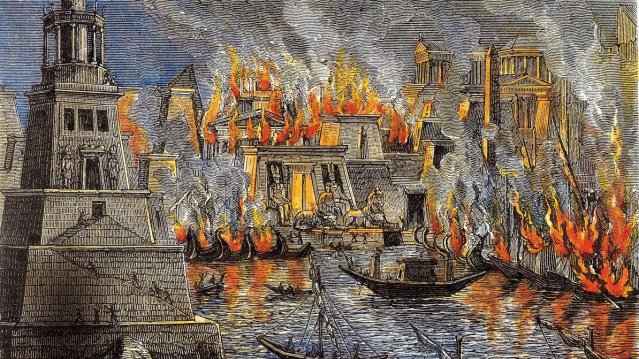
In 48 BCE, embroiled in a campaign against his rival Pompey, Julius Caesar laid siege to the Egyptian city of Alexandria…
The Roman ruler laid siege to the city and decided there was only one way to break the stalemate and maintain military control of the harbor — he lit his docked fleet on fire.
The ensuing blaze quickly spread through the city as fires were wont to do in the days of wooden ships and nonexistent fire departments. The flames soon reached the beloved Library of Alexandria. It is believed that nearly 10 percent of the building went up in flames that day, although the specifics of what was burned and the extent of the damage are unknown.
It was the first time the library — a grand church of universal knowledge and scholarship the likes of which the world had never seen — was attacked. It wouldn’t be the last… [source]
But what if things had unfolded differently?
Julius Caesar’s Egyptian excursion almost ended in catastrophe. Battles broke out in Alexandria, and from the burning ships, the flames moved to the structure of the great, famous library. Already a good 200 years old, it contained the entirety of ancient knowledge and culture. It’s frightening just to think what dark ages would have fallen on the Earth if we had lost this invaluable collection of books.
We owe the rescue of this treasure to Julius Caesar himself. It was he, seeing that the building with tens of thousands of books was threatened, who ordered the Roman soldiers to halt their attack, and threw himself into the battle against the flames. While putting out the fire he was severely burned, losing his left thumb. It was then that he said the famous words: “When books are burning, it’s time to lay down the sword.” Ever since that moment, the divine Julius has been sculpted and painted without his left thumb. And the Roman salute – the left hand raised, with the thumb hidden – gained popularity as a sign of people who are educated and hungry for wisdom….
In this engaging alternative history, the literature preserved in the library, notably Greek writings about steam power, are enough to kick-start an industrial revolution in ancient Rome. Roman steamships cross the Atlantic and discover America. The great historic event of 1492 was the first Moon landing. Contemplate it in its entirety: “Empire of the Alexandrinas: An alternative literary history.” [Via The Browser]
For more on the actual history of Alexandria’s amazing library, see “The Library of Alexandria Is Long-Gone – And All Around Us.”
###
As we explore the road not taken, we might recall that it was on this date in 1520 that Martin Luther burned his copy of the papal bull Exsurge Domine outside Wittenberg’s Elster Gate. The Bull had been published the prior June, in response to Luther’s teachings (which, of course, opposed the views of the Church). It censured forty one propositions extracted from Luther’s Ninety-five Theses and subsequent writings, and threatened him with excommunication unless he recanted. Luther refused and responded instead by composing polemical tracts lashing out at the papacy– and by publicly torching a copy of the bull. As a result, Luther was indeed excommunicated in 1521.

Title page of the first printed edition of Exsurge Domine
You must be logged in to post a comment.