Posts Tagged ‘Moon’
“Here comes the sun”*…

Further, in a fashion, to last Wednesday’s post… We’ve looked before (e.g., here) at the potential havoc that solar storms could wreak on our electified lives. Now, as Paul Voosen reports, scientists are speculating on a defense, suggesting that gases released from satellites could slash the threat of severe “space weather”…
When violent eruptions from the Sun slam into Earth’s magnetic field, they do more than paint aurorae across the night sky. They can scramble the electronics of satellites and induce powerful ground currents that knock out electrical grids. It’s been estimated that a one-in-a-100-year solar storm like the 1859 Carrington Event could cause more than $3 trillion of damage to the power grid alone. [See here.]
Yet for decades, society’s only defenses have been better space weather forecasts and more durable technology on the ground and in space. Now, a small group of space physicists says humanity should intervene and weaken solar storms in real time. In a study published [recently] in Space Weather, the researchers describe a provocative proposal called “StormWall”: a fleet of satellites that would release hundreds of tons of gases into space just before a solar storm strikes Earth. Computer simulations suggest the artificial cloud could cut the intensity of a major solar storm by half or more. “It’s as if you could install an airbag in the magnetosphere,” says Daniel Welling, a co-author and space physicist at the University of Michigan.
Call it “helioengineering”—a deliberate intervention in the near-Earth space environment. But unlike controversial geoengineering proposals to mitigate global warming, which would inject long-lived Sun-blocking particles into the atmosphere, StormWall’s protective gases would dissipate within hours, says Brian Walsh, the study’s lead author and a space physicist at Boston University. “It’s waiting for us to do some temporary modification.”
The proposal would require more extensive simulations and testing. But it is “highly innovative and appears to be quite feasible in the near term,” says Allison Jaynes, a space physicist at the University of Iowa. It’s a “laudable idea,” adds Gurudas Ganguli, a space physicist at the U.S. Naval Research Laboratory (NRL)…
[Voosen explains the technology proposed and considers the challenges in its implementation…]
… Of course, like an airbag, StormWall would have to be replaced if deployed. But just as NASA and other space agencies are studying how to protect the planet from asteroids [and here], Walsh says there’s a good argument for fortifying an electronics-dependent society against massive solar eruptions. “If we lose all our power grids and can’t use the internet for 6 years, it would be traumatic.”
“Radical proposal would block solar storms with orbital ‘airbag’” from @science.org.
* George Harrison
###
As we apply sunscreen, we might send bright birthday greetings to Godfried Wendelen; he was born on this date in 1580. And astronomer (and Catholic priest) known as “the Ptolemy of his time.” Despite the tenets of his church, Wendelen was an audacious proponent of the Copernican theory that the planets orbit around the sun. He made more accurate measurements of the distance to the sun than those previously made by Aristachus (2,000 years earlier) from the geometrical relationships at the exact time of a half-moon.
Wendelen is considered by many as a precursor of Kepler and Newton, and was in fact cited by Newton in his Principia. The crater Vendelinus on the Moon is named after him

“The sacred moon overhead / Has taken a new phase”*…
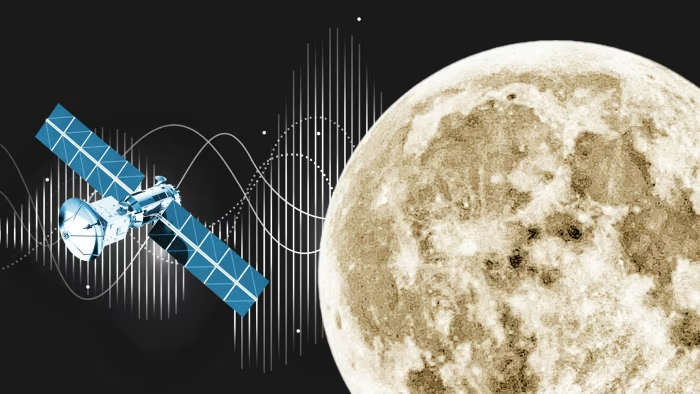
As Oliver Hawkins and Peggy Hollinger report, an analysis of commercial radio spectrum filings shows a growing number of players– government agencies, but increasingly private companies– bettting on the emergence of a lunar economy…
Private companies are staking claims to radio spectrum on the Moon with the aim of exploiting an emerging lunar economy, Financial Times research has found.
More than 50 applications have been filed with the International Telecommunication Union since 2010 to use spectrum, the invisible highway of electromagnetic waves that enable all wireless technology, on or from the Moon.
Last year the number of commercial filings to the global co-ordinating body for lunar spectrum outstripped those from space agencies and governments for the first time, according to FT research. The filings cover satellite systems as well as missions to land on the lunar surface.
“We will look back and see this as an important inflection point,” said Katherine Gizinski, chief executive of spectrum consultancy River Advisers, which has filed for lunar spectrum for three satellite systems on behalf of other companies since 2021.
Although total registrations were lower in 2024 than the previous year, the increased proportion of commercial filings reflects a race to build the infrastructure that will enable the “cislunar economy”, the area between the Earth and Moon…
More on the players and the game: “The race to claim the Moon’s airwaves” (gift article), from @financialtimes.com. See also:
* William Butler Yeats, “The Cat and the Moon”
###
As we linger over the lunar, we might recall that it was on this date in 1971 that NASA accomplished the third lunar EVA: Commander Alan B. Shepard and Lunar Module pilot Edgar D. Mitchell became the fifth and sixth men to walk on the Moon (in the lunar highlands near the crater Fra Mauro) as part of the Apollo 14 mission.
During this four-hour “activity,” they deployed the Apollo Lunar Surface Experiments Package (ALSEP)– scientific experiments that were left on the lunar surface and other scientific and sample collection apparatus. B efore lifting off on the next day, the astronauts went on another moonwalk almost to the rim of nearby Cone crater, collecting 42.9 kg of samples along the traverse. At the end of this 3.45 km walk, Shepard used a contingency sampler with a Wilson 6-iron connected to the end to hit two golf balls.
“We must guard against the acquisition of unwarranted influence, whether sought or unsought, by the military-industrial complex”*…

The world is a turbulent and sometimes dangerous place. No one knew that better than Dwight D. Eisenhower, who led Allied Forces in Europe during World War II and later served as President…
As President of the United States for two terms, Eisenhower had slowed the push for increased defense spending despite pressure to build more military equipment during the Cold War’s arms race. Nonetheless, the American military services and the defense industry had expanded a great deal in the 1950s. Eisenhower thought this growth was needed to counter the Soviet Union, but it confounded him. Though he did not say so explicitly, his standing as a military leader helped give him the credibility to stand up to the pressures of this new, powerful interest group. He eventually described it as a necessary evil.
A vital element in keeping the peace is our military establishment. Our arms must be mighty, ready for instant action, so that no potential aggressor may be tempted to risk his own destruction. . . . American makers of plowshares could, with time and as required, make swords as well. But now we can no longer risk emergency improvisation of national defense; we have been compelled to create a permanent armaments industry of vast proportions. . . . This conjunction of an immense military establishment and a large arms industry is new in the American experience. . . .Yet we must not fail to comprehend its grave implications. . . . In the councils of government, we must guard against the acquisition of unwarranted influence, whether sought or unsought, by the military-industrial complex. The potential for the disastrous rise of misplaced power exists and will persist.
As Samuel Geddes argues, the dilemma has only ripened. Western defense giants tout cutting-edge tech, but their “state-of-the-art” systems often fall short in asymmetrical warfare. From faulty missile defense systems to overpriced carriers, the only thing that consistently works is the profit machine…
The ineffectiveness of “cutting-edge” military technology shown in Israel’s genocide in Gaza and the spillover conflicts undermines the notion that the military-industrial complex aims to win wars. Instead, it reveals its true objective: profiting from ongoing conflicts.
Since its crushing victory in the 1967 Six-Day War, one of Israel’s primary functions as a US-European client state has been that of a weapons laboratory. Throughout eight decades of repressing, invading, and annexing the territory of regional countries, it has served as a proving ground for arms manufacturers.
This continuous opportunity for such demonstration has enabled Israel, starting in the 1980s, to develop its own highly globalized military-industrial complex. From tanks to drones, “Israel” became a byword for the technical superiority and unbeatable effectiveness of western hard power over those on its receiving end.
Since the turn of the millennium, however, and especially since the Hamas-led Palestinian offensive against Israel on October 7, the region has become a weapons lab of a very different kind. It now showcases the armaments of its enemies and their ability, for a fraction of the cost and technical complexity, to render its space-age technology uneconomical and, by extension, obsolete.
The spread of cheap, cost-effective arms among asymmetric opponents of the West has significantly blunted the power of conventional weapons systems. The rational thing to do is accept this and redirect these hundreds of billions of wasted dollars to social programs and infrastructure. Almost anything would be more defensible than the status quo…
[Geddes unpacks the history of the last several decades and examines a number of troubled defense programs…]
… The most notorious example of wastefulness in military spending is undoubtedly the Lockheed Martin F-35 fighter jet. From the program’s inception in 2006 to the present, the F-35 was projected to cost over $1.7 trillion over its lifetime. Persistent cost overruns and development woes have angered even the Pentagon itself, which opened the program up to competitive bidding in 2012. More than a decade later, the rapid spread of drone technology has made it possible for unmanned craft, sometimes referred to as “loitering munitions,” to perform many of the tasks traditionally handled by fighter jets — with little overengineering and none of the risk to an actual pilot. That the total budget of this program could eradicate all American student loan debt or cover half the cost of a national health system only adds to the obscenity of it all.
It is well-known that the military-industrial economy is dependent on public subsidy. The technology in mobile phones, computers, and the internet — essential to modern life —was not “invented” by figures like Mark Zuckerberg or Bill Gates, but was instead developed by public investment. The initial funding came from decades of American taxpayer dollars.
Capitalism is not designed to be ethically consistent, but if it were, companies whose business model depends on state supports would be paying out dividends to every single American as a return on their initial investment.
In 2024, the US military budget reached an incredible $841 billion. If even a fraction of these funds were to be spent on restoring the education system to a level befitting the richest country on earth, canceling university tuition debt, or creating a national health system, it would achieve far greater benefits. While $1 trillion might not result in effective missile shields, it is very likely capable of creating a functioning health or educational system…
“The Incompetence of Masters of War,” from @SamuelGeddes in @jacobin.
Further to his point on the effectiveness of U.S. defense spending, see “America is not ready for a major war, says a bipartisan commission” and “The US might lose a war with China.”
And for more on the arguments for alternatives, see “The military-industrial complex as a variety of capitalism and threat to democracy: rethinking the political economy of guns versus butter.”
* Dwight D. Eisenhower
###
As we contemplate conflict, we might pause to contrast the rigorously serious with the frivolously venal: it was on this date in 1835 that the New York Sun began a series of six articles detailing the discovery of civilized life on the moon; circulation soared. Now known as “The Great Moon Hoax,” the articles attributed the “discovery” to Sir John Herschel (who figured in last Monday’s post), the greatest living astronomer of the day. Herschel was initially amused, wryly noting that his own real observations could never be as exciting. But ultimately he tired of having to answer questioners who believed the story. The series was not discovered to be a hoax for several weeks after its publication and, even then, while the paper did admit (on September 16, 1835) that the whole thing was a “satire,” it never issued a retraction (and didn’t suffer a drop in sales).

“Our grandfathers lived in a world of largely self-sufficient, inward-looking national economies – but our great-great grandfathers lived, as we do, in a world of large-scale international trade and investment, a world destroyed by nationalism.”*…

There’s a growing chorus of opinion arguing that the era of global trade is ending. To be sure, nationalism and the protectionism it can spawn are on the rise. But is globalization’s decline now locked in? In a recent speech at the University of Tokyo, Bill Emmott questions the conclusions of The Economist (which he used to edit) and others predicting an end to a world in which goods and services flow relatively freely– pointing out the global trade is still very much alive. It’s a provocative talk, eminently worth reading in full; it ends with a framework for thinking about the question…
The history of globalisation that I have outlined has shown the development of international trade in goods and services to have been driven by three main forces:
- Peace, war and international security
- National external trade policies
- Technology, and its effect on transaction costs
It is clear that the biggest discontinuity in the growth of international commerce was caused by what we now know as the two world wars of the 20th century.
Russia’s invasion of Ukraine in 2022 has certainly diverted trade and financial flows considerably, thanks to direct security effects and to sanctions. But neither it nor the other conflicts we can see occurring in the Middle East, Africa or elsewhere have been sufficient to block global trade in a significant way.
Tensions between the US and China similarly have some diversionary effects, and are to some degree echoed in tensions between China and Europe and China and Japan. But those geopolitical tensions would have to get a lot worse to have a major effect on global commerce as a whole, in part because the world economy has become much more complex and multipolar in nature.
The one conflict that would be very likely to have a major “deglobalisation” influence would be a conflict between the US and China over Taiwan, for such a conflict would very likely reach catastrophic proportions and would force many countries to choose sides. We cannot predict how commerce and the exchange of ideas would look after such a conflict, just as my European forebears would have been unable to predict the world after 1918 from the standpoint of 1914 or earlier.
Secondly, nations’ external trade policies. As I commented earlier, there has been a clear trend back towards protectionism since the 2008 financial crisis, one that has lately been reinforced by policies aimed at the energy transition and by US-China tensions.
This has not yet however had a major effect on world trade. It could, of course. The big question is what would happen if Donald Trump is re-elected as US President in November and carries out his promise to impose a 10% tariff on all imported goods, and a 60% tariff on all goods from China.
One quite likely possibility is that other countries – including the EU, the UK, Japan and indeed China – would retaliate by imposing higher tariffs of their own, and we would be in a trade war, one that could escalate higher and higher.
The wider such a trade war became – i.e., taking in more countries – the likelier it would be to make deglobalisation visible in the trade statistics. Nonetheless, we should bear one other thing in mind: this is that services, especially digitally delivered services, have become an increasingly important component of global commerce. How they would be affected is unpredictable.
Third, we need to bring in the related and vitally important force of technology. Falling costs and increasing digital capabilities have been a big factor behind the growth of global commerce. The entry of artificial intelligence means that there is no likelihood of this technological force for cross-border commerce diminishing.
During the pandemic, the science and technology behind vaccine development, production and distribution were all global, even if geopolitics introduced some distortions. Moreover, the basic reason why the US stock market has been driven by the so-called “Magnificent Seven” tech stocks is that the market for all of them is global.
Geopolitics threatens, but as yet it does not decide. External trade policies at present divert, but only an escalatory trade war would be likely to have a major effect. Technology, however, remains the most powerful force in favour of continued globalisation.
The future of globalisation will be determined by the interplay of these three forces. There is no currently pre-determined destiny for globalisation. Many commentators over-play the influence of politics and under-play the role of technology. Extreme outcomes are possible, and need to be prepared for. But we must above all keep an open mind as to what the actual outcome will be…
We see deglobalization everywhere except in trade statistics: “The future of globalisation: a history,” from @bill_emmott and his excellent newsletter, Bill Emmott’s Global View .
(Image above: source)
* Paul Krugman
###
As we tackle trade, we might recall that it was on this date in 1178, about an hour after sunset, that five monks from Canterbury saw “the upper horn [of the Moon] split in two.” They reported their experience to the abbey’s chronicler, Gervase, continuing (as he reports) “From the midpoint of the division a flaming torch sprang up, spewing out, over a considerable distance, fire, hot coals and sparks. Meanwhile the body of the Moon which was below writhed, as it were in anxiety, and to put it in the words of those who reported it to me and saw it with their own eyes, the Moon throbbed like a wounded snake. Afterwards it resumed its proper state. This phenomenon was repeated a dozen times or more, the flame assuming various twisting shapes at random and then returning to normal. Then, after these transformations, the Moon from horn to horn, that is along its whole length, took on a blackish appearance.”
In 1976, a geologist suggested that this was consistent with the location and age of the 22-km lunar crater Giordano Bruno. However, such asteroid impact would have ejected debris causing an astonishing meteor shower, which was never reported. So, while that is plausible, it’s now considered more likely that the sighting of 1178 was an exploding meteor that just happened to line up with their view of the Moon.

“Oh dark, dark, dark, amid the blaze of noon, irrevocably dark, total eclipse without all hope of day”*…

Today is the occasion of an annular eclipse, which will pass through eight U.S. states before crossing the Gulf of Mexico and to transit Mexico, Guatemala, Belize, Honduras, Nicaragua, Costa Rica, Panama, Colombia, and Brazil. While some people in the Western Hemisphere will witness a “ring of fire” during the eclipse, many more will experience the phenomenon of crescent sunlight. Rebecca Boyle has advice on how we might approach it…
… This Saturday, for some people in the Western Hemisphere, the Sun will disappear for a few minutes and appear to leave a flaming hole in the sky. Instead of a ball of fire, the Sun will transform into a ring of fire, a strange and wondrous sight. This is an annular solar eclipse, and it happens because the Moon is right smack in front of the Sun.
A solar eclipse only happens during new Moon phases, when we otherwise wouldn’t be able to see our nearest celestial companion. Though we get a new Moon every month, we do not get solar eclipses as often because of our satellite’s oddball path around the planet. Sometimes the Moon casts a shadow just above Earth, and sometimes just below. This weekend, the Moon’s shadow will fall onto Earth, just right for people in parts of the Western Hemisphere to see it.
The annular eclipse is a preview of a more incredible, rarer event next April, when a total solar eclipse will cross the continental United States. There is no experience on Earth like a total eclipse; make plans to see it, if you can. But this weekend’s “ring of fire” eclipse is an event you should try to see first (safely, with eclipse glasses), if you can get yourself into the western U.S. or parts of Central and South America. Here’s a map showing the eclipse path; if you can’t travel to see it in person, you can watch the eclipse online.
Eclipses happen because the Sun and Moon appear to be roughly the same diameter. The Sun is actually about 400 times larger than the Moon, but it is also about 400 times more distant, so they seem like the same size in our sky.
…
The Moon’s shadow forms two concentric cones, composed of an inner shadow called the umbra, where the sun is completely obscured, and an outer, broader cone called a penumbra, where sunlight still shines but it is partially blocked. The umbra can be seen in a narrow geographic ribbon across the Americas, and it’s where you will see a full eclipse; under the penumbra, which covers much of the western U.S., Central and South America, you will see a partial eclipse.
Like the gears of a clock, a combination of precise positions and movements initiate an eclipse of the Sun. As Earth spins, day breaks. The Sun and Moon appear to trace a path across the sky. The Sun is not moving (at least not perceptibly); Earth’s rotation makes the star’s position change. The Moon is moving around us while the Earth rotates, so it seems to move too, but it appears to go slower than our star. The partial solar eclipse begins as the Sun catches up to the Moon’s position in our sky. On Saturday morning around 8:06 a.m. Pacific time, people in Eugene, Oregon, will be the first to see the Moon appear to take a bite out of the Sun. The bite will get progressively bigger until the full annular eclipse begins at 9:16 a.m. Pacific time.
The annular eclipse only lasts about four minutes (depending on your precise location under the Moon’s shadow) but the partial eclipse, which will be visible over a much wider geographic area, lasts about an hour and 15 minutes before and afterward. During this phase, shadows cast by objects on Earth will change in unusual ways. One lovely place to be during a partial solar eclipse is underneath a tree, if you can find an evergreen or a deciduous tree that has not dropped its leaves yet. Look at the ground. In the dappled light, you will see crescents everywhere: the crescent Sun.
Sunlight is the heavens reaching down to touch us right where we stand; I think about this when I step into the light. But crescent sunlight is the Moon joining this experience. Its darkness, rather than its light, reaches out to touch us, too…
An informative and lyrical guide to today’s eclipse: “During an Annular Eclipse, Look to the Shadows,” from @rboyle31 in @atlasobscura.
* John Milton, Samson Agonistes
###
As we don’t look directly, we might recall that on this date in 1609, Galileo (who has claim to the titles Father of observational astronomy, modern-era classical physics, the scientific method, and modern science) put the telescope to use in his astronomical work. Upon hearing (at age 40) that a Dutch optician had invented a glass that made distant objects appear larger, Galileo crafted his telescope. He continued to improve his device, ultimately achieving 30X magnification, and recorded his observations of the Moon, the moons of Jupiter, the Phases of Venus, Sunspots, The Milky Way, and more. He published his initial telescopic astronomical observations in March 1610 in a brief treatise entitled Sidereus Nuncius (Starry Messenger).
Telescopes were also a profitable sideline for Galileo, who sold them to merchants who found them useful both at sea and as items of trade.

You must be logged in to post a comment.