Posts Tagged ‘photography’
“Everywhere is walking distance if you have the time”*…
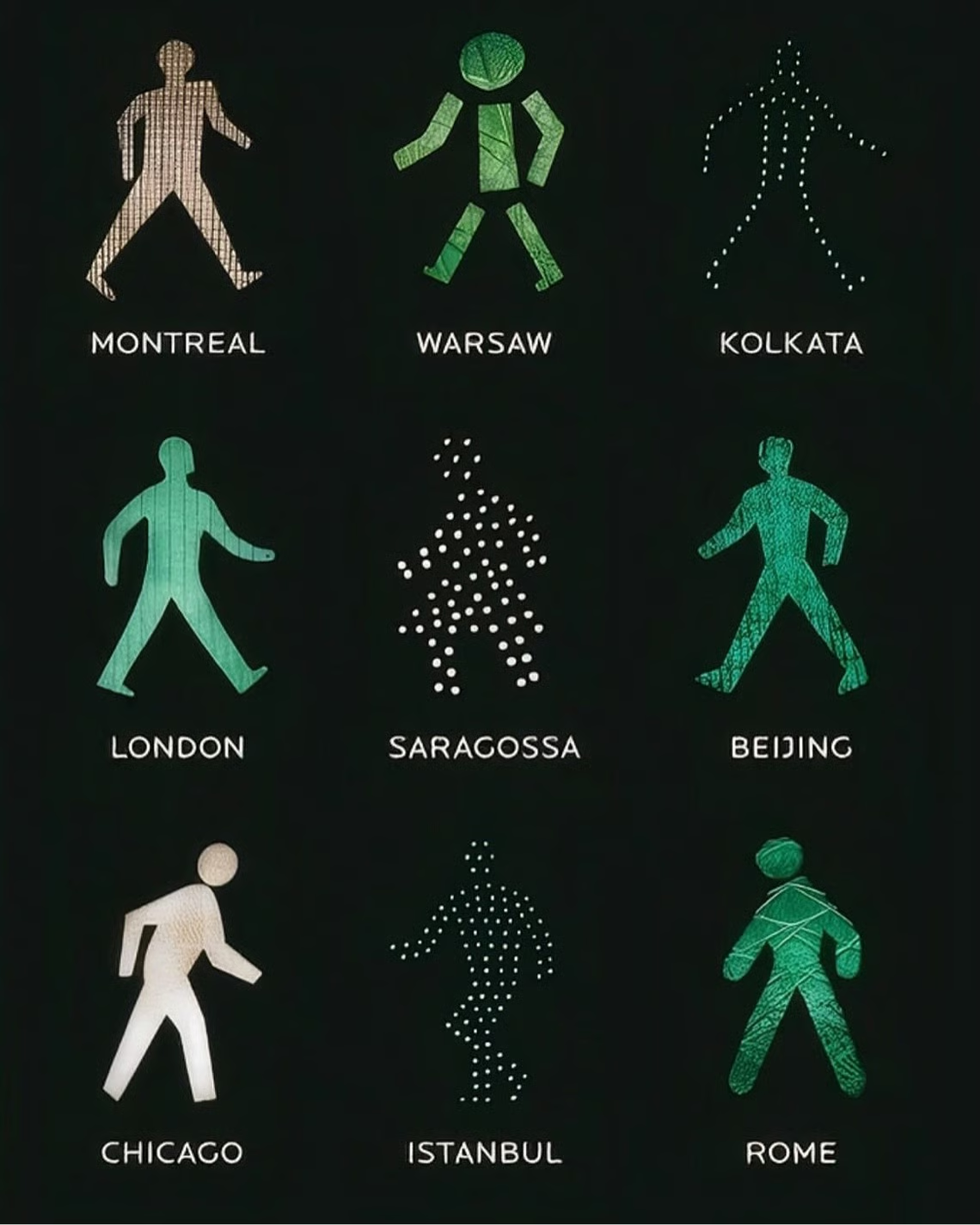
Photographer Maya Barkai has collected pedestrian traffic signals from around the world…
Walking Men worldwide™ is a series of public art installations, a photographic collage of pedestrian traffic icons assembled from around the world, presented in humane scale. The project was conceived as a collaborative effort of international photographers, each adding a piece to the collage… Once assembled on one canvas, these icons represent the ever-growing list of international contributors.
The subject of this project started with one of New York City’s most familiar street icons, one that repeatedly appears in the pedestrian traffic light we meet every day. As one of NYC’s most recognizable figures, the ‘walking man’ is also an international celebrity, a graphic sign that transcends all languages and places, and appears in various forms around the world as an integral part of our urban landscape.
Numerous traffic-light-characters represent the modern “Walking Men”. Standardized yet diverse, they commonly show us the correct and safe way of travel. The Walking Men Worldwide™ project explores various representations of the universally rendered ‘man’, and attempts to examine its inherent conundrum; why is it that while we all consider these icons to be topologically identical, they appear to add such a unique character to our urban identity? These two-dimensional ‘men’, omitted of all idiosyncratic detail, repeatedly reveal themselves in multiple forms on traffic lights and street signs on every corner, as this photographic collage unveils a rich and fascinating world within the confines of a coherent, multi-lingual graphic vocabulary.
What started as a series of largescale public art interventions, has evolved into an important, rare visual document on its own right. This body of work not only provides us with the first and most cohesive look into the world of human circulation, but in leading a participatory experience through a collaborative process that is rooted in the nature of documentary photography, the work has unified people through a simple yet powerful act of art; The creative process involved in my work is an example for how an artist can gather hundreds of worldwide contributors by utilizing social media as a platform, and motivate people to take part in the creation of a collage that unites them all on one canvas. In doing so, it creates a collaborative process that diminishes all political agenda, and becomes a “graphic Esperanto”…
Explore: “Walking Men Worldwide” via Kottke.org.
* Steven Wright
###
As we look both ways, we might send combustible birthday greetings to Robert Bosch; he was born on this date in 1861. An engineer, inventor, and ultimately, buiness magnate, he contributed to the need for the Walking Man: he invented the spark plug and the magneto for automobiles, and founded the German conglomerate Bosch.
The final years of Bosch’s life were painful. When his company was forced to accept Nazi contracts, he had his managing staff join the Nazi party to prevent external, committed Nazi officials from attaining employment and taking over the organization. Bosch slow-walked the orders and used his company and foreign connections to foster anti-Hitler activism. Bosch worked particularly closely with his business advisor Carl Friedrich Goerdeler, a figure central to the 20 July plot to assassinate Hitler. Goerdeler continued the resistance movement after Bosch’s death in 1942.
In 1937, Bosch had restructured his company as a private limited company. He established his last will and testament in which he stipulated that the earnings of the company should be allocated to a foundation devoted to charitable causes (and which received his 94 percent ownership of the company on his death). His will sketched the outlines of the corporate constitution, which was formulated by his successors and is still valid today. Bosch remains in relatively solid shape on the Brand Ledger.

“Let us leave a splendid legacy for our children… guard it well, for it is far more precious than money… and once destroyed, nature’s beauty cannot be repurchased at any price.”*…

From the National Archives, an extraordinary collection of Ansel Adams‘ photos of National Parks in the U.S…
In 1941 the National Park Service commissioned noted photographer Ansel Adams to create a photo mural for the Department of the Interior Building in Washington, DC. The theme was to be nature as exemplified and protected in the U.S. National Parks. The mural project was halted because of World War II and never resumed, however the photographs remained.
Much later in 1962 the photographs were accessioned into the holdings of the Still Picture Branch at the National Archives and Records Administration. The original prints created for the project now reside within the series 79-AA: Ansel Adams Photographs of National Parks and Monuments, 1941 – 1942, while the negatives were originally retained by Adams at the time. Ansel Adams would later visit the Still Picture Branch and review his photographic prints in 1979.
The holdings of the National Archives’ Still Picture Branch include 226 photographs taken for this project, most of them signed and captioned by Adams. They were taken between 1941 and 1942 at the Grand Canyon, Grand Teton, Kings Canyon, Mesa Verde, Rocky Mountain, Yellowstone, Yosemite, Carlsbad Caverns, Glacier, and Zion National Parks; Death Valley, Saguaro, and Canyon de Chelly National Monuments. Other pictures were taken at the Boulder Dam; Acoma Pueblo, NM; San Idelfonso, NM; Taos Pueblo, NM; Tuba City, AZ; Walpi, AZ; and Owens Valley, CA. Many of the latter locations show Navajo and Pueblo Indians, their homes and activities.
The Kings Canyon photographs were taken in 1936 when the establishment of the park was being proposed. These prints were added by Adams to the mural project. The one photograph of Yosemite (79-AAU-1) was a gift from Adams to the head of the Park Service, Horace Albright, in 1933.
In addition, there are eight photographs taken by Adams of Yosemite in the General Photographic Files of the National Park Service (79-G)…
Many, many more at: “Ansel Adams Photographs of National Parks.”
“It is horrifying that we have to fight our own government to save the environment” – Ansel Adams
###
As we wonder, we might recall that it was on this date in 1940 that an ancestor of the art featured above was discovered: a teenager named Marcel Ravidat found the entrance to cs in southwest France when his dog investigated a hole left by an uprooted tree. Ravidat collected three friends, then followed his dog down what turned out to be the narrow entrance into a cavern, where they came upon (part of) the now-storied collection of wall markings— 15,000- to 17,000-year-old paintings, consisting mostly of animal representations– that are among the world’s finest examples of art from the Upper Paleolithic period.
See also: “To practice any art, no matter how well or how badly, is a way to make your soul grow.”

“There are few creatures more remarkable than the lowly slime mold”*…

… nor, perhaps, more beautiful…
We’ve looked before at the at the “intelligent” accomplishments of the humble slime mold, and wondered what they might mean and what they might teach us. Photographer Barry Webb invites us to appreciate their spendor…
Blown wildly out of proportion in large format, the slime molds that British photographer Barry Webb captures seem atmospheric and sculptural. Stemonitis, for example, looks like dozens of thin pieces of wire with their ends coated in colored wax. But this fungi-like form is one of hundreds of kinds of slime mold, and it typically only reaches a height of about two centimeters at the most. Thanks to Webb’s macro photos, we glimpse a phenomenally beautiful world up-close that is otherwise virtually invisible.
Scientists have documented hundreds of these organisms, which aren’t actually related to plants, fungi, animals, or molds—despite the name. They comprise a unique group unto themselves, more closely related to amoebas. And new discoveries are being made all the time. From mottled gray bulbs that look like snow-covered trees to pink, coral-like tendrils, Webb chronicles a huge array of colors and shapes. He also consistently submits images to local and national botanical records so that researchers have access to high-resolution imagery…

“Barry Webb Documents a Marvelous, Macro Array of Colorful Slime Molds,” from @thisiscolossal.com.
More of Webb’s portraits of slime mold on his site.
* Brandon Keim (in “Complexity Theory in Icky Action: Meet the Slime Mold“)
###
As we get small, we might send microscopic greetings to William Ian Beardmore (W. I. B.) Beveridge; he was born on this date in 1908. A microbiologist and veterinarian who served as director of the Institute of Animal Pathology at Cambridge, he identified the origin of the Great Influenza (the Spanish Flu pandemic, 1918-19)– a strain of swine flu.

While there is no way to know with certainty the Bard’s birth date, his baptism was recorded at Stratford-on-Avon on April 26, 1564; and three days was the then-customary wait before baptism. In any case, we do know with some certainty that Shakespeare died on this date in 1616.
“The bigger, the better”*…

Thea Applebaum Licht with a reminder that, when it comes to size, Texas has got nothing on California…
Between about 1905 and 1915, the United States entered a golden age of postcards. Cheaper and faster mail service, the advent of “divided back” cards (freeing the entire front for images), and improved commercial printing all drove a new mass market for collectible communication. It was at this same moment that a craze for “tall-tale” or “exaggeration” postcards reached its peak. By cutting, collaging, and re-photographing images, artists created out-of-proportion illusions. One of the most popular genres was agricultural goods of fantastic dimensions.
Nowhere were such postcards more popular than in the western states. There, in the heart of the tough business of agriculture, illustrations of folkloric American abundance were understandable favorites. Pride and place were tied up with the prodigious crops. Supersized fruits and vegetables were often accompanied by brief captions: “How We Do Things at Attica, Wis.”, “The Kind We Raise in Our State”, or “The Kind We Grow in Texas”. Photographers like William “Dad” H. Martin and Alfred Stanley Johnson Jr. captured farmers harvesting furniture-sized onions and stacking corn cobs like timber, fisherman reeling in leviathans, and children sharing canoe-like slices of watermelon.
In the series of exaggeration postcards [produced in the run-up to the postcard boom, then published during it] collected [here], it is California that takes center stage. Produced by the prolific San Francisco–based publisher Edward H. Mitchell, each card features a single rail car rolling through lush farmland. Aboard are gargantuan, luminous fruits and vegetables: dimpled navel oranges, a dusky bunch of grapes, and mottled walnuts. Placed end-to-end, the cards would make a colorful train crossing California’s fertile valleys. Unlike other, more action-packed “tall-tale” cards — filled with farmers, fisherman, and children for scale — Mitchell’s series is restrained. Sharply illuminated, the colossal cargo lean toward artwork rather than gag. “A Carload of Mammoth Apples”[here], green-yellow and gleaming, could have been plucked from Rene Magritte’s The Son of Man [here].
Fabulous fruit and vegetables: “Calicornication: Postcards of Giant Produce (1909),” from @publicdomainrev.bsky.social.
In other art-related news: (very) long-term readers might recall that, back in 2008, (R)D reported that London’s Daily Mail believed that it had tracked him down, and that he is Robin Gunningham. Now as Boing Boing reports:
Anyone reading Banksy’s Wikipedia article at any point since a famous Mail on Sunday exposé in 2008 would likely get the impression the secretive stenciler is probably Robin Gunningham or Robert Del Naja, artists who came from the Bristol Underground. Reuters, having conducted extensive research into their movements, finds both men present at critical moments, but only one at all of them: an arrest report from New York City puts Gunningham firmly in the frame, and recent public records from Ukraine put it beyond doubt.
We later unearthed previously undisclosed U.S. court records and police reports. These included a hand-written confession by the artist to a long-ago misdemeanor charge of disorderly conduct – a document that revealed, beyond dispute, Banksy’s true identity. … Reuters presented that man with its findings about his identity and detailed questions about his work and career. He didn’t reply. Banksy’s company, Pest Control, said the artist “has decided to say nothing.”
His long-time lawyer, Mark Stephens, wrote to Reuters that Banksy “does not accept that many of the details contained within your enquiry are correct.” He didn’t elaborate. Without confirming or denying Banksy’s identity, Stephens urged us not to publish this report, saying doing so would violate the artist’s privacy, interfere with his art and put him in danger.
Del Naja (better known for other work) evidently participates in painting the murals and is perhaps the stencil draftsman (Banksy: “he can actually draw”). Banksy’s former manager, Steve Lazarides, organized a legal name change for Gunningham after the Mail on Sunday item, which successfully ended records for Banksy’s movements under his birth name and stymied researchers—until Reuters figured out the new one by poring through Ukrainian public records on days Del Naja was there. Gunningham used the name David Jones, among the most common in the U.K. If it rings a bell, you might be thinking of another famous British artist was who obliged by his record company to find something more unique.
* common idiom
###
As we live large, we might spare a thought for Isaac Newton; he died on this date (O.S.) in 1727. A polymath who was a key figure in the Scientific Revolution and the Enlightenment that followed, Newton was a mathematician, physicist, astronomer, alchemist, theologian, author, and inventor. He contributed to and refined the scientific method, and his work is considered the most influential in bringing forth modern science. His book Philosophiæ Naturalis Principia Mathematica (Mathematical Principles of Natural Philosophy), first published in 1687, achieved the first great unification in physics and established classical mechanics. He also made seminal contributions to optics, and shares credit with the German mathematician Gottfried Wilhelm Leibniz for formulating infinitesimal calculus. (Newton developed calculus a couple of years before Leibniz, but published a couple of years after.) Newton spent the last three decades of his life in London, serving as Warden (1696–1699) and Master (1699–1727) of the Royal Mint, a role in which he increased the trustworthiness/accuracy and security of British coinage in a way crucial to the rise of Great Britain as a commercial and colonial power.
Newton, of course, had a famous relationship with fruit:
Newton often told the story that he was inspired to formulate his theory of gravitation by watching the fall of an apple from a tree. The story is believed to have passed into popular knowledge after being related by Catherine Barton, Newton’s niece, to Voltaire. Voltaire then wrote in his Essay on Epic Poetry (1727), “Sir Isaac Newton walking in his gardens, had the first thought of his system of gravitation, upon seeing an apple falling from a tree.” – source
Newton’s apple is thought to have been the green skinned ‘Flower of Kent’ variety.

“Mr. Hackett turned the corner and saw, in the failing light, at some distance, his seat”*…

Michael Wolf is an award-winning and widely-exhibited photographer famous for his documentation of big city architecture and life around the world, but especially in Hong Kong… Consider this series…


Much more at “Informal Seating Arrangements in Hong Kong” and more of Wolf’s other wonderful work on his site.
* Samuel Beckett, Watt
###
As we grab a chair, we might keep our focus on Hong Kong: it was on this date in 1978 that Snake in Eagle’s Shadow was released. A Hong Kong martial arts action comedy film, it was the debut of director Yuen Woo-ping, and the breakthrough outing for its stars, Jackie Chan, Hwang Jang-lee, and (Yuen Woo-ping’s real life father) Yuen Siu-tien.
The film is the story of Chien Fu (Jackie Chan), an orphan who is bullied at a kung fu school, but meets an old beggar, Pai Cheng-tien (Yuen Siu-tien), who becomes his sifu (teacher) and trains him in Snake Kung Fu. The film established Chan’s slapstick kung fu comedy style– which he further developed with Drunken Master, also directed by Yuen Woo-ping, released in the same year, and also starring Jackie Chan, Hwang Jang-lee and Yuen Siu-tien. Snake in Eagle’s Shadow (and Drunken Master) established the basic plot structure used in many, many martial arts films internationally since then.

You must be logged in to post a comment.