Posts Tagged ‘Walking man’
“Everywhere is walking distance if you have the time”*…
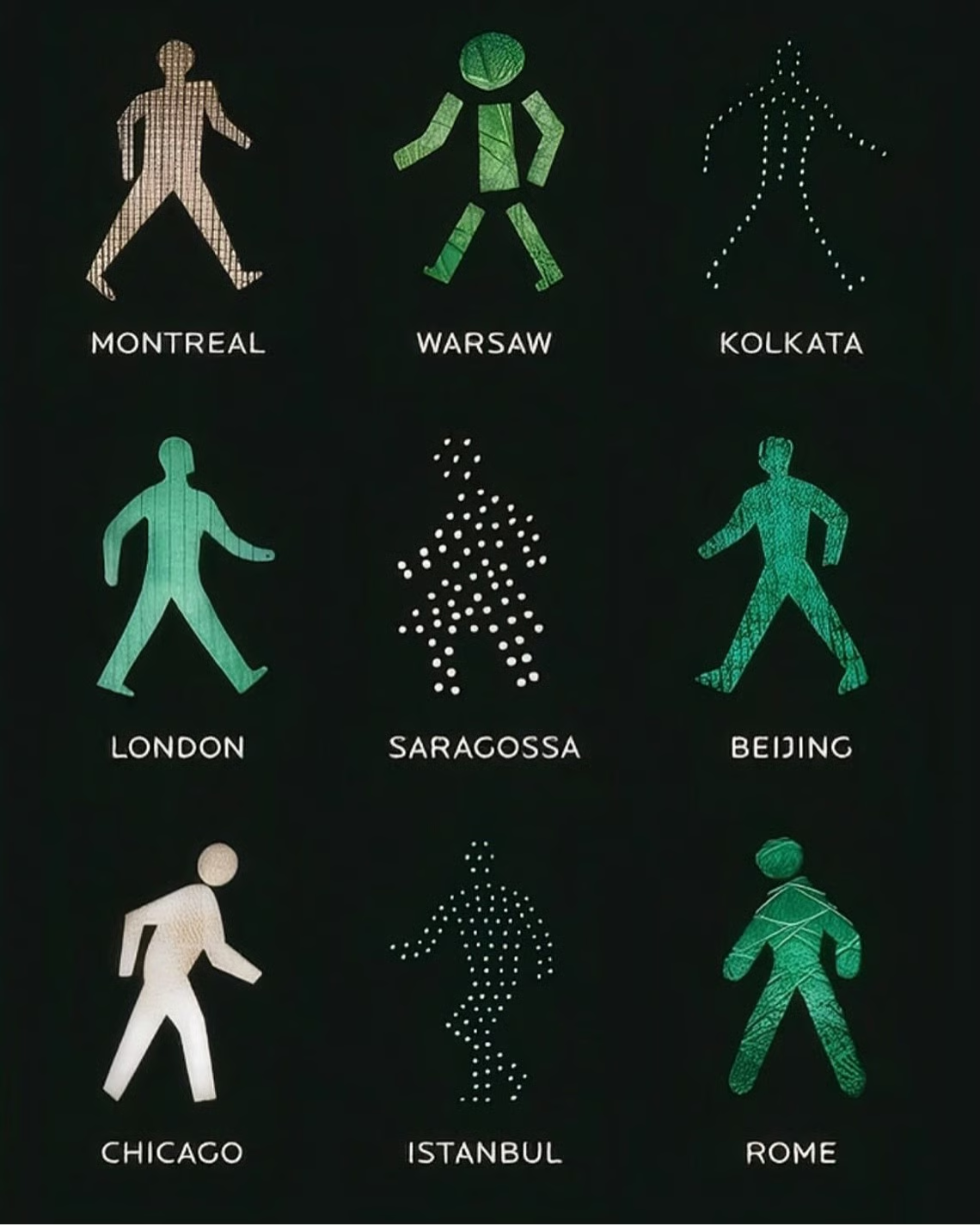
Photographer Maya Barkai has collected pedestrian traffic signals from around the world…
Walking Men worldwide™ is a series of public art installations, a photographic collage of pedestrian traffic icons assembled from around the world, presented in humane scale. The project was conceived as a collaborative effort of international photographers, each adding a piece to the collage… Once assembled on one canvas, these icons represent the ever-growing list of international contributors.
The subject of this project started with one of New York City’s most familiar street icons, one that repeatedly appears in the pedestrian traffic light we meet every day. As one of NYC’s most recognizable figures, the ‘walking man’ is also an international celebrity, a graphic sign that transcends all languages and places, and appears in various forms around the world as an integral part of our urban landscape.
Numerous traffic-light-characters represent the modern “Walking Men”. Standardized yet diverse, they commonly show us the correct and safe way of travel. The Walking Men Worldwide™ project explores various representations of the universally rendered ‘man’, and attempts to examine its inherent conundrum; why is it that while we all consider these icons to be topologically identical, they appear to add such a unique character to our urban identity? These two-dimensional ‘men’, omitted of all idiosyncratic detail, repeatedly reveal themselves in multiple forms on traffic lights and street signs on every corner, as this photographic collage unveils a rich and fascinating world within the confines of a coherent, multi-lingual graphic vocabulary.
What started as a series of largescale public art interventions, has evolved into an important, rare visual document on its own right. This body of work not only provides us with the first and most cohesive look into the world of human circulation, but in leading a participatory experience through a collaborative process that is rooted in the nature of documentary photography, the work has unified people through a simple yet powerful act of art; The creative process involved in my work is an example for how an artist can gather hundreds of worldwide contributors by utilizing social media as a platform, and motivate people to take part in the creation of a collage that unites them all on one canvas. In doing so, it creates a collaborative process that diminishes all political agenda, and becomes a “graphic Esperanto”…
Explore: “Walking Men Worldwide” via Kottke.org.
* Steven Wright
###
As we look both ways, we might send combustible birthday greetings to Robert Bosch; he was born on this date in 1861. An engineer, inventor, and ultimately, buiness magnate, he contributed to the need for the Walking Man: he invented the spark plug and the magneto for automobiles, and founded the German conglomerate Bosch.
The final years of Bosch’s life were painful. When his company was forced to accept Nazi contracts, he had his managing staff join the Nazi party to prevent external, committed Nazi officials from attaining employment and taking over the organization. Bosch slow-walked the orders and used his company and foreign connections to foster anti-Hitler activism. Bosch worked particularly closely with his business advisor Carl Friedrich Goerdeler, a figure central to the 20 July plot to assassinate Hitler. Goerdeler continued the resistance movement after Bosch’s death in 1942.
In 1937, Bosch had restructured his company as a private limited company. He established his last will and testament in which he stipulated that the earnings of the company should be allocated to a foundation devoted to charitable causes (and which received his 94 percent ownership of the company on his death). His will sketched the outlines of the corporate constitution, which was formulated by his successors and is still valid today. Bosch remains in relatively solid shape on the Brand Ledger.

You must be logged in to post a comment.