Posts Tagged ‘play’
“You can deny, if you like, nearly all abstractions: justice, beauty, truth, goodness, mind, God. You can deny seriousness, but not play”*…
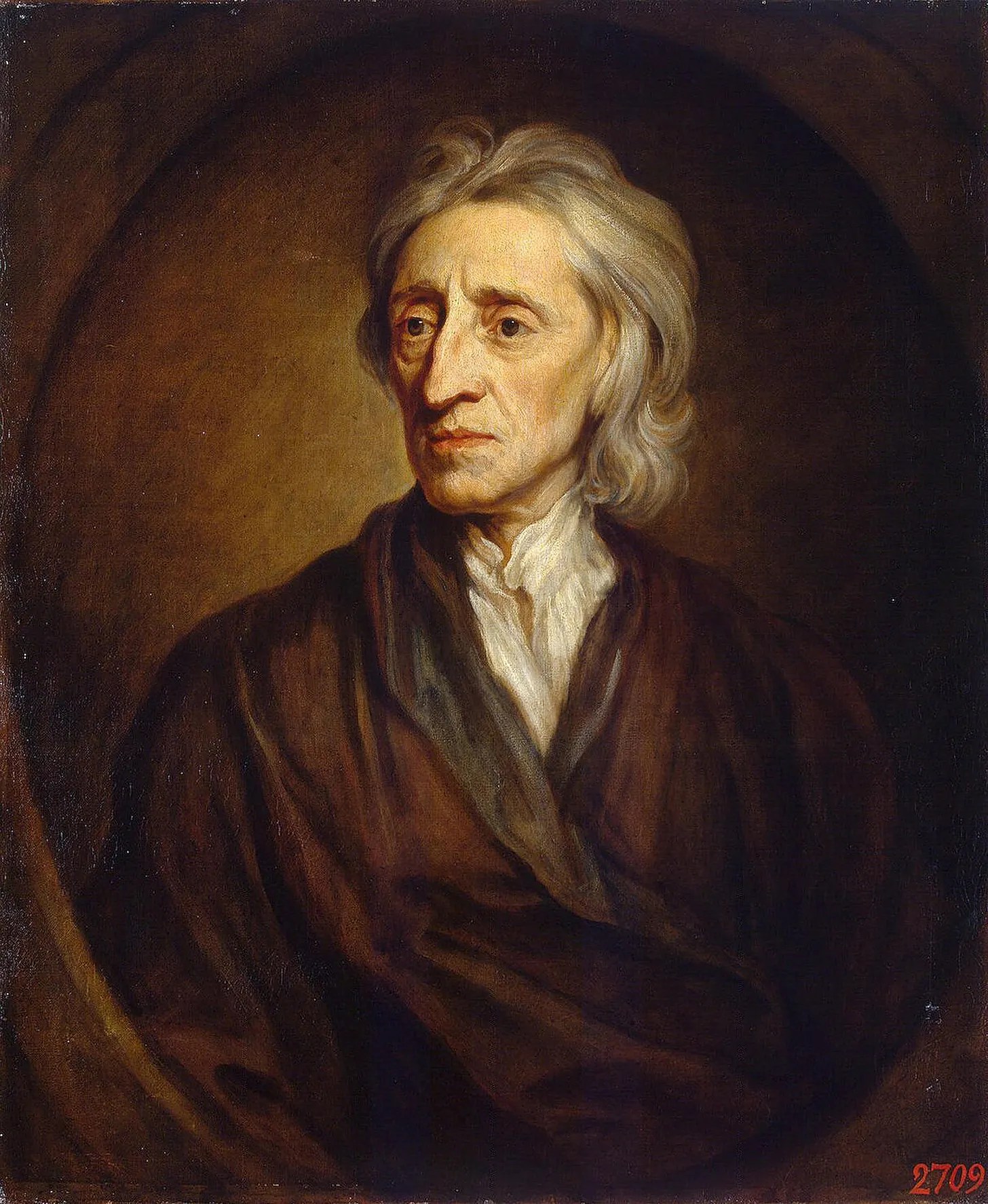
Henry Oliver on John Locke as an exemplar of the importance of play…
One day, when my son was three years old, he stuck his finger into a candle. We were sitting at the table before dinner and he touched the flame without warning. When his sister asked him why he had done it, he told her he just wanted to know what the flame was like. I remembered this when I was reading Locke’s Essay Concerning Human Understanding, in the section when Locke discusses how certainly we can know the world beyond ourselves, and he writes: “he that sees a candle burning, and hath experimented the force of its flame by putting his finger in it, will little doubt that this is something existing without him.” (IV.xi.8) This is how the love of philosophy begins: in a curiosity of the world and a willingness not just to question it, but to test it directly. It illustrates Locke’s larger point about man’s capacity to reason without the use of formal logic. “God has not been so sparing to men to make them barely two-legged creatures, and left it to Aristotle to make them rational.” (IV.xvii.4) We become philosophical as we become interested in knowing the qualities and limits of the world and ourselves. And that begins in childhood.
For the modern, empirical, skeptical mind, Locke’s finger-in-the-flame is akin to the philosopher leaving Plato’s cave. In that experiment, my son became a novice of philosophy. What he learned, he could not communicate. He did not have the language he needed. He was, essentially, at play when he touched that flame. To philosophise, then, requires some play. To be rational requires us to do “irrational” things, like touching a flame.
Play is formal. It might follow the rules of a game, the conventions of the theatre, or the tropes of impersonation—but play is a form of something else. In this way, language is a form of play for our experiences, not the things themselves, but a means of presenting them. Play can be a means of acquiring knowledge that we can express in language, but to begin with it is a means of acquiring impressions, ideas, concepts, feelings, and sensations.
Free play is informal. It is unfamiliar. In its freedom, it is play, just as in their rules the other modes of play are play. Free play might be random (like when children slap paint on paper) or it might be stylized (like free-style swimming) or it might be simply open-ended (as when an invented game keeps changing its content, rules, methods). This is why some play seems both formal and informal, such as when we “play around” with something—an instrument, some materials, an idea—and we are both working at the margin of the known rules and forms and being informal and open-ended.
Over time, play can become practice. The more predictable play becomes, the less playful it is. Children get bored with their imaginary games and begin to expand them: new characters, scenarios, scenes; the old ways of playing are either formalized or discarded. Practice is inherently more boring; it is a form of work. To maintain a good practice, we must, at intervals, allow for some play to revive, reinvent, or reinvigorate the practice. So, the athlete or chess player must know the patterns of their games and must be able to play creatively. So, the thinker or professional must know the accepted knowledge and forms of their discipline and be able to think creatively.
Many modes of life—education, occupations—have to be both work and play, the dynamic development of practices. In ‘Nature: A Fragment’, Goethe says, “we live within her, yet are foreign to her.” So it is with children at play, with students at study. Play is part of the quest for knowledge: we must play both in the sense of removing limits and of pretending. As with children, we must be able to say “this is in the game”, without compromising our sense of the game not being the same as “real life.”
When my son touched that flame, he was playing. When he told his sister that he merely wished to know what the flame was like, that was a similar way of thinking about the world as when they both tell me that something is “in the game.” Occasionally, I hear them saying things that are extraordinary, rude, or that sound like they need help—or that are just downright weird. In response to my puzzlement or offers of help, they explain, off-handedly, “Dad! It’s in the game!” Play is, without them intending it to be, a way of conducting thought experiments with their accumulating knowledge of the world. Touching the candle was a more traditional physical experiment. It was a means of playing that confirmed to my son the existence of the flame, in a way that words and ideas alone never could.
Philosophical play can become abstruse, distant from reality. Locke is hardly a “playful” philosopher, in the colloquial sense. But the plain and clear nature of his prose makes him intellectually exciting because he is always at play, always in the dynamic development of practices and conclusions. He is searching for truth. His insistence on the “plain and clear deductions of words” (IV.viii.11) and his opposition to general and trifling propositions (IV.viii.9) make him substantively and rhetorically compelling. It also brings a repetitive but playful structure to his arguments…
[Oliver considers Locke’s thinking, concluding…]
… Just as my son touched the flame to know the world (and thus to acquire the materials to begin to reason about it), Locke remembered the water and the colours on the bubble (materials he had long ago acquired). The “play” of this way of thinking is all the interplay between mind and reality, idea and experience. What starts as a game of child’s play becomes a practice of reasoning, but in Locke’s hands, the practice is always being played with, always being dynamically tested, refined. New things are always allowed to be “in the game” so long as they enable the pursuit of truth. Locke is not overly formal, following the “rules of philosophy”, but allows the rules of his method to be determined by their ability to enhance his pursuit of truth. Of the metaphysical philosophers who make “trifling” general propositions, he writes:
one may make demonstrations and undoubted propositions in words, and yet thereby advance not one jot in the knowledge of the truth of things: v.g. he that having learnt these following words, with their ordinary mutual relative acceptations annexed to them: v.g. substance, man, animal, form, soul, vegetative, sensitive, rational, may make several undoubted propositions about the soul, without knowing at all what the soul really is: and of this sort, a man may find an infinite number of propositions, reasonings, and conclusions, in books of metaphysics, school-divinity, and some sort of natural philosophy: and, after all, know as little of God, spirits, or bodies, as he did before he set out (IV.viii.9)
This “trifling” is all abstracted play, not based on any experience: it does not base the game on the world. The player is not required to have touched a flame.
Philosophy, as Locke practices it, requires play because there is so little we really know. There are no substances which do not have something in them that “baffles our understandings”, to see ideas and their connections, and to know the proofs of these, requires “single and slow steps, and long poring in the dark”. Our knowledge comes not only short of reality “but even of the extent of our own ideas.” (IV.iii.6) He constantly emphasises that the world cannot be entirely known to us through reason.
…how vain, I say, it is to expect demonstration and certainty in things not capable of it; and refuse assent to very rational propositions, and act contrary to very plain and clear truths, because they cannot be made out so evident, as to surmount every the least (I will not say reason, but) pretence of doubting. He that, in the ordinary affairs of life, would admit of nothing but direct plain demonstration, would be sure of nothing in this world, but of perishing quickly (IV.xi.10)
We must feel the world. We know things through our sensations. To those sensations we must apply reason. We must accept as revealed certain aspects of life and make ourselves more precise in how we discuss those aspects. That is: we find the world through play, and we find the language to describe the world through play, and that play becomes the practice of reasoning.
Some games are high-spirited and dramatic; some are slow and tense; some are hard to see as games, such as when a child sits quietly on the beach and moves the sand around, or re-arranges the pebbles. Locke’s reasoning is often over-determined, persnickety, and can feel like he is attempting to separate out each grain of sand, but in this, as much as in anything else, he has the playful quality of a child who simply wishes to know what it is like to touch the flame, to satisfy himself that the flame does not only exist within the confines of “in the game.”
Frolic is fundamental: “John Locke: The Playful Philosopher.”
Apposite: Richard Feynman (e,g., “Richard Feynman, Spinning Plates and Serious Play“) and Claude Shannon (e.g., “We know the past but cannot control it. We control the future but cannot know it.”)
* Johan Huizinga, in his remarkable Homo Ludens: A Study of the Play Element in Culture (And as for the kinds of games we might play, see James Carse‘s Finite and Infinite Games.)
###
As we celebrate coltish curiosity, we might send lighthearted birthday greetings to Art Clokey; he was born on this date in 1921. An animator, director, producer, screenwriter, and voice actor, he was a pioneer in the popularization of stop-motion clay animation, best known as the creator of the character Gumby (and as the original voice of Gumby’s sidekick, Pokey).

“If you do not resist the apparently inevitable, you will never know how inevitable the inevitable was.”*…

Ah, but how best to resist?
In a short piece adapted from his recent book, On Resistance- A Manifesto, Curtis White offers a plain-spoken, almost playful– but at the same time provocative– prescription in the form of “seven theses on resistance”…
(1) Our politics are a binary melodrama: humanist against evangelical, Democrat against Republican, socialist against fascist, woke against racist, Kimmel against Trump, comedians against reality-show celebrities. By dominating the stage, these dramas exclude other ways of understanding who we are and what we want, in other words, what we lack.
(2) These melodramatic struggles distract us from the real question—what values shall we live by? Our true values are not to be found in what we think, or in what we say we believe, but in how we live.
(3) This contradicts the idea, common among us, that we are a free country rich in belief. “I believe X,” we are told, with the expectation that others will respect that belief, even if it makes no sense. It is as if belief has been reserved only for the unbelievable.
(4) The value we live through in the present moment is no different from the foundational value of ancient Greece and Rome: the “right of conquest.” This may sound hyperbolic, but the people of Gaza, Venezuela, and even Greenland understand it well. This value instructs friend and foe alike, “You can do whatever you want on the condition that you make your desires fit my ends, or else.” As Trump aide Stephen Miller acknowledged in a CNN interview in January 2026, “We live in a world … that is governed by strength, that is governed by force, that is governed by power.” Vae victis, woe to the victims.
(5) The worst psychopathology of everyday life is to be treated unjustly and not to know it. This injustice inevitably concerns money, its inequities, and its specious allure. Buddhist philosopher David Loy writes, “Money is the flight from emptiness that makes life empty.” This is the truth, but it is also something that we don’t know.
(6) Rather than seeing emptiness as a mark of failure, can we see it as something to reclaim? Emptiness is a fundamental human joy if we feel free to respond to it. Freedom to play, to create, to live in our own strength. As Tibetan Buddhist Tarthang Tulku thought, “Life is the play of energy in the void.” Children are primed for life through play, but their play only prepares them for a world that doesn’t exist.
(7) Jesus was a heretic because he hated hypocrites, those whose “throats were open graves.” In Nietzsche’s estimation, this made him “the noblest of men.” Jesus made himself useless to the ways of the Temple and useless to the ways of Empire. He encouraged us to take back our emptiness from the ethical absolutes of the Mosaic Law and from the false gods of Rome. He began the very human remaking of his Father’s earthly kingdom without any ethical guidance beyond the primordial aspirations of love. As Saint Augustine taught, simply, “Love and do what you will.”
Make yourself useless! Take back your emptiness! Make something beautiful!
As universities rid themselves of the arts, humanities, and social sciences, they become glorified vocational schools for those seeking jobs in tech or business. One might object that there is no human interest in the skills developed in such schools, but at least the people are employed, we’re told, and they’re getting the “good jobs.”
But even that logic is in doubt when so many students find that entry-level employment has been monopolized by AI, and, amid the West’s never-ending Industrial Revolution, by automation. This reality is leaving tens of thousands of people, heads filled with expensive skills that nobody wants or needs, living in their childhood bedrooms or their parents’ basement, gloomily doom-scrolling through the day, wondering how in the world their student loans will ever be repaid, and feeling just generally unneeded and unwanted. Not surprisingly, the consequences for mental health have been bad. According to a 2023 Gallup poll, 47 percent of Gen Z adults are anxious or depressed “often or always” because of social media, financial stress, and isolation.
But the numbers are, indeed, brow-raising: in late 2025, the unemployment rate among college graduates stood at nearly 6 percent, while the general unemployment rate was just over 4 percent. So, why go to college at all? Sure, apprentice to one of the trades. Go for construction, as if there were no downside to manual labor.
Techno-capitalism’s circle in hell is the hole (or parental basement) of the Empty Self. Imagine Dante walking in this hell, wondering about the devilish devices that the damned are staring into, fingers flying, and Virgil commenting, “They’re looking for themselves.”
Dante asks, “What are they seeing, master?”
Virgil replies, “Ghosts.”
“And what sin did they commit for this punishment?”
“Their sin was their lifelessness.”
Virgil has Bob Dylan’s “Desolation Row” on heavy rotation.
Gen Z youth imagine that their future is dependent on studying subjects for which they have no living interest. They have only the failing assumption that writing code, analyzing data, programming, or engineering software will eventually lead to prosperous material lives—or just survival, no matter how dull the reality is.
This is made even more hellish by the fact that the people in it are alone. My generation had to disengage from television, but a life lived online is another level of insidious alienation and, worse yet, it is all on the inside, eroding inner life, leaving nothing for the soul, nothing for soul-work, everything for addictive pleasure and profit. As David Foster Wallace commented in a 1996 interview with David Lipsky for Rolling Stone, sounding out a now familiar doom:
At a certain point we’re going to have to build up some machinery inside our guts to help us deal with this. The technology is just going to get better and better. And it’s going to get easier and easier and more and more convenient, and more and more pleasurable, to be alone with images on a screen, given to us by people who do not love us but want our money. If we don’t do that, then (a) as individuals, we’re going to die, and (b) the culture’s going to grind to a halt.
But Wallace didn’t mean to blame the young. The difference between Gen Z and earlier generations is that our young have to suffer the effects of techno-alienation much more intensely because the technology has indeed gotten “better and better.” They will be caught within it for a much longer time, and without the helpful memory of any sort of “time before tech.” Perhaps this is why Gen Z is currently experiencing a paradoxical nostalgia for the analogue world of the 1990s.
Well, then, what are we to do? How about, “Workers of the world, relax! Make yourselves useless, you have nothing to lose but your virtual chains!”
In On Tyranny, Timothy Snyder asks us to say no to rising fascism by preserving liberal democratic institutions. But he never imagines that there might be reasons to say no to those institutions, to our “managers of despair,” as well. He offers little understanding of the importance of a resistant culture, innately anarchic, opposing all that is anti-human. Resistant cultures seek to provide a place where we can become who we really are, a place where we are not mere functions of the world we happened to be born into, not diminished creatures whose being has been reduced to a marketable “skill set.”
Resistant cultures work through honesty, intelligence, and beauty. They ask of us what Buddha asked of his followers: listen, consider, and cultivate. Listen to what we have discovered; consider what you have heard; and if you like what you have heard and considered, if it speaks to you, then join with others in the sangha, the Buddhist community, where you can cultivate a path that others in their turn may follow. This is the ideal way to join any human group: not by thoughtlessly inhabiting its damaged forms and conditions, but by freely engaging, considering, choosing, and, with this freedom in place, making something beautiful. As Thich Nhat Hanh taught, “The next Buddha will be a sangha” [community].
I have written this manifesto in what Vladimir Nabokov called “a state of aesthetic bliss,” which he defined as: a sense of being somehow, somewhere, connected with other states of being where art (curiosity, tenderness, kindness, ecstasy) is the norm.
That’s the hill I intend to die on, for all the good intending will do me. Because that hill may already be gone. I have reclined in its grasses for so long—gazing down on moving water, assuming that all I had to do was turn and I’d be looking up toward the crest—that I may have missed the moment when the earthmovers came in, noisy though they are, and the mountaintop removal began. And then a guy in an orange vest and a hard hat comes up and explains to me that, “Son, you’re living in the world of yesterday.”
Stefan Zweig’s complaint in The World of Yesterday was exactly this: A form of moral beauty had disappeared beneath him and he was left suspended in air. As Goth Rock legend Robert Smith of the Cure sings in “Endsong,” the last song on their album Songs of a Lost World (2024): it’s gone, gone, “Nothing left of all I loved.”
And yet, I hope that this manifesto, in its playfulness, its nonlinear anarchy, expresses not a longing for the work of the past but energy for the future. Not illustrations for an ideology, but the pure energy of worldmaking. In a sense, we need to “forget the Beatles” and the countercultures they inspired. Presently, that culture lives only a gray half-life through Spotify playlists, Hollywood biopics about Dylan and the Doors (et tu, Led Zep?), and the blasphemous productions of corporate giants like Universal Music Group, selling us our own past. That music has been, in tech parlance, the victim of “enshittification,” the apotheosis of which will be that quickly approaching time when music’s “zone” is flooded with AI slop. As one AI music generator named “imoliver” commented, “I have no musical talent at all. I can’t sing, I can’t play instruments, and I have no musical background.” All this under the cover of “democratizing songmaking,” never mind that the mark of the best music has heretofore been its soulful heresies. What was once alive and full of the warmth of sharing is now only about creating a brand and making a buck in a world where anyone, anywhere, could make the next big hit.
You’ve heard of the Land of Cockaigne, that fanciful place where abundance reigns [see image at top, and here]. Well, welcome to the Land of Cliché, where AI rummages through all that has been said and sung and then throws it against the wall to see what sticks. Someone should be ashamed, but we’re all too excited about this brave new world to know it.
The arts need to de-shittify and return to peasant energies, ready to be changed, changed utterly, into something a new generation can live in and live through. In the Imagination, a new comedy will rise, because its loving playfulness, its caring embrace of others, is always with us, regardless of every inhuman distortion of the world as it stands. Hegel called this comedy the “World in Love.” Ultimately, that is what Nietzsche’s “transvaluation of all values” seeks, too: love not as an ethical command but as an artful metaphysic.
Suddenly it is at an end. THE WORLD IS NEW!”—William Carlos Williams, Spring and All
Seven theses on resistance: “Song of a Lost World,” from @laphamsquarterly.bsky.social.
Triangulate with: “Planetary Politics Now,” from Susan Buck-Morss (“The planet is indifferent to political discourses. It counts time in eons, not presidential tenures. Planetary-thinking forces awareness that the cognitive maps of modernity no longer make sense. Neither conservative nor liberal political positions are up to the task of the present.”)
… to all of which your correspondent would humbly add, yes and– VOTE.
###
As we ponder positive possibilities, we might recall that on this date in 1635, in Massachusetts, the General Court of the then-Colony banished Roger Williams for speaking out for the separation of church and state and against the right of civil authorities to punish religious dissension and to confiscate Indian land. Williams moved out to edge of the Narragansett Bay, where with the assistance of the Narragansett tribe, he established a settlement at the junction of two rivers near Narragansett Bay, located in (what is now) Rhode Island. He declared the settlement open to all those seeking freedom of conscience and the removal of the church from civil matters– and many dissatisfied Puritans came. Taking the success of the venture as a sign from God, Williams named the community “Providence.”
Williams stayed close to the Narragansett Indians and continued to protect them from the land greed of European settlers. His respect for the Indians, his fair treatment of them, and his knowledge of their language enabled him to carry on peace negotiations between natives and Europeans, until the eventual outbreak of King Philip’s War in the 1670s. And although Williams preached to the Narragansett, he practiced his principle of religious freedom by refraining from attempts to convert them.

“Every happiness is the child of a separation it did not think it could survive”*…

A third and final (for awhile:) post on AI and what it might mean… Sunday’s post was a consideration of what we might lose if AI becomes central to our lives, a modern echo of Socrates’ lament on the spread of writing. Indeed, we are in a moment of high dudgeon over AI: its potential impact on the environment, on jobs. on the economy more broadly, and in the wake of recent statements from foundational model companies, on their governability(“rogue AI,” though do also see here), and thus on the prospect of our very existence (though do also see here).
Yesterday’s post was an example of thinking that starts from the implicit assumption that AI is coming, then asks how we might govern it. It’s worth noting that even if there is an AI Bubble about to burst, AI could still loom large in our longer-term future. Investors hobbled in many earlier bubbles (e.g., railroads, telecom, the dot.com crash, et al.) were directionally absolutely right about the longer-term promise of the technologies that excited them, just wrong to believe that the early entrants (and their specific offers) in which they were investing were the vehicles to realize that promise.
Today, we stick with the assumption that AI will continue to develop and to change the world around it. Some suggest that AI and its impact are moving us from literacy back to orality (the loss of which so concerned Socrates). But others suggest that AI (and the advances that it enables) could usher in a new Axial Age, a time of huge and ultimately positive transformation, on the other side of which we– humanity– will be… different, as different from the people we were in, say 1999, as Shakespeare was from Socrates.
But what might that be like? It’s relatively easy to imagine disasters that amount to the things we know collapsing; it’s much harder to envisage positive futures filled with altogether new things, futures the contents of which are, essentially by definition, things we’ve not imagined, much less experienced.
Following, from Vinkatesh Rao, one of the most thoughtful approaches I’ve yet come across. He starts with mathematics– with the recent successes of AIs in that field– locates that work in the history of math (in particular axiomatics), then suggests a way of understanding AI’s “success”:
… A theorem prover does not search the space of all possible sequences of logical symbols. It plays inside a world humans have painstakingly designed.
This makes recent achievements in AI mathematics look slightly different.
Perhaps we have been too quick to interpret them as evidence that AI has acquired access to the wild source of mathematical intuition. A significant part of the achievement may instead be that humans spent a century converting increasingly large regions of mathematical wilderness into exceptionally good game boards: semi-closed environments in which the relevant state can be represented, legitimate moves can be made, accumulated technique can be reused, and success can be verified…
Rao then explains how similar trajectories have accrued in the application of AI to programming and to physics, concluding…
Across mathematics, programming and physics, the same pattern keeps appearing. First there is clever performance. Then somebody finds a representation that captures what the clever performers are doing. Then general machinery accumulates around the representation. Then the machinery becomes architecture. Eventually much of the play becomes mechanical.
The creativity has not disappeared. It has moved.
There is an obvious objection to this story.
Perhaps what I am describing as progress is merely legibility.
James C. Scott famously described [and here] the tendency of modern states to simplify complicated social and natural realities into representations that administrators can see and manipulate: cadastral maps, standardized names, scientific forests, censuses, planned cities.
The representation is useful precisely because it throws things away. A forest seen by a forester interested in timber yield is not the forest experienced by the people, animals, fungi and plants living in it. The administrative forest has become extraordinarily legible along a narrow set of dimensions by becoming blind along others.
Every game performs a similar operation. Before you can play, you must decide what the pieces are. You must decide what constitutes the state of the game, what counts as a move, what consequences follow from moves, and what counts as winning. Everything else becomes environment.
A rigid body in a mechanical simulation is not actually rigid. A point mass is not a point. A frictionless surface does not exist. A program described by its types still runs on processors with caches and memory hierarchies. A theorem encoded in Lean does not contain the diagram that gave somebody the idea for it.
Formalization is compression.
In physics this is explicit. Reality becomes a model, the model becomes mathematics, and the mathematics becomes a numerical representation. Information is discarded at every step.
The miracle is not that nothing is lost. The miracle is how often we can throw almost everything away and still retain what matters…
…
… This suggests an important asymmetry. A productive mathematical ecology wants porous epistemic boundaries and impermeable verification boundaries. On the way in, metaphor, hallucination and category mistakes can be useful. On the way out, they are forbidden.
A poem can inspire the theorem. The poem cannot prove it…
… A domain becomes playable when enough of its phenomenological complexity can be compressed into something like a state; when there is some reasonably stable repertoire of actions; when interactions can be repeated; when outcomes provide feedback about better and worse play; and when the environment is stationary enough that lessons learned yesterday remain useful tomorrow.
None of these conditions needs to be perfect. Poker contains hidden information. Markets change their own rules. Hunting happens in an uncontrolled environment. Conversation does not have an explicit score.
Playability is a matter of degree.
Nor is playability the same as formalizability.
Children learn social games without writing axioms. Hunters learn landscapes. Merchants learn markets. Political operators learn institutions. Formalization is merely one unusually powerful technology for increasing playability.
So are money, measurement, domestication, standardization, simulation, bureaucracy and digitization. They do related things. They compress states. They stabilize interactions. They make outcomes comparable. They create memory. They allow experience to accumulate.
This suggests a hypothesis:
Far more of reality than we might reasonably have expected can be carved into semi-closed environments in which experience accumulates, performance improves through repeated play, and success eventually becomes sufficiently legible to automate.
Call this the Curiously Playable Universe hypothesis…
…
… If playability were merely a property of AI-friendly digital environments, none of this would be particularly interesting.
But the pattern is ancient. Consider agriculture.
Hunting and gathering takes place in a relatively wild learning environment. Animals move. Weather changes. Useful plants appear where they appear. The training distribution is supplied by nature.
Agriculture does something profound to the learning problem: It changes the environment.
Fields stabilize locations. Planting stabilizes cycles. Domestication alters organisms. Irrigation alters water availability. Storage alters time. Property regimes and markets stabilize incentives.
Humans did not merely become better at learning nature. They made nature easier to learn.
The wild game becomes domesticated.
Eventually industrial agriculture pushes large portions of the process toward automaticity: standardized breeds, standardized feed, controlled environments, mechanized planting and harvesting, precisely measured yields.
Then the game moves upward.
Instead of merely optimizing how an organism is cultivated, we begin optimizing the organism itself. Selective breeding becomes genetics becomes genomic selection and genetic engineering.
The old player becomes a game piece.
It is tempting to map this progression onto contemporary machine-learning terminology. Hunting looks vaguely like reinforcement learning in a difficult environment. Agriculture introduces something like shaped rewards and a controlled training distribution. Factory farming begins to resemble a regime of relentless verification against measurable outputs.
The analogy should not be pushed too literally. Human cultures have always involved teaching, imitation, norms and complicated reward systems.
But structurally the direction is unmistakable: increasing control over the state representation, action space, feedback signal and training distribution.
Commerce underwent another version of the transformation.
Exchange begins embedded in relationships, obligations, reputation, kinship and local knowledge. Credit can be intensely personal. Value is contextual.
Money performs an astonishing act of compression.
Heterogeneous goods and obligations become comparable through a common medium. Markets then stabilize arenas in which repeated exchange produces prices. Accounting makes states more legible. Contracts formalize future obligations.
Eventually finance builds games on top of the game.
A derivative can be a claim on the future value of another asset. Options put prices on possible future prices. Markets become arenas for expectations about expectations.
Play moves upward.
None of this required artificial intelligence. Humans have been turning wildernesses into games for thousands of years.
What AI changes is the cost of achieving playability in a domain.
Historically, making a domain playable was expensive. Somebody had to invent the categories. Somebody had to measure the variables. Somebody had to standardize the procedures. Somebody had to construct the institutions that made interactions repeatable.
And the resulting representation had to be relatively explicit because ordinary software was brittle.
Machine learning relaxes that requirement…
Rao muses on where this effect might accrue…
Coding is perhaps the clearest domain currently passing through the transition.
Programming was unusually playable before generative AI arrived.
Compilers already supplied verifiers. Type systems constrained legal moves. Unit tests supplied rewards. Version control recorded trajectories. Continuous integration repeatedly evaluated outcomes. Package ecosystems created enormous libraries of reusable moves.
Generative coding systems arrived in a landscape generations of programmers had inadvertently prepared for them.
As implementation becomes cheaper, the game moves upward toward specifications, architectures, product decisions and the increasingly important question of what software should exist in the first place.
Robotics is a more difficult frontier.
The physical world is phenomenologically unruly. Objects deform. Friction varies. Things break. Lighting changes. People walk into rooms. Drawers stick.
Simulation, cheap sensors, multimodal models and increasingly capable world models are gradually making physical environments more playable, but reality continually leaks through the representation.
This is why robotics may be one of the most important tests of the Curiously Playable Universe hypothesis.
Can enough of ordinary physical reality be compressed into stable learned representations to permit the same cycle of domestication and automation?
Science will probably fragment according to playability rather than according to our traditional rankings of intellectual difficulty.
Protein structure turned out to be unusually playable.
Drug discovery is less so because chemical promise must survive biology, organisms, clinical trials and human heterogeneity. Materials discovery may become increasingly playable through the combination of simulation and automated laboratories. Ecology may remain stubbornly wild because every useful abstraction excludes interactions operating at another scale.
Medicine contains both extremes. Image interpretation and molecular design can be made relatively game-like. Caring for an elderly person with five interacting conditions, family constraints and changing preferences is another matter.
Governance may become a particularly strange frontier.
States have spent centuries making populations legible through names, addresses, laws, property records, taxes, censuses, bureaucratic categories and standardized procedures. In that sense the modern administrative state is already a vast game-making machine.
AI will make more of its internal operations automatic.
But political systems contain an unusual source of wilderness: the pieces know they are pieces.
People respond strategically to measurements, categories and incentives. A rule changes the behavior it was intended to regulate. A metric becomes a target and stops being a good metric (Goodhart’s Law). Political actors learn to play the machinery designed to make them legible.
This may push governance upward toward new games involving states themselves: transnational protocols, financial systems, supply chains, standards regimes, platform governance and other structures that do not fit comfortably inside the old nation-state game board.
Some domains may resist for much longer.
Child-rearing is difficult to make playable because the objective changes as the child changes. Friendship has no stable score. Diplomacy involves adversaries whose models include models of your model of them. Entrepreneurship often consists precisely of discovering a game nobody realized existed.
Frontier science operates where we do not yet know which measurements matter. Cultural creation is evaluated by audiences who change partly because of the works being evaluated. Political legitimacy is altered by attempts to measure and optimize it.
These are not necessarily domains AI cannot enter. They are domains in which the wilderness fights back…
He continues…
… We keep asking what it means that machines can now play chess, write programs, fold proteins, prove theorems, steer robots and discover molecules. The question presumes that the remarkable new object is the machine—that some mysterious substance called intelligence has finally become “general” enough to flow from one human province into another.
But perhaps the stranger discovery concerns the provinces: Wildernesses can be reliably turned into game boards. We domesticate the territory, become skilled at its game, build machinery that plays it better than we can, and move outward to construct another game around the first, domesticating a larger scope.
This happened to fields and livestock long before it happened to chess. It happened to trade before it happened to programming. It happened to mechanics before it happened to mathematical proof.
Artificial intelligence did not invent this strange property of reality. It is merely making it difficult not to notice.
The deepest surprise of the AI era may turn out not to be that intelligence was easier to manufacture than we thought. It may be that the universe is far more playable than we imagined…

And he concludes with a consideration of writing…
… Writing sits somewhere awkwardly in the middle of the playability spectrum. It is obviously more playable than friendship or political legitimacy. There are stable artifacts, accumulated techniques, recognizable genres, repeatable operations and abundant feedback. Sentences can be revised. Arguments can be tested for consistency. Stories can be checked for continuity. Editors can compare two versions and usually say something useful about why one works better.
But writing lacks the feature that makes Lean such an extraordinarily good game board: a verifier. There is no kernel that accepts Middlemarch and rejects a bad novel. The relevant state is incompletely represented, the available moves are effectively unlimited, and the reward function wanders around outside the text in readers, institutions, historical circumstances and cultures that change partly in response to what gets written. Recent attempts to extend verifiable-reward techniques to writing therefore have to manufacture approximate evaluators out of principles and pairwise judgments rather than simply checking an answer. Writing is playable, but imperfectly and unevenly so.
The unevenness is becoming easier to see because AI is revealing which kinds of writing were already more game-like than we realized. A corporate memo, SEO article, product description, technical explanation or conventional news report has relatively strong constraints: purpose, audience, format, facts, length, house style, perhaps measurable outcomes. Formulaic genre fiction has a looser but still recognizable game board of beats, tropes, pacing, character functions and reader expectations. Even fiction once assumed to depend heavily on irreducible human voice is proving surprisingly susceptible to systematic generation and variation. Writing is not one game but a family of wilderness activities at very different stages of domestication.
At the other end lies writing whose purpose is partly to alter the terms by which it will be judged. As Walter Benjamin observed, “all great works of literature establish a genre or dissolve one.”
A genuinely new literary form, a strange essay, a foundational work of philosophy, or a piece of criticism that gives its readers a concept they did not previously possess cannot simply optimize against an existing reward function. Its success may consist in creating a new one. This is writing at its most wilderness-like, and perhaps why arguments about AI writing become confused when “writing” is treated as a single capability. Producing competent prose, satisfying a genre contract, developing an argument and inventing a form are different games with different degrees of playability…
… The meta-game emerging above writing may therefore involve constructing—and strategically revealing—the game boards on which execution takes place. If competent prose becomes cheap, more resources can be directed toward finding the question, assembling unlikely source domains, inventing the useful distinction, designing sequences of inquiry, recognizing when an analogy is productive, deciding what belongs together, and establishing the criteria by which a finished object ought to succeed. The writer becomes somewhat less like a person manufacturing sentences and somewhat more like an architect and player of generative constraints.
That does not mean prose becomes irrelevant. A game board badly realized is still a bad essay, just as a brilliant architectural plan does not eliminate the need for a building. Nor does it mean the higher-level activity is permanently reserved for humans. AI systems may themselves become increasingly capable of inventing representations, designing probes, discovering genres and constructing new games. The point is only that automaticity at one level does not end the activity. It displaces its frontier.
Writing may therefore be undergoing the same transition described throughout this essay, only messier and in public. Some of its old games are becoming startlingly playable. Some are approaching automaticity. New games are forming above them. And beyond those remains the poorly mapped territory from which the next game board might emerge…
Eminently worth reading in full: “The Curiously Playable Universe,” from @vgr.bsky.social.
And further: “Our Eukaryotic Moment,” in which Rao urges us to keep our minds open– to resist “premature ontological closure in conceptualizing AI.” A taste:
… About two billion years ago, life underwent a change in architecture. Until then, the planet was ruled by relatively simple prokaryotic cells: bacteria and archaea, tiny packets of chemistry bounded by membranes, carrying their genetic material directly in the same cellular space where much of the business of life took place.
Then something happened, or rather, several things happened in an order that remains uncertain. At some point, an ancestral archaeon cell entered into a permanent symbiosis with a bacterium capable of unusually powerful energy metabolism.
That bacterium eventually became the mitochondrion.
Somewhere in the same long evolutionary transition, genetic material became enclosed within a nucleus, separating the storage and regulation of hereditary information from much of the cell’s everyday chemistry. Internal membranes proliferated, cytoskeletons became more elaborate, and a new kind of cell emerged: the eukaryote….
… Eukaryotic cells became larger, more internally differentiated and capable of forms of organization unavailable to their ancestors. Much later, and independently in several lineages, some evolved multicellularity. Cells themselves became components of larger entities, differentiating and cooperating in increasingly elaborate ways. From the eukaryotic architecture eventually came forests, mushrooms, octopuses, hummingbirds, whales and us.
Eukaryotes were more than just “better bacteria.” They represented a different organization of life, capable of sustaining far more complex structures..
We may be living through an analogous transition now. The emergence of AI, in the particular form that it has appeared (deep learning), is arguably the eukaryotic moment in human cultural evolution, understood in memetic terms, with humans playing the role of mitochondria, and AI the role of the nucleus…
Meantime: “After We Stop Grieving AI: Cyborgs, Centaurs and Cyberpunks” (via Patrick Tanguay) See also: “Diving Deeper Into Digital Transformation” from John Hagel (source of the image above).
As the estimable Tim O’Reilly suggests, we’d probably be wise to take a breath, to treat AI as a “normal technology”: “Technology doesn’t force us… it merely opens the door.”
* Rainer Maria Rilke, Sonnets to Orpheus, Part Two, XII
###
As we crane to conceive what’s beyond our cocoon, we might recall that it was on this date in 1947 that the Association for Computing Machinery (or ACM) was founded. In one sense, computer science dates back to the 17th century and the mechanical calculators of Wilhelm Schickard and Gottfried Leibniz; in another, to the Difference and Analytical Engines of Charles Babbage (and the “programming” of Ada Lovelace). But the ACM can claim to be at least a key stone in the foundation of the field we now knw as “Computer Science”– the first modern “learned society” devoted to the emerging field. (Computer Science began to be established as a distinct academic discipline in the 1950s and early 1960s. The world’s first computer science degree program, the Cambridge Diploma in Computer Science, began at the University of Cambridge Computer Laboratory in 1953. The first computer science department in the United States was formed at Purdue University in 1962.)

“Life is more fun if you play games”*…

David Freidman ponders scientific satire…
I first encountered the scientific paper simply titled “Strapless Evening Gowns” four years ago, when I was flipping through a collection of magazines that once belonged to the cybernetics pioneer Norbert Wiener.
Among his magazines was the May 1960 issue of Voo Doo magazine, which was MIT’s “only intentionally humorous campus publication” going all the way back to 1919.
I got a chuckle out of this article, which attempted to semi-seriously analyze what exactly keeps a strapless dress from falling down:

Scientists have a long history of amusing themselves with humor. In addition to Voo Doo, other science humor magazines include the Annals of Improbable Research, the Journal of Irreproducible Results, and the Worm Runner’s Digest which included both satirical and serious scientific papers, much to the confusion of their readers – a problem eventually solved by printing the satirical articles upside down.
And then there are the quasi-serious scientific studies meant to be amusing, such as this study on the effectiveness of tin foil hats in protecting you from government surveillance (spoiler: tin foil hats can actually amplify certain radio frequencies, so the authors speculate that the government has been behind promotion of tin foil hats all along).
And back in 1974, the Journal of Applied Behavior Analysis published a paper by clinical psychologist Dennis Upper called “The Unsuccessful Self-Treatment Of A Case Of Writer’s Block” [pictured at the top]. And lest you question the veracity of the author’s finding, I should note that the author’s failure to treat his writer’s block has been successfully replicated…
Read on for more on the engineering of the formal dress, both the social (largely sexist) context and the (interestingly meaninful) scientific content– and the art it has inspired: “Science And The Strapless Evening Gown” from @ironicsans.com.
More seriously: “a Nature analysis signals the beginnings of a US science brain drain“: “Researchers in the United States are seeking career opportunities abroad as President Donald Trump’s administration slashes science funding and workforce numbers, finds an analysis of Nature’s jobs-board data…”
* Roald Dahl
###
As we play, we might recall that it was on this date in 1961 that Robert Noyce was issued patent number 2981877 for his “semiconductor device-and-lead structure,” the first patent for what would come to be known as the integrated circuit. In fact another engineer, Jack Kilby, had separately and essentially simultaneously developed the same technology. Ineligible (as a new Texas Instruments empoyee) for a vacation over the summer of 1959, he gave himself the “assignment” of creating “a body of semiconductor material … wherein all the components of the electronic circuit are completely integrated.”
Kilby’s design was rooted in germanium; Noyce’s in silicon and had filed a few months earlier than Noyce. But Kilby’s invention was not a true monolithic integrated circuit chip since it had external gold-wire connections, which would have made it difficult to mass-produce– an obstacle Noyce overcame. Still, Kilby’s contribution was recognized in 2000 when he was Awarded the Nobel Prize– in which Noyce, who had died in 1990, did not share.

“Man’s most serious activity is play”*…

Until the mid-20th century, the “playing fields” on board games tended to be composed of squares; then hexagons emerged. Jon-Paul Dyson explains why…
A board game begins with the board. But how is that board divided up? Often the simplest unit of division is a square. Consider the 64 squares of a chess board, or the 92 squares on a Stratego board. In each case, players take control of a square which exists in relation to other spaces around it, especially if they share adjoining borders. The design of these game boards affords or encourages certain types of movement, usually horizontally or vertically (in four directions) or in some cases diagonally in eight directions (as with the bishop in chess).
And yet there exists a problem with this sort of layout in any game that allows freedom of movement, because the connection between these squares is uneven. Although squares share a long border horizontally and vertically, they do not share such a border on the diagonal connections. In a game like chess, where you physically pick up a piece to move it, this is not much of an issue. But as simulation board games began to develop after World War II, this proved more problematic. Many of these games involved sliding pieces (or cardboard tiles that were frustrating to pick up) from square to square, like army units occupying territory. For these situations, hexagonal spaces that provided equal movement in six directions, produced a better solution.
As is true throughout the history of innovation, whenever there is a problem, it usually turns out that multiple people arrive at similar inventive solutions. That was the case with the development of the hex as a basic unit of division in board games.
Piet Hein [see here], a Danish polymath, who was a quantum physicist as well as a designer, poet, and puzzle and game inventor, came up with the idea in 1942 for a game in which players competed to create connected lines across a game board made up of hexagonal spaces. Thus he might be credited as the father of hex. Yet in the late 1940s, American mathematician John Nash (the subject of the movie A Beautiful Mind) independently invented a similar game at Princeton that also used hex tiles [though we should note that it was a variation on the Shannon switching game, created by Claude Shannon sometime before 1951]. In 1952, Parker Brothers released a version of the game which they called Hex.
This was a time of post-war prosperity when people increasingly had the discretionary income to buy board games, but it was also a period when the United States and the Soviet Union, allies during the war, had become bitter rivals locked in a Cold War. Rather than downsizing after the victory over Germany and Japan, the American military complex shifted from fighting the Axis powers to planning for a major conflict with the Soviet Union and engaging in a series of smaller wars such as that fought in Korea. To help plan American strategy, the Army Air Force and the Douglas Aircraft Company created the Rand Corporation, a think tank that made significant contributions to American policy and computing.
One of the projects the Rand Corporation focused on was modeling conflict through the use of war games. To that end Alexander Mood, a staff member at the Rand Corporation, introduced a honeycombed, hex-shaped board that allowed pieces to move in six directions rather than just four. John Nash was at the Rand Corporation and, in a 1952 paper he coauthored entitled “Some War Games,” he and coauthor R. M. Thrall described using this hex-based system for ground and air games.
It was another game creator, however, who took this development and made the most significant contribution to the development of hex-based games: Charles S. Roberts. Roberts was an army veteran who in 1954 published Tactics, a military simulation board game that is often credited as the first modern wargame. Roberts then founded the game company Avalon Hill, and his games and their innovative simulation of battlefield odds drew the attention of the Rand Corporation because his Combat Results Table for determining the outcome of battles mirrored systems they had developed. The Rand Corporation invited Roberts to visit, and supposedly while he was there he noticed their use of hex-based boards.
Recognizing the superiority of a hex-based system for simulating movement, Roberts began using it in game design in 1961. That year was the centennial of the American Civil War, and so there was a demand for historical simulations. Roberts redesigned his recently released game Gettysburg with the new hex pattern. The Strong owns copies of Gettysburg belonging to Roberts, both in the older square format and in the revised hex version. He also used it for the Avalon Hill game Chancellorsville, another Civil War simulation. Soon the hex system became commonplace in a high proportion of wargames, as well as in more mainstream games such as the 1969 release Psyche-Paths.
Since then, hex board layouts have been used in a wide variety of games. Settlers of Catan is perhaps the most famous example, but plenty of others exist including the spaces in the game Hero Scape. Even video games will often use the hex layout, not only in wargames but in titles such as in Sid Meier’s Civilization V…
“Hex Marks the Spot,” from @jpdysonplay and @museumofplay.
* George Santayana
###
As we make our moves, we might send playful birthday greetings to Seymour Papert; he was born on this date in 1928. Trained as a mathematician, Papert was a pioneer of computer science, and in particular, artificial intelligence. He created the Epistemology and Learning Research Group at the MIT Architecture Machine Group (which later became the MIT Media Lab); he directed MIT’s Artificial Intelligence Laboratory; he authored the hugely-influential LOGO computer language; and he was a principal of the One Laptop Per Child Program. Called by Marvin Minsky “the greatest living mathematics educator,” Papert won a Guggenheim fellowship (1980), a Marconi International fellowship (1981), the Software Publishers Association Lifetime Achievement Award (1994), and the Smithsonian Award (1997).
A champion of fun and games in learning, Papert was the brain behind Lego Mindstorms.

You must be logged in to post a comment.