Posts Tagged ‘Andy Warhol’
“A room hung with pictures is a room hung with thoughts”*…

Nearly $1 trillion of art is expected to change hands in the coming decade, as boomers’ art collections get passed down. There won’t be enough buyers or museums to absorb it all. Felix Salmon on what inter-generational transfer may mean for the art world…
… The baby boomers spent money at an astonishing rate. In the single year of 2005, US boomers spent $7 trillion in 2026 dollars, per McKinsey. Twenty years earlier, in 1985, their predecessors in the Silent Generation had spent just $3 trillion in today’s dollars. Spending on art accelerated as the rich got richer, moved into ever-larger houses and became eager to splash out on discretionary purchases.
That unprecedented demand for art created an unprecedented supply of it too. “The art world became professionalized during the lifetime of the boomers,” notes Michael Darling, a co-founder of Museum Exchange, a company that tries to find museums willing to accept donors’ art. The number of artists making a living from their work reached previously unthinkable levels, with a concomitant increase in the number of galleries. There were about 150 art galleries in New York in 1946, per a 2005 Rand report. That doubled by 1961 and then doubled again by the early 2000s. In Los Angeles, the number of galleries went from almost zero in 1957 to more than 400 in 2005.
When patrons were limited to a few royal courts and religious institutions, the number of people who could make a living by producing art was relatively low. The boomers, blessed with vastly greater numbers, turned their money into battalions of collectable artists. In 1988 the Artnet Price Database, which tracks artists sold at auction, included 8,300 artists, including substantially all the Old Masters. By 2012 there were 90,275.
When you inherit art that was expensive when acquired, it’s difficult to think of it as “stuff” that could be thrown away or given to a thrift store. At the same time, storing and figuring out what to do with it can be enormously challenging. One way of making sure someone appreciates the art is to sell it. But finding buyers can be extraordinarily difficult. Most artists get forgotten over time. Even living artists have a hard time selling their work. A dead artist… needs a dealer who’s committed to resuscitating interest in them — and those dealers are few and far between, since it’s nearly always easier to sell the work of a living artist than a dead one.
Just looking at items that can be sold for cash on the secondary market, which is a tiny minority of all the art out there, roughly $1 trillion of art is expected to change hands just in the next 10 years, per Deloitte. No one is ready. The great wealth transfer includes a vast quantity of paintings and sculptures. A small proportion of it will have some sentimental value and be kept for that reason, but most of it is going to get moved out one way or another — sold, donated or even trashed…
[Salmon explores the options: continued stewardship by the heirs, sale (through auction houses or galleries), or donation (to museums)– all of which are, as he explains, fraught. But perhaps the biggest problem is the evolution of taste…]
… An even bigger barrier for inheritors looking to pass on a collection is the way tastes change over time. Boomers grew up looking at artists like Carl Andre or Balthus, congratulating themselves on how daringly receptive they were to the shattering of historical norms; as those norms get rebuilt, younger art lovers are much more likely to find reasons to avoid showing them entirely. Instead, their collections feature more women artists and tend to be more diverse in many other ways too.
The art world doesn’t fixate on the ultra-new in the way Hollywood or pop music does, where most consumption is of products produced and released in the past year or less. All the same, galleries overwhelmingly show new work by living artists, so that’s what most art collectors end up buying. That means heirs often end up inheriting work that used to be new and exciting but today is often little more than a faint memory.
The rise and fall of artists and artistic reputations is the subject of the emerging discipline of cultural evolution. Just as Darwinian evolution selects for species that do the best at surviving, artistic evolution selects for works that continue to attract our attention. Oleg Sobchuk, a researcher at the Max Planck Institute for Evolutionary Anthropology in Germany, explains that art disappears from our collective memory first quickly and then slowly, in a process known as bi-exponential decay. “Sometimes we think about art as speaking to something that makes us human, that it’s general and timeless,” he says. “But in most cases, art is about something that is happening at that period of time.” The further we get away from the moment an artwork is made, the less of our attention it can generally command.
In paleontology there’s the concept of the “turnover pulse,” where the rate of extinction rises sharply; it’s not dissimilar to the theory of the paradigm shift in the history of science. In art, it’s been more than a century since the modernist revolution that started with impressionism and continued through Picasso and Duchamp. Now, for the first time, the dominant collectors and curators — not to mention artists — will be people who grew up in the age of the internet.
“Every new media, when it appears, creates some kind of rupture,” Sobchuk says. “Usually it functions as a revolution. The culture was in the hands of a small number of powerful individuals, and then from time to time, you have a technological revolution.” That doesn’t mean digital art will displace painting and sculpture. But it probably means there’s less appetite and reverence for modernism. Which doesn’t bode well for those inheriting a lot of it…
[Salmon explains why, though this transfer is essentially inevitable, it will unfold more slowly than we might think (TLDR: “Because there will still be many boomer buyers for every collector planning ahead and unwinding a collection, there won’t be nearly as much of a supply-and-demand mismatch over the next decade as the broader generational shift might imply…”) He concludes…]
… The great art transfer is a much bigger deal than “what are we going to do with all this stuff.” The art we keep will stay in the canon; the art we discard will be lost to history. All the same, the stuff question is becoming urgent, and its answer is sad, if simple: A tiny proportion of the art we inherit will be treasured and valued, and a little bit more will find a good home elsewhere, perhaps slowly accumulating historical value even if it continues to lose cultural cachet. But most of it will probably acquire signs of physical deterioration and neglect — bumps and scratches and sunbleaching… All artists are mortal, after all, and only a minuscule fraction of them achieves immortality through their work. The rest are bound to fade away, sooner or later.
Ars longa? “Boomers Are Leaving Behind More Art Than Anyone Wants,” (or here), from @felixsalmon.com in @bloomberg.com.
Also worth following: the series in e-flux on the relationship between contemporary art, real estate, housing, gentrification, and the material conditions of artists’ lives. Revisiting earlier pieces, it begins with “Art, Creativity, Urbanism, Part I,” from Martha Rossler.
###
As we contemplate the canon, we might send birthday greetings to two artists whose places in the firmament seem, at least so far, secure:
Diego Velázquez was baptized on this date in 1599. A Baroque master of the Spanish Golden Age and leading artist in the court of King Philip IV of Spain and Portugal, he is generally considered one of the greatest artists in the history of Western art.

Andrew Warhola was born on this date in 1928 in Pittsburgh, PA. Better known as Andy Warhol, he was a leading figure in the Pop art movement; his work (painting, filmmaking, photography, publishing, and performance art) challenged traditional boundaries between high and low culture and provoked us to think more clearly about the relationship of reference and referent. Widely considered the most important artist of the second half of the 20th century, he was a role model for a generation of post-modernist artists.

“Look out kid / It’s somethin’ you did / God knows when / But you’re doin’ it again”*…

Feeling for ferment, as we are in fraught times like these, we might wonder if something is brewing… and we might cast our eyes back to a somewhat analogous time…
Ben Arthur revisits a transformative moment in American culture through the lens of J. Hoberman’s Everything Is Now: The 1960s New York Avant-Garde—Primal Happenings, Underground Movies, Radical Pop….
… A few months before “Subterranean Homesick Blues” was released, Allen Ginsberg and Ed Sanders of the Fugs formed LeMar, short for Legalize Marijuana. The organization formed to push for the active use of marijuana, as well as to combat police oversight. On July 29, 1965, the New York Police Department took in two LeMar members (Jack William Martin III and Dale Wilbourne), but the man they really wanted was Ginsberg. When offered a lighter sentence in exchange for information on the poet, Martin declined to rat. His bail jumped from $5,000 to $100,000.
On August 11, LeMar had planned a benefit for their two fallen comrades at the Broadway Central, a sprawling hotel between the East and West Village. On the program was Jack Smith’s glamorous, experimental drag film Normal Love, and Barbara Rubin’s Allen for Allen,a tribute to her muse/lover. The Fugs were to play, along with the Falling Spikes, a garage rock band featuring John Cale, Lou Reed, and at one point Tony Conrad. Allen Ginsberg had poems to read, along with William S. Burroughs, Piero Heliczer, and Andrei Voznesensky.
The event never took place: the Great Bust finally happened. Dylan was a few months off, but who’s keeping track anyways? Heliczer, the benefit’s emcee, had just begun introducing the night’s proceedings when a group of plainclothes officers stormed in. They weren’t wearing trench coats, and they weren’t wearing coonskin caps; they wore Hawaiian shirts that Smith likened to the “moldy 1940’s saloon-rioting waterfront scum of Flatulandia.” Five cops lunged toward Martin, their former detainee, and dragged him out of the room. All hell broke loose. Cops shoved, punched, and kicked. The attendees returned the aggression, making it an all-out brawl. Outside, people were thrown into police cars, only to escape and keep fighting. Smith sucker punched an officer from behind. He was slammed onto the sidewalk and tossed into a cop car. The entire group, now outside on the street, turned into a so-called “mob,” refusing to let the NYPD leave. Once the officers took off, a full detail flanking them, they beat Smith and threw him in the Manhattan House of Detention, colloquially known as “the Tombs.” Just a few nights later, the narcotics division raided Ed Sanders’s apartment, searching for drugs. Instead, they took two of his films, Amphetamine Head: A Study of Power in America and Mongolian Cluster Fuck.
These raids were all too common in Manhattan’s underground: bookstores, studios, offices, apartments, theaters, churches, and gallery spaces were all targeted. Locally, the NYPD would press charges of obscenity, distribution of pornography, or drug possession, flying in blatant opposition to artists’ civil liberties. It seems that nearly everyone in an alternative scene was targeted. Nationally, FBI surveillance zeroed in on Bob Dylan, his manager John Hammond, and Broadside, a magazine that published Dylan’s lyrics alongside political satire. Cranking a cheap mimeograph machine, they published early Dylan protest songs, like “Talking John Birch,” a Guthrie-esque satire of communism. The jokey song, published in 1962, was a far cry from the deep, interwoven “Subterranean Homesick Blues” of 1965, which captures an intense surrealism that defined the decade.
In 1966, less than a year after the Broadway Central melee, the Falling Spikes were performing under a new name. Now under the guidance of the enigmatic Andy Warhol, the band morphed into the Velvet Underground. At the corner of Park and 59th stood the Hotel Delmonico, where the Velvets were attempting to attack the senses and minds of the New York Society for Clinical Psychiatry. This incarnation was called “The Chic Mystique of Andy Warhol,” and it combined the films of Warhol, the drone rock of the Velvets, and the transgressive interrogations of filmmakers Barbara Rubin and Jonas Mekas. Apparently, the event was a chance for the shrinks to understand the inner workings of the “creative mind.”
Cocktail hour began with two Warhol films: the first being 1964’s Harlot, in which Jack Smith’s prima donna Mario Montez sensually eats a banana. Next, the group was subjected to Henry Geldzahler, a 97-minute silent film in which the former curator of the Met smokes a cigar, becoming increasingly uncomfortable with the camera placed before him. One could connect this film, with Geldzahler’s literati status, to this group of psychiatrists: growing ever more disconcerted and fearful of the sights before them.
After nearly two hours of films, dinner was served, and the Velvets took the stage, accompanied by poet Gerard Malanga and superstars Edie Sedgwick, Mary Woronov, and Ingrid Superstar all fervently whip-dancing to the music. As these unsettling disturbances occurred on stage, Rubin and Mekas catechized the black-tied psychiatrists: “What does her vagina feel like?” “Is his penis big enough?” Shoving disorienting lights into the shrinks’ faces, Rubin insisted they would be stars in an upcoming Factory film. Grace Glueck, in a New York Times article the next day, documented the reactions of the doctors attending, who, of course, psychoanalyzed the night’s proceedings: “‘I suppose you could call this gathering a spontaneous eruption of the id,’ said Dr. Alfred Lilienthal. ‘Warhol’s message is one of super-reality.’ said another. […] “You want to do something for mental health?” asked another psychiatrist. “Kill the story.”
Over time, the one-off event morphed into something of a regular institution. At first, it was called “Andy Warhol, Up-tight,” but it would later become the “Exploding Plastic Inevitable,” an anti-hippie version of Ken Kesey’s Acid Tests with the Grateful Dead. “The auditorium, every aspect of it—singers, light throwers, strobe operators, dancers—at all times are screaming with screeching, piercing personality pain,” Mekas wrote in The Village Voice. “I say pain; it could also be called desperation. In any case, it is the last stand of the ego, before it either breaks down or goes to the other side.”…
So very much more at “Delicate and Dirty” from @lareviewofbooks.bsky.social.
* Bob Dylan, “Subterranean Homesick Blues” (and here, the “offical video” of the song, whihc was filmed by D. A. Pennebaker for the documentary Dont Look Back)
###
As we remember that, while history doesn’t repeat, it can rhyme, we might recall that it was on this date in 1977 that South Park premiered on Comedy Central– where it runs to this day. The animated saga of Stan, Kyle, Eric, and Kenny and their exploits in their (titular) Colorado hometown has won five Emmys and a Peabody Award. A theatrical film, South Park: Bigger, Longer & Uncut, was released in June, 1999 to commercial and critical success, and scored an Academy Award nomination.
The show’s 27th season recently launched– with a bang.

“The young, no doubt, make mistakes; but the old, when they try to think for them, make even greater mistakes.”*…
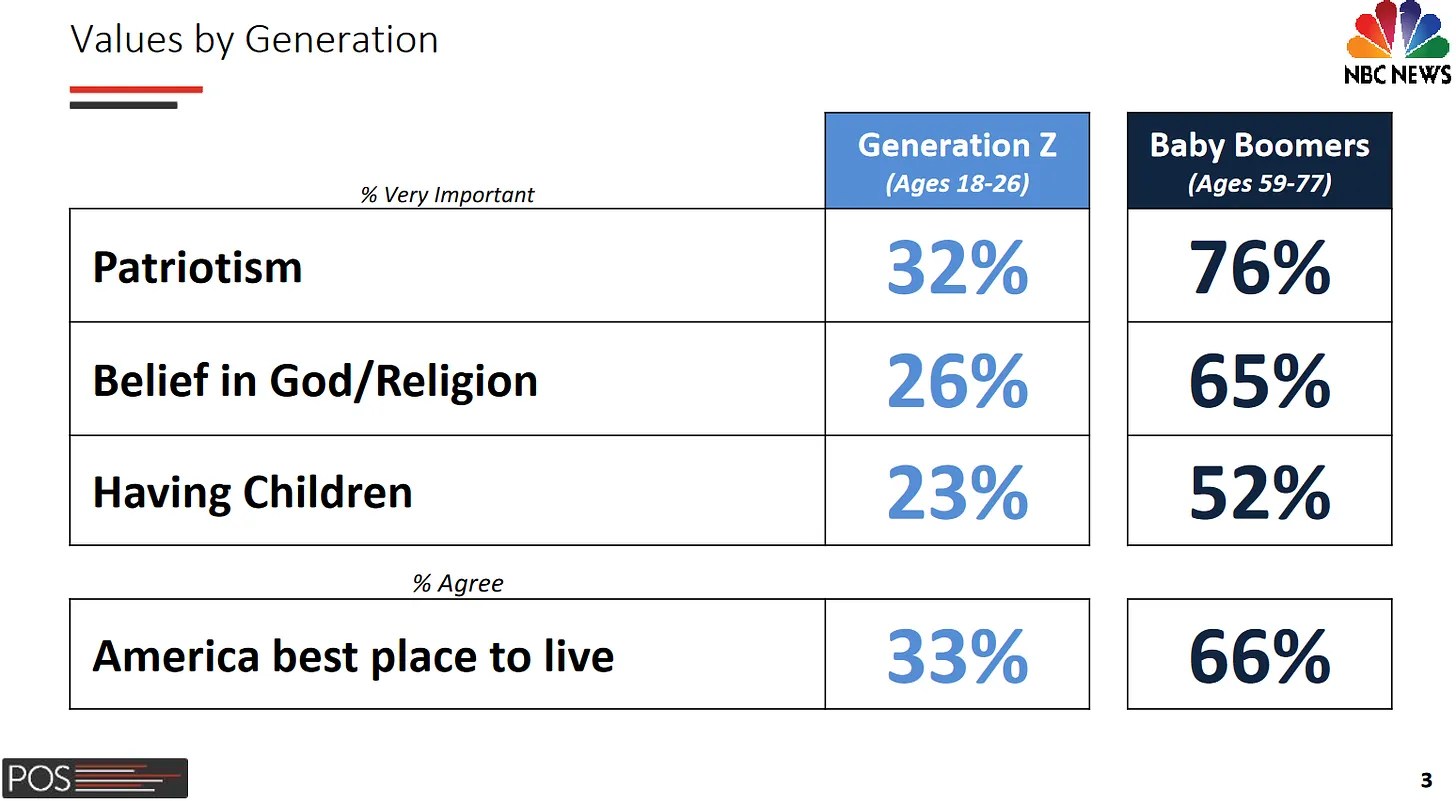
Every Sunday Bruce Mehlman, a Washington insider (a “government relations consultant”) publishes “Six Chart Sunday” in his newsletter, Age of Disruption. They’re always fascinating and informative; this week’s was especially striking.
The chart above and five others, each with brief explanatory summaries, tell the tale of wide “Generation Gaps.”
As Victor Klemperer observed, “A generation has more in common, after all, than a nation, than a profession.”
* Bertrand Russell, Mortals and Others: American Essays 1931-35
###
As we mind the gap, we might recall that it was on this date in 1971 that the Rolling Stones’ Sticky Fingers hit #1 on the U.S. album chart (their second chart-topping album). A critical and popular success, it is also remembered for its cover (conceived by Andy Warhol and photographed and designed by members of his art collective, the Factory, featuring a zippable image of a man’s jeans) and for its introduction of the now ubiquitous tongue and lips logo.

“A picture is a poem without words”*…

A collection of pithy illustrations…


Many more artistic aphorisms at Visualize Value.
* Horace
###
As we picture it, we might send aesthetic birthday greetings to Rene Ricard; he was born on this date in 1946. A painter, poet, actor, and art critic, he was a seminal figure in the New York art scene of later 20th century. After dropping out of school in Boston, he moved to New York City, where he became a protégé of Andy Warhol (and appeared in the Warhol films Kitchen, Chelsea Girls, and The Andy Warhol Story). He was a founder of Theater of the Ridiculous (with John Vaccaro and Charles Ludlam). He was a regularly-published poet. And from the early 90s, he was a widely-exhibited artist. But he was perhaps ultimately most influential in his art criticism (and his contributions to gallery and exhibition catalogues)– especially a series of essays he wrote for Artforum magazine in which (among other impacts) he launched the career of painter Julian Schnabel and helped bring Jean-Michel Basquiat to fame. Andy Warhol called Ricard “the George Sanders of the Lower East Side, the Rex Reed of the art world.”

“They always say time changes things, but you actually have to change them yourself”*…

Andy Warhol enjoyed dressing for parties in drag, sometimes in dresses of his own design. He admired “the boys who spend their lives trying to be complete girls,” so in 1981 he and a photographic assistant, Christopher Makos, agreed to collaborate on a session portraying Warhol in drag. In many ways, they modeled the series on Man Ray’s 1920s work with the French artist Marcel Duchamp, in which the two artists created a female alter ego name Rrose Sélavy for Duchamp.
Warhol and Makos made a number of pictures, both black-and-white prints and color Polaroids, of their first attempt. For the second round of pictures, they hired a theater makeup person. This stage professional better understood the challenge of transforming a man’s face into that of a woman. After the makeup, Warhol tried on curled, straight, long, short, dark, and blonde wigs…
More on Warhols collection of polaroid self-portraits– and more selections from it– at “Oh, You Pretty Thing! Polaroid Portraits of Andy Warhol in Drag.”
* Andy Warhol
###
As we add “Jean Genie” to our playlists, we might note the irony that today is the birthday of both Soren Kierkegaard (1813), the Danish philosopher who was a fierce critic of Hegelianism, and of Karl Marx (1818), the Prussian philosopher (and “father of Communism”), who was one of Hegel’s strongest– and most concretely active– supporters. Thesis… anithesis…

Kierkegaard and Marx
You must be logged in to post a comment.