Posts Tagged ‘Andy Warhol’
How the other half lives…

Andy Warhol’s beach home– the Church Estate, Montauk, Long Island (photo: Warhol Foundation)
Montauk Life recalls the 1972 emergence of America’s best-known artist on the then-quiet Long Island scene…
As his career progressed, the shy, retiring Andy forged an identity that would reshape the way America looked at artists. In a time when revolutionary changes tore down the walls between art, fashion and every day life, Andy held the first sledge hammer. He bought a large loft on West 47th Street and opened the Factory, an industrial approach to art. Not content to re-shape the face of modern art, he took on film, music, writing and journalism. Surrounded by an entourage of up and coming hipsters, drag queens, budding journalists, aspiring actors, drug addicts, and society cast-offs, Andy became king of New York’s avant garde scene…
He wanted… to be famous, to rub shoulders with the brightest and best. To do that he engineered an image, as bizarre and unusual as any. Pasty faced Andy, with his white fright wig, haunted expression and monosyllabic style became as well known as any Hollywood star or Washington politician. By skillfully manipulating the publicity game, this painfully shy artist made himself into a glittering star of the social night, seen everywhere from art openings to the nightly melodrama of Studio 54…
[But] if there was one thing Andy loved more than fame, it was money. That’s what first brought the intensely urban Warhol to wide open Montauk. A long time visitor to the Hamptons proper, he and Paul Morrissey, director of many of Andy’s early avant garde films, decided a home here would be a great investment…
They settled on the Church estate, a collection of 5 classic, clapboard houses built in the 1920’s. Set on 20 acres high above the Atlantic, the buildings had been designed by noted architect Stanford White. The main house, with 7 bedrooms, 5 baths, 4 stone fireplaces and large living areas would be perfect for entertaining. The 4 smaller cottages would be guest accommodations. Andy and Paul split the $225,000 cost– as it turned out, the best buy of Andy’s life. Currently on the market for a cool $50,000,000, it’s the most expensive home for sale on the East End, and one of the most expensive in all of America.
Andy and Paul were pleased at the prospect of occasional entertaining, but needed to make the property pay; Lee Radziwill led the parade of celebrity tenants (bringing with her– literally, in their visits– the cachet of the Kennedys). But the renters who re-framed the reputation of the Hamptons were The Rolling Stones.
Warhol’s next door neighbor in Montauk, photographer, writer, painter, playboy, you-name-it-he-was-it Peter Beard had befriended Mick Jagger while serving as the photographer companion to Truman Capote (as reporter for Rolling Stone) on the Stone’s infamous Exile on Main Street Tour in 1972– at the completion of which Mick visited Beard on the Island.
In planning the preparatory rehearsals for their 1975 tour, Jagger decided that Long Island would be a perfect spot– and rented Warhol’s estate.

The Rolling Stones, with guest percussionist Ollie E. Brown, outside their rehearsal room at Andy Warhol’s Montauk estate (Ronnie Wood, who had just stepped in to replace Mick Taylor, was still technically a member of The Faces)

Montauk, 1975 — Jagger, Catherine Deneuve, and Warhol, taken by Peter Beard

The Stones, “at home”
One of the indelible remains of the Stones stay in Montauk, is the song “The Memory Motel”. Named for the [nearby] bar and motel of same name, this lament for a lost girl has become one of the Stones signature tunes.
Hannah honey was a peachy kind of girl
Her eyes were hazel
And her nose were slightly curved
We spent a lonely night at the Memory Motel
It’s on the ocean, I guess you know it well
It took a starry to steal my breath away
Down on the water front
Her hair all drenched in spray
(Jagger/Richards – C- Rolling Stones/Virgin Records 1975 )
The other legacy of the Stone’s stay? As Warhol recalls in his Diary, “Mick Jagger really put Montauk on the map.”
[TotH to The Selvedge Yard, from whence the photos above– by Ken Regan, except as otherwise noted]
###
As we remind ourselves that It’s Only Rock and Roll, we might recall that it was on this date that same fateful year, 1975, that “Tania”– Patty Hearst– was captured in San Francisco and arrested for armed robbery. Ms. Hearst had been kidnapped in February, 1974 by a group known as the Symbionese Liberation Army and held as a “prisoner of war.” The SLA demanded that her father, publisher Randolph Hearst, pay millions of dollars in food relief to secure her release. Hearst made the donations; the SLA raised its demands. But in April, 1974, the situation changed: Ms. Hearst declared, in a tape sent to the authorities, that she was joining the SLA of her own free will, and would thenceforth be known as “Tania.” Later that month, a surveillance camera took a photo of her participating in an armed robbery of a San Francisco bank, and she was subsequently spotted during the robbery of a Los Angeles store.
In May, 1974, the FBI raided the SLA’s Los Angeles headquarters, and killed the group’s leader (Donald DeFreeze, aka General Field Marshal Cinque), but most of the group was absent. A cross-country manhunt ensued, and for more than a year Ms. Hearst and her conspirators-or-captors eluded the Feds.
Ms. Heart’s defense was that she had been brainwashed by her captors; but her argument wasn’t convincing to a jury. She was convicted in 1976 and sentenced to seven years in prison. (She never did that time: President Carter commuted that sentence; President Clinton later conferred a full pardon.)

“Tania” in action, captured by a bank surveillance camera
From the Plague-On-Both-Their-Houses Department: It’s come to this…

The Andy Warhol banana that graced the cover of the Velvet Underground’s 1967 debut album has become the subject of litigation between the band and the artist’s estate.
In a nutshell, the estate believes that it holds the copyright, and is licensing the image (for everything from iPad covers to Absolut ads). The band argues that there is no copyright (as the original ran without a notice), but that the image is protected as a trademark of the band– so the estate is infringing. (There’s a more detailed recounting of situation and its background at Final Boss Form.)
One is tempted to launch into a discussion of the case as a symptom of the diseased state of intellectual property law and practice in the U.S.; but your correspondent has already burned pixels doing that, e.g., here, here, and here. Suffice it here to quote the ever-insightful Pop Loser: “This whole story is an excellent metaphor for the world we currently live in and should probably make us all a little bit sad.”
As we re-up our affiliation with Creative Commons and write our Representatives to oppose SOPA, we might recall that it was on this date in 1919 that “The Noble Experiment”– the national ban on the sale, manufacture, and transportation of alcohol that was better known as “Prohibition”– was ratified (the 18th Amendment).
By the time it was repealed in 1933, organized crime had become a major feature of American city life, and the American public had adopted the invented-for-the-occasion word “scofflaw.”
 Ku Klux Klan: “Defender of the 18th Amendment” (source)
Overheard amongst the shelves…

Customer: Excuse me, do you have any signed copies of Shakespeare plays?
Me: Er… do you mean signed by the people who performed the play?
Customer: No, I mean signed by William Shakespeare.Customer: I read a book in the Eighties. I don’t remember the author, or the title. But it was green, and it made me laugh. Do you know which one I mean?
Man: Do you have black and white film posters?
Me: Yes, we do, over here.
Man: Do you have any posters of Adolf Hitler?
Me: Pardon?
Man: Adolf Hitler.
Me: Well, he wasn’t a film star, was he.
Man: Yes, he was. He was American. Jewish, I think.
Me: ………..
More from Jen Campbell, a young writer “currently working in bookselling,” in her “Weird Things Customers Say in Bookshops.”
As we lower our voices, we might recall that it was on this date in 1962, in his first one-man show (at the Ferus Gallery in Los Angeles), that Andy Warhol premiered his Campbell’s Soup Can series. It was the debut of Pop Art on the West Coast.
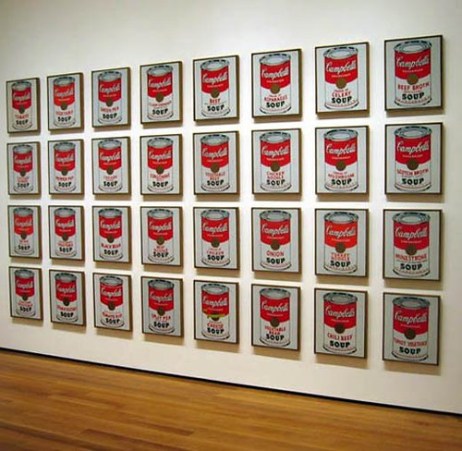
Pardon me, but do you have the time?…

Image via Wikipedia
M. Joseph Young is a writer and game designer who shares your correspondent’s affection for time travel movies. The disciplined Mr. Young has created a site– Temporal Anomalies in Time Travel Movies— that systematically critiques the (sub-)genre.
Time travel has been a staple in Science Fiction since H.G. Wells. Unfortunately, much of what passes for intelligence in this area is poorly considered… For example, it is not possible to return to the past without changing the past in some way; nor is it possible to change the future based on information from the future. Doctor Who realized early on that changes to history were hazardous, and avoided them assiduously. Movies built on a time travel theme frequently become dissatisfying when the thread of time is closely examined. In Millennium, once the era in which the time machine exists is destroyed, aren’t all of those rescued survivors returned to their own times? In The Twelve Monkeys, doesn’t it appear that the disaster which the main character was to prevent would not have happened had he not interfered? In Timecop, would any of that have happened had it not happened? Even the venerable StarTrek has created numerous anomalies which it has failed to resolve. Pasts which are dependent upon futures dependent upon those pasts should make us cringe. However, from time to time something works…
Readers will doubtless be as relieved as your correspondent was to learn that Mr. Young counts Bill and Ted’s Excellent Adventure among the (relatively) successful… after all, “would any of that had happened if it had not happened?”
As we reset our watches, we might spare a celebratory thought for Andrew Warhola, born on this date in 1928 in Pittsburgh, PA. Better known as Andy Warhol, he was a role model for a generation of post-modernist artists; he provoked us think more clearly about the relationship of reference and referent… and he made us (well, most of us anyway) smile.
 Self-Portrait, 1986 source: National Gallery of Art
![Reblog this post [with Zemanta]](https://i0.wp.com/img.zemanta.com/reblog_e.png?w=700)
You must be logged in to post a comment.