Posts Tagged ‘Alberti’
“Firmness, utility, and beauty”*…
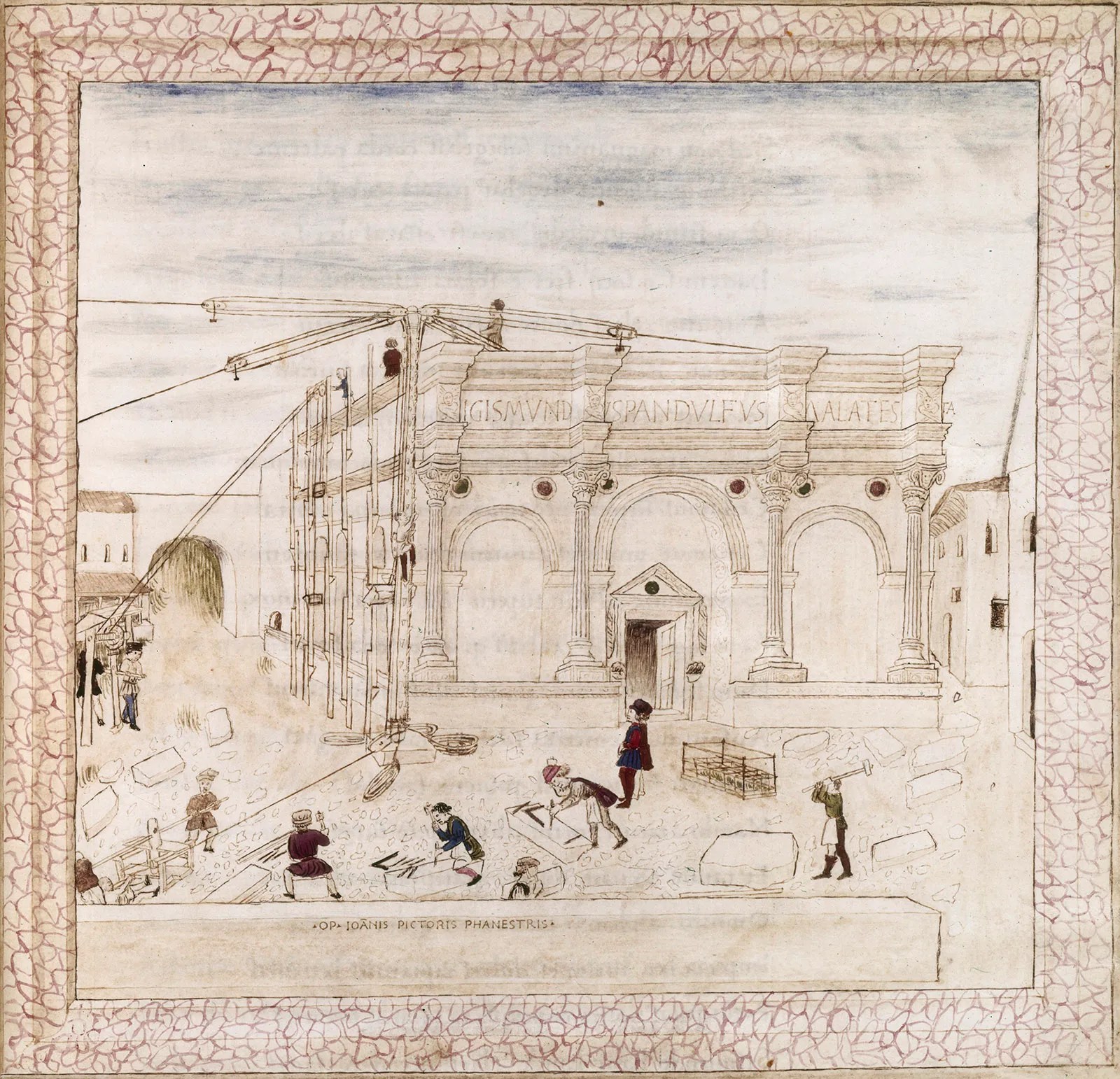
In a review of Indra Kagis McEwen‘s book All the King’s Horses- Vitruvius in an Age of Princes, Ingrid Rowland examines the ways in which Vitruvius’s Ten Books on Architecture [AKA De Architectura] was not only a manual of the building arts but a treatise on how to extend and consolidate the Roman Empire, and lent itself all too well to the autocratic ambitions of Renaissance princes…
As perennial best sellers go, the treatise known as Ten Books on Architecture by the Roman writer Vitruvius is not, perhaps, the most predictable. It includes some gripping stories, certainly, many of them military, like the the Carian queen Artemisia’s surprise naval attack on Rhodes aboard the Rhodians’ own ships or the thwarted siege of the same city by the Macedonian general Demetrius Poliorcetes, the proverbial “Sacker of Cities,” whose gigantic war machine, the “City-seizer” (Helepolis), churns to an ignominious halt in a pool of muck created overnight by the mass emptying of Rhodian chamber pots.
These vignettes, however, are little gems inserted to brighten long passages about what kind of wood to use for different parts of a building, the proportions of temples, and the marvels of waterproof concrete, as well as instructions on how to build, among many other wonders and amenities, sundials, aqueducts, water clocks, and catapults. Its storehouse of practical information helped to ensure that Vitruvius’s handbook, written around 25 BCE, was one of the few ancient Greek and Latin works to survive what the fifteenth-century pundit Leon Battista Alberti called the “shipwreck” of the Middle Ages, along with the poetry of Vergil and Ovid, the prose of Cicero, a Latin translation of Plato’s Timaeus, the Bible, and some other surprisingly durable texts. Ever since the papal printer Eucharius Silber brought out his edition in Rome in 1486, Ten Books on Architecture has never gone out of print.
One of the chief reasons for the enduring interest in On Architecture, aside from its treasury of practical instructions, is the ambitious educational program that Vitruvius puts forth in the first of his ten books (each of which originated as a single papyrus scroll, closer to the length of a modern chapter than an entire book, just as his chapters are approximately the size of a paragraph). Architects, he argues, can only complete their work properly (in his words, “perfect” it) if they are well informed about every one of the subjects that the art of building brings into play—if not as well informed as a specialist, then at least well enough to make the right decisions. A competent practitioner, therefore, must not only master drawing but also have a good grasp of literature, music, mathematics, and law…
… It seems likely that the connection between education, architecture, and empire inspired the creation of the earliest known manuscript of Vitruvius, copied on parchment in the ninth century, perhaps for Charlemagne, perhaps by the hand of his learned adviser Alcuin of York, almost certainly as part of the Frankish king’s project of resurrecting the glories of ancient Rome in a Christian spirit. It is through this same clever wedge, education, that Vitruvius has driven himself and his treatise into the very heart of the way the contemporary world still thinks about any number of things, from human scale to beauty to liberal education to the best methods of town planning. Whether you have read Vitruvius or not, his influence is still palpable in the fabric of modern urban life, and that is why he has been translated as recently as 2017 into Chinese…
… In All the King’s Horses: Vitruvius in an Age of Princes, Indra Kagis McEwen, a Canadian architect and historian, brings out a more chilling aspect of Vitruvius and his millennial tradition: his fatal attractiveness to despots. The “princes” of her title are the princes of whom Machiavelli wrote: strongmen who seized and maintained one-man rule over medieval and early modern Italian city-states by force of arms and charisma. Augustus served these princes as an inspiring model because his trajectory so closely resembled their own—except, of course, for its colossal scale. Like the Italian lords who revered him, the future Imperator rose to his august heights by doing whatever would ensure his own survival, eventually completing a process that Machiavelli attributes to Augustus’s adoptive father, Julius Caesar: supplanting the ancient Roman Republic with one-man rule…
Fascinating… and too timely: “Vitruvius & the Warlords” from @nybooks.com.
* “Firmitas, utilitas, venustas”– the three principles of good architecture, as described by Vitruvius in De Architectura
###
As we analyze the architecture of authoritarianism, we might recall that it was on thsi date in 1527, during the War of the League of Cognac (a dispute between the Holy Roman Empire and the Papacy), that Rome was captured and sacked by the mutinous troops of Charles V, Holy Roman Emperor. Charles V had intended only to threaten military action to make Pope Clement VII come to his terms. But most of Charles’ Imperial army (14,000 Germans, including Lutherans, 6,000 Spaniards, and some Italians) were unpaid, and took matters into their own hands. Despite being ordered not to storm Rome, they broke into the scarcely defended city and began looting, killing, and holding citizens for ransom. Clement VII took refuge in Castel Sant’Angelo after the Swiss Guard were annihilated in a delaying rear guard action; he remained there until a ransom was paid to the pillagers. Benvenuto Cellini witnessed the Sack and described the it in his works.
The Sack of Rome impacted the histories of Europe, Italy, and Christianity, creating lasting ripple effects throughout European culture and politics. Before the sack, Rome had been a center of Italian High Renaissance culture and patronage, and the main destination for any European artist eager for fame and wealth, thanks to the prestigious commissions of the papal court. In the sack, Rome suffered depopulation and economic collapse, sending artists and writers elsewhere.
The Sack of Rome also permanently shifted the balance of power between Church and State. Before the sack, Pope Clement VII opposed the ambitions of Emperor Charles V. Afterward, he no longer had the military or financial resources to do so. To avert more warfare, Clement adopted a conciliatory policy toward Charles. The power shift – away from the Pope, toward the Emperor – also produced lasting consequences for Catholicism.
And the Sack of Rome also contributed to making permanent the split between Catholics and Protestants. (After the sack, Clement acceded to Charles’ wishes, agreeing to call a Church Council to decide how to address the Protestant Reformation and naming the city of Trent, Italy as its site. In 1545, eleven years after Clement’s death, his successor Pope Paul III convened the Council of Trent. As Charles predicted, it reformed the corruption present in certain orders of the Catholic Church. But by 1545, the moment for reconciliation between Catholics and Protestants – arguably a possibility during the 1520s, given cooperation between the Pope and Emperor – had passed.)
The Sack of Rome is widely identified by historians as the the end of the Italian High Renaissance.

“Reality favors symmetry”*…
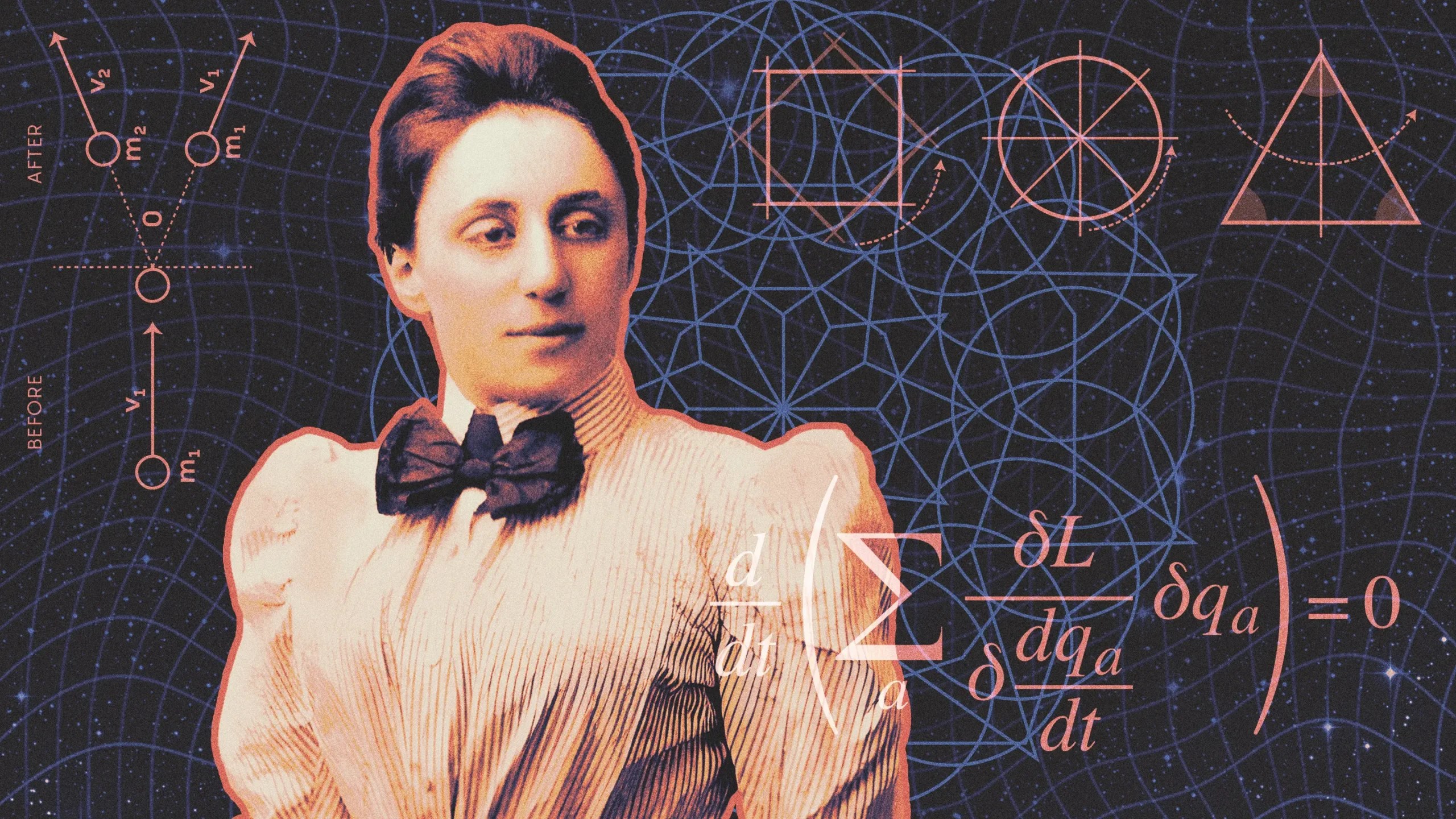
Emmy Noether showed that fundamental physical laws are themselves a consequence of simple symmetries. As Shalma Wegsman explains, a century later, her insights continue to shape physics…
In the fall of 1915, the foundations of physics began to crack. Einstein’s new theory of gravity seemed to imply that it should be possible to create and destroy energy, a result that threatened to upend two centuries of thinking in physics.
Einstein’s theory, called general relativity, radically transformed the meaning of space and time. Rather than being fixed backdrops to the events of the universe, space and time were now characters in their own right, able to curve, expand and contract in the presence of matter and energy.
One problem with this shifting space-time is that as it stretches and shrinks, the density of the energy inside it changes. As a consequence, the classical energy conservation law that previously described all of physics didn’t fit this framework. David Hilbert, one of the most prominent mathematicians at the time, quickly identified this issue and set out with his colleague Felix Klein to try to resolve this apparent failure of relativity. After they were stumped, Hilbert passed the problem on to his assistant, the 33-year-old Emmy Noether.
Noether was an assistant in name only. She was already a formidable mathematician when, in early 1915, Hilbert and Klein invited her to join them at the University of Göttingen. But other faculty members objected to hiring a woman, and Noether was blocked from joining the faculty. Regardless, she would spend the next three years prodding the fault line separating physics and mathematics, eventually setting off an earthquake that would shake the foundations of fundamental physics.
In 1918, Noether published the results of her investigations in two landmark theorems. One made sense of conservation laws in small regions of space, a mathematical feat that would later prove important for understanding the symmetries of quantum field theory. The other, now just known as Noether’s theorem, says that behind every conservation law lies a deeper symmetry.
In mathematical terms, a symmetry is something you can do to a system that leaves it unchanged. Consider the act of rotation. If you start with an equilateral triangle, you’ll find that you can rotate it by multiples of 120 degrees without changing how it looks. If you start with a circle, you can rotate it by any angle. These actions without consequences reveal the underlying symmetries of these shapes.
But symmetries go beyond shape. Imagine you do an experiment, then you move 10 meters to the left and do it again. The results of the experiment don’t change, because the laws of physics don’t change from place to place. This is called translation symmetry.
Now wait a few days and repeat your experiment again. The results don’t change, because the laws of physics don’t change as time passes. This is called time-translation symmetry.
Noether started with symmetries like these and explored their mathematical consequences. She worked with established physics using a common mathematical description of a physical system, called a Lagrangian.
This is where Noether’s insight went beyond the symbols on the page. On paper, symmetries seem to have no impact on the physics of the system, since symmetries don’t affect the Lagrangian. But Noether realized that symmetries must be mathematically important, since they constrain how a system can behave. She worked through what this constraint should be, and out of the mathematics of the Lagrangian popped a quantity that can’t change. That quantity corresponds to the physical property that’s conserved. The impact of symmetry had been hiding beneath the equations all along, just out of view.
In the case of translation symmetry, the system’s total momentum should never change. For time-translation symmetry, a system’s total energy is conserved. Noether discovered that conservation laws aren’t fundamental axioms of the universe. Instead, they emerge from deeper symmetries.
The conceptual consequences are hard to overstate. Physicists of the early 20th century were shocked to realize that a system that breaks time-translation symmetry can break energy conservation along with it. We now know that our own universe does this. The cosmos is expanding at an accelerating rate, stretching out the leftover light from the early universe. The process reduces the light’s energy as time passes…
… Noether’s theorem has shaped the quantum world too. In the 1970s, it played a big role in the construction of the Standard Model of particle physics. The symmetries of quantum fields dictate laws that restrict how fundamental particles behave. For instance, a symmetry in the electromagnetic field forces particles to conserve their charge.
The power of Noether’s theorem has inspired physicists to look toward symmetry to discover new physics. Over a century later, Noether’s insights continue to influence the way physicists think…
“How Noether’s Theorem Revolutionized Physics,” from @shalmawegs in @QuantaMagazine.
* Jorge Luis Borges
###
As we contemplate cosmology, we might send insightful birthday greetings to the man who “wrote the book” on perspective, Leon Battista Alberti; he was born on this date in 1404. The archetypical Renaissance humanist polymath, Alberti was an author, artist, architect, poet, priest, linguist, philosopher, cartographer, and cryptographer. He collaborated with Toscanelli on the maps used by Columbus on his first voyage, and he published the the first book on cryptography that contained a frequency table.
But he is surely best remembered as the author of the first general treatise– Della Pictura (1434)– on the the laws of perspective, which built on and extended Brunelleschi’s work to describe the approach and technique that established the science of projective geometry… and fueled the progress of painting, sculpture, and architecture from the Greek- and Arabic-influenced formalism of the High Middle Ages to the more naturalistic (and Latinate) styles of Renaissance.


“Make visible what, without you, might perhaps never have been seen”*…

Lawrence Weschler is no stranger to controversy. In 2000 he published an article in The New Yorker, recounting a theory that David Hockey had shared with him, that ignited a fire storm in the art world– and that burns (or at least smolders) to this day.
And he’s at it again…
A few months back—in the lee of the Rijksmuseum’s epic Vermeer show and Ren’s [Wechsler’s] controversial Atlantic magazine article (featured in our Issue #39) on Vermeer and Benjamin Binstock’s intriguing contention that eight of the thirty-four paintings conventionally attributed to the Delft master were in fact by his daughter Maria—the eminent curator Helen Molesworth invited Ren and Claudia Swan (the historian behind Rarities of These Lands and other classics on the Dutch Golden Age) to engage in a conversation evaluating both that show and Binstock’s thesis for an episode of her ongoing Dialogues podcast, out of the David Zwirner Gallery. And indeed, that half-hour episode dropped yesterday—and we thought you might enjoy hearing it here. Spoiler alert: Two of the top people in the field seem decidedly open to Binstock’s theory…

Fascinating: “Vermeer’s Daughter?”
* Robert Bresson
###
As we argue over attribution, we might send grateful birthday greetings to Leon Battista Alberti; he was born on this date in 1404. The archetypical Renaissance humanist polymath, Alberti was an author, artist, architect, poet, priest, linguist, philosopher, cartographer, and cryptographer. Indeed, with Johannes Trithemius, he is considered the father of cryptography. And he collaborated with Toscanelli on the maps used by Columbus on his first voyage.
But he is surely best remembered as the man who “wrote the book” on perspective: he authored of the first general treatise– De Pictura (1434)– on the the laws of perspective, which built on and extended Brunelleschi’s work to describe the approach and technique that established the science of projective geometry… and fueled the progress of painting, sculpture, and architecture from the Greek- and Arabic-influenced formalism of the High Middle Ages to the more naturalistic (and Latinate) styles of Renaissance.

“I was a peripheral visionary. I could see the future, but only way off to the side.”*…

As Niels Bohr said, “prediciton is hard, especially about the future.” Still, we can try…
While the future cannot be predicted with certainty, present understanding in various scientific fields allows for the prediction of some far-future events, if only in the broadest outline. These fields include astrophysics, which studies how planets and stars form, interact, and die; particle physics, which has revealed how matter behaves at the smallest scales; evolutionary biology, which studies how life evolves over time; plate tectonics, which shows how continents shift over millennia; and sociology, which examines how human societies and cultures evolve.
The far future begins after the current millennium comes to an end, starting with the 4th millennium in 3001 CE, and continues until the furthest reaches of future time. These timelines include alternative future events that address unresolved scientific questions, such as whether humans will become extinct, whether the Earth survives when the Sun expands to become a red giant and whether proton decay will be the eventual end of all matter in the Universe…
A new pole star, the end of Niagara Falls, the wearing away of the Canadian Rockies– and these are just highlights from the first 50-60 million years. Read on for an extraordinary outline of what current science suggests is in store over the long haul: “Timeline of the far future,” a remarkable Wikipedia page.
Related pages: List of future astronomical events, Far future in fiction, and Far future in religion.
* Steven Wright
###
As we take the long view, we might send grateful birthday greetings to the man who “wrote the book” on perspective (a capacity analogically handy in the endeavor featured above), Leon Battista Alberti; he was born on this date in 1404. The archetypical Renaissance humanist polymath, Alberti was an author, artist, architect, poet, priest, linguist, philosopher, cartographer, and cryptographer. He collaborated with Toscanelli on the maps used by Columbus on his first voyage, and he published the the first book on cryptography that contained a frequency table.
But he is surely best remembered as the author of the first general treatise– De Pictura (1434)– on the the laws of perspective, which built on and extended Brunelleschi’s work to describe the approach and technique that established the science of projective geometry… and fueled the progress of painting, sculpture, and architecture from the Greek- and Arabic-influenced formalism of the High Middle Ages to the more naturalistic (and Latinate) styles of Renaissance.
“There’s no idea in economics more beautiful than Arrow’s impossibility theorem”*…

Tim Harford unpack’s Kenneth Arrow‘s Impossibility Theorem (which feels a bit like a socio-economic “Monty Hall Problem“) and considers it’s implications…
… if any group of voters gets to decide one thing, that group gets to decide everything, and we prove that any group of decisive voters can be pared down until there’s only one person in it. That person is the dictator. Our perfect constitution is in tatters.
That’s Arrow’s impossibility theorem. But what does it really tell us? One lesson is to abandon the search for a perfect voting system. Another is to question his requirements for a good constitution, and to look for alternatives. For example, we could have a system that allows people to register the strength of their feeling. What about the person who has a mild preference for profiteroles over ice cream but who loathes cheese? In Arrow’s constitution there’s no room for strong or weak desires, only for a ranking of outcomes. Maybe that’s the problem.
Arrow’s impossibility theorem is usually described as being about the flaws in voting systems. But there’s a deeper lesson under its surface. Voting systems are supposed to reveal what societies really want. But can a society really want anything coherent at all? Arrow’s theorem drives a stake through the heart of the very idea. People might have coherent preferences, but societies cannot…
On choice, law, and the paradox at the heart of voting: “Arrow’s Impossibility Theorem,” from @TimHarford in @WhyInteresting. Eminently worth reading in full.
* Tim Harford
###
As we contemplate collective choice, we might send grateful birthday greetings to the man who “wrote the book” on perspective, Leon Battista Alberti; he was born on this date in 1404. The archetypical Renaissance humanist polymath, Alberti was an author, artist, architect, poet, priest, linguist, philosopher, cartographer, and cryptographer. He collaborated with Toscanelli on the maps used by Columbus on his first voyage, and he published the the first book on cryptography that contained a frequency table.
But he is surely best remembered as the author of the first general treatise– Della Pictura (1434)– on the the laws of perspective, which built on and extended Brunelleschi’s work to describe the approach and technique that established the science of projective geometry… and fueled the progress of painting, sculpture, and architecture from the Greek- and Arabic-influenced formalism of the High Middle Ages to the more naturalistic (and Latinate) styles of Renaissance.
You must be logged in to post a comment.