Posts Tagged ‘business’
“If you optimize everything, you will always be unhappy.”*…

Phil Tinline on the history and consequences of the impulse to optimize businesses, markets, and governments…
Optimization means achieving a measurable objective—that is, maximizing or minimizing a given number. It requires controlling the inputs and processes that affect the objective, in order to find the most efficient way to achieve it. It draws on centuries of mathematical discovery, but it emerged in its modern form under the pressure of World War II and the need to manage the byzantine complexity of US military logistics.
In the summer of 1947, a Stanford-trained mathematical scientist named George Dantzig sat in his office at the Pentagon, laboring over US Air Force planning issues with a desk calculator. The problems he had dealt with during the war and since involved “an astronomical number of feasible solutions to choose from,” making it impossible to calculate which was the best. As he recalled, “Those in charge often do a hand-wave and say, ‘I’ve considered all the alternatives,’ but this is so much garbage.” All those leaders had to offer was that their “‘experience’ and ‘mature judgment’ would guide the way” by laying down rules that would limit the options.
The problem, Dantzig realized, was that “you could never find any direct relationship between the stated goal and the actions to achieve the goal.” The solution, he believed, was to formulate a complex real-world problem as a mathematical model. This could then be solved by what became Dantzig’s “simplex algorithm” (or “simplex method”), provided a precise goal was set as its “objective function.”
The simplex algorithm radically reduced the number of feasible solutions. It soon became clear that it could be brought to bear far beyond the military: “All one had to do,” Dantzig remembered, “was change the names of the columns and the rows, and it was applicable to an economic planning problem or to an industrial planning problem.”
In engineering, optimization was put to use in designing rockets and aircraft, and the shape of cars, wind turbines, and hydrofoils. It redefined manufacturing, circuit design, and the management of supply chains. Its impact is still visible in measures of the occurrence of the word “optimization” itself. Before 1950, the term was barely in use at all; thereafter, its frequency soared.
Economists embraced optimization too. An early application was in the development of “portfolio theory,” which, as the aerospace engineer Joaquim R. R. A. Martins and the computer scientist Andrew Ning put it, “formalized the idea of investment diversification, marking the birth of modern financial economics.”7 One important element of optimization in economics is the inclusion of constraining factors: Given a set level of income or cost, how can we maximize utility? But economics is not quite as scientifically determinable as engineering—it’s more exposed to messy, contradictory fellow humans. Here, optimization starts to look rather suboptimal…
… As computers have become ubiquitous, optimization has spread ever deeper into human life. In 2021, a trio of Stanford academics published a book titled System Error: Where Big Tech Went Wrong and How We Can Reboot. They observed: “What begins as a professional mind-set for the technologist easily becomes a more general orientation to life. … The paramount goal becomes removing friction from everyday activities, automating repetitive tasks, and finding ways to save time while improving outcomes.” US tech companies, for instance, are often led by software engineers, who manage their staff accordingly, measuring results against precisely set objectives. An over-dominant engineering mindset, System Error argued, is extending optimization beyond the areas where it can be effective.
This might surprise the tech analyst Dan Wang, whose 2025 bestseller Breakneck: China’s Quest to Engineer the Future argued that “an American elite, made up mostly of lawyers, excelling at obstruction” had much to learn from China’s “technocratic class, made up of mostly engineers, that excels at construction.” But even Wang admitted that engineering logic can be taken too far. “Sometimes, it feels like China’s leadership is made up entirely of hydraulic engineers,” he wrote, “who view the economy and society as liquid flows, as if all human activity—from mass production to reproduction—can be directed, restricted, increased, or blocked with the same ease as turning a series of valves.”
Given its mathematical foundations, optimization depends on having numerical data that can be adjusted to achieve the numerically expressed objective. As the American historian of science Theodore Porter showed in his 1995 study Trust in Numbers: The Pursuit of Objectivity in Science and Public Life, governments began to gather data at scale and to rely on it for decision-making for reasons similar to those set out by Dantzig—to get away from the subjective judgment of leaders.
However, Porter warned that while using numbers to exercise power objectively might be an attractive idea, it is also impossible to do. Even governments can’t count everything, and choosing what to leave out is an intensely political decision. Worse, Porter wrote, “numbers have often been an agency for acting on people, exercising power over them,” even turning people “into objects to be manipulated.” As Wang noted, in China the drive to meet numerical targets has sometimes taken a crushingly simple form, as with the government’s “one child” or “zero Covid” policies.
Even when optimizers aren’t sealing sick people in their homes, as the Chinese state did during the pandemic, they are often so focused on their objective that they don’t notice the damage they’re doing. Whatever is not relevant to the objective can be shrugged off as a so-called externality. Witness corporations optimizing their operations to maximize profits or the price of their shares. Some squeeze pay or working conditions; others pollute with abandon, or exploit their dominant market position to force down their suppliers’ prices, regardless of the impact.
And the problem with optimization is not just a matter of unfortunate side-effects. We are seeing the emergence of what we might call “social optimization”—the belief that this idea offers a way to transform society as a whole. But as Porter’s work suggests, this is not a matter of neutrally making things better. Optimization privileges the measurable over the unmeasurable. And it places the onus for improving society on the ever-striving individual rather than asking more fundamental, structural questions about why systems work as they do and whom they empower and disempower.
This is not an explicit ideology. No doubt, businesses and governments often are simply following the logic and opportunities implicit in new digital technology, from smartphones to the cameras and sensors that can now cheaply and efficiently monitor a wide range of activities. Nonetheless, as new technology has made it possible to gather ever more numerical data, optimization has begun to embed its implicit values into our lives.
In the workplace, this can swiftly make people’s lives worse. Particularly in sectors such as logistics, new technology allows employers to optimize more and more rigorously for maximum productivity and minimum cost. It has become commonplace to give employees an ongoing score, with the aim of incentivizing them to compete continually. This goes beyond even the monitoring of worker efficiency that the management consultant Frederick Taylor pioneered in the early twentieth century and the numerical key performance indicators that his successors promoted. The intensive quantification of employees’ performance has come to be known as “digital Taylorism.”
Optimization has refocused the media around the measurable preferences of the individual, as tallied in clicks, page views, unique browses, and similar metrics. This erodes the shared moments that build a culture and the shared truths that underpin democracy. Social media takes this even further: Algorithms are optimized to maximize attention, incentivizing people to respond to political issues not with thought but vivid expressions of feeling, rewarding users numerically in follows, likes, and shares. Meanwhile, tracking apps increasingly normalize the optimization of health metrics.
Yet technologists are keen to go much further. Off the back of their successes producing software, they are raising their sights to the horizon, optimizing for a few grand objectives at all costs, in pursuit of an ever more perfect world. They have formed an alliance with philosophers and philanthropists in the Effective Altruism movement, which aims to purge generosity of the influence of feeling in favor of calculable reason—even as it confidently prophesies the far future. Other tech leaders support the principles of the “network state.” According to the journalist Gil Duran, this concept proposes to create “private, corporate-controlled cities” that will liberate innovators from the constraints of the democratic state and its messy, unmeasurable trade-offs.13
And most of all, the dream of social optimization reverberates through promises of an AI-transformed future, in which once unthinkably efficient tech will supposedly liberate individual human potential. In “The Techno-Optimist Manifesto” (2023), the venture capitalist Marc Andreessen proposed using technology and the free market to maximize abundance to the point of infinity. Though Andreessen insists he does not believe in “the Unconstrained Vision of Utopia,” he dismisses the “Precautionary Principle” as an “enemy.”
The problem here is obvious to anyone not immersed in the culture of Silicon Valley. Not every worthwhile objective can be measured. How do we quantify social peace, for instance, or the health of our arts and culture, or the concentration of power? Or the worth of work itself, or a truly enriching education, or kindness? We might hope the realization that not everything can be measured would prompt the promoters of social optimization to accept its limitations and appreciate the qualities of more deeply rooted systems, such as democracy. Alas, they tend to conclude that if a goal or a problem has no measure, it is not worth bothering with. Kevin Kelly, a technology journalist and an apostle of the Quantified Self movement, has faced criticism, as he puts it, that “only intangibles like meaningful happiness count.” His response: “Meaningfulness is very hard to measure, which makes it very hard to optimize.” Similarly, in a critique of the US anti-monopoly movement, the journalist Matthew Yglesias has protested that “‘corporate power’ doesn’t mean anything” on the grounds that it “doesn’t add up to anything measurable or actionable.”
But this is not the first time similar-sounding criticisms have been raised against attempts to perfect society. Where they chose to focus their fire, and where they didn’t, reveals what’s distinctive about the phenomenon of social optimization…
[Tinline reaches back to the early 19th century (and the earliest known use of the word “optimize”) then follows the development of what has become a powerful mindset– in effect, a movement. He concludes…]
Governments today do have something to learn from Dantzig’s insistence on the importance of having a clear objective. But his overly dim view of leadership needs to be constrained. It is increasingly clear that, in the less calculable areas of life, a leader exercising human judgment is preferable to an implacable optimization algorithm. Without such human-centered constraints in place, social optimization won’t make things better—only more extreme.
On not letting the perfect be the enemy of the possible– and often the preferable: “The Cult of Optimization,” from @philtinline.bsky.social in The Ideas Letter.
We should note that the optimization craze has taken hold at the personal level as well, with similar results. See. e.g., “Optimising is just perfectionism in disguise. Here’s why that’s a problem” and “Optimization Culture Is Making Us Miserable.”
* Donald Knuth (the godfather of computer programming)
###
As we celebrate slack and internalize externalities, we might spare a thought for a man who looked beyond the metrics od his day, Clifford W. Beers; he died on this date in 1943. An author and psychiatric patient, he is best known as the founder of the American mental hygiene movement.
Clifford Whittingham Beers was an American author and social reformer who wrote an autobiography documenting appalling conditions and maltreatment by staff of mental patients. His classic book, A Mind That Found Itself (1908) raised public consciousness of the need for reform. He had already himself experienced treatment as a mental patient, first in 1900, diagnosed with depression and paranoia. His four siblings also suffered mental health problems and died in mental hospitals, as he also did. In 1909, Beers founded the National Committee for Mental Hygiene (since renamed as Mental Health America) with the mission to improve the treatment in mental health institutions. By 1913, he was able to establish the Clifford Beers Clinic in New Haven, an outpatient mental health clinic, the first of its kind in the U.S., which continues his legacy to the present. – source

“The present is the past rolled up for action, and the past is the present unrolled for understanding”*…
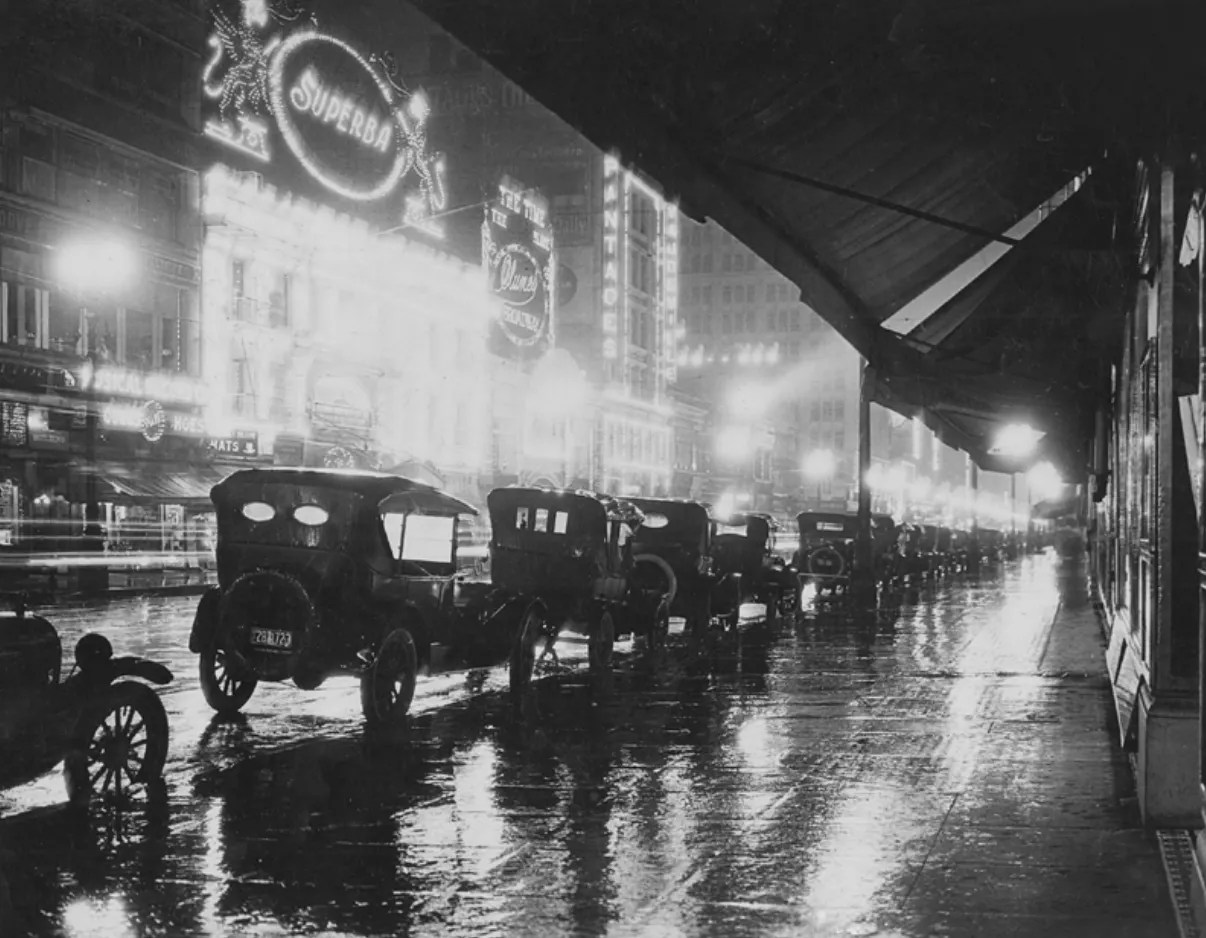
As Jean-Baptiste Alphonse Karr put it, “plus ça change, plus c’est la même chose” (“the more things change, the more they stay the same”). Case in point: Derek Thompson reminds us that about 100 years ago, America was obsessed with technology, immigration, women, work, and money. Sound familiar?
[Just over] one hundred years ago, on September 26, 1929, President Herbert Hoover gathered a group of social scientists at the White House. He asked them to begin research on the most detailed report ever produced on the state of the nation. Four years later, running more than 1,500 pages long, Recent Social Trends was published, offering an unusually granular look at life in the mid-1920s.
The document is almost entirely forgotten. But today, for America’s 250th birthday, I’m blowing the cobwebs off this sucker and taking readers inside its yellowed pages for a look back at what life was like in the U.S. exactly 100 years ago, when the U.S. was celebrating its sesquicentennial anniversary…
And what a look it is…
… Imagine that you are the typical American in 1926. You are a white 26-year-old. (In 2026, the median age is 40.) Since most immigrants have been male, we’ll say you’re a guy. Your name is John. Born in the first term of William McKinley’s presidency, you are raised on a farm without flush toilets or electric lighting. Too young to fight in World War I, you come of age alongside a generation that sees war in Europe as a “useless colossal blunder,” in the words of historian David M. Kennedy. Your life—indeed, your entire generation—is shaped by several notable developments: education, urbanization, automation, and women’s rights. You are the first person in your family to finish high school.
At 19, you move from the countryside to an urban apartment, as one small drop in the migratory flood from farm to city. Jobs in manufacturing and retail are easy to find. They’re also easy to lose. Temporary unemployment is the norm. You earn $100 a month and put some away for a rainy day, confident that the bustling city will provide another job in a few months. (Unemployment insurance does not exist; neither does Social Security.) In the evenings, you “radio”; yes, it’s a verb, too. Every weekend, you visit a cineplex, where the movies are black-and-white and silent. Sometimes, you down a few prohibited cocktails and go dancing with flappers. Several times a week, you drive around in a black Model T.
The year 1926 has been good to you. City life is a blur of high-velocity machines—cars, assembly lines, and radio broadcasts—and you sometimes miss the ancient rhythms of your farmland home. One year from now, Charles Lindbergh will shock the world by flying across the Atlantic. In two years, at 28, you’ll be married. In three years, you’ll have a baby. And in four years, in 1930, just months after the biggest stock market crash in American history, the world as you know it will be over…
Thompson goes on to unpack the details of the economy and employment, the migration from farm to city, the extraordinary centrality of the automobile, changing mores and gender roles, the primacy of literature and the rise of radio, and so much more. He concludes…
The authors of Recent Social Trends were astonishingly prescient about the direction of technology. In one paragraph, they somehow anticipated the rise of audiobooks, YouTube, Netflix, smartphone cameras, musical software, ubiquitous air conditioning, and the electric battery revolution:
It may be that the world will find much use for talking books; school and college students may listen to lectures by long-running phonographs or talking pictures; moving pictures may be transmitted by wireless into houses; seeing with that new electric eye, the photo-electric cell, and recording what is seen, appear to have almost unlimited applications; new musical instruments different from any now in use may be given to us by electricity; the production of artificial climate may become widespread; an efficient storage battery of light weight and low cost might produce changes rivaling those of the internal combustion engine. And these are only a few of the myriad possibilities from new inventions in the future!
In an equally oracular section, the authors predicted the emergence of remote work and declining geographic mobility, anticipating that “the transmission of goods, of the voice and possibly of vision may act as a retarding influence on human mobility in the future and may cause a development of more remote and impersonal direction and controls.”
But the social scientists did not see these trends as altogether good. They worried that modern life, defined in equal parts by urbanization and technology, obliterated people’s values and their sense of self. Even as they gawked at the increase in patents—which grew more than 20-fold between the 1850s and the 1920s—they worried that a growing number of discoveries would bring “problems of morals, of education, of law, of leisure time, of unemployment, of speed, of uniformity and of differentiation.”
Social scientists of the 1920s saw machines pushing workers off of farms and competing with workers in manufacturing plants. How long, they wondered, until they would replace human workers in all tasks? “A larger proportion of work by machines, and a smaller proportion of human labor, is to be expected in the future,” they wrote. “There are indeed a few cases of wholly automatic factories and automatic stores and many automatic salesmen.” It is extraordinary to read these fears and not reflect on the AI jobs panic of the present, while also marveling at the thousands of occupations that are possible today precisely because machines made old jobs obsolete.
The dawn of the age of the machine drove us mad. Physicians of the day warned that the frail human mind was no match for the car, predicting at the time that “diseases of the wheel” would afflict the youth who rode bicycles and cars without restraint. It was not entirely obvious that they were wrong. In Germany, the number of patients registered in mental hospitals grew from 40,375 in 1870 to 220,881 in 1910. Over the same period, the share of patients admitted to general hospitals for illnesses of the nervous system rose from 44 to 60 percent.
Most perceptively, social critics of the age recognized that the urban-technological revolution of the early 20th century—what we might even call “modernity”—transformed not only our minds but also our values. Machines and systems that pulled Americans off the farm, away from the family home, and into churning markets of people and products threatened to replace the Judeo-Christian values that had bound the country for centuries with a new system of values dictated by markets. In 1903, the sociologist Georg Simmel anticipated the anxieties of the Twenties—ours and theirs—when he observed that in cities “money takes the place of all the manifoldness of things” and becomes “a common denominator of all values.” Money “hollows out the core of things, their peculiarities, their specific values, and their uniqueness and incomparability in a way which is beyond repair.”
One hundred and twenty years after the publication of that essay, the Wall Street Journal asked thousands of Americans what values were still important to them. While a declining share of Americans endorsed the worthiness of patriotism, religion, community, and children, the share who said “money” was “very important to them” went up. It sometimes seems as if markets and money are the last value standing, the final common denominator beneath all human endeavor.

On its 250th birthday, the U.S. similarly defines itself through markets. Those famous words of Calvin Coolidge, America’s president in 1926, could just as well serve this American president and this American moment: “The chief business of the American people is business.”…
Eminently worth reading in full: “America, 1926: What a Forgotten 100-Year-Old Report Says About Who We Are,” from @dkthomp.bsky.social.
You can find the full text of Recent Social Trends in the United States- Report of the President’s Research Committee on Social Trends, from the collection of the remarkable Prelinger Library, at the invaluable Internet Archive: Volume 1 and Volume 2.
* Will and Ariel Durent, The Lessons of History (in which, also: “Progress is an improvement in the means that we use for achieving the same old ends. I sometimes wonder if the progress is only of means without any progress in ends.”)
###
As we hear the echo, we might recall that today marks the anniversary of a signature advance during the period covered by Recent Social Trends in the United States: on this date in 1928, sliced bread was sold for the first time, by the Chillicothe Baking Company of Chillicothe, Missouri.
For more on this seminal development, see “What was the best thing before sliced bread?“

“The clearest way to see through a culture is to attend to its tools for conversation”*…
Matt Pearce revisits Neil Postman‘s 1992 Technopoly: The Surrender of Culture to Technology…
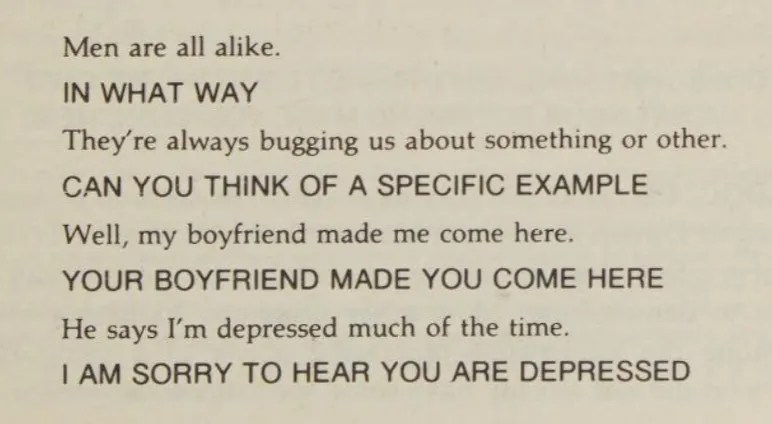
In the 1960s, a German-American computer scientist named Joseph Weizenbaum coded an early version of today’s AI chatbots. Weizenbaum called his program ELIZA, after the “My Fair Lady” character Eliza Doolittle who takes speech lessons (and gets better).
How people reacted to Weizenbaum’s crude creation tells us almost everything we need to know about AI hype more than half a century later.
ELIZA could hold basic “conversations,” including playing the role of a psychotherapist with real human users. [In the example above, ELIZA’s responses to one woman are shown in capital letters.]
Anybody with a cursory awareness of recent headlines about AI romances and AI psychosis already knows where this is going. ELIZA’s human interlocuters in the 1960s, despite talking to a clunky machine they knew had been programmed by Weizenbaum, refused to believe that they were talking to a mere machine. His secretary, having watched him build the contraption over several months, after just a few exchanges with ELIZA, asked Weizenbaum to leave the room so she could have some privacy.
Weizenbaum, exhibiting a bit of Freudian sangfroid about all this, was not surprised to see people form emotional attachments with inanimate objects. He’d already seen people get attached to their cars or guitars or computers. But “what I had not realized is that extremely short exposures to a relatively simple computer program could induce powerful delusional thinking in quite normal people,” Weizenbaum wrote in his 1976 book “Computer Power and Human Reason: From Judgment to Calculation.”…
… I learned about Weizenbaum’s ELIZA experiment from Neil Postman’s 1992 book “Technopoly: The Surrender of Culture to Technology,” a work of technoconservatism that, like Weizenbaum’s writings, was imbued with foresight about our struggles with today’s vastly more powerful technologies.
Consider this passage from Postman’s “Technopoly”:
In a technocracy, tools play a central role in the thought-world of the culture. Everything must give way, in some degree, to their development. The social and symbolic worlds become increasingly subject to the requirements of that development. Tools are not integrated into the culture; they attack the culture. They bid to become the culture. As a consequence, tradition, social mores, myth, politics, ritual, and religion have to fight for their lives.
Technology, attacking and taking over the culture? Bending society to its own imperative for advancement? In my United States of America? Postman (most famous for writing “Amusing Ourselves to Death”) thought the U.S. was the world’s first “Technopoly,” a society marked by “the submission of all forms of cultural life to the sovereignty of technique and technology,” where information itself has become a form of pollution.
To Postman, “the milieu in which Technopoly flourishes is one in which the tie between information and human purpose has been severed, i.e., information appears indiscriminately, directed at no one in particular, in enormous volume and at high speeds, and disconnected from theory, meaning or purpose.”
Neil Postman wrote “Technopoly” before the introduction of ChatGPT and Sora; TikTok and YouTube; Twitter and Facebook; Google Search and the Netscape browser. Postman wrote the book before Windows 95 existed. A philosophy of technology that mostly holds up through successive eras of technical revolution has already passed time’s first test, which is for the philosophy to outlive the philosopher. And Postman’s philosophy is ultimately conservative, motivated by the desire to preserve the traditions of humanism, social cohesion and a shareable sense of collective history.
Technoconservatism was old before it was new. Postman quotes Plato’s “Phaedrus,” where Thamus warns that whoever learns writing (one of our first dangerous technologies) “will cease to exercise their memory and become forgetful” and “will receive a quantity of information without proper instruction, and in consequence be thought very knowledgeable when they are for the most part quite ignorant.” And Postman, to his credit, is like — well, yeah! Writing really did that. A new technology is neither good nor bad, but ecological: it “does not add or subtract something. It changes everything. In the year 1500, fifty years after the printing press was invented, we did not have old Europe plus the printing press. We had a different Europe.”
In previous generations, societies dealt with information revolutions (which always produced information gluts) by creating institutions that prioritize “good” information and deprioritize the bad; think about schools with their organized curricula, courts with their standards of evidence, newspapers with their party lines or codes of journalistic ethics. But Postman notes that we got lucky after the Gutenberg revolution, when information technology’s development slowed down long enough for societies to catch up and be excellent:
From the early seventeenth century, when Western culture undertook to reorganize itself to accommodate the printing press, until the mid-nineteenth century [with the invention of the telegraph], no significant technologies were introduced that altered the form, volume, or speed of information. As a consequence, Western culture had more than two hundred years to accustom itself to the new information conditions created by the press. It developed new institutions, such as the school and representative government. It developed new conceptions of knowledge and intelligence, and a heightened respect for reason and privacy. It developed new forms of economic activity, such as mechanized production and corporate capitalism, and even gave articulate expression to the possibilities of a humane socialism. New forms of public discourse came into being through newspapers, pamphlets, broadsides, and books. It is no wonder that the eighteenth century gave us in the work of Goethe, Voltaire, Diderot, Kant, Hume, Adam Smith, Edmund Burke, Vico, Edward Gibbon, and, of course, Jefferson, Madison, Franklin, Adams, Hamilton, and Thomas Paine. I weight the list with America’s “Founding Fathers” because technocratic-typographic America was the first nation ever to be argued into existence in print.
Contrast the luxuriously slow social pace of the Gutenberg era with today’s information development timelines. Over the course of three decades, we’ve seen the rise and now-decline of the open web; the rise and now-decline of social media; the rise of short-form video and the rise of chatbots and synthetic information. All created enormous economic and philosophical disruptions whose fundamental impacts you can’t get a group of people in a room together to describe accurately. Among the disruptions: These increasingly efficient forms of sharing information keep encountering falling test scores; universities are trying to implement AI as their own students use it for cheating or boo the tech at their graduations; people are falling in love with their chatbots, which sometimes tell their users to kill themselves. A society that wants to understand itself probably wouldn’t act like this…
Read on for how we might — dare one suggest, should— act: “A society that wants to understand itself probably wouldn’t act like this,” from @mattdpearce.com.
Compare to/contrast with with Yuval Avnar‘s riff on Pascal’s musing on the implications of his invention, the “arithmetic machine” (an early, if not the first, modern mechanical calculator): “The Inventor of the Thinking Machine Didn’t Worry. Neither Should You.“
* Neil Postman, Amusing Ourselves to Death: Public Discourse in the Age of Show Business
###
As we introspect, we might send pointed birthday greetings to Ambrose Bierce; he was born on this date in 1842. His satirical lexicon The Devil’s Dictionary was named as one of “The 100 Greatest Masterpieces of American Literature” by the American Revolution Bicentennial Administration. His story “An Occurrence at Owl Creek Bridge” has been described as “one of the most famous and frequently anthologized stories in American literature”; and his book Tales of Soldiers and Civilians (also published as In the Midst of Life) was named by the Grolier Club as one of the 100 most influential American books printed before 1900.
A prolific and versatile writer, Bierce was regarded as one of the most influential journalists in the United States, and as a pioneering writer of realist fiction. For his horror writing, Michael Dirda ranked him alongside Edgar Allan Poe and H. P. Lovecraft. S. T. Joshi argues that he may well be the greatest satirist America has ever produced, and can take his place with such figures as Juvenal, Swift, and Voltaire. His war stories influenced Stephen Crane, Ernest Hemingway, and others; and he was an influential and feared literary critic. In recent decades Bierce has gained even wider regard as a fabulist and for his poetry.
In 1913, Bierce told reporters that he was travelling to Mexico to gain first-hand experience of the Mexican Revolution. He disappeared over the border and was never seen again.
Apropos the piece featured above:
TELEPHONE, n. An invention of the devil which abrogates some of the advantages of making a disagreeable person keep his distance.
– The Devil’s Dictionary

“Always look on the bright side of life”*…

The estimable economic historian Louis Hyman has been engaged in an on-going “friendly debate” with his equally-estimable friend and Johns Hopkins colleague Rama Chellappa on “what AI means”…
… As I see this debate, this question of our age, there are two main questions that history can shed some light on.
- Is AI a complement or a substitute for labor? That is, will it increase demand for and the productivity of workers, or decrease it?
- Will AI be controlled by the few or be accessible to the many?
A Complement or a Substitute?
Consider a some of the most important technologies of the past 200 years.
When I am asked about what automation might look like, I inevitably discuss agriculture. Roughly all of our ancestors were farmers and approximately none of us today are. Yet we still eat bread made from wheat. That shift is possible because of automation.
The mechanical thresher, used to process wheat, was a substitute for the most backbreaking work of the harvest. But it also enabled more land to be cultivated, and that land was cultivated more efficiently, allowing for greater harvests. Mechanization of the farm, like the thresher, turned the American Midwest into the breadbasket of the world.
Those displaced farmers found work on railroads, moving all that. And those jobs, according to people at the time, were a kind of liberation from the raw animal labor of threshing. On net, it created demand for more workers at better wages in work more fit for people than beasts. For those that remained farmers, they found other higher-value work to be done. On a farm, there is always more work to do.
The failure, then and now, is to think farmers were only threshers. That was one part of their jobs. Today, our work, for most people, is also a bundle of tasks. Workers then and now could and can focus on parts of their job that are of higher value. And in a new economy, new tasks in new industries will be created. Many of the jobs that we do today (web designer, UI expert) were simply unimaginable in 1850. That is a good thing.
Consider now the assembly line. I’m sure you all know about the staggering increases in productivity that come from the division of labor. If you take my class in industrial history, you would learn deeply about the story of the automobile. With the assembly line, and no other change in technology, car assembly went from 12 and a half hours to about 30 minutes (once they worked out the kinks). Did this reduce the demand for workers? No. It reduced the price of cars. And that increased the demand for workers, who eventually could demand even higher wages through unionization.
It is important here to realize that better tools don’t make us get paid worse. They generally make us get paid more. Why? Because the tool, without the person, is useless. Even for today’s most cutting-edge AIs, that is true. It can code, but it can only code what I imagine it to code. It can draw, but only what I imagine it to draw. That is true for AIs as it was true for the thresher.
So, I would offer that AI will create more growth, more abundance. In the long run, all growth comes from higher productivity.
I would add one more piece to this story. Economic inequality has worsened since roughly 1970. It has worsened, therefore, not in the industrial era, but the digital era. I have argued elsewhere that this happened because for decades we did not use computers as tools of automation but as glorified typewriters (and then as televisions). Our productivity did not increase, especially to justify the expense of computers. Economists have debated for decades now over the lack of increase in productivity that came with the “digital age” of computing, but it is simple. We don’t use them as computers. Now we can.
For the first time now, normal people with their normal problems can use their computers to solve and automate their problems. AI can write code. AI can automate their tedium. The digital age did not bring any gains because it had no yet arrived. We were living through the last gasp of the industrial economy.
It is now here.
This technology will unleash unimaginable productivity gains. It will level the playing field between coders and the rest of us. Coders will lose their jobs, to be sure, but for the rest of us, the bundle of workplace tasks will become much better.
And truthfully, the demand for real computer scientists will probably increase in the era of vibe-coding. Computer science itself is a bundle of skills, of which coding is just one. The more important skill – software and data architecture – will only increase in demand as the usefulness of software expands…
[Hyman goes on to explore the dangers of monopolization (which, for reasons he explains, he believes are overstated); the future of softward (which, he believes, will skew to open-sorce), and of hardware (which, he believes will not be a bottleneck). He concludes…]
… Put together we come to a very different picture of what the digital age will be. The industrial age required massive investments to build the factories to make the products that were in demand. In the digital age, in contrast, the factories to build digital products will be made by the AI on your laptop. That is not inequality. That is equality.
The physical products of the Fordist industrial age were made for the mass market. In contrast, the digital products of the post-fordist digital age will be long-tail products. I don’t need to make mass market products; I can make them for a small niche, or just for myself.
Rather than fostering inequality, AI, then, is a great equalizer. To make products for a global market you don’t need a billion-dollar factory. You just need a laptop. That is astonishing.
That said, it will not be all sunshine and rainbows. Will AI solve the inequities of capitalism or its reliance on externalities as a source of primitive accumulation? Probably not.
But at the same time, AI is not a normal technology in that it has the potential to radically undermine many of the tendencies to concentrate capital that we have seen in the industrial age. We have been automated out of work before, that is nothing new, but it has always concentrated capital in the hands of the few. For the first time, there is potentially an alternative path forward.
AI will bring the digital age out of the hands of the coders. AI will not widen the gap—it will bridge it. Its ubiquity will mean that AI will be a tool that nearly all of us will be able to use in our daily work, which will make ordinary people more productive and prosperous…
Eminently worth reading in full: “Hooray! Post-Fordism Is Finally Here!“
Even as Hyman’s message is reassuring in the context of the flood of jeremiads in which we’re awash, it’s worth remembering that eerily-similar points were made a couple of decades ago about the threat/promise of digital publishing/commerce. Given the then-current conditions and then-plausible futures, those predictions might have come true… but in the event, they didn’t pan out as projected. That said, things are changing, so maybe this time things are different?
(Image above: source)
* song (by Eric Idle) from Monty Python’s Life Of Brian
###
As we resolve to remain rosy, we might send productive birthday greetings to Andrew Meikle; he was born on this date in 1719. A Scottish millwright, he invented the threshing machine (for removing the husks from grain, as mentioned above). One of the key developments of the British Agricultural Revolution in the late 18th century., it was also one of the main causes of the Swing Riots— an 1830 uprising by English and Scottish agricultural workers protesting agricultural mechanization and harsh working conditions.

“The present is pregnant with the future”*…

The estimable Tim O’Reilly uses scenario planning to create an insightful look at AI, our futures, and the choices that will define them…
We all read it in the daily news. The New York Times reports that economists who once dismissed the AI job threat are now taking it seriously. In February, Jack Dorsey cut 40% of Block’s workforce, telling shareholders that “intelligence tools have changed what it means to build and run a company.” Block’s stock rose 20%. Salesforce has shed thousands of customer support workers, saying AI was already doing half the work. And a Stanford study found that software developers aged 22 to 25 saw employment drop nearly 20% from its peak, while developers over 26 were doing fine.
But how are we to square this news with a Vanguard study that found that the 100 occupations most exposed to AI were actually outperforming the rest of the labor market in both job growth and wages, and a rigorous NBER study of 25,000 Danish workers that found zero measurable effect of AI on earnings or hours?
Other studies could contribute to either side of the argument. For example, PwC’s 2025 Global AI Jobs Barometer, analyzing close to a billion job ads across six continents, found that workers with AI skills earn a 56% wage premium, and that productivity growth has nearly quadrupled in the industries most exposed to AI.
This is exactly the kind of contradictory, uncertain landscape that scenario planning was designed for. Scenario planning doesn’t ask you to predict what the future will be. It asks you to imagine divergent possible futures and to develop a strategy that improves your odds of success across all of them. I’ve used it many times at O’Reilly and have written about it before with COVID and climate change as illustrative examples. The argument between those who say AI will cause mass unemployment and those who insist technology always creates more jobs than it destroys is a debate that will only be resolved by time. Both sides have evidence. Both are probably right at some level. And both framings are not terribly helpful for anyone trying to figure out what to do next…
[O’Reilly explains the scenario approach, then applies it to our future with AI (see the image above), astutely assessing the conflicting signals that we’ve experiencing; he explores the “robust strategy” for our uncertian future (strategic choices that make sense regardless of which future unfolds); then he concludes…
… I’ll return to the theme that I sounded in my book WTF? What’s the Future and Why It’s Up To Us.
Every time a company uses AI to do what it was already doing with fewer people, it is making a choice for the lower half of the scenario grid. Every time a company uses AI to do something that wasn’t previously possible, to serve a customer who wasn’t previously served, to solve a problem that wasn’t previously solvable, it is making a choice for the upper half. These choices compound, for good or ill. An economy that uses AI primarily for efficiency will slowly hollow itself out.
Looking at the news from the future, both sets of signals are present. The question is which will dominate. AI will give us both the Augmentation Economy and the Displacement Crisis, in different measures in different places, depending on the choices we make.
Scenario planning teaches us that we don’t have to predict which future we’ll get. We do have to prepare for a very uncertain future. But the robust strategy, the one that works across every quadrant, is to focus on doing more, not just doing the same with less, and to find ways that human taste still matters in what is created. As long as there is unmet demand, as long as there are problems we haven’t solved and people we haven’t served, AI will augment human work rather than replacing it. It’s only when we stop looking for new things to do that the machines come for the jobs…
Eminently worth reading in full. Indeed, speaking as a long-time scenario planner, your correspondent can only wish that everyone who wields “scenarios” applies the approach as appropriately, adriotly, and acutely as Tim has: “Scenario Planning for AI and the ‘Jobless Future‘,” from @timoreilly.bsky.social.
* Voltaire
###
As we take the long view, we might send formative birthday greetings to Mark Pinsker; he was born on this date in 1923. A mathematician, he made impoprtant contributions to the fields of information theory, probability theory, coding theory, ergodic theory, mathematical statistics, and communication networks. This work, which helped lay the foundation for AI-as-we-know-it, earned him the IEEE Claude E. Shannon Award in 1978, and the IEEE Richard W. Hamming Medal in 1996, among other honors.

You must be logged in to post a comment.