Posts Tagged ‘heliocentrism’
“The story of the events and the people who, over centuries, came together to bring us in from the cold and to wrap us in a warm blanket of technology is a matter of vital importance, since more and more of that technology infiltrates every aspect of our lives”*…

From Étienne Fortier-Dubois, the Historical Tech Tree, “a timeline to visualize the full history of all major technologies (or 1,780 of them, at least), from 3.3 million years ago to today. More importantly, it also contains more than 2,000 connections between them: prerequisites, improvements, inspirations: anything that allows you to understand how one thing led to another”…
The historical tech tree is a project by Étienne Fortier-Dubois to visualize the entire history of technologies, inventions, and (some) discoveries, from prehistory to today. Unlike other visualizations of the sort, the tree emphasizes the connections between technologies: prerequisites, improvements, inspirations, and so on.
These connections allow viewers to understand how technologies came about, at least to some degree, thus revealing the entire history in more detail than a simple timeline, and with more breadth than most historical narratives. The goal is not to predict future technology, except in the weak sense that knowing history can help form a better model of the world. Rather, the point of the tree is to create an easy way to explore the history of technology, discover unexpected patterns and connections, and generally make the complexity of modern tech feel less daunting….
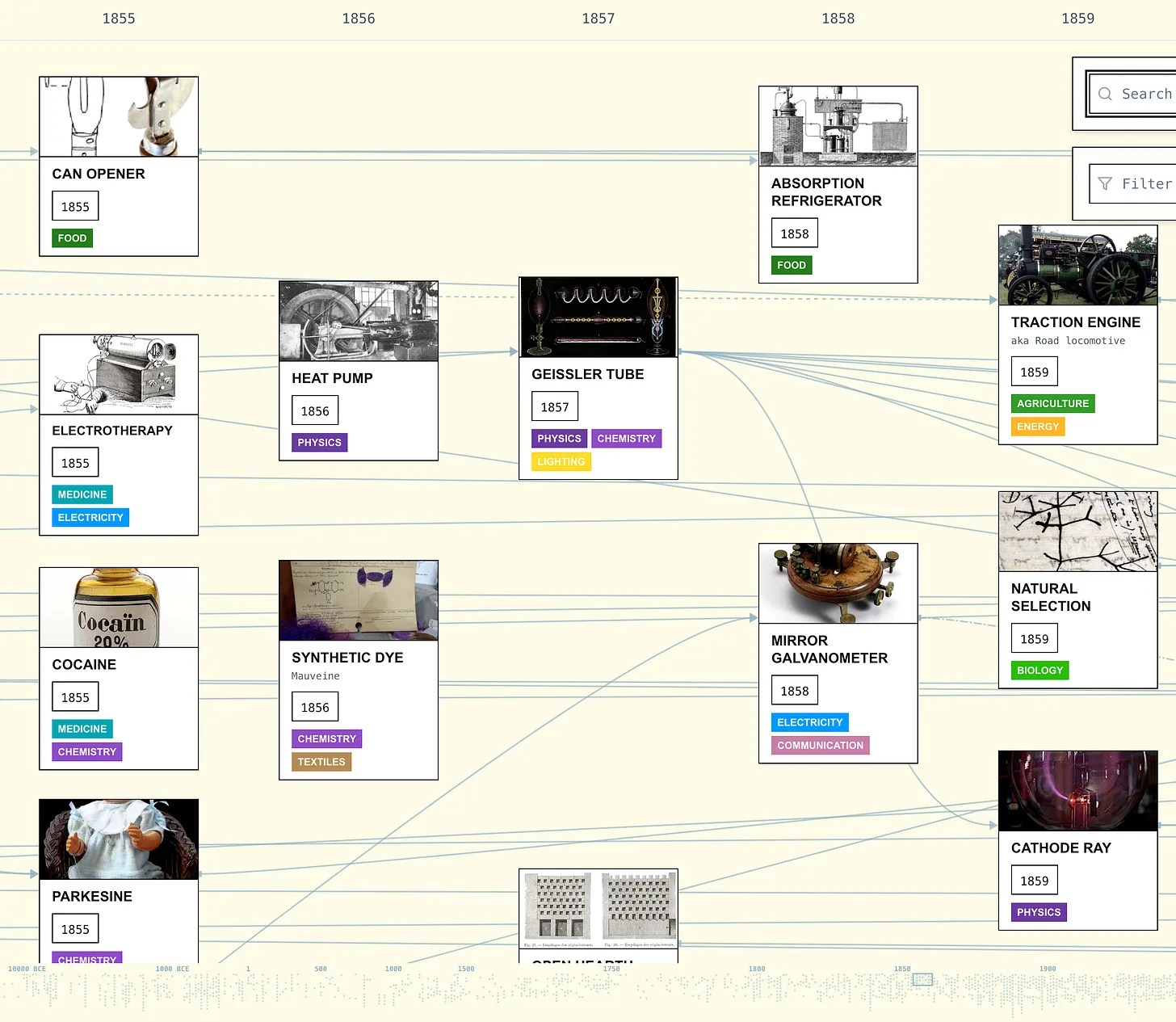
How one thing led to another: “Historical Tech Tree.”
See also: “Introducing the Historical Tech Tree.”
* “The story of the events and the people who, over centuries, came together to bring us in from the cold and to wrap us in a warm blanket of technology is a matter of vital importance, since more and more of that technology infiltrates every aspect of our lives. It’s become a life-support system without which we can’t survive. And yet, how much of it do we understand?”- James Burke, in the first episode of Connections.
###
As we ponder progress, we might recall that it was on this date in 1633, following an Inquisition, that the Holy Office in Rome forced Galileo Galilei to recant his view that the Sun, not the Earth, is the center of the Universe in the form in which he presented it. Gaileo had used a telescope (1603 on the Timeline) to reach his (correct) conclusion.
He refused to recant, and put under house arrest, where he effectively remained for the rest of his life. He dedicated his time in restriction to one of his finest works, Two New Sciences, in which he summarised work he had done some forty years earlier, on the two sciences now called kinematics and strength of materials, and published in Holland to avoid the censor. As a result of this work– highly praised by Albert Einstein– Galileo is often called the “father of modern physics.”

“Mathematics has not a foot to stand on which is not purely metaphysical”*…

Lest we forget…
A forgotten episode in French-occupied Naples in the years around 1800—just after the French Revolution—illustrates why it makes sense to see mathematics and politics as entangled. The protagonists of this story were gravely concerned about how mainstream mathematical methods were transforming their world—somewhat akin to our current-day concerns about how digital algorithms are transforming ours. But a key difference was their straightforward moral and political reading of those mathematical methods. By contrast, in our own era we seem to think that mathematics offers entirely neutral tools for ordering and reordering the world—we have, in other words, forgotten something that was obvious to them.
In this essay, I’ll use the case of revolutionary Naples to argue that the rise of a new and allegedly neutral mathematics—characterized by rigor and voluntary restriction—was a mathematical response to pressing political problems. Specifically, it was a response to the question of how to stabilize social order after the turbulence of the French Revolution. Mathematics, I argue, provided the logical infrastructure for the return to order. This episode, then, shows how and why mathematical concepts and methods are anything but timeless or neutral; they define what “reason” is, and what it is not, and thus the concrete possibilities of political action. The technical and political are two sides of the same coin—and changes in notions like mathematical rigor, provability, and necessity simultaneously constitute changes in our political imagination…
Massimo Mazzotti with an adaptation from his new book, Reactionary Mathematics: A Genealogy of Purity: “Foundational Anxieties, Modern Mathematics, and the Political Imagination,” @maxmazzotti in @LAReviewofBooks.
* Thomas De Quincey
###
As we count on it, we might send carefully-calculated birthday greetings to Regiomontanus (or Johannes Müller von Königsberg, as he was christened); he was born on this date in 1436. A mathematician, astrologer, and astronomer of the German Renaissance, he and his work were instrumental in the development of Copernican heliocentrism during his lifetime and in the decades following his death.

“Look up at the stars and not down at your feet. Try to make sense of what you see, and wonder about what makes the universe exist.”*…

Our environment…
This map shows a slice of our Universe. It was created from astronomical data taken night after night over a period of 15 years using a telescope in New Mexico, USA. We are located at the bottom. At the top is the actual edge of the observable Universe. In between, we see about 200,000 galaxies.
Each tiny dot is a galaxy. About 200,000 are shown with their actual position and color. Each galaxy contains billions of stars and planets. We are located at the bottom. Our galaxy, the Milky Way, is just a dot. Looking up, we see that space is filled with galaxies forming a global filamentary structure. Far away from us (higher up in the map), the filaments become harder to see…
For a (much crisper, more vivid, and interactive) version: “The Map of the Observable Universe.”
* Stephen Hawking
###
As we explore, we might recall that it was on this date in 1616 that The Minutes of the Roman Inquisition recorded the conclusion that Galileo’s writings in support of Copernicus’ heliocentric view of the solar system were “foolish and absurd in philosophy, and formally heretical since it explicitly contradicts in many places the sense of Holy Scripture.” The next day, Galileo was called before Cardinal Bellarmine, who (on Pope Paul V’s instruction) ordered Galileo to abandon the teaching. Shortly thereafter, Copernicus’s De Revolutionibus and other heliocentric works were banned (entered onto the Index Librorum Prohibitorum) “until correction.”
Sixteen years later, Galileo “published” Dialogue Concerning the Two Chief World Systems (Dialogo sopra i due massimi sistemi del mondo)– that’s to say, he presented the first copy to his patron, Ferdinando II de’ Medici, Grand Duke of Tuscany. Dialogue, which compared the heliocentric Copernican and the traditional geo-centric Ptolemaic systems, was an immediate best-seller.
While there was no copyright available to Galileo, his book was printed and distributed under a license from the Inquisition. Still, the following year it was deemed heretical– and he joined Copernicus on the Index Librorum Prohibitorum: the publication of anything else Galileo had written or ever might write was also banned… a ban that remained in effect until 1835.

B-ing all that they can B…

As the emphasis at American Movie Classics has slid every more completely from “Classics” to “American,” viewers have had to take consolation in channel originals like Mad Men and (the less-well-known, but arguably even better) Breaking Bad…
Now, as though in penance, AMC has fielded “BMC”– “B-Movie Classics“– a web site on which one can stream the best of the worst…
Bikinis! Monsters! Motorcycles! Welcome to BMC, your new go-to site for B-movies by the likes of John Carpenter (Dark Star) and Roger Corman (Saga of the Viking Women). Now online and in full screen, watch unsung classics like Asylum by Psycho screenwriter Robert Block or Corridors of Blood with the inimitable Christopher Lee. Want to see international icons before they made it big? Check out Raquel Welch in A Swingin’ Summer or kung fu king Sonny Chiba in Terror Beneath the Sea. Looking for the unexpected? How about The Ruthless Four, a spaghetti Western starring Klaus Kinski.
Now updated with even more B-movies featuring femmes fatales (The Cat Girl), jungle adventures (Curse of the Voodoo) and talking ventriloquist’s dummies (Devil Doll). Whatever your B-movie taste, BMC has got you covered.
(As a special treat, check out Carnival of Souls— a B-Movie that transcends…)
As we salt our popcorn, we might recall that it was on this date in 1593 that the Vatican opened the seven-year trial Italian philosopher, mathematician and astronomer Giordano Bruno– whose championing of heliocentrism and an infinite universe landed him in the dock. Bruno’s theory went beyond the Copernican model in identifying the sun as just one of an infinite number of independently-moving heavenly bodies; indeed, he was the first person (Western person, anyway) to have understood the universe as a continuum in which the stars one sees at night are identical in nature to the Sun… Not a view comfortable to the Orthodoxy. Bruno was convicted of heresy in 1600, and burned at the stake. All of his works were placed on the Index Librorum Prohibitorum in 1603.

You must be logged in to post a comment.