“The story of the events and the people who, over centuries, came together to bring us in from the cold and to wrap us in a warm blanket of technology is a matter of vital importance, since more and more of that technology infiltrates every aspect of our lives”*…

From Étienne Fortier-Dubois, the Historical Tech Tree, “a timeline to visualize the full history of all major technologies (or 1,780 of them, at least), from 3.3 million years ago to today. More importantly, it also contains more than 2,000 connections between them: prerequisites, improvements, inspirations: anything that allows you to understand how one thing led to another”…
The historical tech tree is a project by Étienne Fortier-Dubois to visualize the entire history of technologies, inventions, and (some) discoveries, from prehistory to today. Unlike other visualizations of the sort, the tree emphasizes the connections between technologies: prerequisites, improvements, inspirations, and so on.
These connections allow viewers to understand how technologies came about, at least to some degree, thus revealing the entire history in more detail than a simple timeline, and with more breadth than most historical narratives. The goal is not to predict future technology, except in the weak sense that knowing history can help form a better model of the world. Rather, the point of the tree is to create an easy way to explore the history of technology, discover unexpected patterns and connections, and generally make the complexity of modern tech feel less daunting….
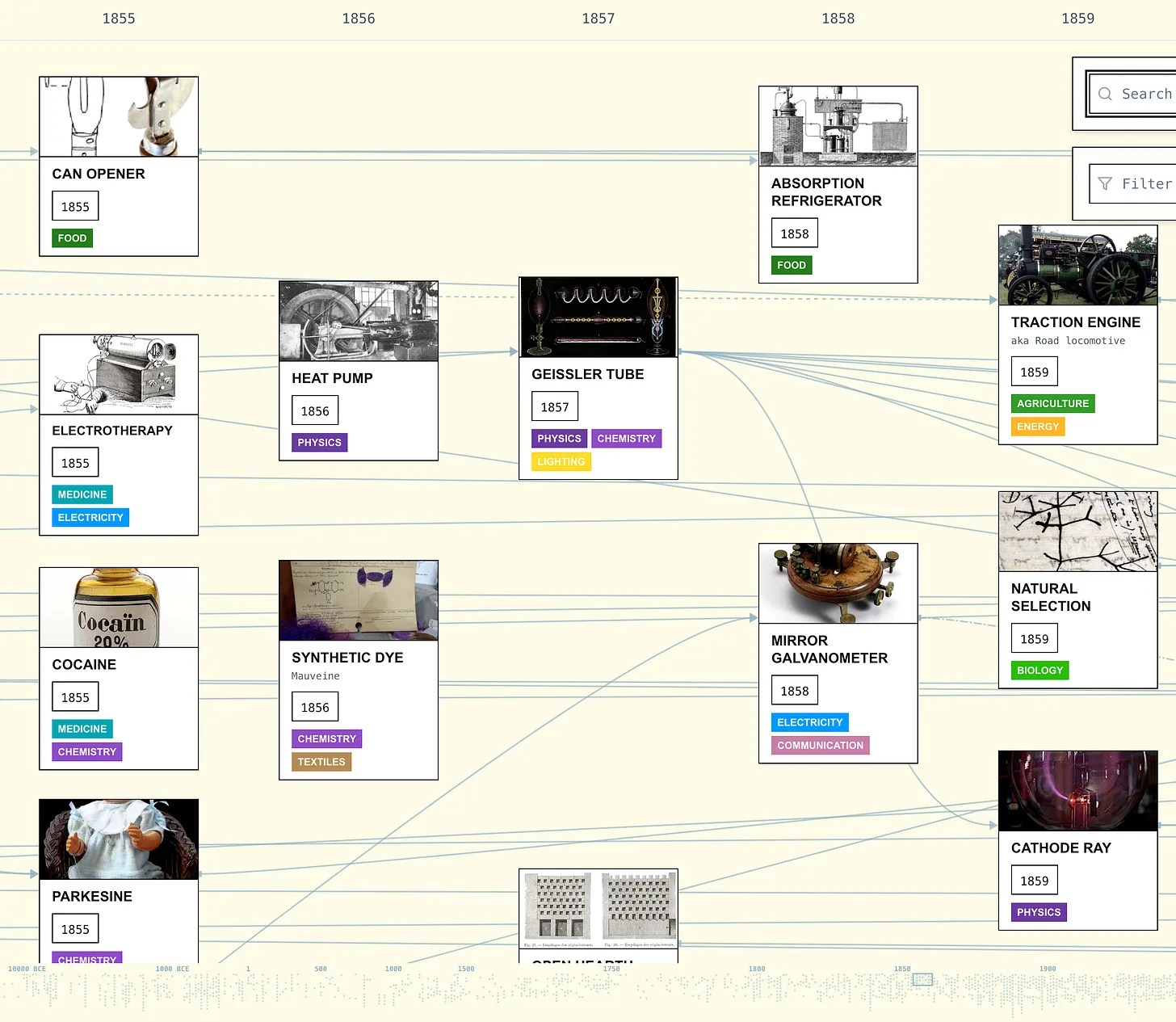
How one thing led to another: “Historical Tech Tree.”
See also: “Introducing the Historical Tech Tree.”
* “The story of the events and the people who, over centuries, came together to bring us in from the cold and to wrap us in a warm blanket of technology is a matter of vital importance, since more and more of that technology infiltrates every aspect of our lives. It’s become a life-support system without which we can’t survive. And yet, how much of it do we understand?”- James Burke, in the first episode of Connections.
###
As we ponder progress, we might recall that it was on this date in 1633, following an Inquisition, that the Holy Office in Rome forced Galileo Galilei to recant his view that the Sun, not the Earth, is the center of the Universe in the form in which he presented it. Gaileo had used a telescope (1603 on the Timeline) to reach his (correct) conclusion.
He refused to recant, and put under house arrest, where he effectively remained for the rest of his life. He dedicated his time in restriction to one of his finest works, Two New Sciences, in which he summarised work he had done some forty years earlier, on the two sciences now called kinematics and strength of materials, and published in Holland to avoid the censor. As a result of this work– highly praised by Albert Einstein– Galileo is often called the “father of modern physics.”

You must be logged in to post a comment.